
Mammee Apple (Mammea americana)
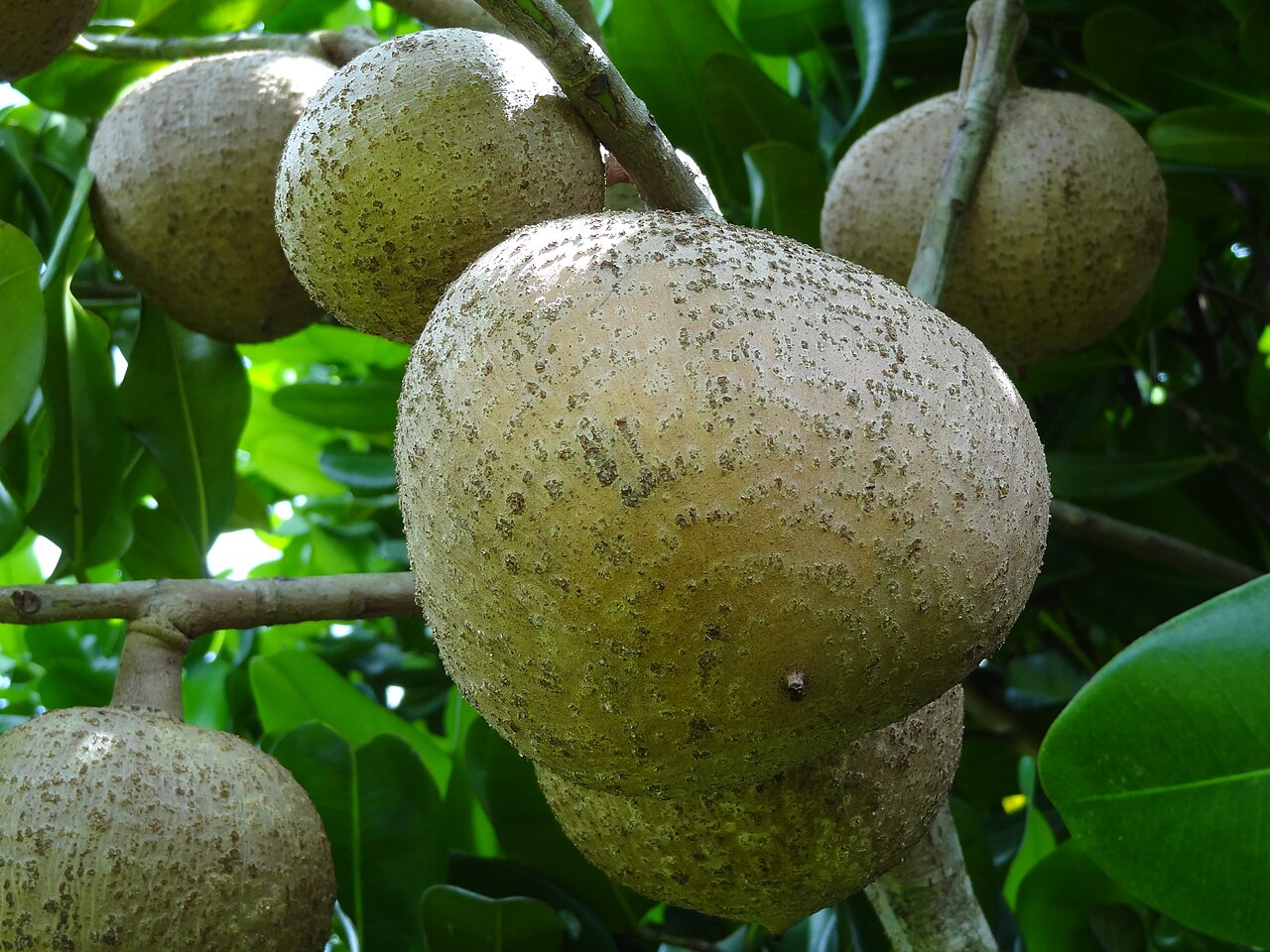
Mammea americana, the Mammee Apple, is known throughout Puerto Rico simply as mamey. It is a stately evergreen fruit tree of the Calophyllaceae, a family closely related to the mangosteen family (Clusiaceae), which includes the pitch apple, with dense, dark green, leathery leaves and a thick, upright, oval crown. USDA PLANTS lists it as native to Puerto Rico and the U.S. Virgin Islands, and the Smithsonian’s Flora of the West Indies records it from the Greater and Lesser Antilles.
The tree is grown above all for its fruit: a heavy, round berry about 4 to 8 inches across with a thick, russet-brown, sandpapery skin and firm, apricot-orange flesh around one to four large seeds. The flavor has been compared to apricot or raspberry, which is why it is also called Santo Domingo apricot or tropical apricot. In Puerto Rico it is eaten fresh, stewed, and in preserves and pastes.
In Spanish-speaking countries the name mamey can cause confusion. Mammea americana is sometimes called mamey amarillo to separate it from the unrelated mamey sapote (Pouteria sapota) of Mexico and Central America, which has red flesh. This guide covers how to recognize the native mamey of the Antilles, where it grows, and how to grow it, including in South Florida, where it is a cultivated fruit tree rather than a native one.
Identification
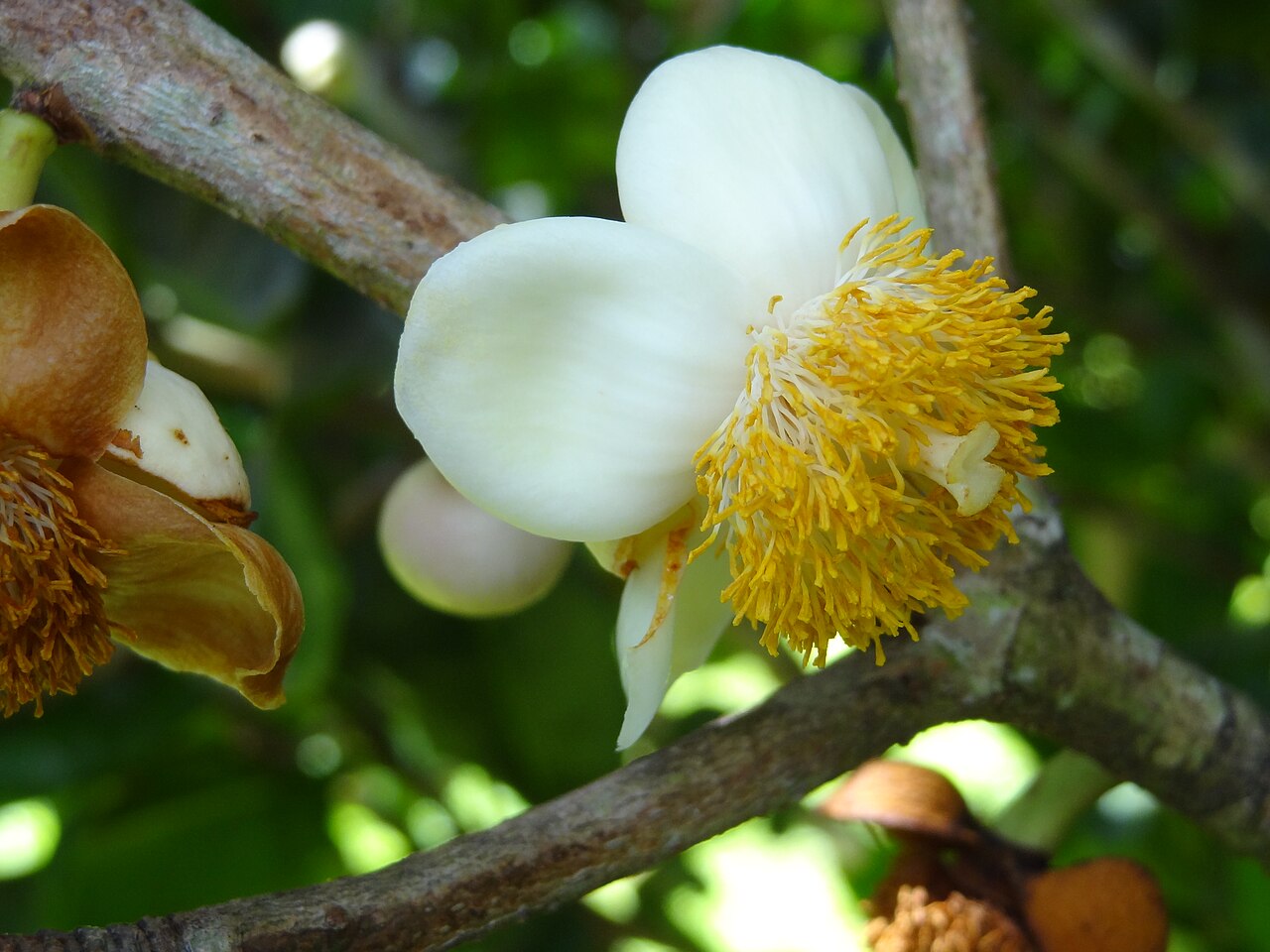
Mamey is easy to recognize when fruiting. Out of fruit, look for the combination of opposite, thick, glossy leaves, a dense oval crown and fragrant white flowers with a mass of golden stamens.
Trunk & Crown
Mature trees typically reach about 60 to 70 feet (18 to 21 m) in good sites, with a short, stout trunk and upright branches that form a dense, oval head. The overall look has often been compared to the southern magnolia. The bark exudes a gum when cut, as in many of its relatives.
Leaves
The leaves are opposite, thick, leathery and glossy dark green, broadly elliptic with a rounded tip. They can reach about 4 inches (10 cm) wide and twice as long, with a prominent pale midrib. Old leaves stay on the tree, so the crown is evergreen and casts deep shade.
Flowers
Flowers are fragrant, 1 to 1½ inches (2.5 to 4 cm) across, with four to six white petals around a dense brush of golden stamens. They are borne singly or in groups of two or three on short stalks along the twigs, often below the leaves. A single tree can carry male, female and bisexual flowers, and individual trees vary in how many of each they produce, which affects how well they fruit.
Fruit & Seeds
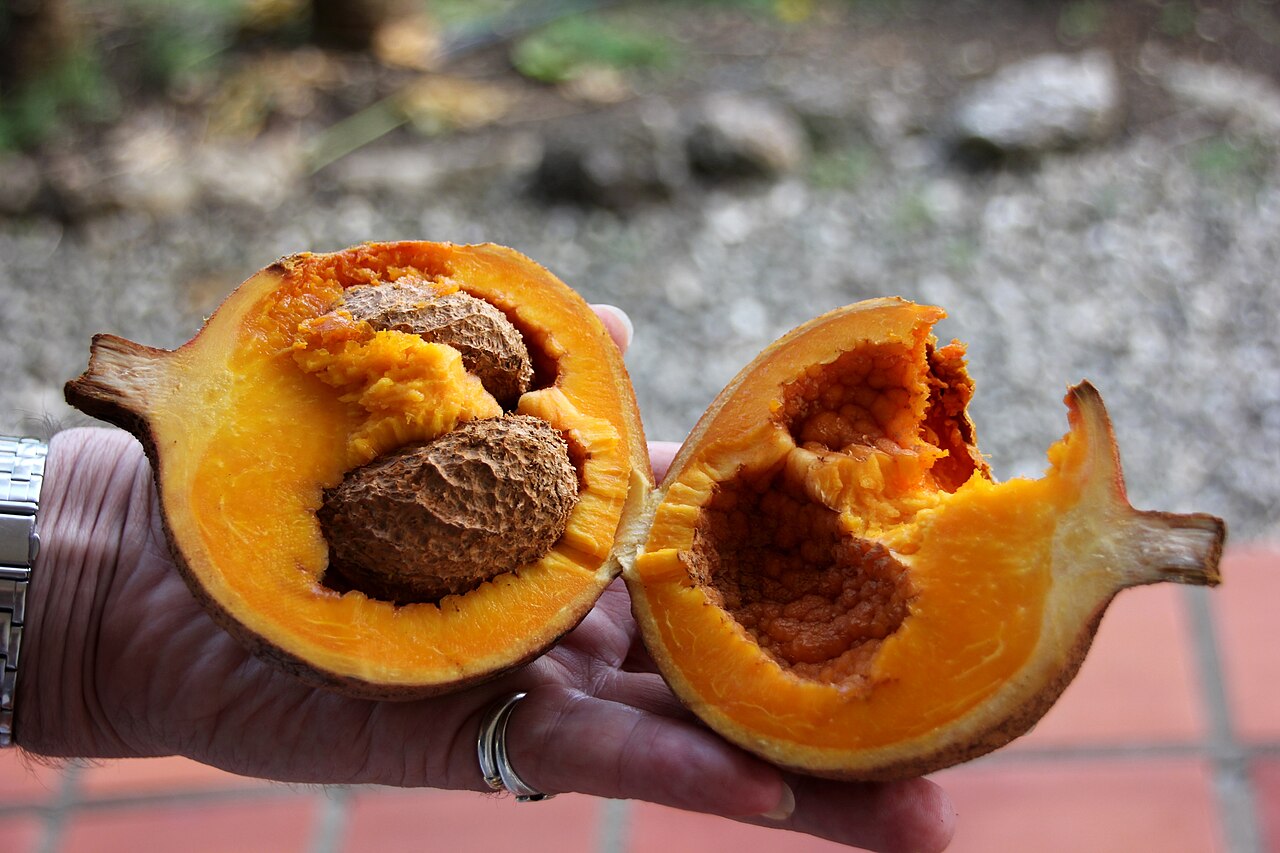
The fruit is a round or slightly irregular berry, about 4 to 8 inches (10 to 20 cm) across, with a short, thick stem and a small point at the tip. The rind is about ⅛ inch thick, brown to grayish brown and rough. Under it lies a thin, white, bitter membrane, which should be scraped off before eating, and then firm, non-fibrous orange or yellow flesh. Small fruits hold one seed; larger ones up to four. The seeds are rough, brown and oval, about 2½ inches (6 cm) long, and their juice leaves an indelible stain.
Quick Facts
| Scientific Name | Mammea americana; USDA common name: mammee apple |
| Family | Calophyllaceae (formerly placed in Clusiaceae/Guttiferae) |
| Plant Type | Evergreen fruit tree |
| Mature Height | 30–70 ft (smaller in cultivation) |
| Mature Spread | Broad, dense oval crown |
| Growth Rate | Slow to moderate |
| Sun Exposure | Full sun to partial shade |
| Water Needs | Moderate; regular moisture, some drought tolerance once established |
| Soil Type | Deep, rich, well-drained soils; also grows on limestone and coral rock |
| Soil pH | Adaptable; acidic volcanic soils to alkaline limestone |
| Bloom Time | Variable; timing in Puerto Rico not well documented |
| Flower Color | White with golden stamens; fragrant |
| Fall Color | None; evergreen |
| Fruit | Round berry 4–8 in across, russet skin, orange flesh, 1–4 large seeds |
| Deer Resistant | Not applicable in Puerto Rico |
| USDA Hardiness Zones | 10b–12 (frost-free only) |
Native Range
The mammee apple is a Caribbean native. The Smithsonian’s Flora of the West Indies lists it as native through the Lesser Antilles, including Antigua, Barbados, Dominica, Martinique, Montserrat, Saba, St. Eustatius, St. Kitts, St. Martin and St. Vincent, and in the Greater Antilles in Jamaica, Cuba, the Cayman Islands, Hispaniola and Puerto Rico. USDA PLANTS lists it as native in Puerto Rico and the U.S. Virgin Islands. Because people have planted it for centuries, it is hard to say exactly where its wild range ends. Gonzalo Fernández de Oviedo described it among the fruits of the New World as early as the 1520s.
In Puerto Rico mamey is a familiar tree of farms, backyards and roadsides, where many trees have been planted or have grown from discarded seeds. It does well on a wide range of soils, including limestone, which allows it to grow in the karst region as well as on volcanic soils. Elsewhere in the Caribbean it grows on oolitic limestone in the Bahamas and on old coral rock in Barbados.
Outside its native range the tree has been planted in Central and South America, West Africa, Southeast Asia and Hawaii. On the U.S. mainland it is grown only as a cultivated fruit tree in frost-free South Florida and the Florida Keys, where it was probably introduced from the Bahamas. It is not native to Florida or Hawaii.
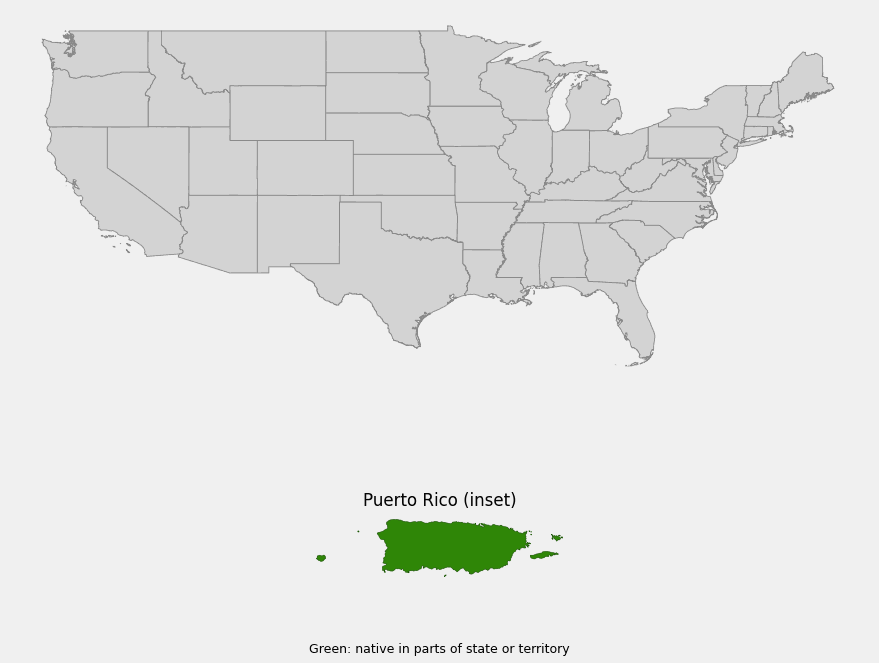
📋 Regional plant lists featuring Mammee Apple: Puerto Rico
Growing & Care Guide
Mamey is an excellent native shade and fruit tree for Puerto Rico and the Virgin Islands, where it needs little care once established. It is a large tree, so give it room. On the U.S. mainland it can be grown outdoors only in frost-free parts of South Florida and the Keys, and Hawaii; elsewhere it is a curiosity for a large greenhouse. Young trees are especially sensitive to cold.
Light
Plant in full sun for the best growth and fruit. Young trees tolerate some shade and are often started under taller trees, but mature trees fruit best with sun on the crown.
Soil & Water
Mamey does best in deep, rich, well-drained soil, but it adapts to clay, sand and limestone, including alkaline soils over karst. Avoid sites that stay waterlogged. Water young trees regularly through dry periods for the first couple of years. Established trees in Puerto Rico’s moist areas usually need no irrigation, though fruit is larger with steady moisture.
Planting Tips
Plant at the start of the rainy season, at least 25 to 30 feet from buildings: the tree grows large, and heavy fruits that fall from height can damage cars and roofs. Grafted trees from a nursery are preferred, because they fruit sooner and their fruit quality is known. Seedling trees can take many years to bear, and some may produce few fruits.
Pruning & Maintenance
Little pruning is needed beyond shaping young trees to a strong central framework and removing dead or crossing branches. Keeping the tree lower makes harvest easier. Fertilize young trees lightly during the growing season. The species is generally resistant to pests and diseases.
Propagation
Mamey can be grown from fresh seed, but germination is slow and uneven, taking about two to nine months. Because seedlings vary and are slow to bear, grafting onto seedling rootstock is the preferred method for fruit production.
Landscape Uses
- Home fruit tree: a traditional backyard fruit across Puerto Rico and the Virgin Islands
- Shade tree: its dense evergreen crown gives deep shade for large yards, farms and parks
- Agroforestry: a long-lived canopy tree for mixed farms and coffee or fruit plantings
- Wildlife plantings: flowers feed insects, and fallen fruit feeds a range of animals
- Specimen tree in South Florida: where gardeners can grow it as a tropical fruit tree (not native there)
Wildlife & Ecological Value
As a large, long-lived evergreen tree, mamey adds shade, nesting places and food to the landscape. Published studies of its wildlife value in Puerto Rico are limited, so the notes below stay general.
For Pollinators
The fragrant white flowers with their mass of stamens produce abundant pollen and attract bees and other insects. Because trees carry varying proportions of male, female and bisexual flowers, insect visits help move pollen between flowers and trees.
For Birds
The dense, glossy evergreen crown gives birds shelter and nesting sites year-round, and insects on the foliage and flowers provide foraging. The hard-skinned fruits are too large for most birds to eat whole, but birds may feed on ripe, opened fruit.
For Mammals
Fallen ripe fruits are eaten by a variety of animals. The large, heavy fruits and seeds are mostly spread by people, gravity and water.
Ecosystem Role
Mamey is part of the long history of people and plants in the Caribbean. As a native shade tree, it helps keep native canopy cover in farms and suburbs. Parts of the tree, especially the seed, contain natural insecticidal compounds, which may help explain its resistance to pests.
Cultural & Historical Uses
Mamey has been eaten in the Caribbean for a very long time. The chronicler Gonzalo Fernández de Oviedo included it in his review of the fruits of the New World in the early sixteenth century, and the tree was later carried to West Africa, Asia and Hawaii. In the French Antilles a fragrant liqueur, eau créole or crème créole, has been distilled from the flowers.
In Puerto Rico the tree has practical folk uses beyond its fruit. Puerto Rican gardeners traditionally wrapped mamey leaves around young tomato plants to keep mole crickets and cutworms away. Elsewhere in the Caribbean the bark gum was mixed with fat to repel chiggers and fleas, and in the Virgin Islands tannin from the bark was used to tan leather. The heavy, hard wood is easy to work but has seen only limited commercial use.
The fruit is eaten fresh, in fruit salads, or cooked into jams, preserves and pastes. The bitter white membrane under the skin and the seeds should always be removed, since the seeds are not edible. Mamey is part of the island’s food heritage and a common gift from neighbors with a productive tree.
Frequently Asked Questions
Is mammee apple the same as mamey sapote?
No. Mammee apple (Mammea americana) is a Caribbean native in the Calophyllaceae with orange-yellow flesh. Mamey sapote (Pouteria sapota) is an unrelated tree of Mexico and Central America with salmon-red flesh, in the sapodilla family. Both are called mamey in Spanish, so the scientific name helps.
Can I grow mammee apple in Florida?
Only in frost-free South Florida and the Keys, where it is grown as a cultivated tropical fruit tree. It is not native to Florida. Young trees are easily damaged by frost, and the tree cannot be grown outdoors farther north.
How long until a mamey tree bears fruit?
Grafted trees fruit much sooner than seedlings. Seedling trees can take many years to start bearing, and their fruit quality varies, which is why growers prefer grafted plants.
Are all parts of the fruit edible?
No. Peel off the rough skin and scrape away the white, bitter membrane beneath it before eating the orange flesh. Discard the seeds, which are not edible and contain insecticidal compounds.
Is mammee apple a good shade tree?
Yes, for large spaces. Its dense evergreen crown casts deep shade, but plant it well away from buildings, driveways and patios, because the heavy fruits fall from a height.

Looking for a nursery that carries Mammee Apple?
Our nursery directory does not yet include Puerto Rico. Browse the native plant nursery directory by state: Alabama–Arkansas · California · Colorado–Hawaii · Idaho–Kansas · Kentucky–Montana · Nebraska–Oklahoma · Oregon · Pennsylvania–Virginia · Washington · West Virginia–Wyoming