
Turk’s Cap Cactus (Melocactus intortus)
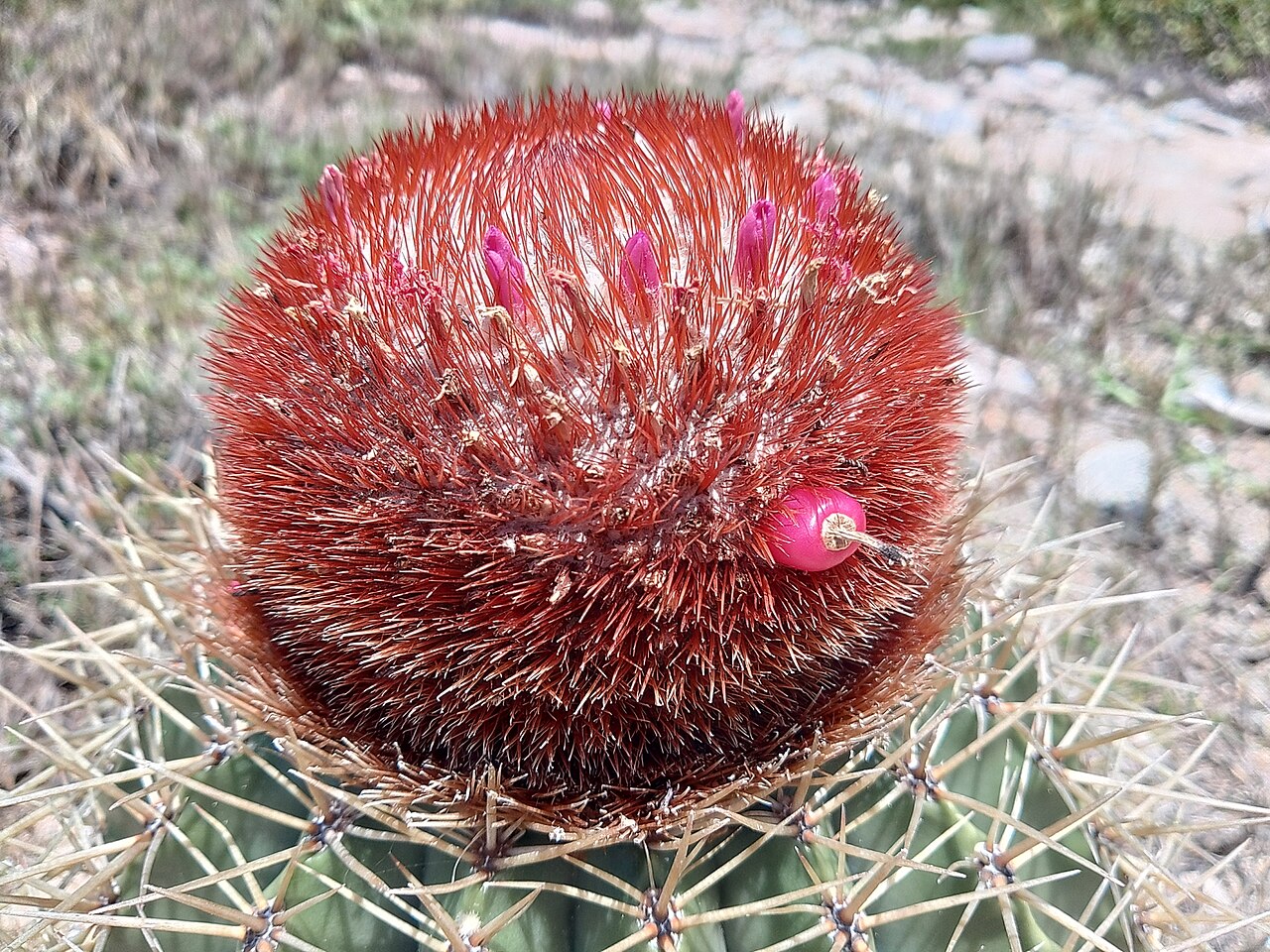
Melocactus intortus, the Turk’s Cap Cactus (USDA common name Turk’s cap, also called Turk’s head cactus), is one of the most recognizable plants of the dry Caribbean coast. In Puerto Rico it is known as melón de costa, the “coastal melon,” and as erizo, the “sea urchin,” two names that describe it perfectly: a ribbed, melon-shaped green body armored with stout yellowish spines.
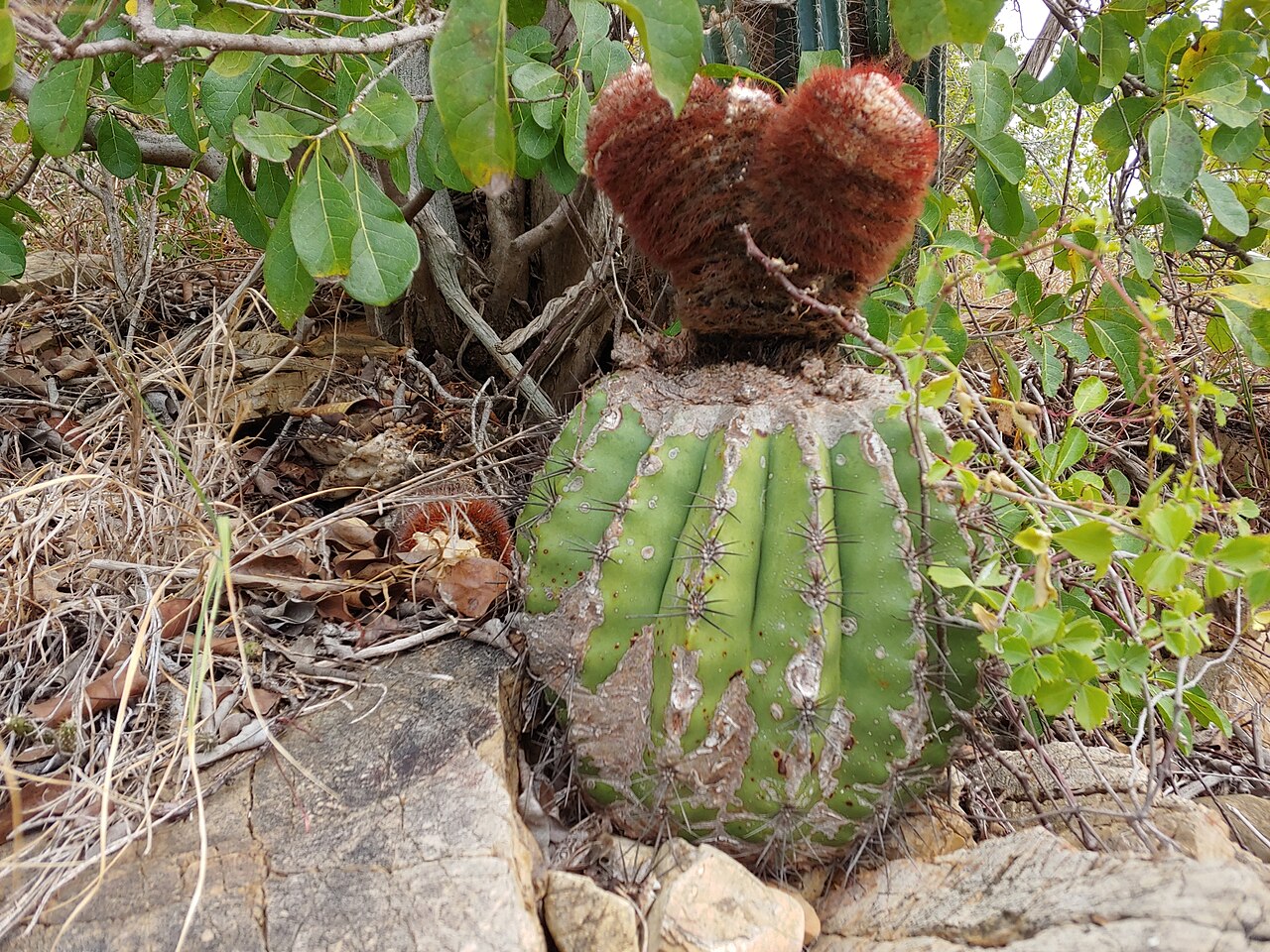
What makes it unforgettable is the cap. Once a plant is mature, it stops adding green stem and grows a woolly, bristly column on top called a cephalium, colored brick red to reddish brown. Small pink flowers and bright pink fruits emerge from that cap, and it keeps growing taller, slowly, for the rest of the plant’s life. On an old plant the cap can be as tall as the green body below it, which is how the plant got its fez-like silhouette and its English name.
This guide covers how to identify Turk’s cap cactus, where it grows in Puerto Rico and the wider Caribbean, how to grow it in a frost-free garden or a container, its value to hummingbirds and other wildlife, and the surprising fact that a whole island group, the Turks Islands, is named after it.
Identification
No other native Puerto Rican plant looks like a mature Turk’s cap. Young plants without a cap can be mistaken for other small ribbed cacti, so check the rib count, the spines and, if present, the cephalium.
Stem
The stem is solitary, light green and globe-shaped to short-cylindrical, about 6 to 16 inches (15 to 40 cm) across. Including the cephalium, an old plant can reach about 3 feet (1 m) tall. There are usually 14 to 20 broad, prominent ribs, sometimes slightly spiraled, which is what the Latin intortus (“twisted”) refers to. The stem does not normally branch, although a damaged or leaning plant may push out offsets.
Spines
Each areole carries about 9 to 21 stout spines, yellow to horn-colored, roughly ¾ to 2¾ inches (2 to 7 cm) long. They are rigid and sharp, and central and radial spines are hard to tell apart. On older plants the lower spines weather to grey.
Cephalium
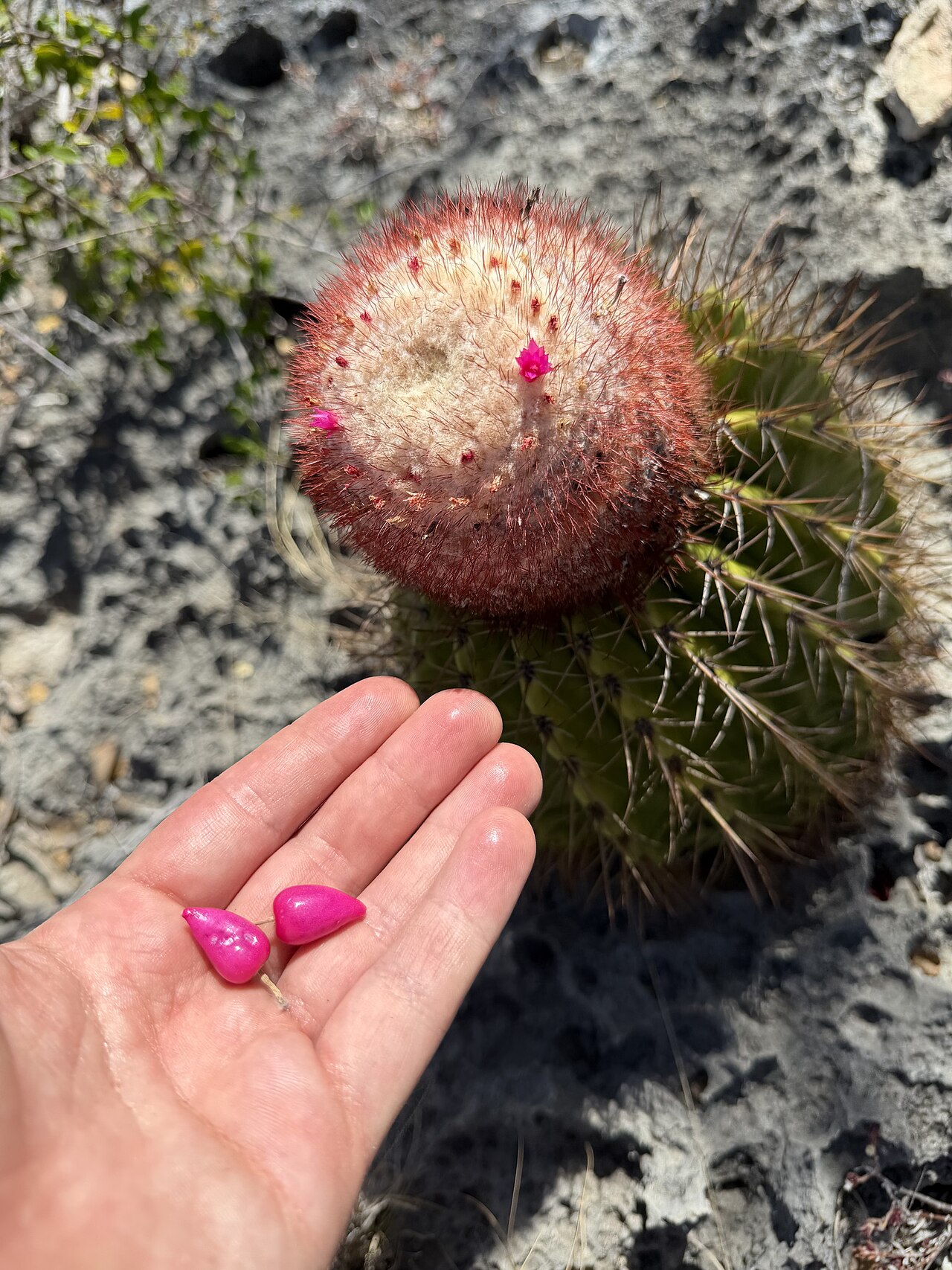
The cephalium is the defining feature. It is a dense cap of white wool packed with fine, soft, reddish-brown bristles. It starts as a low dome on top of the stem and then grows upward without getting any wider, slowly turning into a column. Cactus growers report that a plant takes many years, often more than a decade, to produce its first cephalium; once it does, the green body essentially stops growing.
Flowers and Fruit
The pink flowers are small, about ½ to ¾ inch (1.5 to 2 cm) long, and only the tips poke out of the cephalium wool. The fruit is a smooth, glossy, pink, club-shaped berry about ¾ to 1 inch (2 to 2.5 cm) long. It ripens inside the wool and is gradually pushed out, then either sits on top of the cap or drops to the ground. The seeds are small and black.
Quick Facts
| Scientific Name | Melocactus intortus (Mill.) Urb. (syn. Cactus intortus Mill., Melocactus communis (Aiton) Link & Otto); USDA common name: Turk’s cap |
| Family | Cactaceae (cactus family) |
| Plant Type | Solitary globular to columnar cactus |
| Mature Height | 1–3 ft including the cephalium |
| Mature Spread | 6–16 in |
| Growth Rate | Very slow |
| Sun Exposure | Full sun |
| Water Needs | Very low; drought tolerant |
| Soil Type | Rocky, sandy or gravelly; sharp drainage essential |
| Soil pH | Neutral to alkaline; at home on limestone |
| Bloom Time | Intermittently through much of the year in Puerto Rico |
| Flower Color | Pink |
| Fall Color | None; evergreen |
| Fruit | Glossy pink club-shaped berry, ¾–1 in, pushed out of the cephalium |
| Deer Resistant | Not applicable in Puerto Rico; heavily spined |
| USDA Hardiness Zones | 10b–12; frost-free only |
Native Range
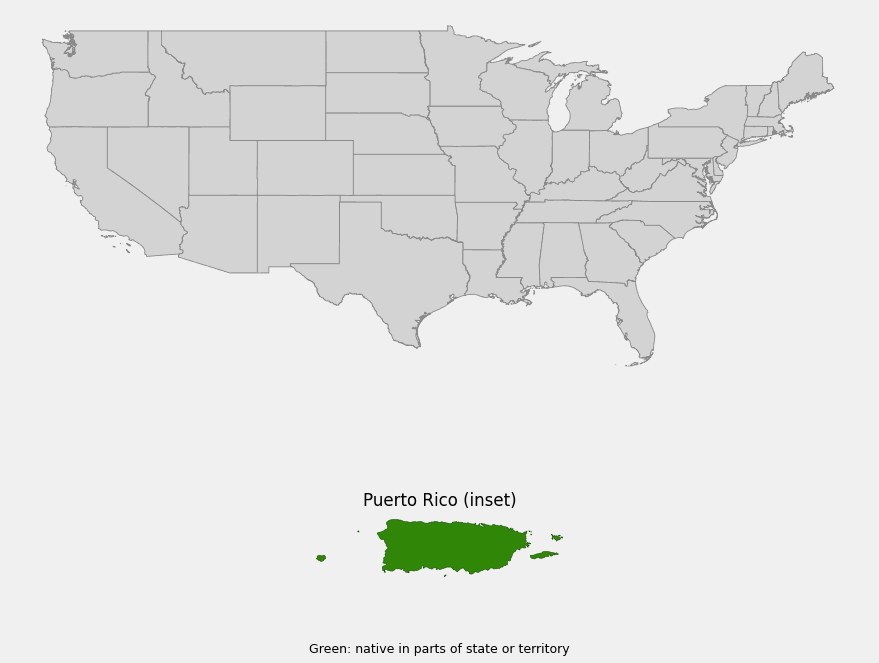
USDA PLANTS lists Melocactus intortus as native to Puerto Rico and the U.S. Virgin Islands. The Smithsonian flora of Puerto Rico and the Virgin Islands records it on the main island plus the offshore islands of Mona, Vieques, Caja de Muertos, Desecheo and Isla Magueyes, and across the Virgin Islands on St. Croix, St. John, St. Thomas, Tortola, Virgin Gorda, Anegada and the Guana Islands. Beyond U.S. territory it grows in the Bahamas, the Turks and Caicos Islands and through the Lesser Antilles.
It is a plant of the hot, dry coast. It grows from sea level to roughly 330 feet (100 m), mostly on limestone rock and rocky coastal slopes in seasonally dry scrub, and in the southern part of its range also on volcanic rock. In Puerto Rico the main populations are along the dry south and southwest coast: around Guánica and Guayanilla, the Cabo Rojo and Boquerón area, and on the small dry islands offshore, such as Caja de Muertos and Mona. It is often seen growing out of cracks in bare rock or in the open gaps of thorny scrub, fully exposed to sun and salt wind.
The species is not listed under the U.S. Endangered Species Act, and the IUCN Red List rates it Least Concern because it is widespread and locally common. Like nearly all cacti it is covered by CITES Appendix II, which regulates international trade. Its main local threats are coastal and tourism development, grazing animals that eat cacti for water during droughts, and illegal digging of large specimens with tall caps. Buy only nursery-propagated plants and never collect from the wild.
📋 Regional plant lists featuring Turk’s Cap Cactus: Puerto Rico
Growing & Care Guide
Turk’s cap is not a beginner’s cactus, but its needs are simple: full sun, very fast drainage, heat, and much less water than you think. Most losses in cultivation come from cold and from rot in wet soil. In the dry south of Puerto Rico it can be planted directly into a rock garden. Elsewhere on the island, and anywhere on the mainland, a pot or raised mineral bed is the safer choice. Outdoors in the continental United States it is realistic only in the warmest, frost-free parts of South Florida and the Keys, and even there summer rain is a risk. Everywhere else, grow it as a container plant in a greenhouse or sunny window.
Light
Give it full sun. In habitat it grows completely exposed on bare rock. Plants grown in too little light stretch, lose their compact shape and rarely produce a good cephalium. If you move a greenhouse plant outdoors, harden it off over a couple of weeks so the stem does not scorch.
Soil & Water
Use a very gritty mineral mix: at least half crushed limestone, pumice, coarse sand or gravel, with only a little organic matter. In the ground, plant it on a slope, on a raised mound or among rocks so that water never pools around the base. Water deeply only when the soil has dried out completely, and much less in cool or cloudy weather. Unlike many cacti, Melocactus dislike real cold. Most growers keep them above about 50°F (10°C) and keep them on the dry side whenever they are cool.
Planting Tips
Wear thick gloves or handle the plant with folded newspaper or foam; the spines are stiff and sharp. Set the plant at the same depth it was growing, never deeper, and wait about a week before the first watering so any broken roots can callus. In Puerto Rico it suits xeriscapes, coastal rock gardens and seaside plantings where little else survives. Choose a nursery seedling or a grafted plant; a specimen already carrying a tall cap is almost always a wild-dug plant.
Pruning & Maintenance
There is nothing to prune. Pull weeds by hand so they do not shade the base or hold moisture against it, and top-dress with gravel to keep the stem collar dry. Watch for mealybugs in the cephalium wool and at the base of the spines. Do not try to remove or trim the cephalium: it is the plant’s only flowering structure, and the green stem will not make another one.
Propagation
Seed is the only practical method. Cut a ripe pink fruit, rinse the small black seeds free of pulp, and surface-sow them on a fine, gritty mix kept warm and lightly moist under bright, indirect light. Germination is usually good with fresh seed. Seedlings grow slowly and are prone to damping off, so give them good air circulation. Expect many years before a seedling forms its first cephalium.
Landscape Uses
- Coastal rock gardens: tolerates salt wind, reflected heat and thin limestone soils on the dry south coast
- Xeriscapes: a sculptural accent that needs almost no irrigation once established
- Containers: the usual way to grow it outside southern Puerto Rico and South Florida
- Hummingbird gardens: the small pink flowers are visited by hummingbirds
- Educational plantings: a living example of the cephalium, a structure found in only a few cactus groups
Wildlife & Ecological Value
A single Turk’s cap does not look like much of a resource, but in dry coastal scrub, where nectar, fruit and water are scarce for months at a time, a scattered population of these cacti matters.
For Pollinators
The flowers are pollinated by hummingbirds. Because a mature plant opens a few flowers at a time over a long season rather than all at once, it provides a small but dependable nectar source in dry scrub when little else is blooming.
For Birds
Besides the hummingbirds that visit the flowers, birds eat the juicy pink fruits as they are pushed out of the cap, and they carry the small seeds away to new crevices in the rock.
For Mammals
Bats are Puerto Rico’s only native land mammals, and none depend on this cactus. Introduced goats, cattle and other grazers, however, will break into cacti for water during droughts, which is a well-known cause of decline for Melocactus on grazed islands.
Ecosystem Role
Turk’s cap is part of the low, spiny layer of coastal dry scrub. It holds water through long dry seasons, its fruits feed small animals, and its spiny body gives shelter at ground level to insects and small lizards. Healthy populations with plants of all ages are a sign that a stretch of coast has escaped heavy grazing and development.
Cultural & Historical Uses
The Turks Islands of the Turks and Caicos are named after this cactus: its red cephalium reminded early visitors of the fez, the red felt cap worn by Turkish men in the Ottoman era. A stylized Turk’s head cactus still appears prominently on the coat of arms of the Turks and Caicos Islands.
The species has a long botanical history. Charles Plumier mentioned it in 1703 with the phrase “Melocactus purpureis, striis in spiram contortis,” describing the purple cap and the spirally twisted ribs. Philip Miller formally named it Cactus intortus in 1768, turning Plumier’s “contortis” into “intortus,” and Ignatz Urban moved it into Melocactus in 1919. The genus name combines the Greek words for melon and thistle.
The Spanish names used in Puerto Rico are just as descriptive. Melón de costa compares the ribbed body to a melon growing by the sea, and erizo compares it to a sea urchin. In the French Antilles it is called tête à l’anglais, “Englishman’s head,” a reminder that every island that knows this plant has found its own joke in that red cap.
Frequently Asked Questions
How old is a Turk’s cap cactus with a tall cap?
Older than it looks. A plant spends many years as a green, spiny globe before it forms a cephalium, and the cap then grows upward only slowly. A plant with a tall red column on top has been growing for decades, which is one reason large wild specimens should never be dug up.
Can I grow it outdoors in Florida?
Only in the warmest, frost-free parts of South Florida and the Keys, and only with very sharp drainage, because it rots easily in wet summer soil and is damaged by cold. It is not native to Florida. In most of the U.S. it is a container plant for a greenhouse or a hot, sunny window.
Is it endangered?
It is not listed under the U.S. Endangered Species Act, and the IUCN rates it Least Concern. Like nearly all cacti it is on CITES Appendix II, which regulates international trade. Local populations still suffer from coastal development, grazing and poaching, so buy nursery-propagated plants only and never collect from the wild.
Why did my cactus stop getting bigger?
That is normal once the cephalium appears. A mature Melocactus puts its growth into the cap, not into the green stem. If the green body is shrinking or wrinkling, it needs water; if it is soft at the base, it is rotting and needs drier conditions.
Are the fruits edible?
The small pink fruits are juicy and are eaten by birds. They are tiny and mostly seed, and the plant is too slow-growing and too valuable as a seed source to treat as food, so leave them for wildlife or for sowing.

Looking for a nursery that carries Turk’s Cap Cactus?
Our nursery directory does not yet include Puerto Rico. Browse the native plant nursery directory by state: Alabama–Arkansas · California · Colorado–Hawaii · Idaho–Kansas · Kentucky–Montana · Nebraska–Oklahoma · Oregon · Pennsylvania–Virginia · Washington · West Virginia–Wyoming