
Palma de Lluvia (Gaussia attenuata)
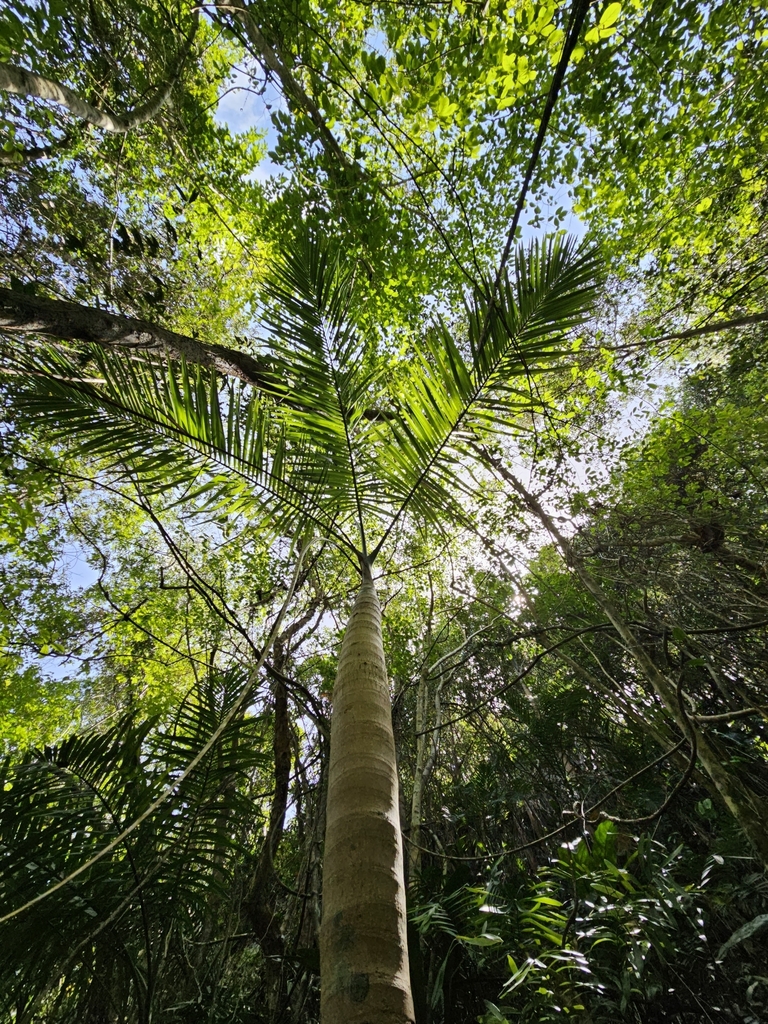
Gaussia attenuata, known in Puerto Rico as palma de lluvia (rain palm) and llume (USDA PLANTS: llume), is a tall, slender palm of the island’s limestone country. It grows on the mogotes, the steep, haystack-shaped limestone hills of the northern karst, often rooted in bare rock where hardly any soil exists. Its pale gray trunk is swollen at the base and tapers steadily upward to a small crown of feathery leaves that rises above the surrounding forest.
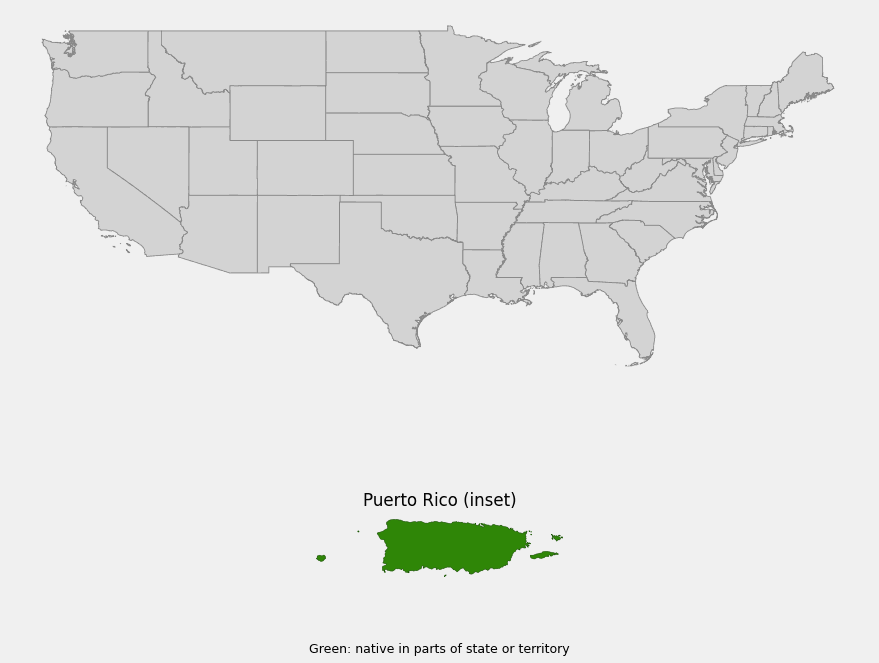
The species is native to Puerto Rico and the eastern Dominican Republic and grows nowhere else in the wild. USDA PLANTS lists it as native only in Puerto Rico among U.S. states and territories. Older literature calls it Aeria attenuata, the name under which O. F. Cook first described it, and Gaussia portoricensis is another synonym. Some sources also call it palma de sierra, which leads to confusion with the very different sierra palm of El Yunque.
For Puerto Rican gardeners, palma de lluvia is a native palm suited to the well-drained limestone soils of the north coast and karst region, where it handles rocky ground better than most palms. It is a fine choice for a tall, narrow accent in a native garden. It is also grown in South Florida botanical collections such as Fairchild Tropical Botanic Garden, though it is not native to Florida.
Identification
The tapering trunk is the key feature: thick and swollen near the ground, narrowing all the way up to a sparse crown of only five to seven leaves. No other native Puerto Rican palm has quite this bottle-to-pole shape.
Form & Size
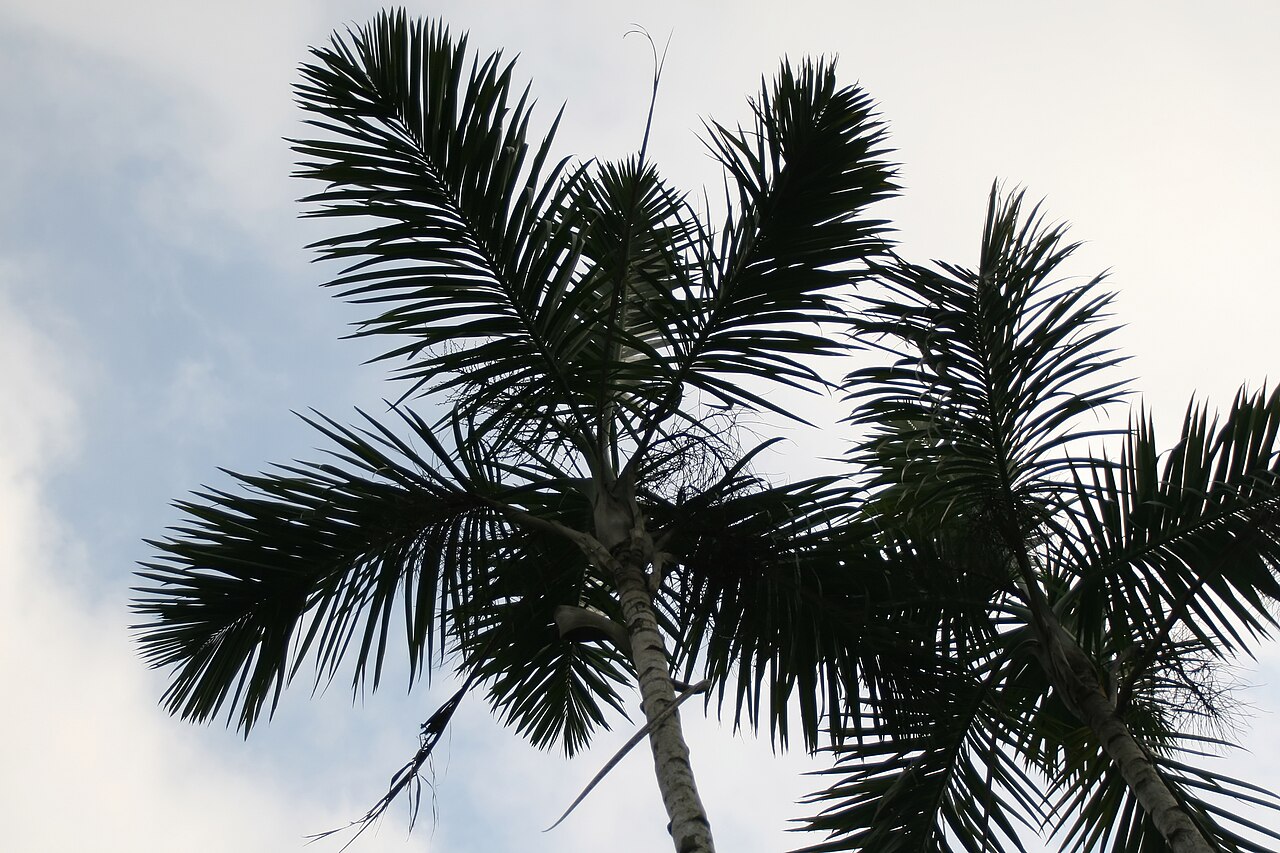
A single-stemmed palm up to about 15 m (50 ft) tall, sometimes taller. The crown is small and open, with only five to seven pinnate leaves, so the palm looks airy and see-through even when mature. On mogote summits and cliff faces the crowns often stand out above the broadleaf canopy.
Trunk & Roots
The trunk is 15 to 25 cm (6 to 10 in) in diameter, gray to light brown and smooth, often spotted with lichens. It is clearly swollen at the base and tapers gradually toward the crown, which is the meaning of the species name attenuata (tapering). A cluster of aerial roots may form at the base, helping the palm grip the limestone.
Leaves
The leaves are pinnate, with numerous narrow, dark green leaflets arranged along each side of the leaf stalk. With only a handful in the crown at any time, each leaf is easy to see in silhouette against the sky.
Flowers
Small, stalkless, orange to greenish flowers are borne in a well-branched cluster. Flowering and fruiting take place mainly in summer and winter and occasionally through the rest of the year.
Fruit
The fruit is orange-red, round to pear-shaped, about 1.4 to 1.6 cm (roughly ⅝ in) long and 1.2 cm (½ in) across, and holds one to three seeds. The bright fruit clusters are conspicuous against the dark leaves.
Similar Species
The sierra palm (Prestoea acuminata var. montana) of El Yunque has a uniform, non-tapering trunk on stilt roots, hanging whitish flower clusters and purplish-black fruit, and grows in wet mountain forest rather than on limestone. The Puerto Rico royal palm (Roystonea borinquena), which also grows in the karst, is much stouter, with a smooth green crownshaft and a full, dense crown.
Quick Facts
| Scientific Name | Gaussia attenuata (O.F. Cook) Becc. |
| Family | Arecaceae (palm family) |
| Plant Type | Evergreen feather palm, single-stemmed |
| Mature Height | Up to about 50 ft (15 m) |
| Mature Spread | Narrow sparse crown, roughly 10–15 ft (3–4.5 m) |
| Growth Rate | Slow to moderate |
| Sun Exposure | Full sun to part shade |
| Water Needs | Moderate; tolerates dry spells once established in well-drained soil |
| Soil Type | Limestone rock and thin, rocky, well-drained soils |
| Soil pH | Neutral to alkaline |
| Bloom Time | Mainly summer and winter; occasionally year-round |
| Flower Color | Orange to greenish |
| Fall Color | None; evergreen |
| Fruit | Orange-red, round to pear-shaped, about 1.5 cm long |
| Deer Resistant | Not applicable in Puerto Rico |
| USDA Hardiness Zones | 10b–13 (frost-tender) |
Native Range
Palma de lluvia is native to Puerto Rico and the eastern Dominican Republic and is found nowhere else in the wild. USDA PLANTS (symbol GAAT, llume) lists it as native in Puerto Rico only; it is not native in any U.S. state, including Florida, and USDA does not list it for the U.S. Virgin Islands.
In Puerto Rico it grows on the steep-sided limestone hills known as mogotes. These haystack hills are the signature landform of the northern karst belt, the band of limestone country between the coast and the Cordillera Central that includes forest reserves such as Cambalache and Guajataca. Cambalache Forest Reserve, whose moist forests cover mogotes, is one of the protected areas where the species is found, along with the Puerto Rico royal palm.
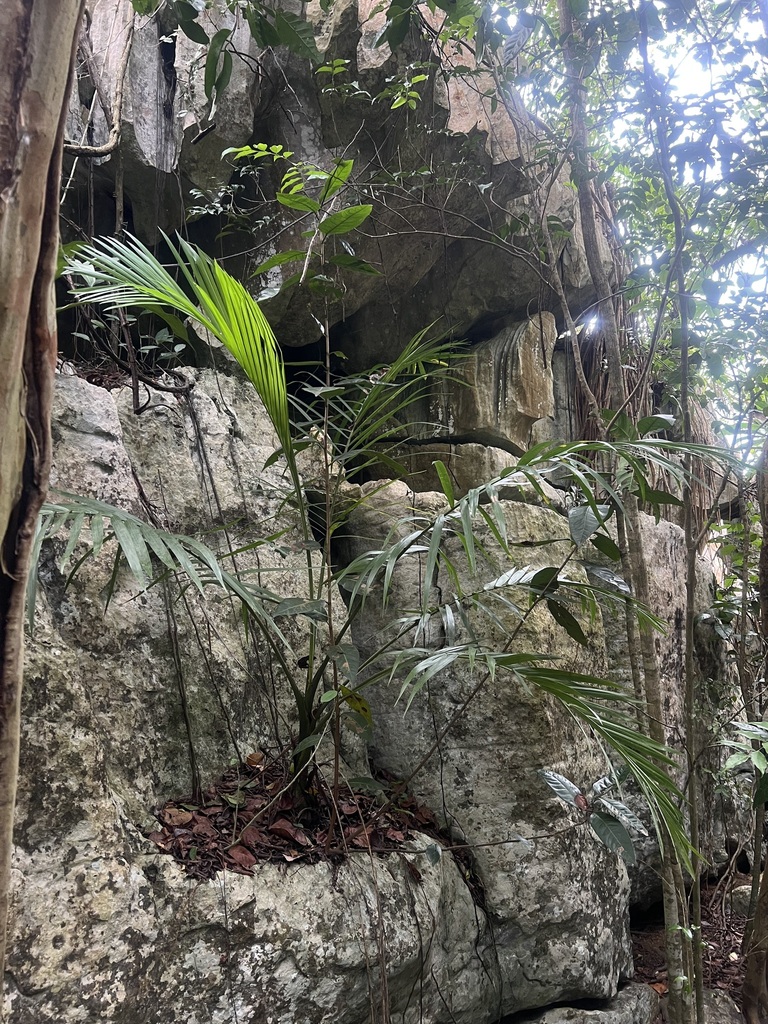
Mogote habitat is unusual: the summits and cliffs are bare or nearly bare limestone with thin pockets of soil, and they dry out quickly between rains even though the surrounding valleys are humid. Palma de lluvia is adapted to this rocky, sharply drained ground, and seedlings can be found rooted in crevices and on ledges of the rock itself.
📋 Regional plant lists featuring Palma de Lluvia: Puerto Rico
Growing & Care Guide
Palma de lluvia is one of the best native palms for rocky, limestone sites in Puerto Rico. Give it excellent drainage and room to grow tall, and it needs little care once established. Buy nursery-grown plants; never take seedlings from mogotes or forest reserves.
Light
In the wild it grows in forest openings and on exposed mogote summits and cliffs. Young plants accept part shade and appreciate some protection while they establish; older palms take full sun.
Soil & Water
Plant in fast-draining soil. Limestone rubble, rocky fill and the thin, alkaline soils of the north coast all suit it, and it is a good choice where soil is shallow over rock. Water regularly the first year or two; after that it tolerates dry spells, though growth is best with occasional deep watering during long droughts. Avoid soggy, poorly drained clay.
Planting Tips
Plant at the same depth as in the container, in a hole broken into the rock if necessary. Because the trunk becomes tall and slender and the crown stays small, the palm works as a vertical accent in narrow spaces, in groups of three, or rising behind lower native shrubs. Allow for its eventual height away from overhead lines.
Pruning & Maintenance
Remove fully dead leaves only; the palm holds just a few leaves at a time, so never strip green ones. Do not cut into the trunk or growing point. Fallen fruit can be cleared from paths or left for wildlife.
Propagation
Grow from fresh seed. Collect ripe orange-red fruits from cultivated palms, remove the pulp and sow promptly in a well-drained mix kept warm and lightly moist. Palm seed loses viability if allowed to dry out, and germination can be slow and uneven.
Landscape Uses
- Native accent palm: a tall, narrow palm for limestone and rocky gardens in Puerto Rico
- Karst restoration: a characteristic palm of mogote forests in the northern karst
- Wildlife gardens: orange-red fruits for fruit-eating birds
- Botanical collections: grown in South Florida and other tropical palm collections
- Educational plantings: an excellent example of the plants of Puerto Rico’s karst landscape
Wildlife & Ecological Value
Palma de lluvia is part of the distinctive plant community of Puerto Rico’s limestone hills, where its tall crowns and colorful fruit add to the food and structure available to wildlife.
For Pollinators
The small orange to greenish flowers are produced on well-branched clusters, mainly in summer and winter, and are visited by small insects.
For Birds
The orange-red fruits are the right size for fruit-eating birds, which are the likely dispersers of the seeds to other ledges and crevices in the karst.
For Mammals
Puerto Rico’s native land mammals are bats. The palm offers forest structure in the karst, where caves and limestone cliffs also support bat colonies.
Ecosystem Role
Palma de lluvia is one of the few tall trees that can root directly on mogote rock. By anchoring in crevices and ledges it adds height and cover to the thin-soiled summits and cliffs, and its presence is a mark of intact karst forest in the north of the island.
Cultural & Historical Uses
The American botanist O. F. Cook described this palm as Aeria attenuata, and Odoardo Beccari moved it to Gaussia in 1912, the name used today. Gaussia portoricensis is a later synonym. The genus honors the German mathematician Carl Friedrich Gauss (1777–1855), and the species name attenuata refers to the trunk tapering toward the top.
Its Puerto Rican names are palma de lluvia, the rain palm, and llume, which USDA PLANTS adopts as the English common name. Some references, including Wikipedia, also list palma de sierra, a name more often used for the sierra palm of the Luquillo Mountains; checking the scientific name avoids mixing up the two. Botanical garden labels in Puerto Rico present it as an endemic of the island, and Wikipedia records it also from the eastern Dominican Republic.
Palma de lluvia is one of the plants that make Puerto Rico’s karst special. The mogote region holds much of the island’s remaining forest and many of its endemic species, and palms like this one rising from bare limestone are a visible part of that landscape.
Frequently Asked Questions
Is palma de lluvia endemic to Puerto Rico?
Almost. It is native to Puerto Rico and the eastern Dominican Republic, and grows wild nowhere else. In the United States and its territories it is native only in Puerto Rico, according to USDA PLANTS.
Is Gaussia attenuata an endangered species?
It is not listed under the U.S. Endangered Species Act. Because it grows in a limited habitat, buy nursery-propagated plants and never collect seedlings or seed from the wild or from forest reserves such as Cambalache.
What is the difference between palma de lluvia and the sierra palm?
Palma de lluvia (Gaussia attenuata) grows on limestone mogotes and has a trunk swollen at the base that tapers upward, with orange-red fruit. The sierra palm grows in the wet mountain forests of El Yunque, has a uniform trunk on stilt roots and bears purplish-black fruit.
Can I grow palma de lluvia on a dry, rocky lot?
Yes, it is one of the better native palms for that. It is adapted to limestone rock and thin soils that drain fast. Water it while it establishes; once rooted it handles dry spells. For coastal dry sites, the Puerto Rico hat palm is another native option.
Can I grow it in Florida?
It is grown in South Florida, for example at Fairchild Tropical Botanic Garden in Miami, but it is not native there and is frost-tender. Florida gardeners who want a native palm for limestone soils should consider Florida thatch palm or Florida silver palm.

Looking for a nursery that carries Palma de Lluvia?
Our nursery directory does not yet include Puerto Rico. Browse the native plant nursery directory by state: Alabama–Arkansas · California · Colorado–Hawaii · Idaho–Kansas · Kentucky–Montana · Nebraska–Oklahoma · Oregon · Pennsylvania–Virginia · Washington · West Virginia–Wyoming