
Santa María (Calophyllum antillanum)
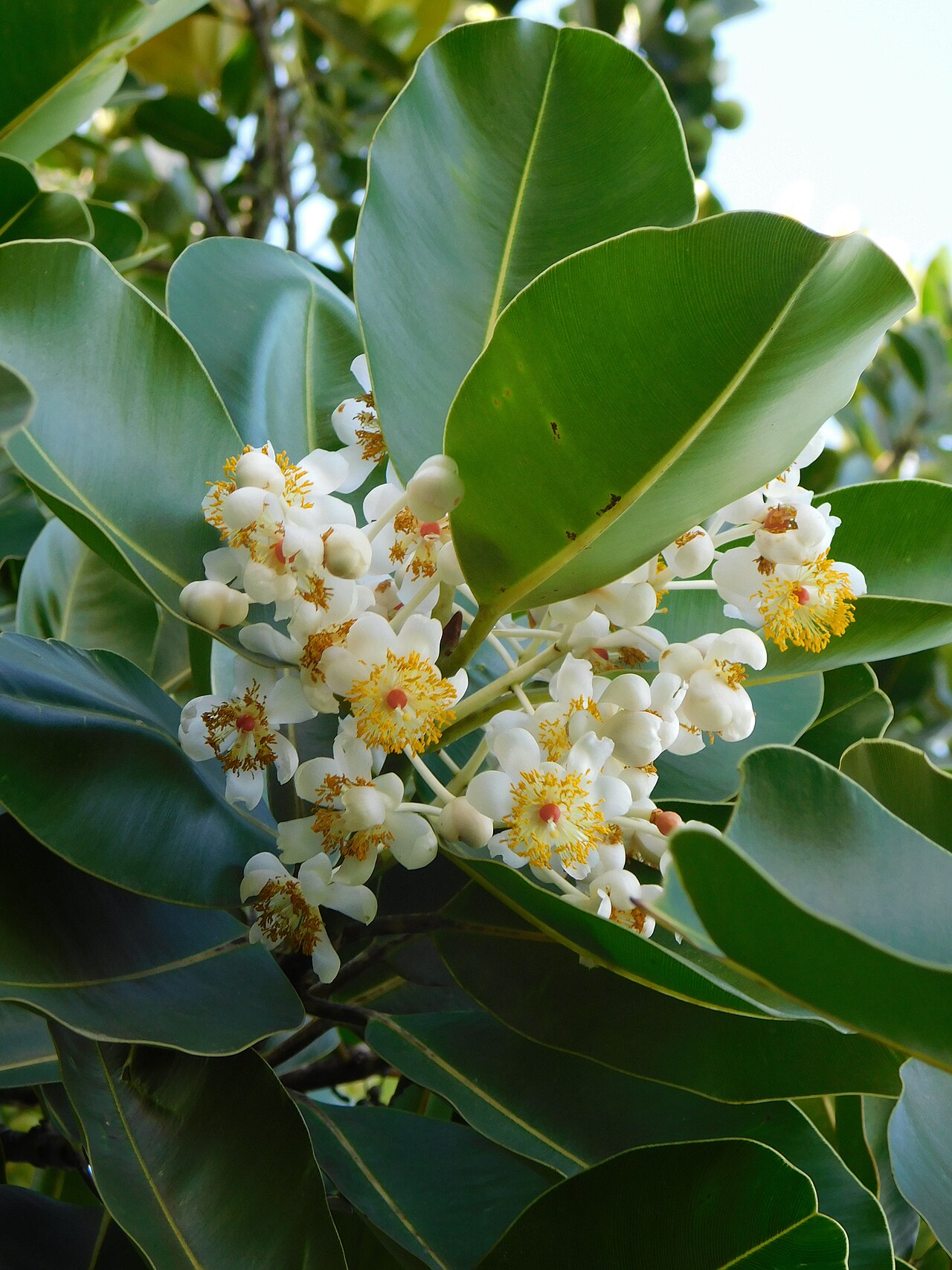
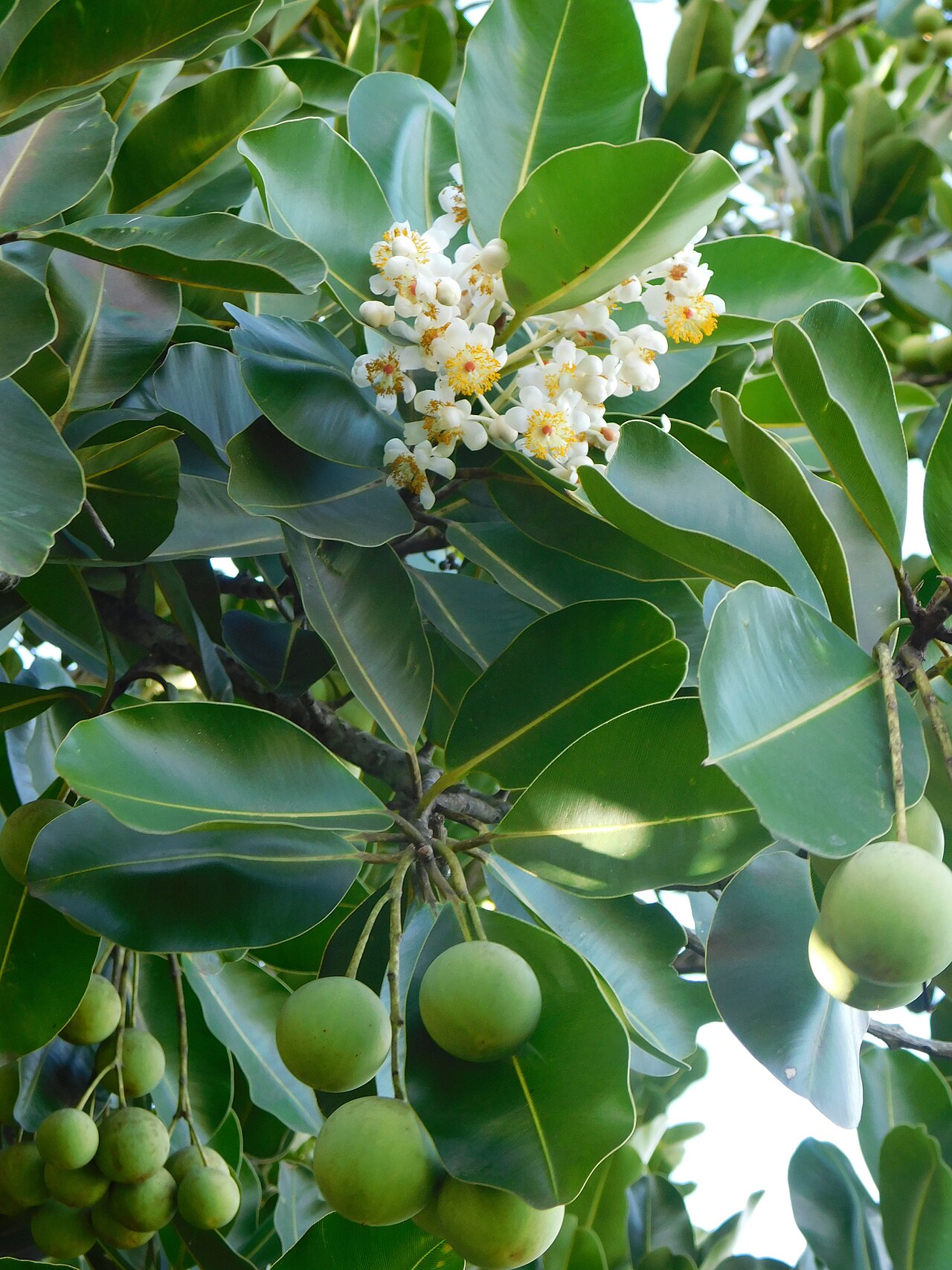
Calophyllum antillanum, called Santa María or palo María in Puerto Rico and listed by USDA as Antilles calophyllum, is a handsome evergreen tree of the Caribbean islands. It has thick, glossy, oval leaves marked by many fine parallel veins, clusters of small, fragrant white flowers with yellow centers, and round green fruits about the size of a large marble. Other English names include West Indian laurel, mast wood and galba, its name in Trinidad.
The tree is native throughout the West Indies, from Cuba, Jamaica and Hispaniola through Puerto Rico and the Virgin Islands to the Lesser Antilles and Trinidad. In Puerto Rico it is one of the most familiar native trees, growing in moist forests and along the coast and planted widely as a street, shade and windbreak tree. It tolerates salt spray, poor soils and wind, and foresters have used it to restore degraded land on the island.
Santa María is an excellent choice for Puerto Rican gardens, parks and coastal plantings that need a tough, dense, evergreen tree. The situation is different in mainland Florida and Hawaii, where it was introduced and is not native: in Florida it has escaped from cultivation and is treated as an invasive species, so it should be planted only within its native Caribbean range.
Identification
Santa María is easy to recognize once you know its leaves. The combination of opposite, leathery leaves with dense parallel side veins, yellowish latex and round single-seeded fruit separates it from most other Puerto Rican trees.
Form & Bark
It is a medium-sized evergreen tree, commonly 30 to 50 feet tall in cultivation and sometimes taller in forest, with a dense, rounded to oval crown. The bark is gray to brown and becomes fissured with age. When the bark is cut it releases a sticky yellowish latex, a trait shared by other members of the genus.
Leaves
The leaves are opposite, simple, elliptic to oblong, and about 3 to 6 inches long. They are thick, leathery and shiny dark green above with a prominent yellowish midrib. The most distinctive feature is the many fine, closely spaced side veins running almost straight out from the midrib to the leaf edge, which gives the leaf a finely striped look.
Flowers
The flowers are small, white and fragrant, about half an inch across, with a central tuft of numerous yellow stamens. They are borne in short clusters in the leaf axils near the branch tips, and a flowering tree can be dotted with them throughout the crown.
Fruit & Seeds
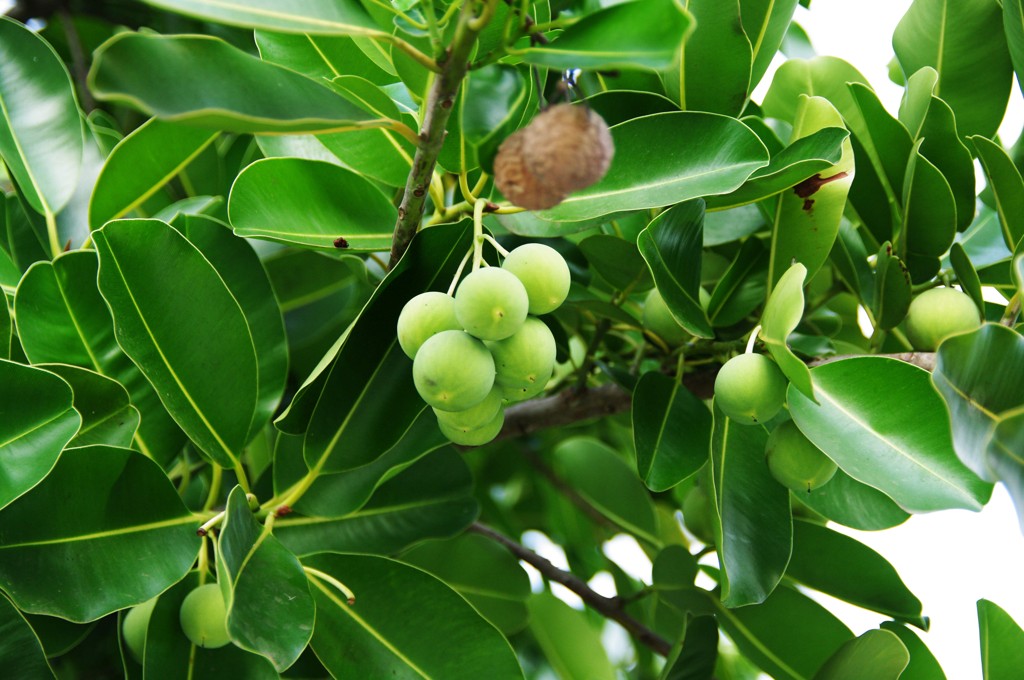
The fruit is a round, smooth drupe about 1 inch across, green at first and turning yellowish to brown as it ripens and dries. Each fruit holds a single large seed. Fruit often hangs in clusters below the leaves.
Quick Facts
| Scientific Name | Calophyllum antillanum Britton |
| Family | Calophyllaceae (formerly Clusiaceae) |
| Plant Type | Evergreen tree |
| Mature Height | 30–50 ft; occasionally taller in forest |
| Mature Spread | 20–35 ft |
| Growth Rate | Moderate |
| Sun Exposure | Full sun to partial shade |
| Water Needs | Moderate; tolerates short dry spells once established |
| Soil Type | Adaptable: sandy, clay or poor soils if not waterlogged |
| Soil pH | Acidic to slightly alkaline |
| Bloom Time | Variable; can flower at several times of year |
| Flower Color | White with yellow stamens |
| Fall Color | None; evergreen |
| Fruit | Round green drupe about 1 in, single-seeded |
| Deer Resistant | Not a concern in Puerto Rico, which has no native deer |
| USDA Hardiness Zones | 10b–12; frost-sensitive |
Native Range
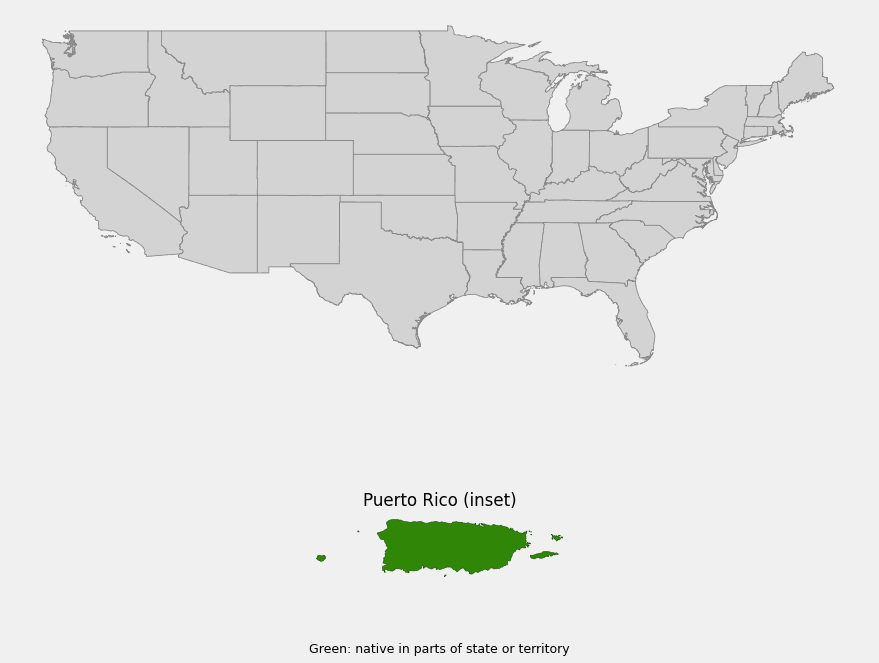
Santa María is native to the West Indies. USDA PLANTS lists it as native in Puerto Rico and the U.S. Virgin Islands, and the Smithsonian’s Flora of the West Indies records it from Puerto Rico, Cuba, Jamaica, Hispaniola and many of the Lesser Antilles. It has also been reported from parts of Mexico, Central America and northern South America, although tropical American Calophyllum species are closely related and their boundaries have been treated differently by different botanists.
In Puerto Rico it grows in moist lowland and lower montane forests, along streams and on coastal plains, and it is planted along streets, in parks and as hedges and windbreaks across the island, including near the ocean, where its tolerance of salt spray is valuable. Its adaptability to many sites has made it a common choice for reforestation of degraded land.
Outside its native range it has been introduced to Florida and Hawaii. USDA PLANTS still carries an older lower-48 native flag for the species, but Florida treats it as an introduced plant that has escaped into natural areas, so this guide maps it to Puerto Rico only.
📋 Regional plant lists featuring Santa María: Puerto Rico
Growing & Care Guide
Santa María is one of the easiest native trees to grow in Puerto Rico. It is tough, long-lived and tolerant of wind, salt and poor soil, and it needs little care once established.
Light
It grows best in full sun, which produces the densest crown and the most flowers and fruit, but it tolerates partial shade, especially when young.
Soil & Water
It adapts to a wide range of soils, from sandy coastal soils to clays, as long as they are not permanently waterlogged. Water regularly during the first year until the roots are established; after that, normal rainfall is usually enough in most of Puerto Rico, although young trees appreciate watering in long dry spells.
Planting Tips
Give it room: a mature tree can be 30 feet or more wide. It makes a fine shade tree for large yards and parks, a coastal windbreak, or a tall clipped hedge. Keep it away from places where falling fruit would be a nuisance on paving. Plant it only within its native Caribbean range; in Florida it is an invasive escape and should not be planted.
Pruning & Maintenance
Little pruning is needed beyond removing low or crossing branches to raise the canopy. It responds well to shearing, which is why it is often used for hedges along property lines in Puerto Rican towns.
Propagation
It is grown from fresh seed, which should be planted soon after the fruit falls. Remove the fleshy outer layer and sow in a well-drained mix; seedlings grow steadily and can be planted out after reaching a sturdy size.
Landscape Uses
- Shade and street tree: a dense, evergreen canopy for streets, plazas and parks
- Coastal windbreak: tolerates wind and salt spray near the ocean
- Hedges and screens: takes regular shearing to form tall, dense hedges
- Reforestation: used to restore degraded land in Puerto Rico
- Wildlife plantings: fragrant flowers for insects and fruit eaten by bats and other animals
Wildlife & Ecological Value
As a widespread, long-lived evergreen, Santa María provides year-round cover and seasonal flowers and fruit for Caribbean wildlife.
For Pollinators
The small, fragrant white flowers with their many stamens offer pollen and nectar to bees and other small insects.
For Birds
The dense evergreen crown gives birds shelter and nesting cover, including in towns and along windy coasts where few other trees grow well.
For Mammals
The round, single-seeded fruits are the kind eaten by fruit bats and other animals that can carry seeds away from the parent tree, and fallen fruit has traditionally been fed to hogs in the Caribbean.
Ecosystem Role
Santa María helps hold soil on degraded land and on coastal sites, and its shade and leaf litter help other native forest species establish beneath it. In planted areas it provides some of the closest thing to native forest cover in otherwise developed landscapes.
Cultural & Historical Uses
The genus name Calophyllum means “beautiful leaf” in Greek, a fitting name for its glossy, finely striped foliage. The species name antillanum refers to the Antilles, and it was described by Nathaniel Lord Britton, who led the scientific survey of Puerto Rico and the Virgin Islands in the early twentieth century.
Santa María is valued for its hard, durable wood, which has been used across the Caribbean for construction, flooring, furniture, boatbuilding, poles and tool handles. The latex from the trunk was used in traditional medicine, and oil pressed from the seeds was once burned in lamps.
In Trinidad the tree is known as galba, and the name is said to have inspired the stage name of the Grenadian-born calypsonian Sir Galba. In Trinidad its wood was also used to make spinning tops for children.
Frequently Asked Questions
Is Santa María native to Puerto Rico?
Yes. USDA PLANTS lists Calophyllum antillanum as native in Puerto Rico and the U.S. Virgin Islands, and it is native throughout the West Indies.
What is the Spanish name for Santa María in Puerto Rico?
It is called Santa María, María or palo María. USDA lists it in English as Antilles calophyllum, and it is also known as West Indian laurel.
Can I plant Santa María in Florida?
No. It is not native to Florida, where it has escaped from cultivation and is treated as an invasive species. Choose a Florida native tree instead.
Does Santa María tolerate salt and wind?
Yes. It is widely planted near the coast in Puerto Rico as a windbreak and to protect against salt spray.
Is Santa María a good hedge plant?
Yes. It takes shearing well and is often pruned into tall, dense hedges along property lines in Puerto Rican towns.

Looking for a nursery that carries Santa María?
Our nursery directory does not yet include Puerto Rico. Browse the native plant nursery directory by state: Alabama–Arkansas · California · Colorado–Hawaii · Idaho–Kansas · Kentucky–Montana · Nebraska–Oklahoma · Oregon · Pennsylvania–Virginia · Washington · West Virginia–Wyoming