
Pirigallo (Guzmania berteroniana)
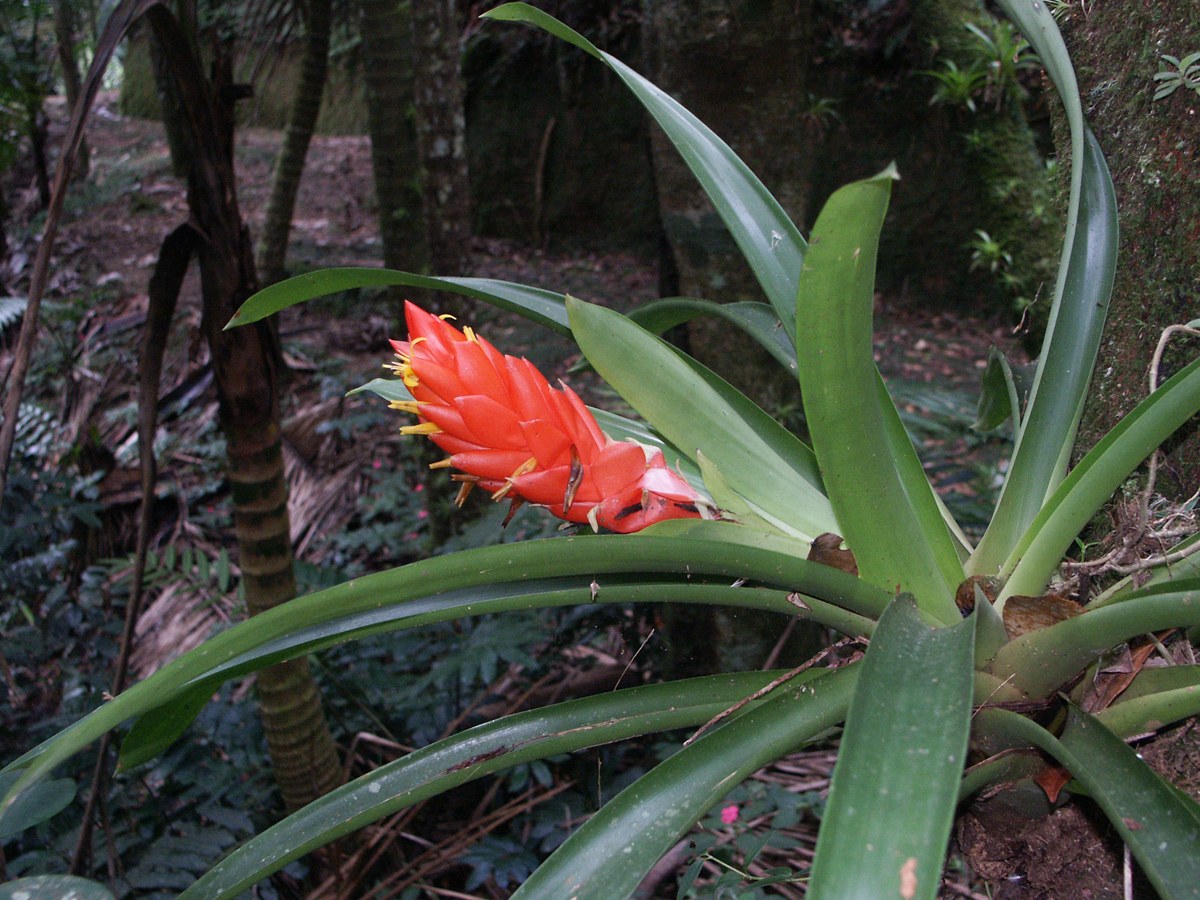
Guzmania berteroniana, known in Puerto Rico as Pirigallo, is a native tank bromeliad of the island’s wet mountain forests,. USDA PLANTS calls it Bertero’s tufted airplant. Other Puerto Rican names recorded by the Smithsonian Flora of the West Indies are mata de agua, bejuco de sapo and parásita; in the Dominican Republic it is called tinaja, tinajita and piña de palo.
It grows as a vase-shaped rosette of smooth, glossy green leaves, perched on tree trunks and branches or sometimes rooted on the ground and on rocks. When it blooms, a dense, upright head of scarlet bracts rises from the center, studded with small yellowish flowers. The rosette holds water in its center, which is where the names “mata de agua” (water plant) and the Dominican “tinaja” (water jar) come from.
This guide covers how to identify pirigallo, where it grows in Puerto Rico’s mountain forests, how to grow it, and the role its water-filled tank plays in the forest.
Identification
Puerto Rico has several native bromeliads with red flower heads. Pirigallo stands out for its smooth, unspotted green leaves and its compact, cone-shaped head of bright red bracts held just above the rosette.
Growth Form
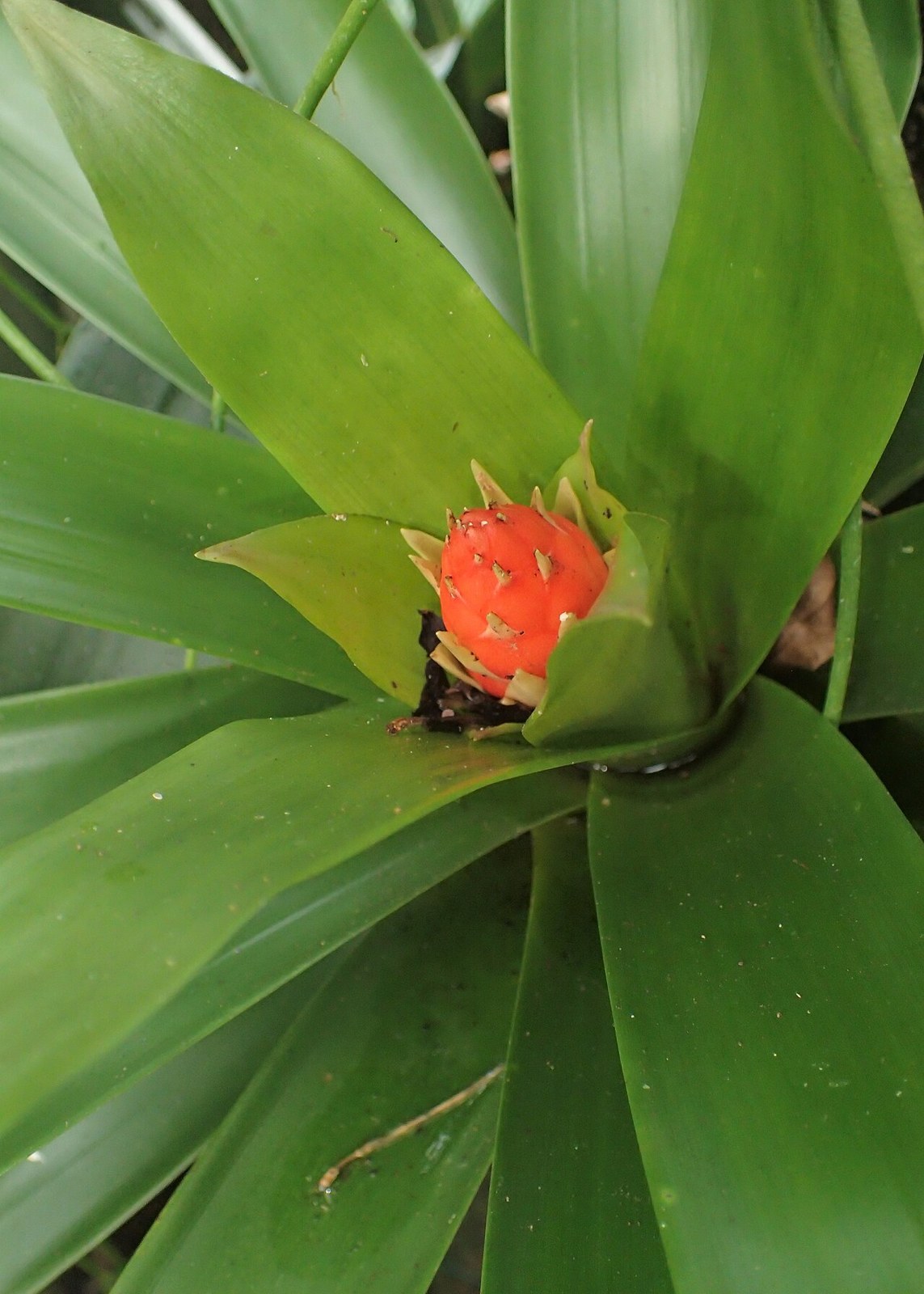
A medium-sized evergreen bromeliad that forms a funnel-shaped rosette of leaves. It is usually epiphytic, growing on trees, but also grows on rocks and on the ground in very wet forest. Plants are typically about 1 to 2 feet (30 to 60 cm) tall and wide, and the flower head adds several inches more.
Leaves
The leaves are strap-shaped, smooth-edged (without spines), glossy and bright to medium green, broad at the base and tapering to a pointed tip. Their wide, overlapping bases form the central cup, or tank, that collects rainwater and leaf litter.
Inflorescence
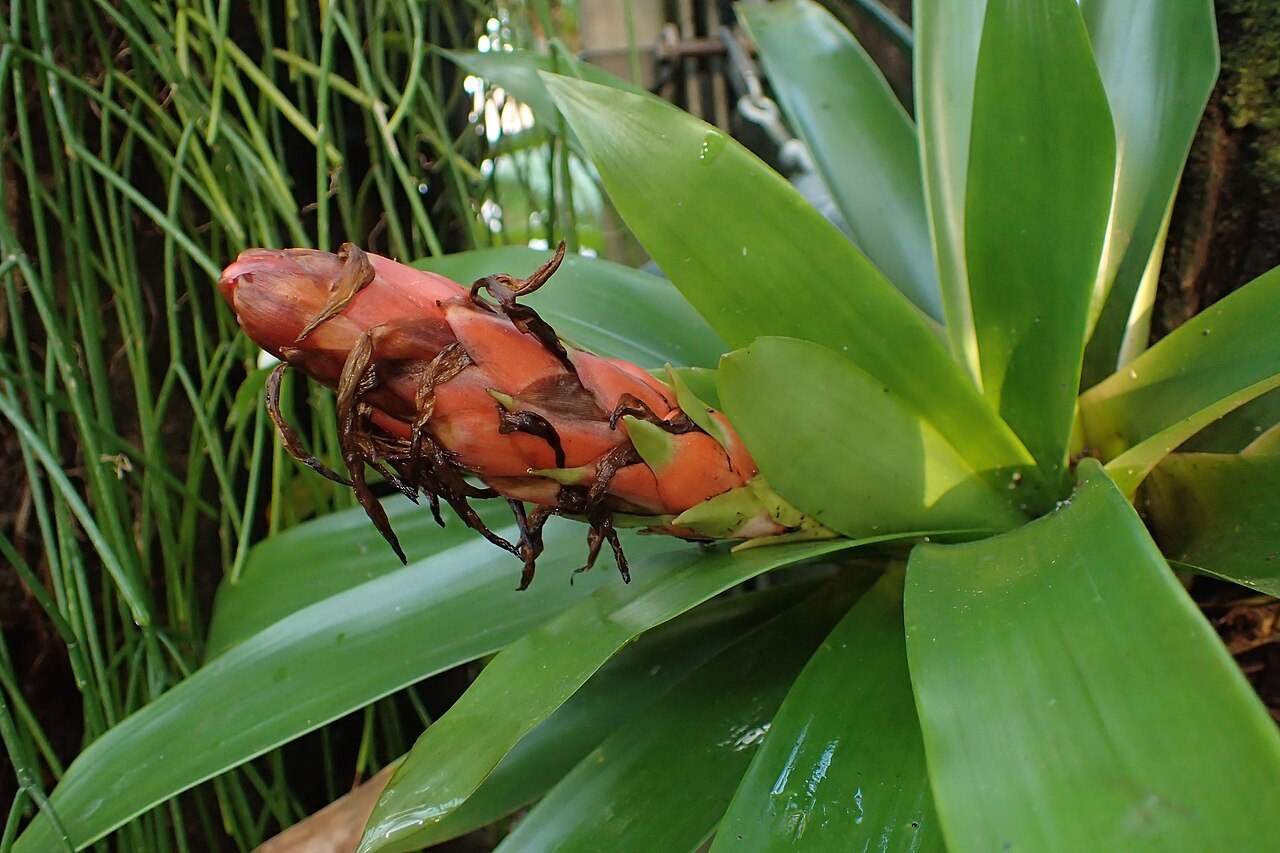
The flower head is upright, dense and cone- to club-shaped, on a short, stout stalk covered with red, leafy bracts. The bracts of the head are bright scarlet to orange-red and overlap like the scales of a cone. They stay colorful for weeks, long after individual flowers fade.
Flowers and Fruit
The true flowers are small, tubular and pale yellow, and they open a few at a time from between the red bracts. The fruit is a dry capsule that splits to release many small seeds, each with a tuft of fine hairs that carries it on the wind, like the seeds of air plants.
Quick Facts
| Scientific Name | Guzmania berteroniana (Schult. & Schult. f.) Mez (syn. Caraguata berteroniana); USDA common name: Bertero’s tufted airplant |
| Family | Bromeliaceae (bromeliad family) |
| Plant Type | Evergreen epiphytic tank bromeliad |
| Mature Height | 1–2 ft |
| Mature Spread | 1–2 ft |
| Growth Rate | Slow to moderate |
| Sun Exposure | Partial shade to bright filtered light |
| Water Needs | High humidity; keep the central cup filled with water |
| Soil Type | Epiphytic: mounted on bark, or in a loose orchid or bromeliad mix |
| Soil pH | Acidic |
| Bloom Time | Variable; individual flower heads last for weeks |
| Flower Color | Scarlet bracts with pale yellow flowers |
| Fall Color | None; evergreen |
| Fruit | Dry capsule with wind-borne, hairy seeds |
| Deer Resistant | Not applicable in Puerto Rico |
| USDA Hardiness Zones | 10b–12; frost tender |
Native Range
USDA PLANTS lists Guzmania berteroniana as native to Puerto Rico. The Smithsonian Flora of the West Indies (Acevedo-Rodríguez & Strong) records it as native in Puerto Rico and in the Dominican Republic on Hispaniola, and also in Panama in Central America.
In Puerto Rico it is a plant of the wet, cloudy mountain forests of the interior and the east. It is known from the Toro Negro State Forest in the Cordillera Central above Ponce, where it grows in mossy, humid forest. It grows mainly on tree trunks and branches, and sometimes on rocks, banks and the ground in very wet sites.
It is not listed under the U.S. Endangered Species Act. Its natural habitat is limited to the island’s mountain forests, so never collect plants from the wild. Buy only nursery-propagated plants, and note that many “Guzmania” plants sold as houseplants are hybrids of other species.
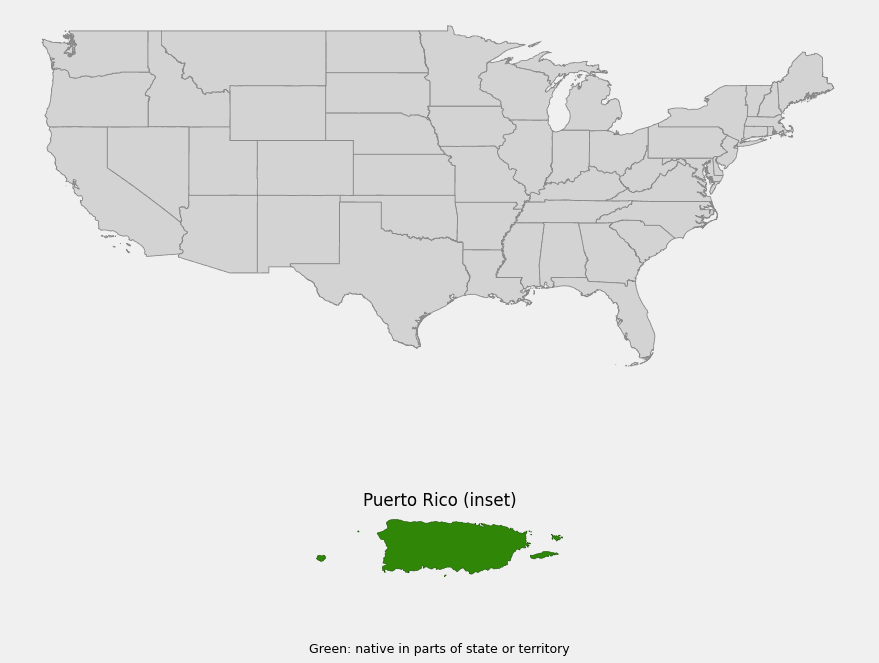
📋 Regional plant lists featuring Pirigallo: Puerto Rico
Growing & Care Guide
Pirigallo is a cool, wet-forest plant. It grows best in humid, shaded gardens in Puerto Rico’s uplands or the wetter north coast. In hot, dry lowland areas, or on the mainland, grow it in a pot or mounted in a shaded, humid spot, such as a shade house or greenhouse.
Light
Give it bright, filtered light or partial shade, like the dappled light under a forest canopy. Direct afternoon sun bleaches and burns the leaves; too much shade produces soft, dark leaves and fewer flowers.
Soil & Water
As an epiphyte it needs air around its roots. Mount it on a piece of bark or a tree branch, or pot it in a very coarse, fast-draining mix of bark and perlite. Keep the central cup filled with fresh rainwater or soft water, and flush it every week or two so the water does not go stale. Mist or water the roots so they never dry out completely, but don’t let the pot stand in water.
Planting Tips
To mount a plant on a tree, tie it in place with soft string or plant ties against rough bark, with a pad of moss around the base; it will attach itself with its roots in a few months. Choose a tree with rough bark in a humid, shaded spot.
Pruning & Maintenance
Each rosette flowers once and then slowly declines, but before it does, it produces offsets (pups) at its base. Cut off the old rosette once it fades and the pups are established. Feed sparingly with a dilute fertilizer applied to the leaves and roots; never use strong fertilizer in the cup.
Propagation
Separate pups when they are about a third to half the size of the parent and have a few roots. Seeds can be sown on moist, fine bark or sphagnum moss in a humid container, but seedlings take several years to reach flowering size.
Landscape Uses
- Shade and fern gardens: bright red color in humid, shaded spots
- Tree mounting: grows naturally on trunks and branches
- Hummingbird gardens: tubular flowers and red bracts attract hummingbirds
- Containers and shade houses: compact enough for pots and baskets
- Native plant collections: a native bromeliad of Puerto Rico’s mountain forests
Wildlife & Ecological Value
Like other tank bromeliads, pirigallo creates a tiny wetland in the forest canopy, and its red flowers are designed for birds.
For Pollinators
The red bracts and tubular yellow flowers fit the pattern of plants pollinated by hummingbirds, which visit bromeliads for nectar in Puerto Rico’s mountain forests. Insects also visit the flowers.
For Birds
Hummingbirds feed on the nectar, and other birds pick insects from the rosettes and drink from the water stored in the cups.
For Mammals
Pirigallo is not an important food plant for mammals; Puerto Rico’s only native land mammals are bats.
Ecosystem Role
The central tank collects rainwater and fallen leaves, creating a small pool where insect larvae and other tiny animals live. In Puerto Rico, bromeliad tanks are used by frogs, including coquíes, as well as lizards, spiders and many invertebrates, and the decaying litter in the tank feeds the plant.
Cultural & Historical Uses
The species is named after Carlo Giuseppe Bertero (1789–1831), an Italian physician and botanist who collected plants in the West Indies, including Hispaniola, in the early 1800s. The genus Guzmania honors Anastasio Guzmán, an 18th-century Spanish pharmacist and naturalist.
Its many local names reflect how familiar it is in the mountains. “Mata de agua” (water plant) in Puerto Rico and “tinaja” and “tinajita” (water jar) in the Dominican Republic all refer to the water held in the rosette.
Guzmanias are among the most popular bromeliads in the houseplant trade, and garden selections such as ‘Elaine’ are grown under the name Guzmania berteroniana. The wild species, though, is a native of a few Caribbean islands and Panama.
Frequently Asked Questions
Is pirigallo a parasite?
No. Although one Puerto Rican name is “parásita,” it is an epiphyte: it grows on trees for support but takes no food from them. It gets water and nutrients from rain, air and the debris that collects in its cup.
Where can I see it in Puerto Rico?
It grows in the wet mountain forests of the island’s interior, such as the Toro Negro State Forest in the Cordillera Central, where it perches on tree trunks and branches.
Does the plant die after flowering?
Each rosette flowers only once and then slowly dies back over months, but it produces offsets at the base that grow on and flower in a few years.
Should I fill the center with water?
Yes. Keep a little fresh, soft water in the cup and flush it regularly. Never let it stagnate, and don’t add strong fertilizer to the cup.
Can I grow it on the U.S. mainland?
Only outdoors in frost-free, humid areas such as South Florida, in shade. Elsewhere it does well as a houseplant or in a humid greenhouse.

Looking for a nursery that carries Pirigallo?
Our nursery directory does not yet include Puerto Rico. Browse the native plant nursery directory by state: Alabama–Arkansas · California · Colorado–Hawaii · Idaho–Kansas · Kentucky–Montana · Nebraska–Oklahoma · Oregon · Pennsylvania–Virginia · Washington · West Virginia–Wyoming