
Kraenzlin’s Peacock Orchid (Psychilis kraenzlinii)
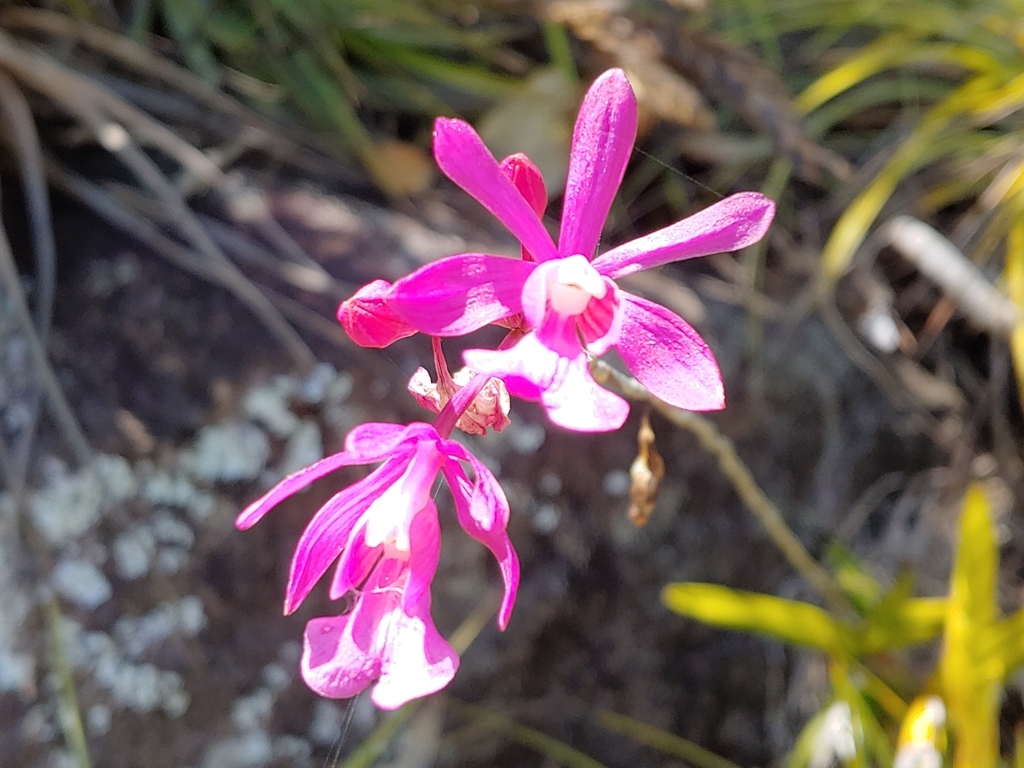
Psychilis kraenzlinii, Kraenzlin’s Peacock Orchid, is a magenta-flowered orchid found only in Puerto Rico. It grows on bare rock and thin soil: the tops and cliffs of limestone mogotes, serpentine barrens in the west, and rocky scrub, as well as on tree trunks. From a clump of stiff, narrow leaves it sends up a long, wiry flower stalk that can reach about 3 feet, and the stalk keeps producing new flowers at its tip, a few at a time, for months or even years.
USDA PLANTS lists Kraenzlin’s peacock orchid as native in Puerto Rico, and the Smithsonian’s Flora of the West Indies treats it as endemic to the island. The Institute for Regional Conservation (IRC) records it in Maricao, Río Abajo and Susúa state forests, and reports it from Guánica. Herbarium and observation records gathered by GBIF place it from the north-coast karst of Isabela, Quebradillas and Vega Baja to Salinas on the south coast and Fajardo in the east.
This guide covers how to recognize this orchid, where it grows, and how it is grown by orchid enthusiasts. Like all orchids it is listed in CITES Appendix II. Because it grows nowhere else in the world, buy only nursery-propagated plants and never collect it from the wild.
Identification
Peacock orchids (Psychilis) are a small Caribbean genus of about 15 species, most of them in Hispaniola and Puerto Rico. The Spanish Wikipedia notes that they were separated from Epidendrum because the lip is fused to the column and the flower stalk keeps flowering from its tip. Puerto Rico has several species; Kraenzlin’s peacock orchid is the island’s magenta-flowered rock dweller.
Leaves & Pseudobulbs
The plant forms a tight clump of short, swollen stems (pseudobulbs), each topped with stiff, narrow, leathery leaves. In full sun on rock the leaves are often yellow-green and tinged with red, and the clump can look like a tuft of coarse grass or a small bromeliad when it is not in flower.
Flower Stalk
The flower stalk is long, thin and wiry. A herbarium label from Puerto Rico describes stalks up to about 1 m (3 ft) long. As in other peacock orchids, the stalk does not wither after its first flowers but keeps growing and blooming from its tip, so older stalks become knobby with the scars of earlier flowers and fruits.
Flowers
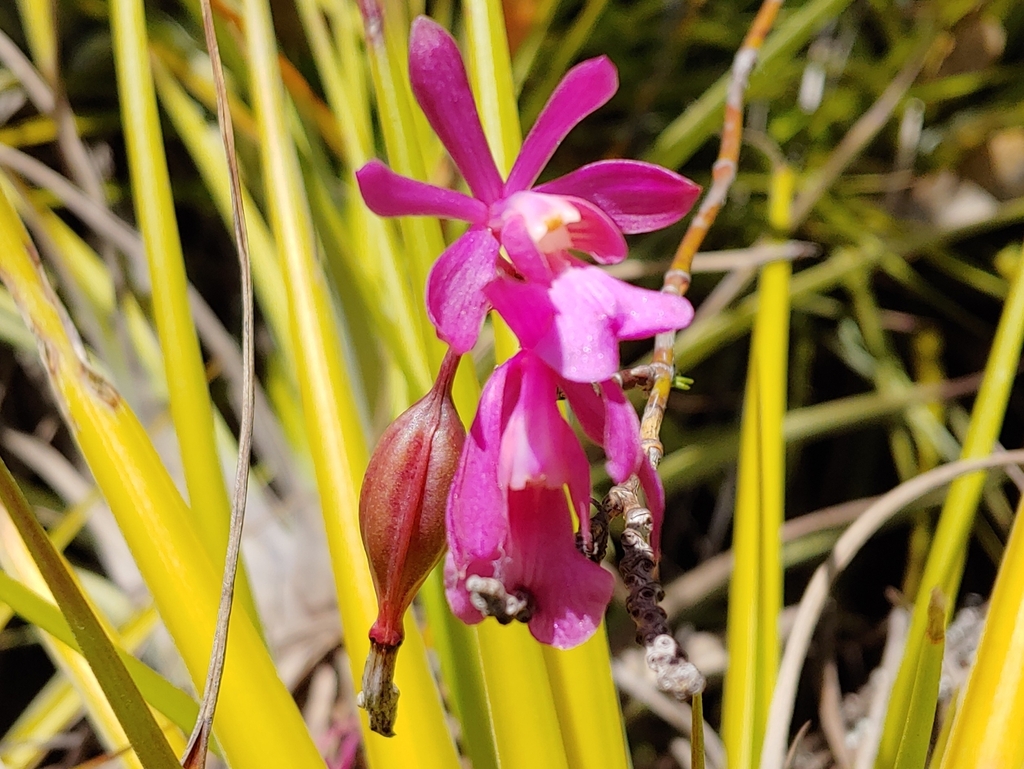
The flowers are up to about 2 inches across, and the same label describes them as pale pink. Many plants, including the ones in our photographs, have vivid magenta-pink flowers with a broad lip that is paler at the center. The sepals and petals spread widely, and the lip, fused to the column at its base, projects forward. Records from Puerto Rico document flowers in nearly every month.
Fruit & Seeds
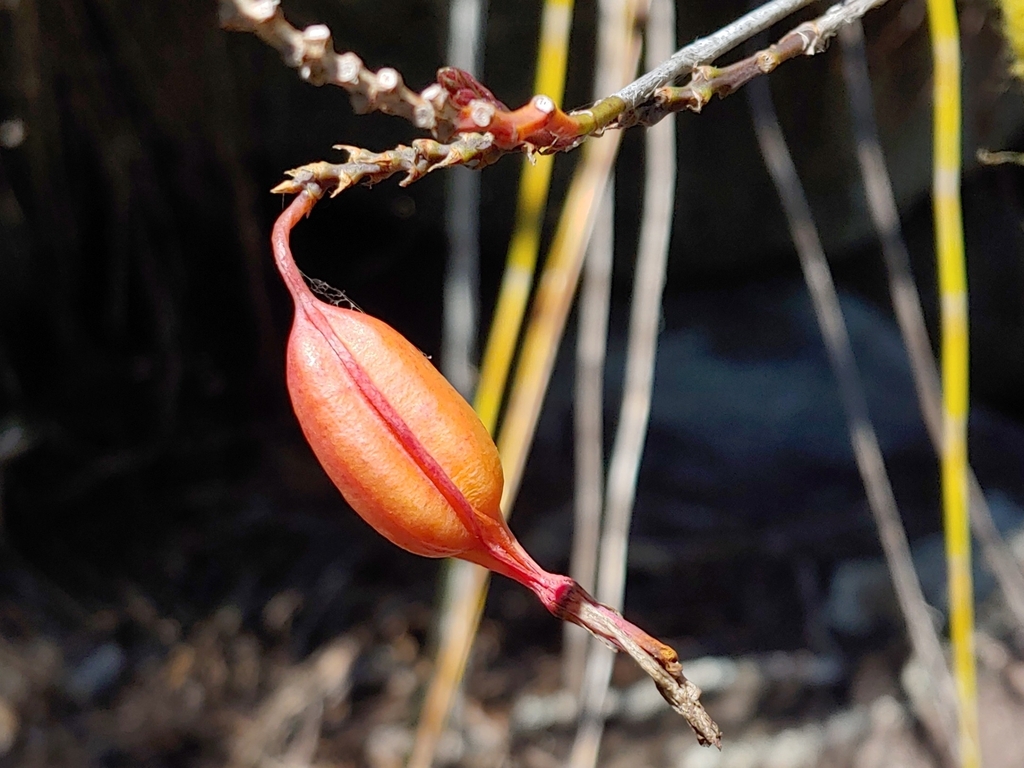
Pollinated flowers ripen into a spindle-shaped, ribbed capsule that turns orange-brown and hangs from the stalk. When dry it splits to release thousands of dust-like seeds, which need a compatible fungus to germinate.
Quick Facts
| Scientific Name | Psychilis kraenzlinii (Bello) Sauleda (syn. Epidendrum kraenzlinii Bello, Encyclia kraenzlinii (Bello) Ackerman) |
| Family | Orchidaceae (orchid family) |
| Plant Type | Rock-dwelling (lithophytic), terrestrial or epiphytic orchid; evergreen perennial |
| Mature Height | Leaves several inches long; flower stalk to about 3 ft |
| Mature Spread | Forms small clumps; slowly widens over years |
| Growth Rate | Slow |
| Sun Exposure | Full sun to bright light |
| Water Needs | Low to moderate; drought-tolerant once established, needs sharp drainage |
| Soil Type | Bare limestone, serpentine and volcanic rock; thin, rocky soil; white-sand savanna |
| Soil pH | Neutral to alkaline on limestone; varies on serpentine and volcanic rock |
| Bloom Time | Recorded in nearly every month; flower stalks rebloom for long periods |
| Flower Color | Pale pink to vivid magenta |
| Fall Color | None; evergreen |
| Fruit | Spindle-shaped capsule with dust-like seeds |
| Deer Resistant | Not applicable in Puerto Rico; no deer browse |
| USDA Hardiness Zones | 11–13 (frost-free tropics) |
Native Range
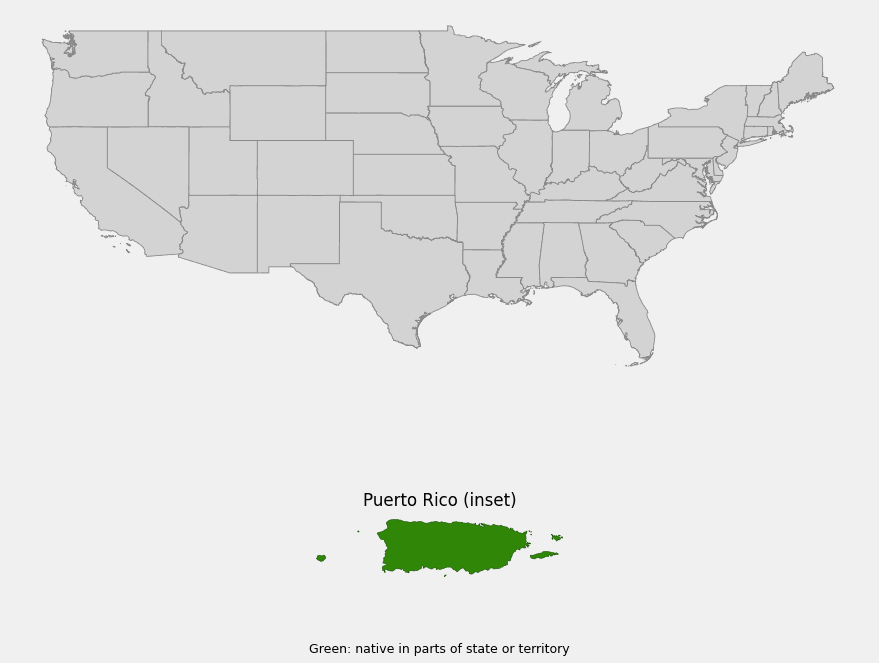
Kraenzlin’s peacock orchid is endemic to Puerto Rico. USDA PLANTS lists it as native in Puerto Rico and records it nowhere else in the United States, and the Smithsonian’s Flora of the West Indies lists it as a Puerto Rico endemic. It does not grow in the U.S. Virgin Islands or Florida.
IRC records it in Maricao State Forest and Susúa State Forest on the serpentine hills of the west, in Río Abajo State Forest in the northern karst, and reports it from Guánica State Forest in the southwestern dry forest. IRC lists its substrates as limestone and karst, serpentine and volcanic rock. Herbarium labels gathered by GBIF describe plants on mogote summits and limestone hills near Hato Tejas (Bayamón), on cliffs and rock walls, in low serpentine scrub and serpentine barrens, and at the shady base of cocoplum thickets in a white-sand savanna. GBIF records with elevations range from about 75 m (250 ft) to 560 m (1,840 ft), and IRC lists the species at middle elevations of 500 to 1,000 m.
What these sites share is sun, sharp drainage and very little soil. Kraenzlin’s peacock orchid is a plant of exposed rock, where few other plants compete and where its tough leaves and thick roots let it survive the dry season.
📋 Regional plant lists featuring Kraenzlin’s Peacock Orchid: Puerto Rico
Growing & Care Guide
Kraenzlin’s peacock orchid is grown mainly by orchid specialists, and plants are seldom offered for sale. Because it grows only in Puerto Rico, and because wild plants on rock almost never survive being removed, it should never be collected. All orchids are listed in CITES Appendix II, and plants in Puerto Rico’s state forests are protected. Look for seed-grown plants from reputable orchid nurseries or growers.
Light
Give it very bright light. In the wild it grows on sun-baked rock, and plants grown in too much shade produce soft leaves and few flowers. In Puerto Rico it can be grown outdoors in full morning sun with light afternoon shade.
Soil & Water
Grow it on a mount of cork or hardwood, on a rock in a rock garden, or in a small clay pot with a very coarse, fast-draining mix of bark, charcoal and limestone gravel. Water thoroughly and then let the roots dry completely before watering again. It tolerates drought far better than constant wetness, which rots the roots.
Planting Tips
Tie the plant firmly to its mount so it cannot rock while new roots attach. On a garden rock, wedge it into a crevice with a little coarse bark and gravel. Choose a site with good air movement and protection from long periods of waterlogging during heavy rains.
Pruning & Maintenance
Do not cut off old flower stalks while they are still green: peacock orchids keep flowering from the tips of existing stalks. Remove a stalk only when it has turned brown and dry. Feed sparingly with a dilute orchid fertilizer during active growth.
Propagation
Mature clumps can be divided carefully when new roots appear. Growing from seed requires sterile laboratory culture with careful technique, and it is how conservation programs and specialist nurseries produce plants without harming wild populations.
Landscape Uses
- Rock gardens: for sunny crevices on limestone in Puerto Rico gardens
- Mounted orchid displays: on cork or hardwood in bright light
- Native orchid collections: a Puerto Rico endemic for specialist growers
- Conservation education: a living example of Puerto Rico’s endemic flora
- Dry-forest and karst gardens: with other native plants of rock and thin soil
Wildlife & Ecological Value
Kraenzlin’s peacock orchid is part of the special flora of Puerto Rico’s rock outcrops, a community of tough, sun-loving plants that grows where forest cannot.
For Pollinators
The bright magenta flowers stand above the leaves on long stalks, where they are easy for flying insects to find. The pollinators of this species in Puerto Rico have not been well documented.
For Birds
The orchid has no known direct value for birds. The rocky scrub and mogote summits where it grows are also habitat for Puerto Rico’s dry-forest birds.
For Mammals
Puerto Rico’s only native land mammals are bats, and none are known to depend on this orchid.
Ecosystem Role
On bare rock, orchids like this one help build tiny pockets of organic matter around their roots, where mosses, lichens and seedlings of other plants can take hold. Like all orchids, it depends on fungi in the bark, rock crevices or soil for its seeds to germinate.
Cultural & Historical Uses
This orchid was first described as Epidendrum kraenzlinii by Domingo Bello y Espinosa, a Spanish botanist who studied the flora of Puerto Rico in the late 19th century. The species name honors the German orchid specialist Fritz Kränzlin. The orchid specialist James Ackerman later moved it to Encyclia, and in 1988 Ruben P. Sauleda transferred it to Psychilis, a genus named by Constantine Rafinesque in 1838.
The common name peacock orchid refers to the whole genus Psychilis and its showy, colorful flowers. Peacock orchids are best known from Hispaniola and Puerto Rico, where several species and natural hybrids occur.
Kraenzlin’s peacock orchid is one of many endemic plants on Puerto Rico’s limestone mogotes and serpentine hills, two of the island’s most distinctive landscapes. Protecting those rock outcrops from quarrying, development and illegal plant collecting also protects this orchid.
Frequently Asked Questions
Is Kraenzlin’s peacock orchid native to Puerto Rico?
Yes, and it is endemic. USDA PLANTS lists it as native in Puerto Rico, and the Smithsonian’s Flora of the West Indies records it from Puerto Rico only. IRC records it in Maricao, Río Abajo and Susúa state forests and reports it from Guánica.
Where does it grow?
Mostly on rock: limestone mogotes and cliffs in the northern karst, serpentine barrens and scrub in the west, and rocky dry forest, as well as on trees and in white-sand savanna. Records range from low hills of about 250 ft up to middle elevations in the western mountains.
Why shouldn’t I cut the old flower stalks?
Peacock orchids keep producing new flowers from the tips of their old stalks, sometimes for years. Cut a stalk only after it has turned brown and dry.
Can I collect one from the wild?
No. It grows only in Puerto Rico, all orchids are covered by CITES Appendix II, and plants in state forests are protected. Wild plants also rarely survive being pried off rock. Buy nursery-propagated plants.
What other orchids are called peacock orchids?
The name applies to the genus Psychilis, a group of about 15 Caribbean species. Puerto Rico has several; Kraenzlin’s peacock orchid is distinguished by its magenta flowers and its preference for rock.

Looking for a nursery that carries Kraenzlin’s Peacock Orchid?
Our nursery directory does not yet include Puerto Rico. Browse the native plant nursery directory by state: Alabama–Arkansas · California · Colorado–Hawaii · Idaho–Kansas · Kentucky–Montana · Nebraska–Oklahoma · Oregon · Pennsylvania–Virginia · Washington · West Virginia–Wyoming