
Threeleaf Goldthread (Coptis trifolia)
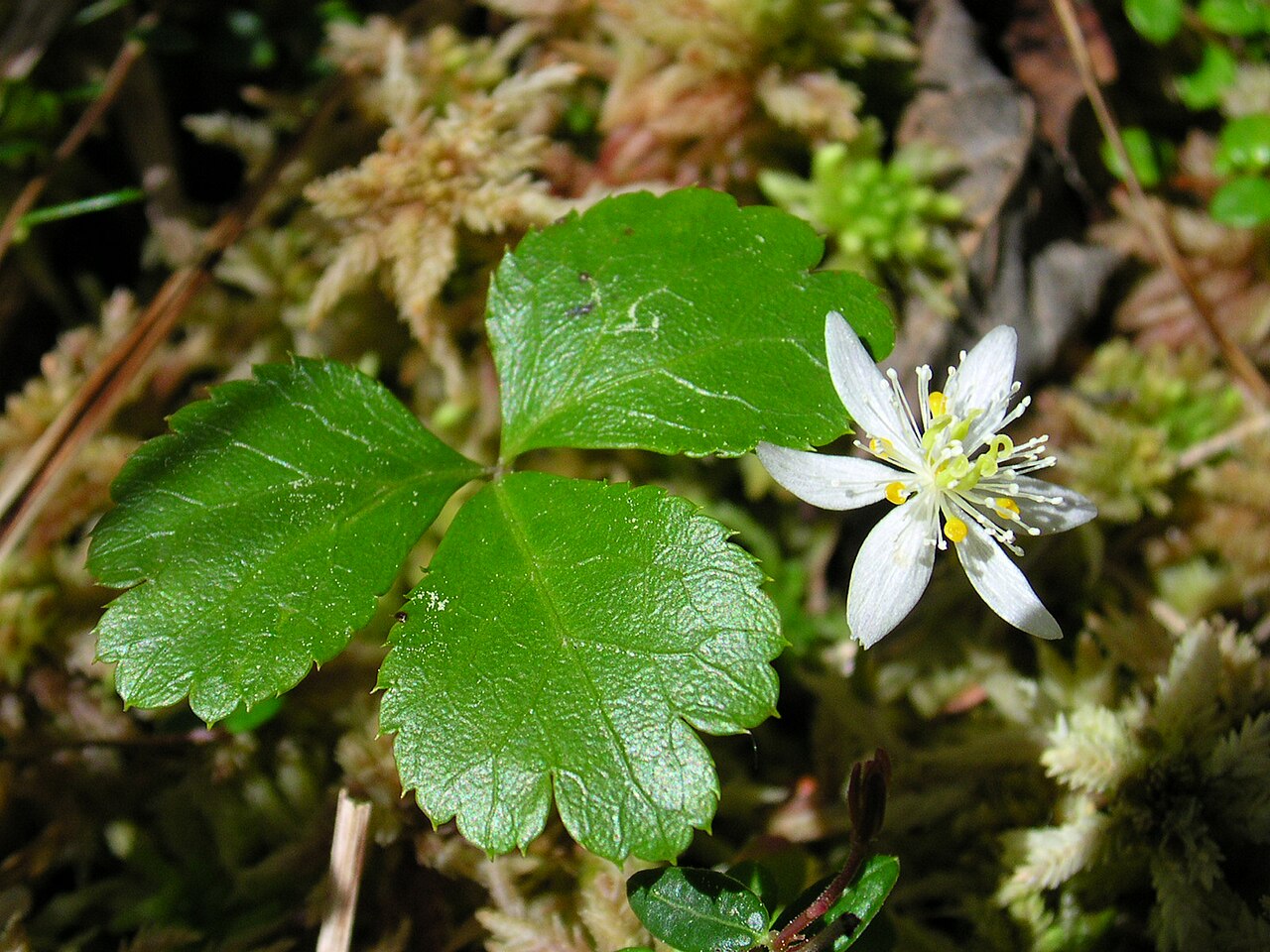
Coptis trifolia, known as Threeleaf Goldthread or simply goldthread, is a small evergreen wildflower of cool, mossy northern forests and bogs, in the buttercup family (Ranunculaceae). It forms low carpets of glossy, dark green leaves, each divided into three scalloped leaflets, only 3 to 6 inches tall. In late spring each plant raises a slender, leafless stalk with a single starry white flower about half an inch across.
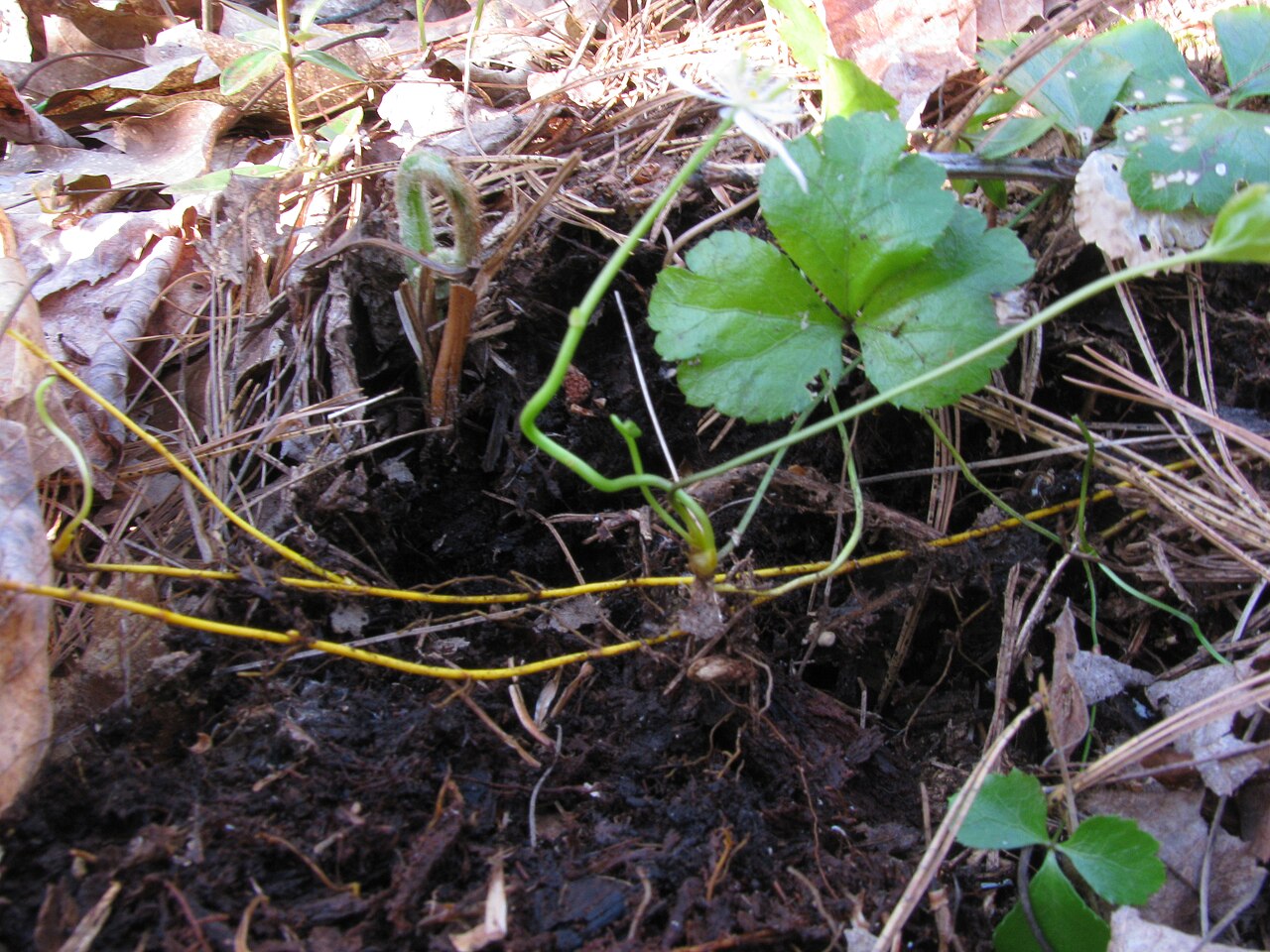
The name comes from what lies underground. Goldthread spreads by thin, creeping rhizomes that are a startling bright yellow-orange, like strands of golden wire running through the moss and needle litter. They are intensely bitter and rich in the yellow alkaloid berberine, and for centuries they were gathered as a remedy for mouth sores, earning the plant another old name, canker root.
Goldthread grows across the cool forests of the Northern Hemisphere: in North America from Alaska and Labrador south to the Great Lakes and, in the mountains, to West Virginia and North Carolina, and in East Asia. It is a plant of conifer and mixed woods, swamps and bogs with cold, acidic, constantly moist soil. This guide covers identification, range, the realities of growing it, its ecology and its history as a medicinal plant.
Identification
Goldthread is easy to recognize year-round by its glossy, evergreen, three-parted leaves, and in spring by its small white starry flowers. If in doubt, gently scrape back the moss at the edge of a patch: the golden rhizomes are unmistakable.
Leaves
All leaves rise directly from the rhizome on slender stalks 1 to 4 inches long. Each leaf is divided into three fan-shaped to broadly oval leaflets, ½ to 1 inch long, with shallow lobes and small, sharp teeth. They are leathery, shiny dark green above and paler beneath, and they stay green through the winter under snow. Patches often look like a miniature strawberry or a small, glossy clover.
Rhizomes
The rhizomes are thread-thin, branching and bright golden yellow to orange. They run horizontally just below the surface through moss, decaying needles and leaf litter, sending up leaves and flowers at intervals. Over time a single plant can form a patch several feet across.
Flowers
Single flowers are borne on leafless stalks 2 to 6 inches tall, usually rising just above the leaves. What look like petals are five to seven white, oblong sepals forming a star about ½ inch wide. The true petals are reduced to tiny, club-shaped, hollow nectaries tipped in yellow, which surround a brush of numerous white stamens and a cluster of three to seven slender green pistils in the center. Flowering is mostly May to June, extending into July in the far North and at high elevations.
Fruit & Seeds
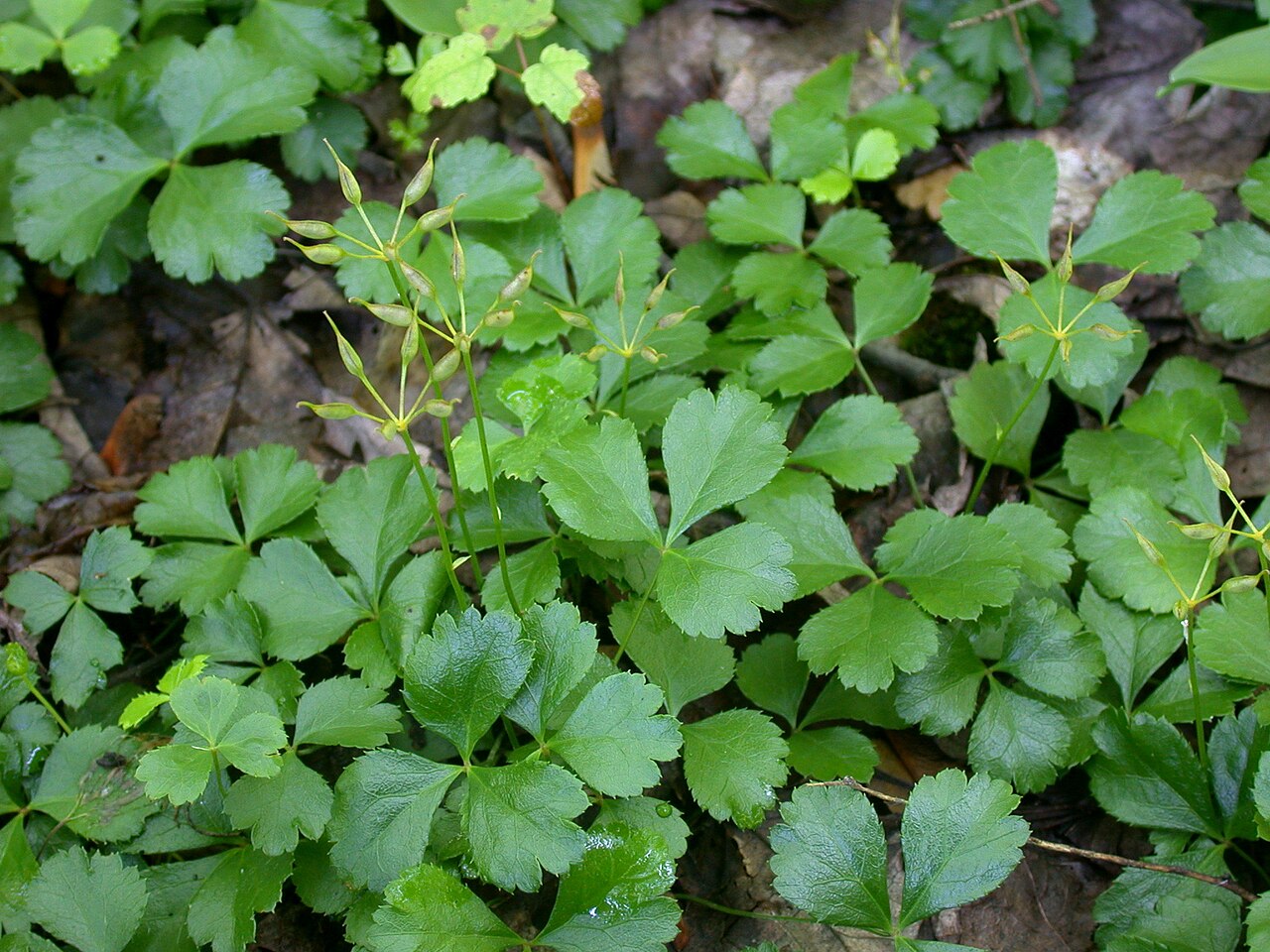
Each pistil develops into a small, stalked, beaked pod (follicle). Together they radiate from the top of the stalk like the ribs of a tiny umbrella. Each pod opens at the top to release a few small, shiny black seeds, which fall out as rain splashes or wind shakes the stalk.
Similar Species
Other goldthreads in western North America, such as fernleaf goldthread (Coptis aspleniifolia) and Oregon goldthread (Coptis laciniata), have deeply divided, fern-like or lacy leaves. Wood strawberry and barren strawberry also have three leaflets but are hairy and have different flowers. Mountain wood sorrel (Oxalis montana), which often grows alongside it, has heart-shaped, clover-like leaflets that fold at night. Dwarf raspberry and dewberries have prickly or hairy, deciduous leaves.
Quick Facts
| Scientific Name | Coptis trifolia (syn. Coptis groenlandica) |
| Family | Ranunculaceae (buttercup family) |
| Plant Type | Evergreen herbaceous perennial spreading by rhizomes |
| Mature Height | 3–6 in |
| Mature Spread | 6–24 in; forms slowly spreading mats |
| Growth Rate | Slow |
| Sun Exposure | Partial shade to full shade |
| Water Needs | Medium to high; soil should stay cool and moist |
| Soil Type | Acidic humus, moss, peat or decaying conifer litter |
| Soil pH | About 4.0–6.0 (acidic) |
| Bloom Time | May–June (to July in the far North) |
| Flower Color | White with yellow-tipped nectaries |
| Fall Color | Evergreen; leaves may bronze slightly in winter |
| Fruit | Umbrella-like cluster of small stalked, beaked pods |
| Deer Resistant | Generally yes; bitter foliage is seldom browsed |
| USDA Hardiness Zones | 2–7 |
Native Range
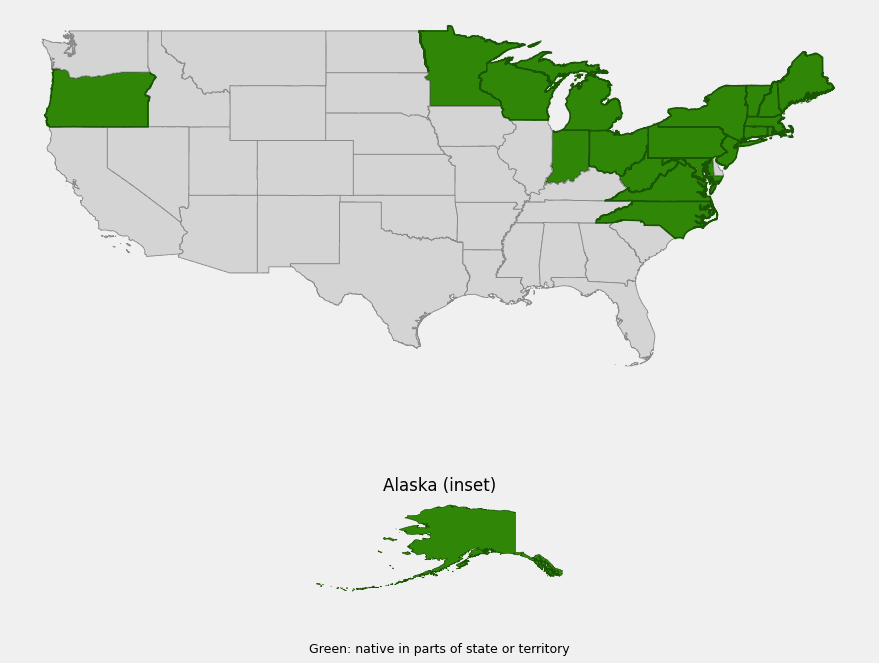
Threeleaf goldthread has a wide northern range. In North America it grows from Alaska, the Yukon and the Northwest Territories across Canada to Labrador and Newfoundland, and on Greenland. USDA PLANTS records it as native in 20 states. In the East it ranges through New England, New York, New Jersey and Pennsylvania west to the Great Lakes states of Ohio, Indiana, Michigan, Wisconsin and Minnesota, and south in the cool, high Appalachians through Maryland, West Virginia and Virginia to North Carolina. It also occurs in eastern Asia, including Japan.
In the Pacific Northwest it is rare. Oregon populations are known from a few sites in the Cascades, documented by herbarium specimens and state natural heritage records, and the species has also been collected in coastal bog prairies on Washington’s Olympic Peninsula. Alaska has extensive populations, especially in the coastal and interior forests of the south.
Throughout its range, goldthread is a plant of cool, moist, acidic habitats. In the North it is common in boreal spruce-fir forests, cedar and tamarack swamps, mossy hemlock and pine woods, and the margins of sphagnum bogs. Toward its southern limits it is confined to cold microhabitats such as high-elevation spruce forests, north-facing ravines and bogs, and it becomes uncommon to rare near the southern edge of its range.
📋 Regional plant lists featuring Threeleaf Goldthread: New York, Pennsylvania & Northern New Jersey · Ohio & Indiana · Michigan, Wisconsin & Eastern Minnesota · Connecticut, Massachusetts & Rhode Island · New Hampshire, Maine & Vermont · Maryland, Virginia & West Virginia · Delaware, Southern New Jersey & Long Island · Alaska
Growing & Care Guide
Goldthread is a charming evergreen groundcover in the right conditions, but those conditions are specific: cool summers, constant moisture and acidic, organic soil. It is slow to establish and seldom sold. Buy only nursery-propagated plants, and never dig it from the wild. Wild clumps rarely survive transplanting, and collecting it has depleted populations in the past.
Light
Give it partial to full shade, such as the dappled light under conifers or on the north side of a building. Morning sun is fine in the North, but hot afternoon sun will scorch it.
Soil & Water
Goldthread needs acidic, humus-rich, moisture-retentive soil that stays cool. Mix generous amounts of peat-free leaf mold, composted pine bark or decaying conifer needles into the planting area, or grow it in a moss-covered pocket near a shady bog garden. Water in dry spells; it will not tolerate summer drought or soil that heats up. Gardeners in warm-summer regions south of its natural range usually find it short-lived.
Planting Tips
Plant small potted divisions in spring or early fall, setting the rhizomes just below the surface. Mulch lightly with conifer needles or shredded leaves. Pair it with other acid-loving, shade-tolerant groundcovers such as partridgeberry, twinflower, wintergreen and mosses, which share its needs and will not overwhelm it.
Pruning & Maintenance
No pruning is needed. Remove fallen hardwood leaves that mat heavily on top of it in fall, but leave conifer needles. Keep the soil acidic: avoid lime, mushroom compost and hard tap water where possible. Pull vigorous weeds by hand rather than hoeing, which damages the shallow rhizomes.
Propagation
Healthy patches can be divided in spring or early fall by cutting sections of rhizome with attached leaves and replanting them at once in moist, acidic soil. Fresh seed sown in fall on moist peat or moss outdoors can germinate the next spring, but seedlings grow slowly.
Landscape Uses
- Shade and woodland gardens in cool climates: a glossy evergreen groundcover under conifers
- Bog garden margins: on moist, mossy hummocks around a shady bog
- Northern native plant gardens: with twinflower, bunchberry, starflower and partridgeberry
- Moss and fern gardens: small enough to weave among mosses without crowding them
- Forest restoration in the North: in boreal and hemlock forest understories, using propagated stock
Wildlife & Ecological Value
Goldthread is a small but constant presence in northern forests, where its evergreen mats help hold the moss and needle layer together and its early flowers feed small insects.
For Pollinators
The tiny cup-shaped nectaries hold nectar that attracts small flies, fungus gnats, small bees and beetles. These insects are active in cool, shady northern forests in late spring, when larger pollinators are less common. The flowers are open and easy to reach, with abundant pollen on the many stamens.
For Birds
Goldthread is not an important food plant for birds. Its habitat is home to many northern forest birds, including spruce grouse, winter wrens, hermit thrushes and boreal warblers.
For Mammals
The bitter, berberine-rich leaves and rhizomes are seldom eaten by deer, moose or rodents. Small mammals and invertebrates live in the moss and litter that goldthread mats help shelter.
Ecosystem Role
As an evergreen, goldthread can photosynthesize in spring and fall when the deciduous canopy is open and temperatures allow. Its creeping rhizomes help bind organic soil and moss on forest floors and bog hummocks. It is a characteristic species of cool, acidic, undisturbed forests, and its presence in southern sites usually marks cold microhabitats left from glacial times.
Cultural & Historical Uses
Goldthread has a long history of use as a medicinal plant. Native American peoples across its range, including Algonquian and Iroquoian groups, used the bitter rhizome to treat mouth sores, sore throats and eye irritations and as a bitter tonic. European settlers adopted it, and by the nineteenth century “canker root” was a standard remedy for children’s mouth sores in New England. Large quantities were dug for the patent medicine trade. The rhizomes were also used to make a yellow dye.
Its bitterness and yellow color come from berberine and related alkaloids, which are also found in goldenseal and barberry. Asian species of Coptis, especially Chinese goldthread (Coptis chinensis), are important in traditional Chinese medicine. Goldthread is not suitable for home use: berberine has potent effects on the body, can interact with medications and should not be taken by pregnant women or infants. Wild collecting also harms slow-growing populations.
The genus name Coptis comes from a Greek word meaning “to cut,” referring to the divided leaves, and trifolia means “three-leaved.” Older North American books often call the plant Coptis groenlandica, after the Greenland populations. Today goldthread is valued mostly by naturalists as one of the characteristic plants of the northern woods.
Frequently Asked Questions
Why is it called goldthread?
Because of its rhizomes, which are thin, threadlike and bright golden yellow to orange. Scraping back the moss at the edge of a patch reveals them running just below the surface.
Is goldthread evergreen?
Yes. Its glossy, three-parted leaves stay green through the winter, often under snow, which makes it a useful groundcover in cool, shady gardens.
Can I grow goldthread in my garden?
It grows well only in cool, moist, acidic, humus-rich soil in shade, conditions found in northern and mountain gardens. It is slow to establish and does poorly in hot, dry summers. Use nursery-propagated plants only.
Is goldthread safe to use as an herbal remedy?
Not without medical advice. Its alkaloids, mainly berberine, are biologically active and can interact with medications, and they are not safe for pregnant women or infants. Wild harvesting also damages slow-growing populations.
Can I dig goldthread from the woods?
No. Wild plants rarely survive transplanting, collecting harms populations, and it is protected or tracked as rare in several states at the edge of its range. Digging on public land or without permission is illegal.

Looking for a nursery that carries Threeleaf Goldthread?
Browse our native plant nursery directory: Alaska · Connecticut · Indiana · Maine, Maryland, Massachusetts, Michigan & Minnesota · New Hampshire, New Jersey, New York, North Carolina & Ohio · Oregon · Pennsylvania, Rhode Island, Vermont & Virginia · West Virginia & Wisconsin