
California Fetid Adderstongue (Scoliopus bigelovii)
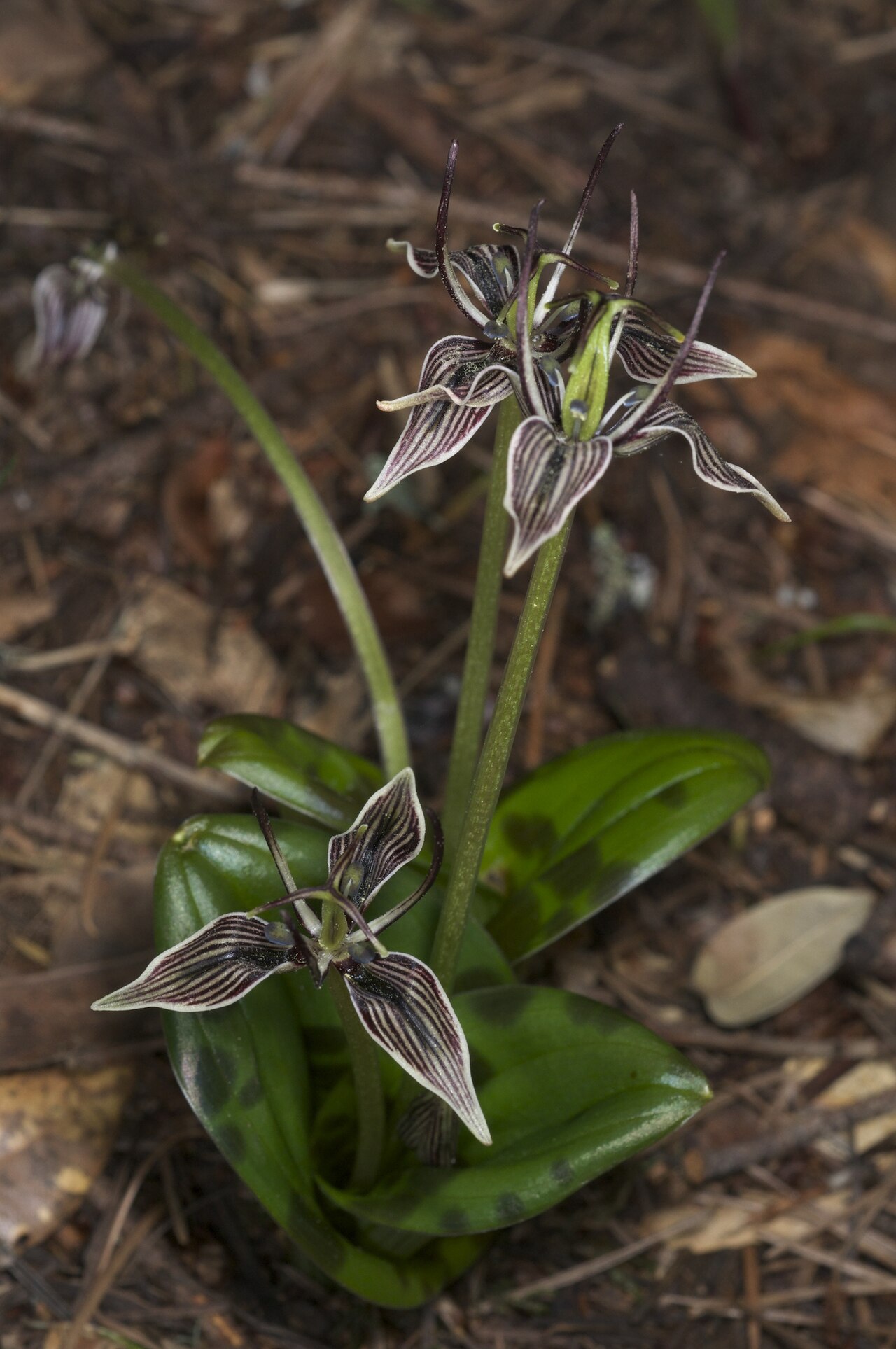
Scoliopus bigelovii, the California Fetid Adderstongue, also called Bigelow’s adderstongue, slinkpod or brownies, is a small, early-blooming lily of the coast redwood forests of northern California. In the darkest weeks of winter, often from January to March, it opens strange and beautiful flowers just above the forest floor: three broad, pale sepals boldly striped with dark purple, and three slender, upright petals. The flowers have an unpleasant, carrion-like odor, which is the source of the “fetid” in its name.
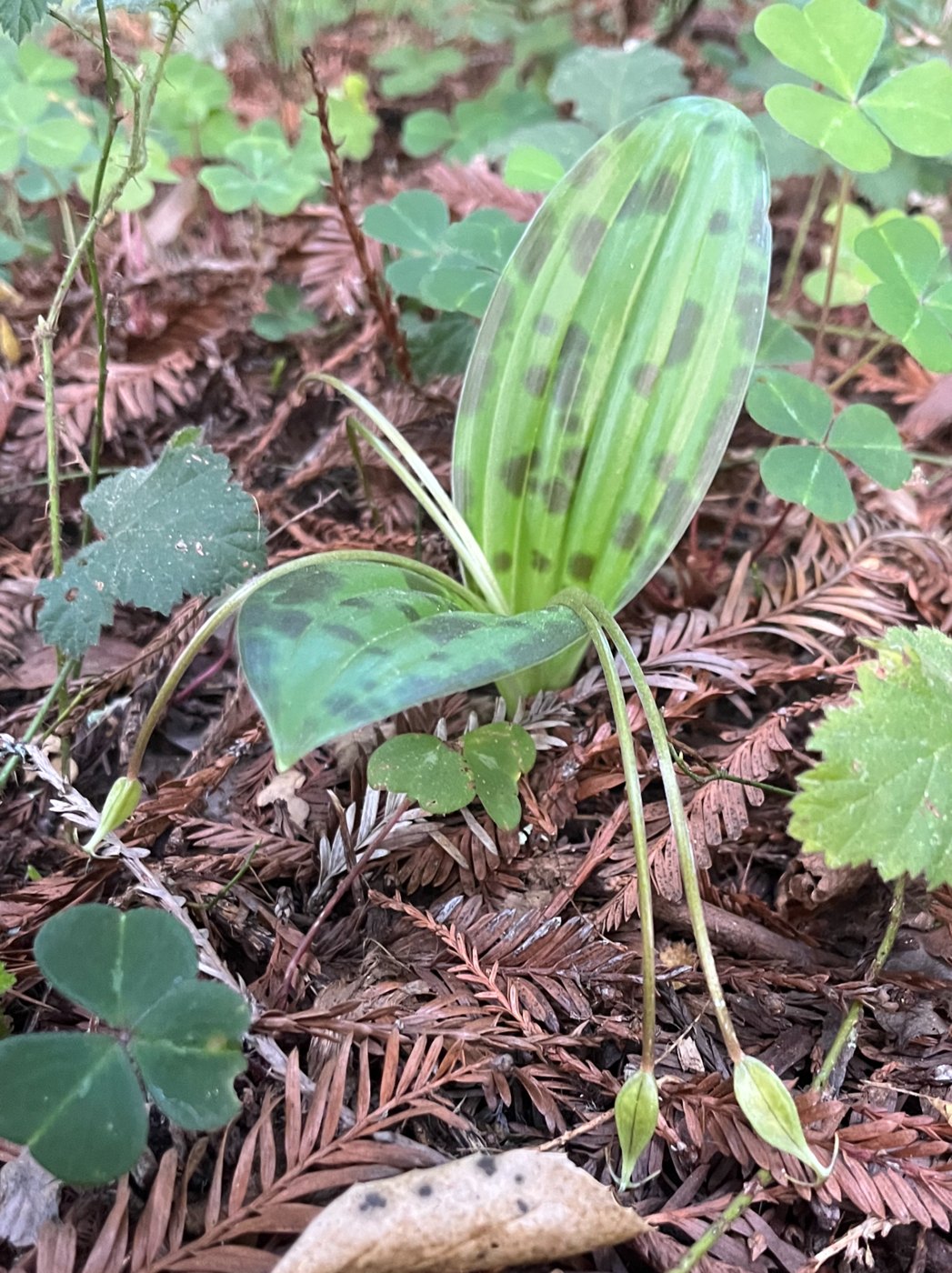
Its leaves are almost as striking as its flowers. Each plant usually has two broad, glossy leaves, up to about 9 inches long, mottled with dark green to purplish-brown blotches, rather like a trout lily. After flowering, the slender flower stalks bend and twist until the seed capsules rest on the ground, a habit that inspired both the genus name, from Greek words for “crooked foot,” and the folk name “slinkpod.”
This plant is found almost nowhere else on Earth: it is essentially endemic to California, with a single collection just over the Oregon border. It grows slowly, depends on cool, moist, undisturbed forest, and should never be dug from the wild. This guide covers how to identify it, where to see it, how it is pollinated and dispersed, and how to grow nursery-propagated plants responsibly.
Identification
California fetid adderstongue is unmistakable in flower. Out of flower it can be confused with trout lilies or young trilliums, but its two (sometimes three or four) mottled, parallel-veined basal leaves and its winter flowering time are distinctive.
Leaves
Plants grow from a short rhizome and produce usually two (occasionally three or four) basal leaves. The leaves are elliptic to oblong, up to about 9½ inches long and 4 inches wide, with several prominent parallel veins. They are green with darker green to purplish-brown mottling, and are smooth and somewhat glossy. They emerge in late fall or winter and fade by early summer.
Flowers
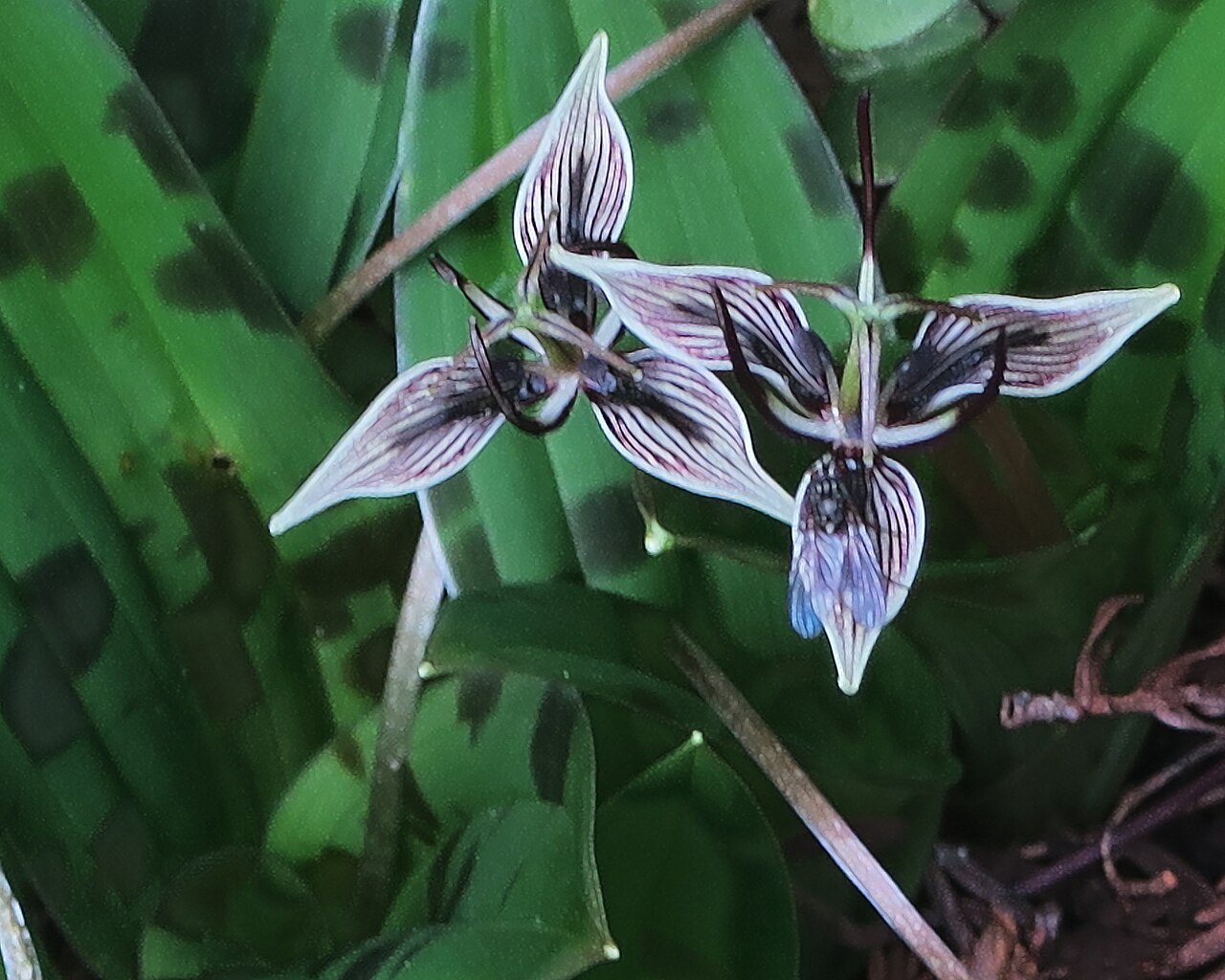
The flowers are borne in an umbel whose main stalk stays mostly underground, so 3 to 12 slender flower stalks appear to rise separately from between the leaves, each 4 to 8 inches tall and carrying a single flower. Each flower has three flat, spreading, pointed sepals, pale greenish to cream and striped or netted with dark purple, and three narrow, upright, fingerlike petals. There are three short stamens and a style with three long, curving branches. The flowers smell unpleasant, like carrion.
Fruit & Seeds
After flowering, the flower stalks bend, twist and droop until the three-angled capsules lie on the ground. The capsules ripen in spring and release seeds that are collected and dispersed by ants. Mature plants are long-lived; individuals in wild populations have been reported to live at least 20 years.
Look-alikes
The closely related Oregon fetid adderstongue (Scoliopus hallii) grows in Oregon and is generally smaller. Trout lilies (Erythronium) also have mottled leaves but bear nodding, lily-like flowers with six similar tepals. Western Trillium has three leaves in a whorl on a single stem.
Quick Facts
| Scientific Name | Scoliopus bigelovii |
| Family | Liliaceae (lily family) |
| Plant Type | Herbaceous perennial from a short rhizome; winter-growing |
| Mature Height | 4–8 in |
| Mature Spread | 6–10 in |
| Growth Rate | Slow |
| Sun Exposure | Shade to part shade |
| Water Needs | Moderate; soil should stay moist in winter and spring |
| Soil Type | Moist, rich, humusy forest soil |
| Soil pH | About 5.0–6.5 (acidic) |
| Bloom Time | December–March, mainly January–February |
| Flower Color | Pale greenish to cream, striped with dark purple |
| Fall Color | None; leaves fade by early summer |
| Fruit | Three-angled capsule laid on the ground by the bending stalk |
| Deer Resistant | Unknown; slugs are the main pests |
| USDA Hardiness Zones | 8–10 (coastal climates) |
Native Range
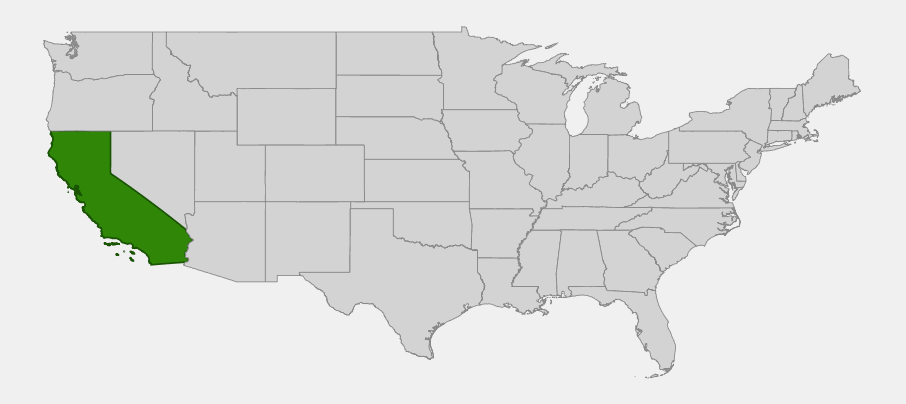
California fetid adderstongue has one of the smallest ranges of any plant featured on this site. USDA PLANTS lists it only in California, where it grows in the Coast Ranges within about 50 miles of the Pacific Ocean, from the Santa Cruz Mountains through the San Francisco Bay Area and Marin County north through the North Coast Ranges to Humboldt County. The Lady Bird Johnson Wildflower Center gives its range as Humboldt to Santa Cruz counties.
It has also been collected once in Curry County, Oregon, within a few miles of the California border, but it is essentially a California endemic. Within its range it is closely tied to the coast redwood forest and grows in moist, shaded, often mossy places on slopes and along streams below about 1,500 feet.
Typical companions include coast redwood, tanoak, bigleaf maple, California bay laurel and Douglas-fir, along with redwood sorrel, sword fern and western trillium on the forest floor. Research has found that it is sensitive to logging and other disturbances, which reduce the shade, moisture and stable soil it depends on.
📋 Regional plant lists featuring California Fetid Adderstongue: California & Nevada
Growing & Care Guide
California fetid adderstongue is a plant for collectors of unusual woodland plants and for gardeners within or near its native range who can provide cool, moist shade. Never dig plants from the wild. Wild populations are slow to grow and sensitive to disturbance, and collected plants rarely establish. Look for nursery-propagated plants from native plant nurseries and botanic garden sales.
Light
Grow it in shade or part shade, ideally under tall trees that provide cool, filtered light, as in a redwood forest. Direct sun dries and scorches the leaves.
Soil & Water
It needs moist, rich, well-drained soil with plenty of organic matter, such as a woodland soil topped with leaf litter. Keep the soil moist during its winter and spring growing season. In summer, when the leaves die back, it tolerates drier conditions but should not be baked or completely dried out; in coastal gardens, occasional summer water under a mulch of leaf litter works well.
Planting Tips
Plant nursery-grown rhizomes or potted plants in fall, at the start of the rainy season, in a sheltered, shady spot. Place them where they can be seen up close, such as along a woodland path, among ferns, redwood sorrel and wild ginger. The Lady Bird Johnson Wildflower Center notes that the plant needs protection from slugs, which can destroy the emerging leaves and flowers.
Pruning & Maintenance
Little care is needed. Let the leaves die back naturally in early summer, and leave fallen leaves and needles in place as a natural mulch. Control slugs and snails during the growing season. Avoid disturbing the soil around established plants.
Propagation
Propagate by seed or by division of the short rhizome, as the Lady Bird Johnson Wildflower Center recommends. Sow fresh seed in a shaded, moist, humusy mix outdoors; seedlings grow slowly and may take several years to flower. Divide established clumps carefully in fall while dormant. Propagate only from garden plants or legally obtained seed.
Landscape Uses
- Woodland and shade gardens: a rare winter-blooming curiosity for cool, moist shade near the coast
- Redwood and fern gardens: with redwood sorrel, sword fern and western trillium
- Native plant and botanical collections: a distinctive California endemic for specialist growers
- Education and interpretation: a vivid example of fly pollination and ant seed dispersal
- Where to see it: redwood parks of the Santa Cruz Mountains, Marin County and the North Coast in winter
Wildlife & Ecological Value
California fetid adderstongue has an unusual ecological story: its winter flowers are pollinated by small flies, and its seeds are carried off and planted by ants.
For Pollinators
The flowers bloom in winter, mainly January and February, when few other plants are in flower and bees are inactive. Their carrion-like odor and dark-striped sepals attract fungus gnats, small flies whose larvae live in moist soil and fungi. Studies have identified fungus gnats in the genera Mycetophila, Sciara and Corynoptera as its pollinators, and carrion flies also visit.
For Birds
The plant has little direct value for birds, but it is part of the rich forest-floor plant community of redwood forests, which support many birds.
For Mammals
It is of little importance to mammals. Slugs and snails, rather than mammals, are its main herbivores.
Ecosystem Role
As the fruit stalks bend, the capsules are delivered to the forest floor, where ants carry the seeds away in late spring, a process called myrmecochory. Ant species recorded doing this include Formica fusca and Aphaenogaster subterranea. This dispersal moves seeds short distances to suitable spots and helps explain why the plant is patchy and slow to spread. Its sensitivity to logging and disturbance makes it an indicator of intact, shaded redwood forest.
Cultural & Historical Uses
The species was first collected by John Milton Bigelow, a physician and botanist on the Whipple railroad survey expedition of the 1850s, at a place he called “Tamul Pass,” today’s Mount Tamalpais in Marin County. John Torrey described it in 1857 in the government’s Pacific Railroad Reports, naming it in Bigelow’s honor.
The genus name Scoliopus combines Greek words for “crooked” and “foot,” referring to the bending, twisting fruit stalks. The common name “adderstongue” probably refers to the narrow, tongue-like petals and mottled leaves, which recall the trout lilies sometimes called adder’s tongue. “Slinkpod” describes the way the seed pods slink down to the ground.
For many visitors to the redwood parks around San Francisco Bay, finding fetid adderstongue in bloom is a winter tradition: a reminder that even in the coldest, darkest part of the year, something is flowering on the forest floor. Enjoy it where it grows, and leave it in place.
Frequently Asked Questions
Why is it called fetid adderstongue?
“Fetid” refers to the unpleasant, carrion-like smell of its flowers, which attracts the small flies that pollinate it. “Adderstongue” probably refers to its narrow, tongue-like petals and mottled leaves.
When and where can I see it in bloom?
Look in moist, shaded redwood forests from Santa Cruz County to Humboldt County, California, mainly from January to March. Parks in the Santa Cruz Mountains and around Mount Tamalpais are good places to find it.
Can I dig it up for my garden?
No. Never collect it from the wild. It grows slowly, its populations are sensitive to disturbance, and wild plants rarely survive transplanting. Buy nursery-propagated plants or grow it from legally obtained seed.
How is it pollinated?
Its winter flowers are pollinated mainly by fungus gnats attracted by the odor and markings. After flowering, the stalks lay the seed capsules on the ground, and ants carry the seeds away.
Is it found outside California?
Essentially no. Apart from a single collection just over the Oregon border in Curry County, it is endemic to the coastal forests of northern and central California.

Looking for a nursery that carries California Fetid Adderstongue?
Browse our native plant nursery directory: California