
Snow-on-the-Prairie (Euphorbia bicolor)
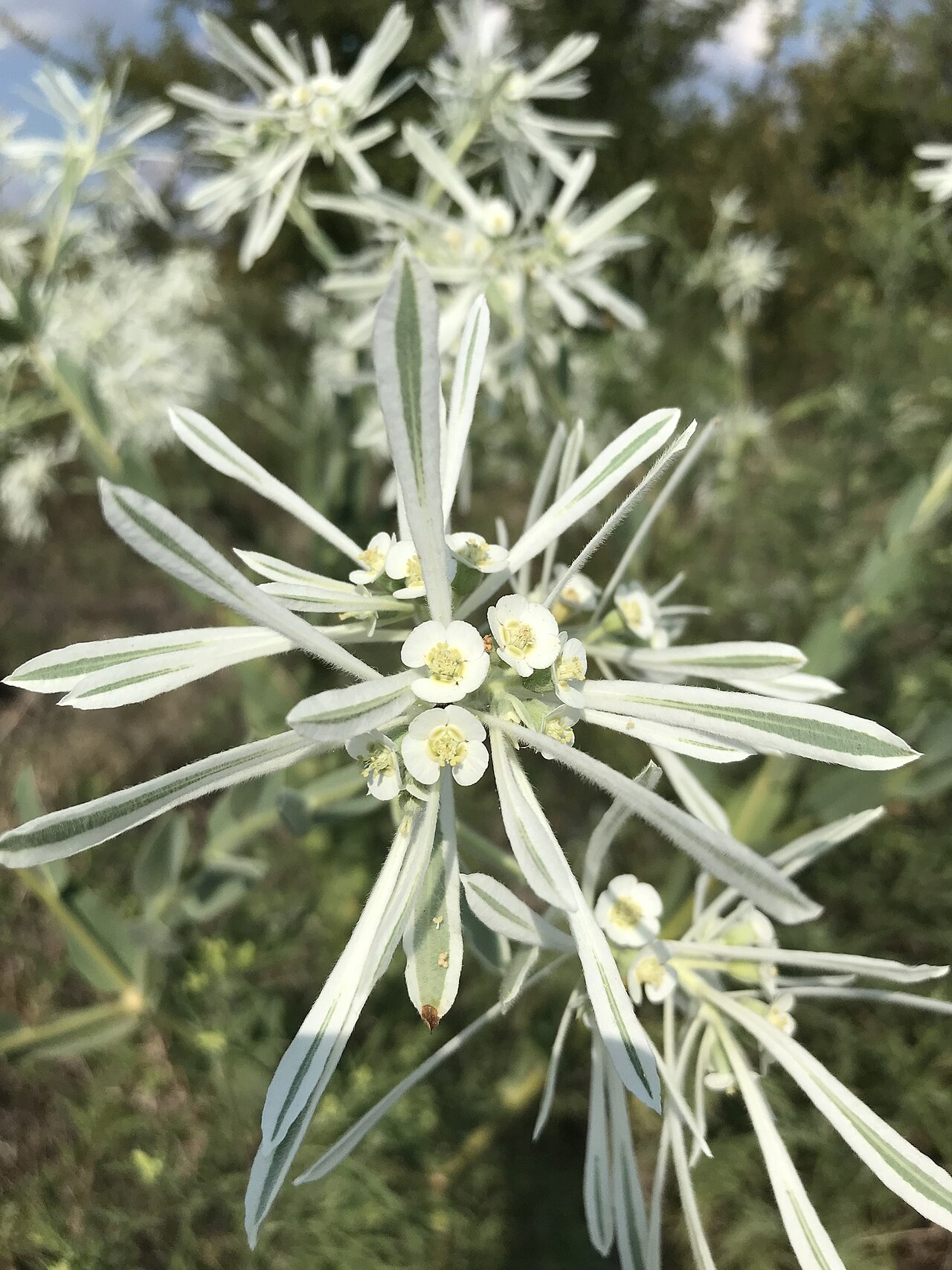
Euphorbia bicolor, known as Snow-on-the-Prairie (USDA: snow on the prairie), is a showy native annual of the south-central United States. It belongs to the spurge family (Euphorbiaceae) and is a close relative of the better-known Snow-on-the-Mountain. It grows 1 to 4 feet tall, with a single, softly hairy stem that branches near the top into a broad, flat-topped crown.
From midsummer to fall, the upper leaves become long, narrow bracts 2 to 4 inches long, each edged with a broad band of white. Clustered around the tiny white flowers, they create a frosty, starburst effect, and where the plant grows in dense colonies it can make whole pastures and roadsides look dusted with snow in the heat of late summer. The true flowers are small cups with white, petal-like glands.
Snow-on-the-prairie is most common on the heavy clay soils of the Blackland Prairie and other prairies of Texas, Oklahoma, Arkansas and Louisiana. It is a striking plant for large, informal prairie plantings. Safety note: like other spurges, it has a milky latex sap that is toxic if eaten and can severely irritate the skin and eyes. Wear gloves when handling it and keep it away from children and pets.
Identification
In late summer snow-on-the-prairie is easy to spot by its white-edged upper leaves. The key to telling it from snow-on-the-mountain is the shape of those upper leaves and bracts.
Stems & Growth Habit
It is an annual that grows from seed each spring, with a single stout stem 1 to 4 feet tall that is covered in soft, spreading hairs. The stem branches repeatedly near the top in groups of three, forming an umbrella-shaped crown. All parts ooze white, milky latex when broken.
Leaves
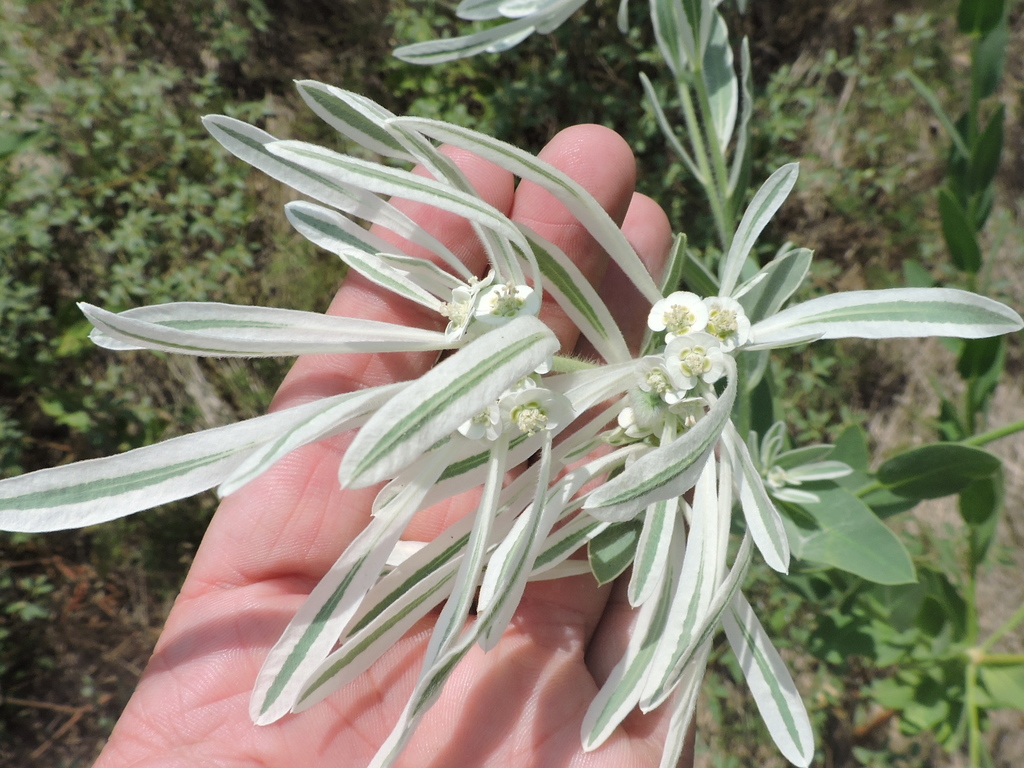
The lower leaves are alternate, oblong to lance-shaped, 1 to 1 1/4 inches long, all green and set close to the stem. Toward the top the leaves become much longer and narrower, 2 to 4 inches long, linear to narrowly lance-shaped and arranged in whorls, with a broad white margin. The leaves are softly hairy and have a slightly silvery look.
Flowers
From about July to October, tiny flower clusters (cyathia) form at the branch tips. Each cluster is a small cup holding many male flowers, each just a single stamen, and one female flower. The rim of the cup has white, petal-like appendages, so each cluster looks like a small white flower about 1/4 inch across.
Fruit & Seeds
The female flower develops into a hairy, three-lobed capsule about 1/4 inch wide on a short stalk. When ripe it splits explosively, flinging out three rounded, gray to brown seeds. Seeds fall near the parent plant and germinate the next spring.
Look-alikes
Snow-on-the-Mountain (Euphorbia marginata) is very similar but has broader, oval upper leaves and bracts, and its range extends north through the Great Plains. Snow-on-the-prairie has longer, narrower, more strap-like white-edged bracts, and its stems and capsules are usually more hairy. Its range is concentrated farther south and east.
Safety Note
The milky sap is toxic and irritating. On skin it can cause redness, itching and blisters, especially in sunlight, and in the eyes it can cause intense pain and temporary blindness. Eating any part of the plant can cause vomiting and diarrhea. Wear gloves and long sleeves when handling it, never touch your eyes afterward, and keep it away from children, pets and livestock. Livestock generally avoid it.
Quick Facts
| Scientific Name | Euphorbia bicolor |
| Family | Euphorbiaceae (spurge family) |
| Plant Type | Warm-season annual wildflower |
| Mature Height | 1–4 ft |
| Mature Spread | 1–2 ft |
| Growth Rate | Fast |
| Sun Exposure | Full sun to part shade |
| Water Needs | Low to medium; tolerates dry and moist soils |
| Soil Type | Heavy clay, clay loam, loam; poor soils |
| Soil pH | About 6.0–8.5 |
| Bloom Time | July–October |
| Flower Color | White (white-edged bracts, tiny white flowers) |
| Fall Color | None; annual, dies after seeding |
| Fruit | Hairy three-lobed capsule; toxic sap |
| Deer Resistant | Yes; toxic sap deters browsing |
| USDA Hardiness Zones | Annual; grows where zones 7–9 occur |
Native Range
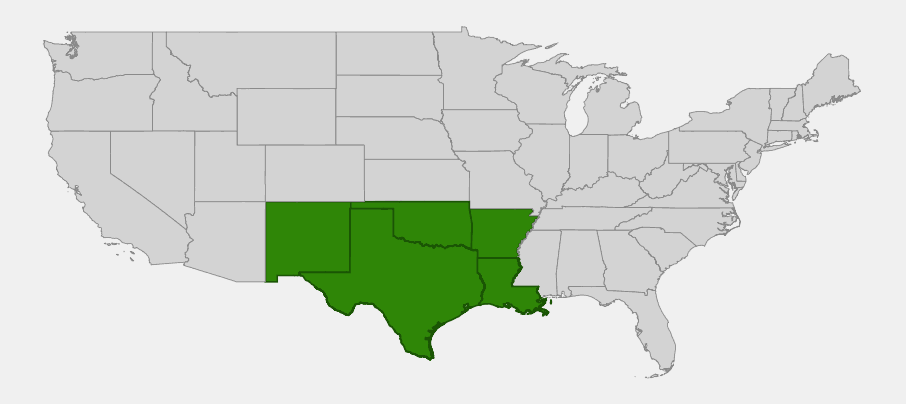
Snow-on-the-prairie has a small native range centered on the south-central United States. USDA PLANTS records it in five states: Texas, Oklahoma, Arkansas, Louisiana and New Mexico. It is most abundant in the eastern half of Texas, especially on the Blackland Prairie from the Dallas-Fort Worth area south through Temple to the Coastal Prairie near Houston, and in southeastern Oklahoma, southern Arkansas and western Louisiana.
The New Mexico record is an outlying one, far west of the main range. NatureServe considers the species uncommon in Louisiana, at the eastern edge of its range. Outside these states it occasionally appears in gardens and along roads, but it is not established elsewhere as a native.
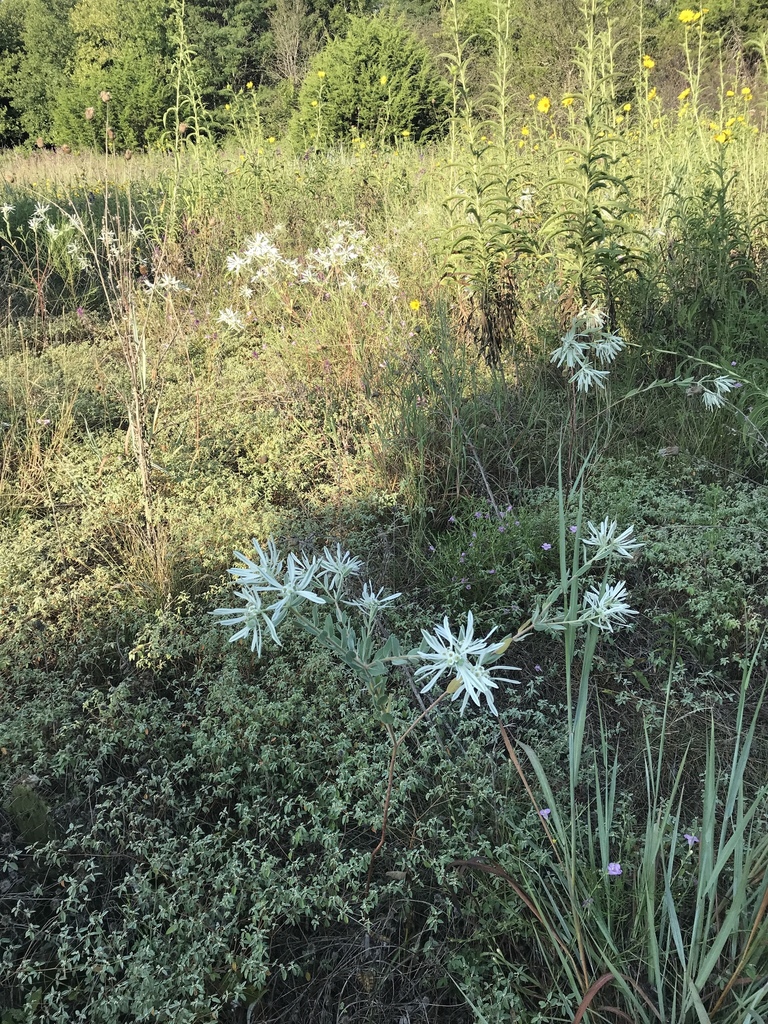
It grows on prairies, pastures, rangelands, old fields, roadsides, railways and the edges of woods, usually on heavy clay or clay loam soils. It favors open, sunny ground and often increases after soil disturbance, with large colonies forming in years with good spring rain.
📋 Regional plant lists featuring Snow-on-the-Prairie: Arkansas, Louisiana, Eastern Oklahoma & Eastern Texas
Growing & Care Guide
The Lady Bird Johnson Wildflower Center notes that snow-on-the-prairie is rarely sold commercially but would be an excellent plant for large areas with poor soils. It is easy to grow from seed, adapts to both dry and wet years, and can form extensive colonies. Because of its irritating sap, plant it where people and pets will not brush against it.
Light
Full sun is best and produces the fullest, whitest plants. It tolerates part shade at woodland edges but becomes taller and thinner.
Soil & Water
It grows naturally in hard clay soils and does well in heavy clay, clay loam and lean, unimproved ground. It needs no fertilizer. It tolerates both drought and wet periods, though it grows tallest and fullest after a wet spring.
Planting Tips
Sow seed directly in the fall or early spring where you want it to grow; seedlings do not transplant well. Scatter seed on bare soil and rake it in lightly. It looks best in drifts in a large meadow, prairie planting or roadside, mixed with native grasses that support the tall stems. Keep it away from paths, play areas and vegetable gardens because of the toxic sap.
Pruning & Maintenance
No pruning is needed. Wear gloves and eye protection if you must cut or pull it, since the sap is irritating. Let plants set seed if you want them to return next year; remove them before the capsules ripen if you do not want them to spread.
Propagation
Grow it from seed. Collect the capsules as they begin to dry in fall, placing them in a paper bag because they split open and fling their seeds. Sow outdoors in fall for natural winter stratification. Plants self-sow readily in open ground.
Landscape Uses
- Prairie and meadow plantings: late-summer white color in large drifts
- Roadside and rangeland restoration: a native annual for heavy clay soils
- Poor-soil sites: thrives in hard, unimproved clay where many plants struggle
- Pollinator plantings: late-season nectar for bees, wasps and flies
- Naturalistic landscapes: a frosty contrast to native grasses in late summer
Wildlife & Ecological Value
Snow-on-the-prairie blooms in the heat of late summer and fall, when nectar is often scarce on southern prairies.
For Pollinators
The small flowers produce nectar from glands on the rim of each flower cup, attracting many small bees, wasps, flies and butterflies. Its long bloom season in late summer and fall makes it a useful late-season nectar source.
For Birds
Seed-eating birds such as mourning doves and quail eat spurge seeds, and the plants provide some cover in open grasslands.
For Mammals
The toxic, irritating sap deters most mammals. Cattle, deer and other grazers generally avoid it, which is why it can become abundant in pastures.
Ecosystem Role
As a native annual of prairies and disturbed ground, it fills open spaces after disturbance, then gives way to perennial grasses and wildflowers. Its late bloom supports insects that feed on nectar and pollen when many prairie flowers have finished.
Cultural & Historical Uses
The species name bicolor means “two-colored,” for the green and white leaves. Snow-on-the-prairie and its relative snow-on-the-mountain are among the few native North American spurges grown as ornamentals, and snow-on-the-mountain is widely sold in seed mixes. Snow-on-the-prairie remains mostly a plant of wild prairies and roadsides.
Spurges get their name from an old word meaning “to purge,” because many species were used as strong laxatives, often with dangerous results. The milky latex of snow-on-the-prairie and its relatives has a long history of causing skin irritation in people who handle the plants, and ranchers in Texas have long known to avoid it.
In late summer, roadside stands of snow-on-the-prairie are a familiar sight in Central and East Texas, where they whiten fields and highway rights-of-way. It is valued by native plant enthusiasts as a signature plant of the Blackland Prairie, one of the most endangered grassland ecosystems in North America.
Frequently Asked Questions
Is snow-on-the-prairie poisonous?
Yes. The milky sap is toxic if eaten and can cause painful skin irritation and blisters and serious eye injury. Wear gloves and eye protection when handling it, and keep it away from children and pets.
How is snow-on-the-prairie different from snow-on-the-mountain?
Snow-on-the-prairie has long, narrow, strap-like upper leaves with white margins, while snow-on-the-mountain has broader, oval upper leaves. Snow-on-the-prairie grows mainly in Texas and nearby states; snow-on-the-mountain ranges north through the Great Plains.
Is snow-on-the-prairie a perennial?
No. It is an annual that grows from seed each spring, blooms from midsummer to fall and dies after setting seed.
Where can I see snow-on-the-prairie?
In late summer and fall along roadsides, pastures and prairies in eastern and central Texas, southeastern Oklahoma, southern Arkansas and western Louisiana, especially on heavy clay soils.
Can I grow snow-on-the-prairie in my garden?
Yes, from seed sown directly in fall or early spring in full sun. It is best in large, informal meadow plantings away from paths because of its irritating sap.

Looking for a nursery that carries Snow-on-the-Prairie?
Browse our native plant nursery directory: Arkansas · Louisiana · New Mexico & Oklahoma · Texas