
Southern Annual Saltmarsh Aster (Symphyotrichum divaricatum)
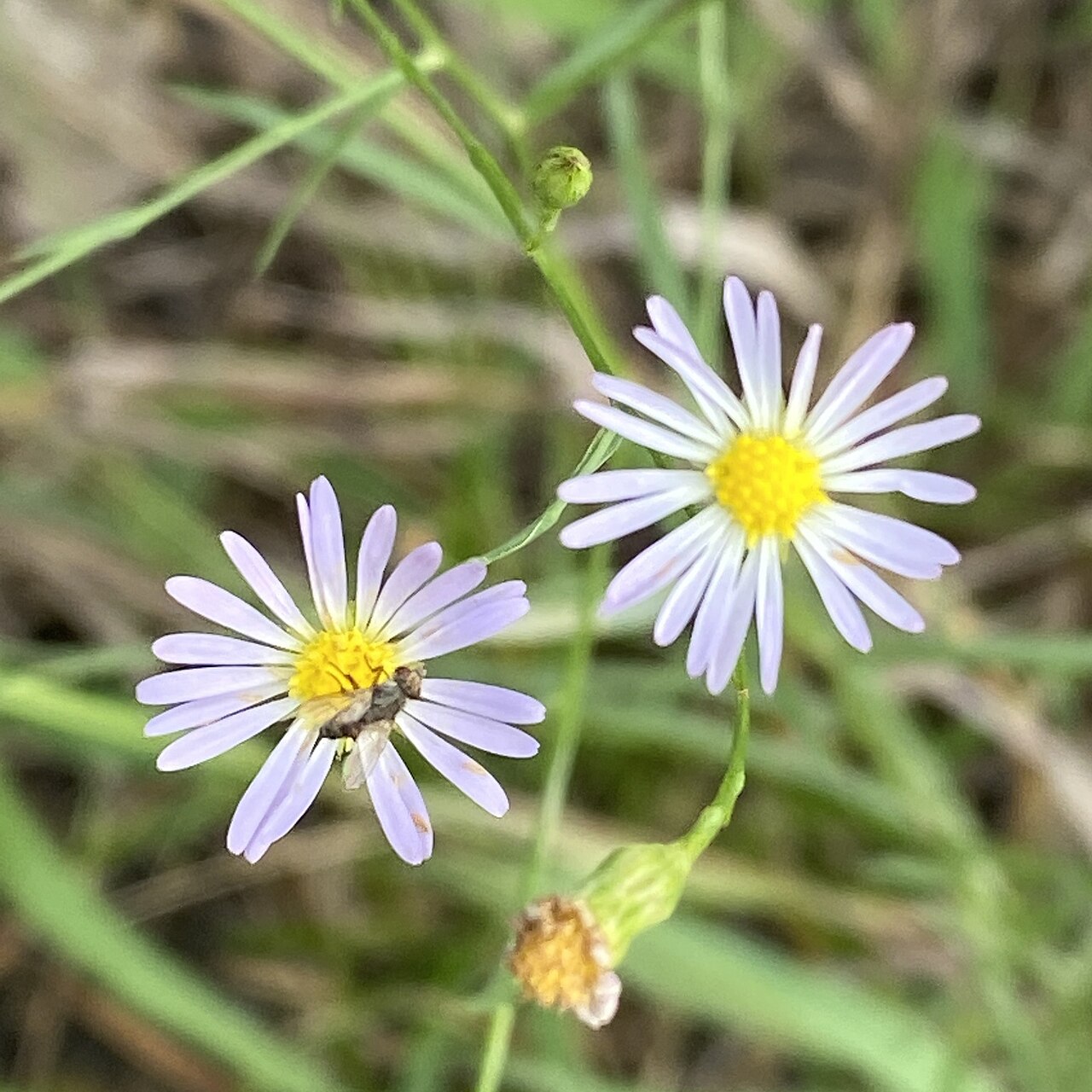
Symphyotrichum divaricatum, known as Southern Annual Saltmarsh Aster, southern annual aster or “yard aster,” is a slender annual aster of the southern United States and northern Mexico. Despite its name, it is not limited to salt marshes. It grows in fresh and brackish marsh edges, wet ditches, pond margins, roadsides, lawns, fields and almost any open, moist, disturbed ground, and in Texas it often appears by the thousands in lawns and vacant lots in fall.
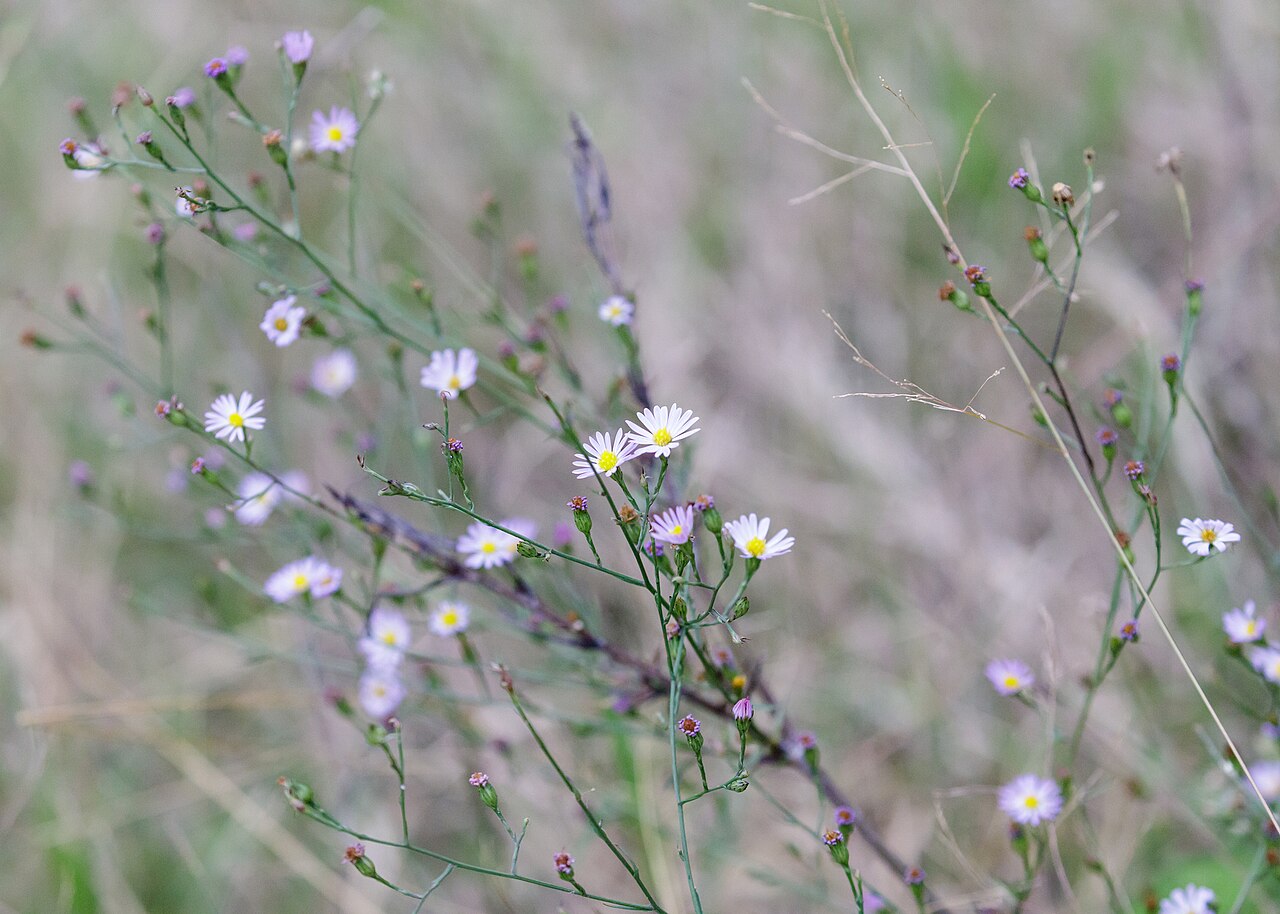
Plants are smooth and hairless, usually 1 to 3 feet tall (sometimes much taller in rich, wet soil), with narrow leaves and stiff, widely spreading branches. From late summer into late fall, and sometimes into winter in the far South, they carry clouds of small flower heads about half an inch across, with many narrow lavender, pale blue or white rays around a yellow center. As the heads age, the rays curl up into tight coils.
This species was long treated as a variety of the eastern annual saltmarsh aster (Symphyotrichum subulatum var. ligulatum) and has also been called Aster divaricatus (Nutt.) Torr. & A. Gray. That old name is easily confused with Aster divaricatus L., the white wood aster (now Eurybia divaricata), an entirely different woodland plant. This guide covers how to identify it, where it grows and how to use it in informal, wildlife-friendly plantings.
Identification
Look for a smooth, wiry annual with narrow leaves, widely spreading branches and many small, lavender-to-white daisy heads in late summer and fall, often in lawns, ditches and other moist, disturbed places.
Stems & Growth Habit
Southern annual saltmarsh aster grows from a taproot as a single main stem that branches widely in its upper half. Plants are usually 1 to 3 feet tall but range from a few inches in mowed lawns to over 6 feet in wet, fertile ground. The stems are green, often with purple or brownish areas, and are hairless. Mowed plants can still bloom, forming low mats of short stems.
Leaves
Leaves are alternate, thin, green to dark green and hairless. Lower leaves are narrowly lance-shaped and up to about 6 inches long; they often wither by flowering time. Upper leaves are much smaller, narrow and linear, becoming tiny and bract-like on the flowering branches. Leaf edges are smooth or have a few small teeth.
Flowers
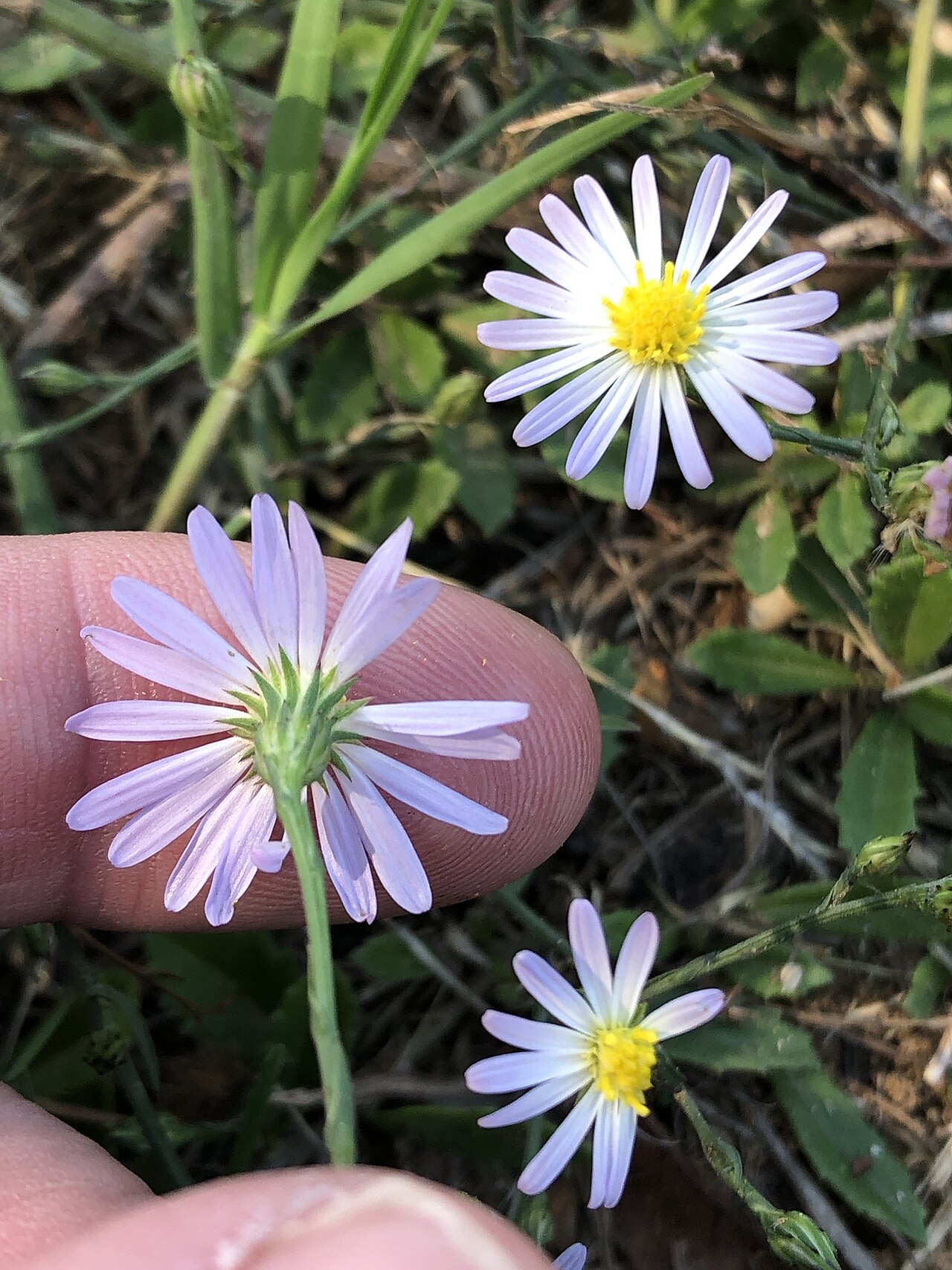
The flower heads are about 1/3 to 2/3 inch across and are produced in large numbers on the spreading branches. Each has roughly 20 to 30 narrow ray florets, lavender, pale blue, pinkish or white, which clearly extend past the bracts, around a yellow disk that turns reddish-brown with age. Beneath each head are several overlapping rows of narrow, pointed, green-tipped bracts. As the heads dry after flowering, each ray curls under into several tight coils. Bloom runs mostly from about August through November, sometimes starting in July and continuing into winter in mild areas.
Fruit & Seeds
Each floret produces a tiny, ribbed seed (cypsela) topped by a tuft of soft, white bristles (pappus). The fluffy seed heads open in late fall and the seeds are carried by wind, which helps the plant quickly colonize bare, moist ground.
Look-alikes
Eastern annual saltmarsh aster (Symphyotrichum subulatum) of Atlantic and Gulf Coast salt and brackish marshes has tiny rays that barely extend beyond the pappus. Bushy asters such as frost aster (Symphyotrichum pilosum) are perennials, often hairy, with white rays and many small leaves on the branches. Fleabanes (Erigeron) bloom mostly in spring and have very fine, thread-like rays. The white wood aster (Eurybia divaricata) shares an old scientific name but is a perennial woodland plant with heart-shaped leaves.
Quick Facts
| Scientific Name | Symphyotrichum divaricatum |
| Family | Asteraceae (aster family) |
| Plant Type | Annual (sometimes biennial) wildflower |
| Mature Height | 1–3 ft (occasionally to 6 ft) |
| Mature Spread | 1–2 ft |
| Growth Rate | Fast |
| Sun Exposure | Full sun |
| Water Needs | Medium to high |
| Soil Type | Moist to wet clay, loam, silt or sand; tolerates some salt |
| Soil pH | About 6.0–8.5 |
| Bloom Time | August–November (sometimes July to winter) |
| Flower Color | Lavender, pale blue or white rays with yellow centers |
| Fall Color | Stems often purplish |
| Fruit | Tiny seeds with fluffy white pappus |
| Deer Resistant | Moderate |
| USDA Hardiness Zones | 6–10 (annual) |
Native Range
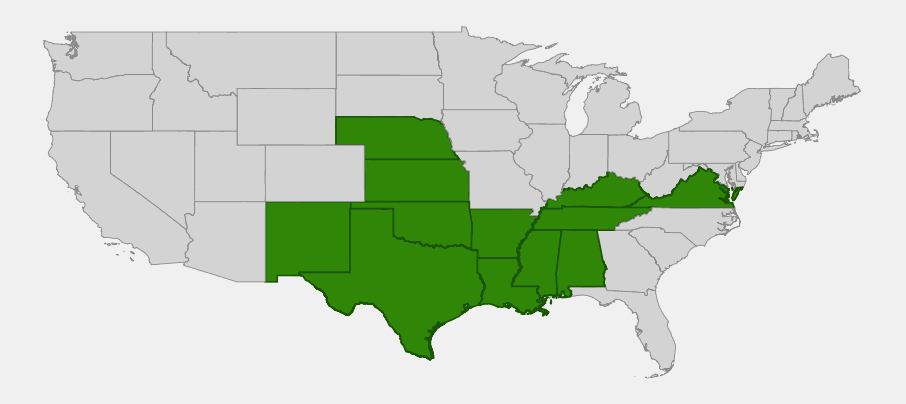
Southern annual saltmarsh aster is native to the south-central and southeastern United States and northern Mexico. USDA PLANTS lists it in Alabama, Arkansas, Kansas, Kentucky, Louisiana, Mississippi, Missouri, Nebraska, New Mexico, Oklahoma, Tennessee, Texas and Virginia. NatureServe treats it as exotic in Missouri, so Missouri is left off the map here. In Mexico it grows in Baja California Sur, Chihuahua, Coahuila and Tamaulipas. It has been introduced in New York and in parts of South America.
Its center of abundance is Texas and Oklahoma, where it is one of the most common fall asters in towns and countryside alike, from the Gulf Coast and South Texas to the Edwards Plateau, the Cross Timbers and the Trans-Pecos. It is also widespread in Louisiana, Arkansas and the lower Mississippi Valley, and it extends north through Kansas and Nebraska. Populations in Kentucky, Tennessee, Alabama and Virginia are more scattered and are often found along roads, rivers and other disturbed corridors.
It grows from near sea level to about 4,900 feet (1,500 m), in fresh and brackish marsh edges, wet prairies, stream and pond margins, ditches, playas, roadsides, lawns, pastures, fields and vacant lots. It tolerates moderately salty soils, which is how it earned its common name, and it is often described as weedy because it moves so readily into disturbed ground.
📋 Regional plant lists featuring Southern Annual Saltmarsh Aster: Kentucky & Tennessee · Nebraska, Kansas & Eastern Colorado · Maryland, Virginia & West Virginia · Alabama, Georgia & Mississippi · Arkansas, Louisiana, Eastern Oklahoma & Eastern Texas · South & West Texas
Growing & Care Guide
Southern annual saltmarsh aster is seldom planted on purpose, but it is worth welcoming where it appears on its own. It is a low-maintenance source of late-season flowers for pollinators in lawns, rain gardens, ditches and wild corners. As a weedy annual that reseeds freely, it suits informal, naturalistic plantings rather than tidy borders. If you want it, the easiest approach is often to let existing plants go to seed or to mow around a patch in late summer.
Light
Full sun. It tolerates light shade but becomes lanky and flowers less.
Soil & Water
It does best in moist to wet soil and tolerates clay, compacted ground, periodic flooding and somewhat salty conditions. It also survives drier spells, especially in lawns where it stays small. Fertilizer is not needed.
Planting Tips
Scatter fresh seed on bare, moist soil in fall or late winter, or simply allow volunteers to grow. In a “freedom lawn” or pollinator lawn, raise the mower height or skip mowing from late August through November so the plants can bloom. In rain gardens and detention basins, it can fill bare gaps among perennial plantings in its first years.
Pruning & Maintenance
No pruning is needed. Cut or mow the dead plants after the seeds have dispersed, or leave them standing for winter cover. Pull seedlings where you do not want them; they are shallow-rooted when young and come out easily.
Propagation
Grow it from seed. Collect the fluffy seed heads in late fall and sow the seeds on the soil surface without covering them deeply. Many seeds germinate in late winter and spring, and plants bloom the same year.
Landscape Uses
- Pollinator lawns and meadows: abundant late-season flowers when mowing is paused in fall
- Rain gardens and detention basins: tolerates wet, compacted and periodically flooded soil
- Ditches and roadside plantings: a tough native colonizer of moist, disturbed ground
- Brackish and coastal sites: tolerates moderate salinity near the Gulf Coast
- Wildlife corners: seeds and late flowers for insects and birds
Wildlife & Ecological Value
Because it blooms so late and so abundantly, southern annual saltmarsh aster is an important fall resource for insects, especially in urban areas where it fills lawns and empty lots.
For Pollinators
The small heads are visited by many insects, including small native bees, honey bees, wasps, flies and small butterflies such as skippers, sulphurs and hairstreaks. Its fall bloom overlaps with the monarch migration through Texas, and monarchs and other migrating butterflies sometimes nectar on it.
For Birds
Sparrows, finches and other small seed-eating birds eat the seeds in late fall and winter.
For Mammals
Rabbits and deer may browse the plants, but they are of little importance to mammals.
Ecosystem Role
As a fast-growing annual, it is one of the first plants to cover bare, moist ground after disturbance, helping to hold soil and providing late-season food for insects. Like other asters, it can host the caterpillars of several moths and of the pearl crescent butterfly, which feeds on asters.
Cultural & Historical Uses
The genus name Symphyotrichum comes from Greek words meaning “junction” and “hair,” a reference to the structure of the pappus bristles. The species name divaricatum means “spreading at a wide angle” and describes its widely forking branches. In the 1990s, most North American asters were moved from the genus Aster into Symphyotrichum and several other genera.
This plant was first described by Thomas Nuttall in the 1800s and later treated by many botanists as a variety of the coastal Symphyotrichum subulatum. It was raised back to species rank as Symphyotrichum divaricatum by the botanist Guy Nesom. Older references may call it Aster subulatus var. ligulatus, Aster exilis or Aster divaricatus (Nutt.) Torr. & A. Gray, which should not be confused with the white wood aster, Aster divaricatus L.
In Texas, where it often fills mowed lawns in fall, it is popularly known as “yard aster.” For many people there, it is the first wild aster they learn to recognize, blooming right outside the door.
Frequently Asked Questions
Does southern annual saltmarsh aster only grow in salt marshes?
No. It tolerates some salt, but it grows mainly in freshwater wetlands, ditches, roadsides, lawns, fields and other moist, disturbed places across the southern Great Plains and the South.
Is it the same as white wood aster (Aster divaricatus)?
No. One old name for this plant, Aster divaricatus (Nutt.) Torr. & A. Gray, looks like the name of the white wood aster, Aster divaricatus L. (now Eurybia divaricata), but they are completely different species.
Is southern annual saltmarsh aster a weed?
It is native but often weedy, since it quickly colonizes lawns and disturbed ground. Many gardeners welcome it for its late flowers and value to pollinators, especially in informal areas.
When does it bloom?
Mostly from August through November, sometimes from July and into winter in mild areas.
How is it different from eastern annual saltmarsh aster?
Eastern annual saltmarsh aster (Symphyotrichum subulatum), found mainly in coastal salt and brackish marshes, has tiny rays that barely show beyond the bristly pappus. Southern annual saltmarsh aster has longer, more obvious rays and grows widely inland.

Looking for a nursery that carries Southern Annual Saltmarsh Aster?
Browse our native plant nursery directory: Alabama & Arkansas · Kansas · Kentucky, Louisiana & Mississippi · Nebraska, New Mexico & Oklahoma · Tennessee, Texas & Virginia