
Clasping Milkweed (Asclepias amplexicaulis)
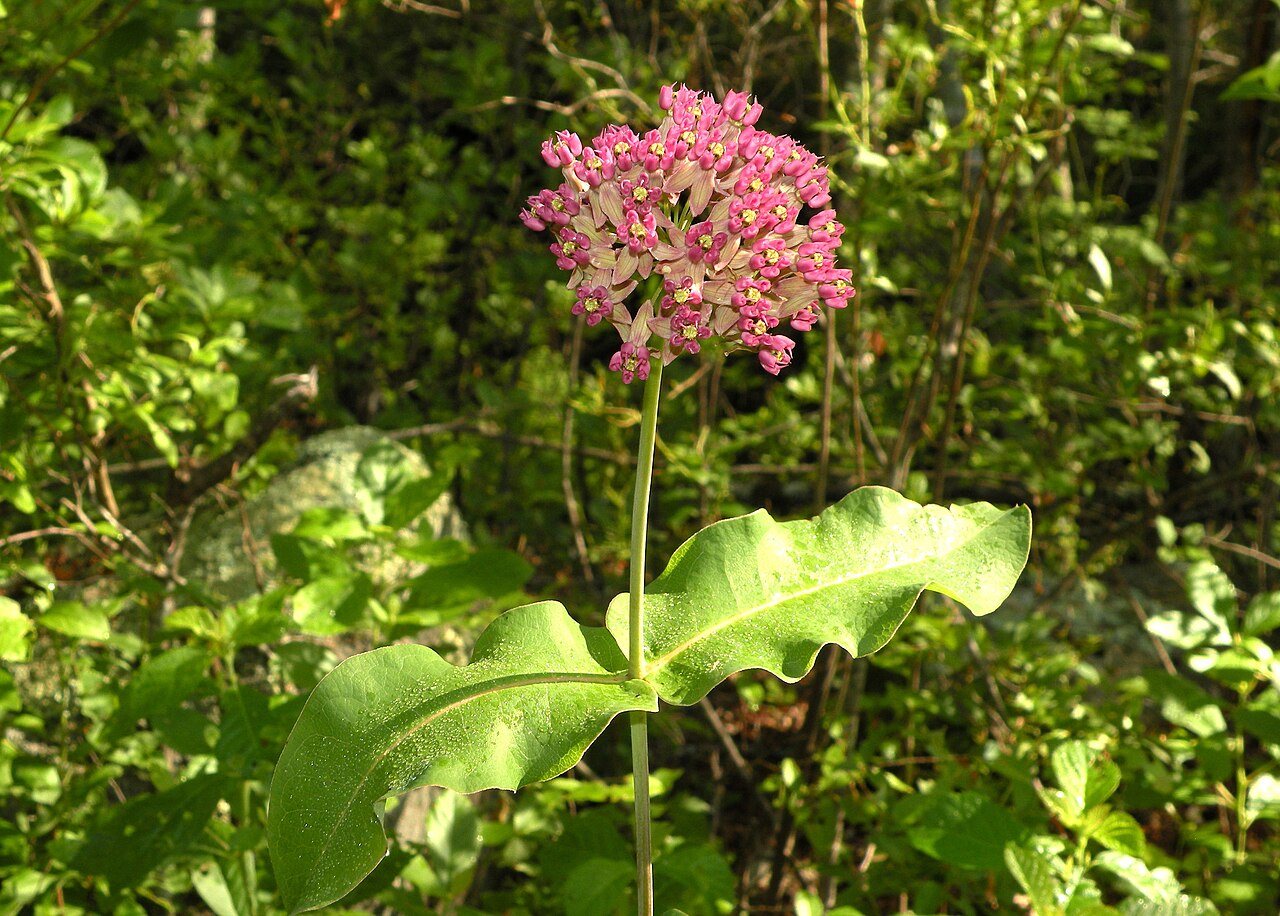
Asclepias amplexicaulis, known as Clasping Milkweed (also blunt-leaved milkweed or sand milkweed), is a native milkweed of dry, sandy, open ground across the eastern and central United States. It belongs to the dogbane family (Apocynaceae), which now includes the former milkweed family (Asclepiadaceae).
It is easy to recognize: a single, smooth, bluish-green stem 1 to 3 feet tall with pairs of broad, blunt, strongly wavy-edged leaves that wrap around (clasp) the stem, and usually just one rounded cluster of fragrant, pinkish-purple to greenish flowers held up on a long stalk at the top. It blooms in late spring and early summer in sand prairies, oak and pine barrens, open sandy woods, old fields and roadsides.
Like other milkweeds, it is a host plant for monarch butterfly caterpillars and a strong nectar source for bees and butterflies. Safety note: all parts of the plant contain toxic cardiac glycosides (cardenolides) in a milky sap. Do not eat it, keep it away from livestock and pets that might graze it, and wash your hands after handling the sap, which can irritate the eyes.
Identification
Look for a single smooth stem with opposite, stalkless, blunt, very wavy leaves that clasp the stem, and one long-stalked ball of pinkish-purple flowers at the top, on dry sandy ground in late spring.
Stems & Habit
Clasping milkweed grows from a deep taproot and usually produces a single unbranched stem 1 to 3 feet tall. The stem is stout, smooth and often has a whitish, waxy bloom. Like all milkweeds, it oozes milky sap when broken.
Leaves
The leaves are in 2 to 5 opposite pairs, 3 to 6 inches long and 1 1/2 to 3 inches wide, oblong to oval with a blunt or rounded tip. They have no stalks and their heart-shaped bases clasp the stem. The leaves are thick, smooth, bluish green, often with a pinkish midrib, and their edges are conspicuously wavy.
Flowers
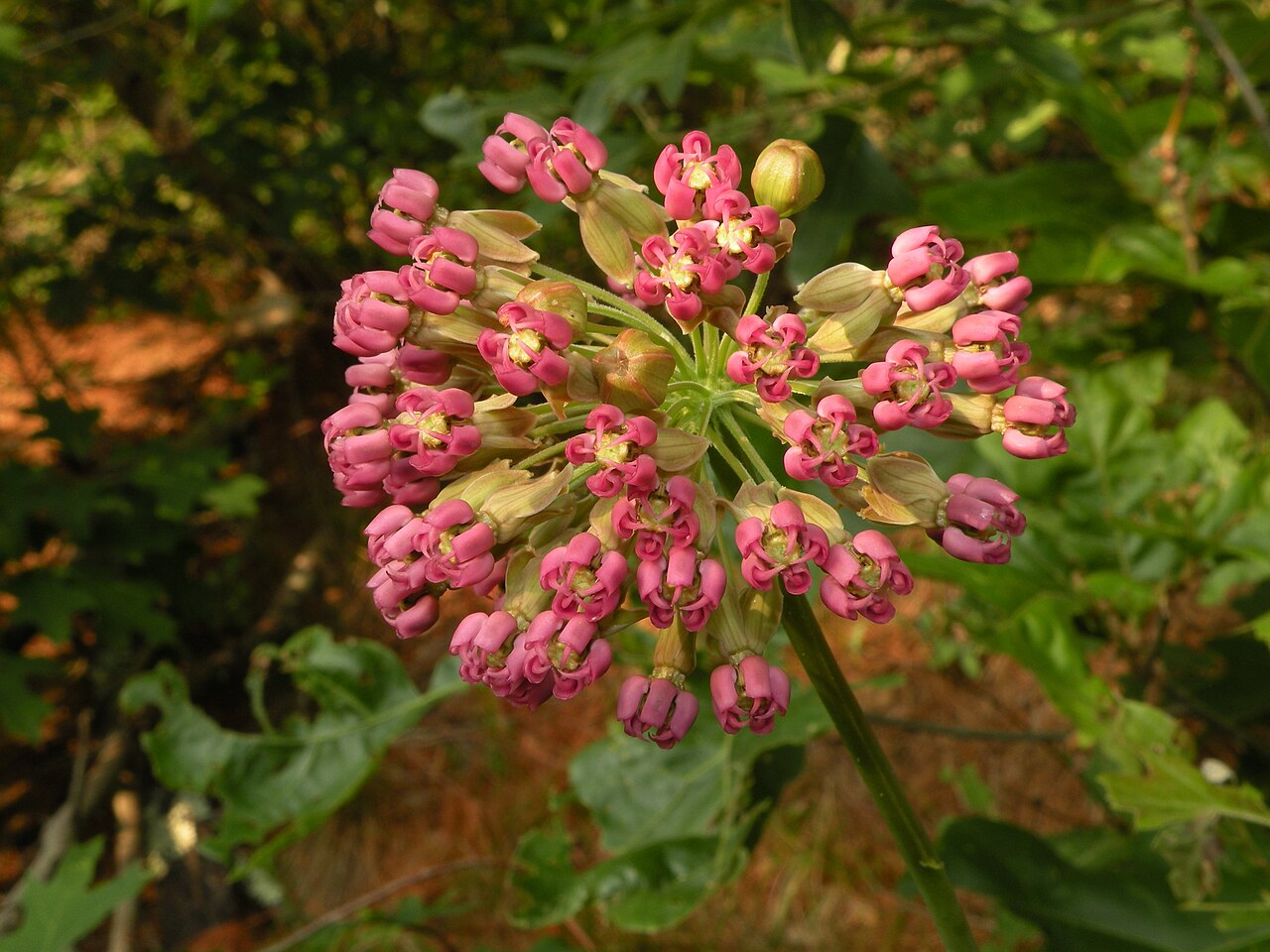
Usually a single umbel of 15 to 80 flowers is held on a long stalk (peduncle) at the top of the stem, sometimes with a second smaller one. The cluster is rounded and 2 to 3 inches across. Each flower has five reflexed petals, greenish purple to rose purple, and five erect, pale pink to lavender hoods around the center. The flowers are fragrant. Bloom time is May to July, earlier in the South.
Fruit & Seeds
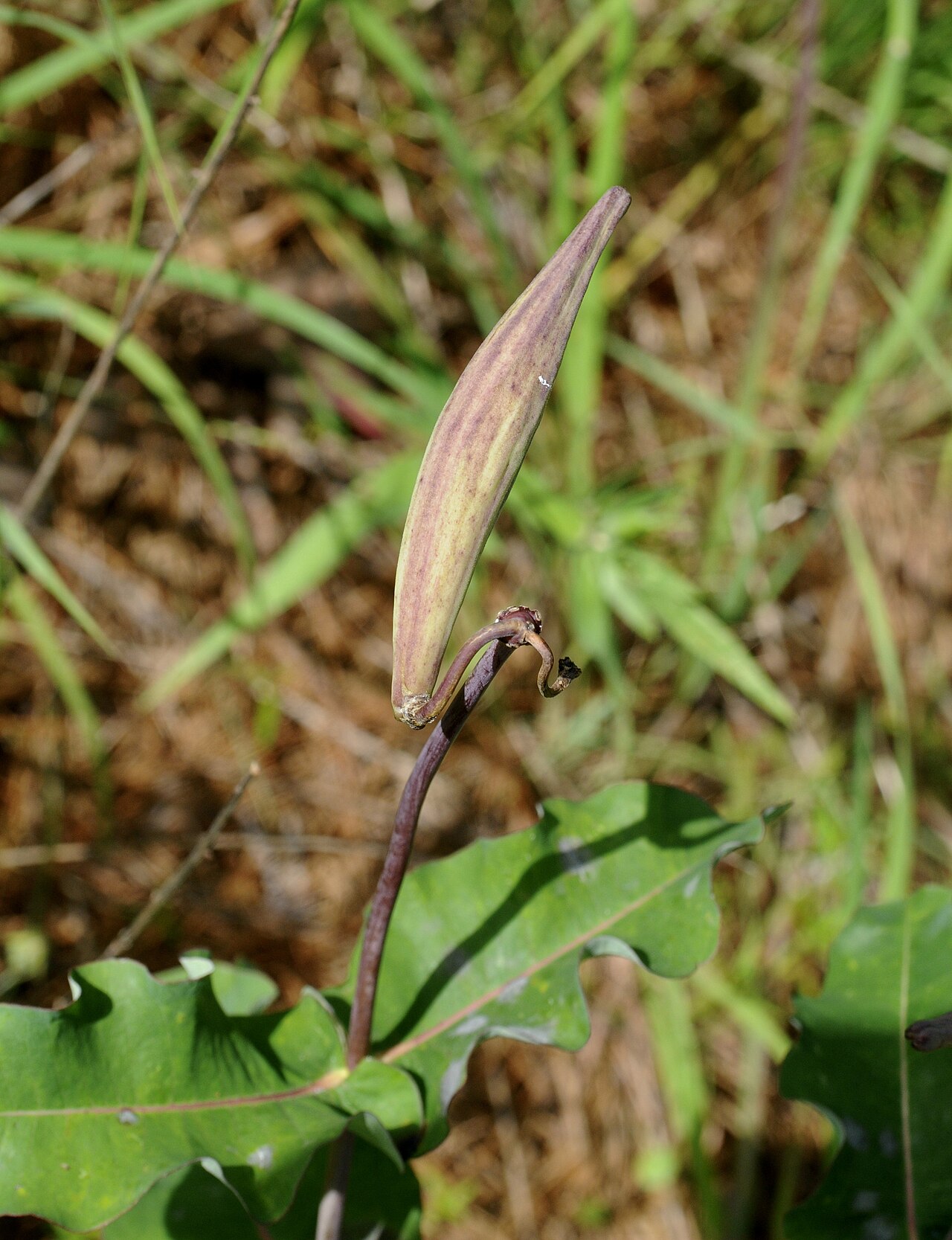
The seed pods (follicles) are slender, smooth and spindle-shaped, 4 to 6 inches long, and stand upright on curved stalks. In late summer they split open to release flat brown seeds, each with a tuft of silky white hairs that carries it on the wind.
Look-alikes
Common milkweed (Common Milkweed, A. syriaca) has several flower clusters along the upper stem, short-stalked, flat leaves without wavy edges and warty pods. Purple milkweed (A. purpurascens) and four-leaved milkweed (A. quadrifolia) have stalked, flat leaves. Sandhill milkweed (A. humistrata) of the Southeast has pink-veined, clasping leaves that lie nearly flat. Clasping milkweed is told apart by its very wavy, blunt, clasping leaves and its single long-stalked flower cluster.
Safety & Conservation
All parts of the plant are poisonous if eaten, containing cardiac glycosides that can affect the heart; livestock poisoning from milkweeds has occurred where animals graze them in hay or overgrazed pastures. The milky sap can irritate the eyes. Clasping milkweed is widespread but local, and it is listed as rare or protected in several states at the edges of its range, especially in the Northeast. Buy nursery-grown plants or seed and do not dig wild plants.
Quick Facts
| Scientific Name | Asclepias amplexicaulis |
| Family | Apocynaceae (dogbane family); formerly Asclepiadaceae |
| Plant Type | Herbaceous perennial wildflower |
| Mature Height | 1–3 ft |
| Mature Spread | 6–12 in |
| Growth Rate | Slow to moderate |
| Sun Exposure | Full sun to light shade |
| Water Needs | Low; drought tolerant once established |
| Soil Type | Dry, sandy or gravelly, well-drained soils |
| Soil pH | About 5.0–7.0 |
| Bloom Time | May–July |
| Flower Color | Greenish purple to rose pink, with pale pink hoods |
| Fall Color | Leaves turn yellow |
| Fruit | Slender upright pods with silky-tufted seeds |
| Deer Resistant | Mostly; toxic sap, though deer sometimes eat the flowers |
| USDA Hardiness Zones | 4–9 |
Native Range
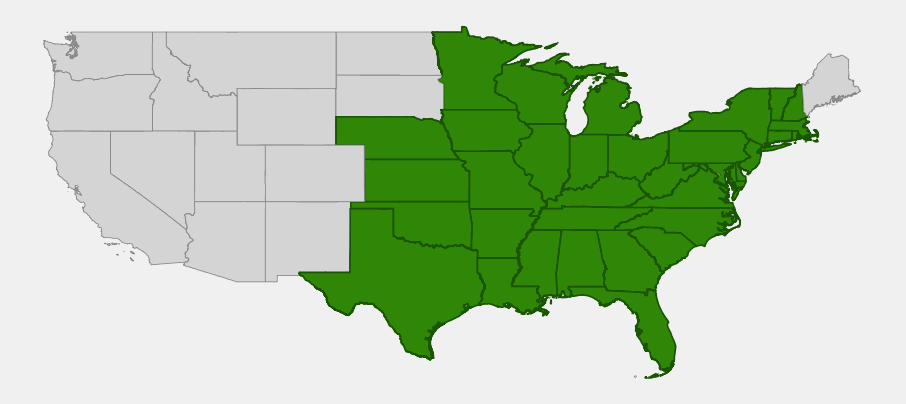
Clasping milkweed is native to the eastern and central United States. USDA PLANTS lists it as native in Alabama, Arkansas, Connecticut, Delaware, Florida, Georgia, Illinois, Indiana, Iowa, Kansas, Kentucky, Louisiana, Maryland, Massachusetts, Michigan, Minnesota, Mississippi, Missouri, Nebraska, New Hampshire, New Jersey, New York, North Carolina, Ohio, Oklahoma, Pennsylvania, Rhode Island, South Carolina, Tennessee, Texas, Vermont, Virginia, West Virginia and Wisconsin.
It ranges from southern New England and New York west through the Great Lakes states to southeastern Minnesota and eastern Nebraska, and south to northern Florida and East Texas, reaching west to the eastern Cross Timbers. It is most common on the sandy soils of the Atlantic and Gulf coastal plains, the sand prairies and oak savannas of the Midwest, and the sandhills of the Carolinas.
It grows in dry, open, sunny places with sandy or gravelly soil: sand prairies and dunes, oak and pine barrens, open sandy woodlands, old fields, pastures and roadsides. It often grows as scattered single plants rather than in large colonies.
📋 Regional plant lists featuring Clasping Milkweed: New York, Pennsylvania & Northern New Jersey · Ohio & Indiana · Michigan, Wisconsin & Eastern Minnesota · Kentucky & Tennessee · Nebraska, Kansas & Eastern Colorado · Connecticut, Massachusetts & Rhode Island · New Hampshire, Maine & Vermont · Maryland, Virginia & West Virginia · Delaware, Southern New Jersey & Long Island · Illinois, Iowa & Missouri · Alabama, Georgia & Mississippi · North & South Florida · North & South Carolina · Arkansas, Louisiana, Eastern Oklahoma & Eastern Texas
Growing & Care Guide
Clasping milkweed is a good choice for dry, sandy gardens and prairie plantings where monarchs are welcome. It is slower and less aggressive than common milkweed and stays as tidy single stems.
Light
Full sun to light shade. It flowers best in full sun.
Soil & Water
It needs dry to medium, very well-drained sandy or gravelly soil, and it rots in heavy, wet clay. Water young plants until established; after that it is very drought tolerant and needs no extra water.
Planting Tips
Plant small container plants in spring or sow seed in fall. Choose the spot carefully: the deep taproot makes established plants hard to move. Plant in groups among low grasses and wildflowers so the single stems are not lost. It may be slow to emerge in spring, so mark its location.
Pruning & Maintenance
Little care is needed. Leave the stems standing through the season so monarch caterpillars can feed, and cut them back in winter or early spring. Wear gloves to avoid getting the milky sap on skin or in the eyes.
Propagation
Grow from seed. Sow outdoors in fall, or give seed about 30 days of cold, moist stratification before sowing in spring. Seedlings may take two or three years to bloom. Seed is available from some native seed suppliers.
Landscape Uses
- Monarch habitat: larval host plant for monarch caterpillars
- Pollinator gardens: fragrant nectar for bees and butterflies
- Sandy and dry gardens: thrives where other plants struggle
- Prairie and barrens restoration: native forb for sand prairies and oak savannas
- Naturalistic plantings: striking wavy foliage and single flower heads
Wildlife & Ecological Value
Clasping milkweed supports a whole community of milkweed specialists as well as many generalist pollinators.
For Pollinators
The Xerces Society notes special value to native bees, bumble bees and honey bees. Bumblebees, carpenter bees, wasps and butterflies such as swallowtails, fritillaries and skippers visit its fragrant flowers. Monarch butterflies lay eggs on the leaves, and the caterpillars feed on them and store the plant’s toxins for their own defense. Milkweed specialists such as milkweed beetles, milkweed bugs and milkweed tussock moths also feed on it.
For Birds
Insect-eating birds hunt among the many insects the plant attracts, and some birds use the silky seed fluff in nests.
For Mammals
Most mammals avoid the toxic foliage, though deer sometimes eat the flower buds and flowers.
Ecosystem Role
As a long-lived, deep-rooted perennial of dry sandy habitats, it is part of the native plant community of sand prairies and barrens, habitats that are now rare in many states, and it provides monarch food in places where common milkweed is scarce.
Cultural & Historical Uses
The genus Asclepias is named for Asklepios, the Greek god of medicine. The species name amplexicaulis means “stem-clasping,” describing the leaves.
Milkweeds are famous as the only host plants of monarch butterflies. Planting native milkweeds suited to local conditions, such as clasping milkweed on dry, sandy soils, is a common recommendation in monarch conservation programs.
Other milkweeds on this site include Common Milkweed, Butterfly Weed, Swamp Milkweed and Whorled Milkweed.
Frequently Asked Questions
Is clasping milkweed poisonous?
Yes. All parts contain cardiac glycosides and are toxic if eaten by people, pets or livestock. The milky sap can irritate eyes, so wash hands after handling it.
Do monarchs use clasping milkweed?
Yes. Monarch butterflies lay eggs on it, and the caterpillars eat the leaves.
How do I recognize clasping milkweed?
Look for a single smooth stem with broad, blunt, very wavy leaves that clasp the stem, and one long-stalked round cluster of pinkish-purple flowers at the top.
Does clasping milkweed spread like common milkweed?
No. It grows from a deep taproot and usually stays as single stems instead of spreading by runners.
What soil does it need?
Dry, sandy or gravelly, well-drained soil in full sun. It does poorly in wet clay.

Looking for a nursery that carries Clasping Milkweed?
Browse our native plant nursery directory: Alabama & Arkansas · Connecticut, Delaware, Florida & Georgia · Illinois, Indiana, Iowa & Kansas · Kentucky, Louisiana, Maryland, Massachusetts, Michigan, Minnesota, Mississippi & Missouri · Nebraska, New Hampshire, New Jersey, New York, North Carolina, Ohio & Oklahoma · Pennsylvania, Rhode Island, South Carolina, Tennessee, Texas, Vermont & Virginia · West Virginia & Wisconsin