
Lanceleaf Greenbrier (Smilax smallii)
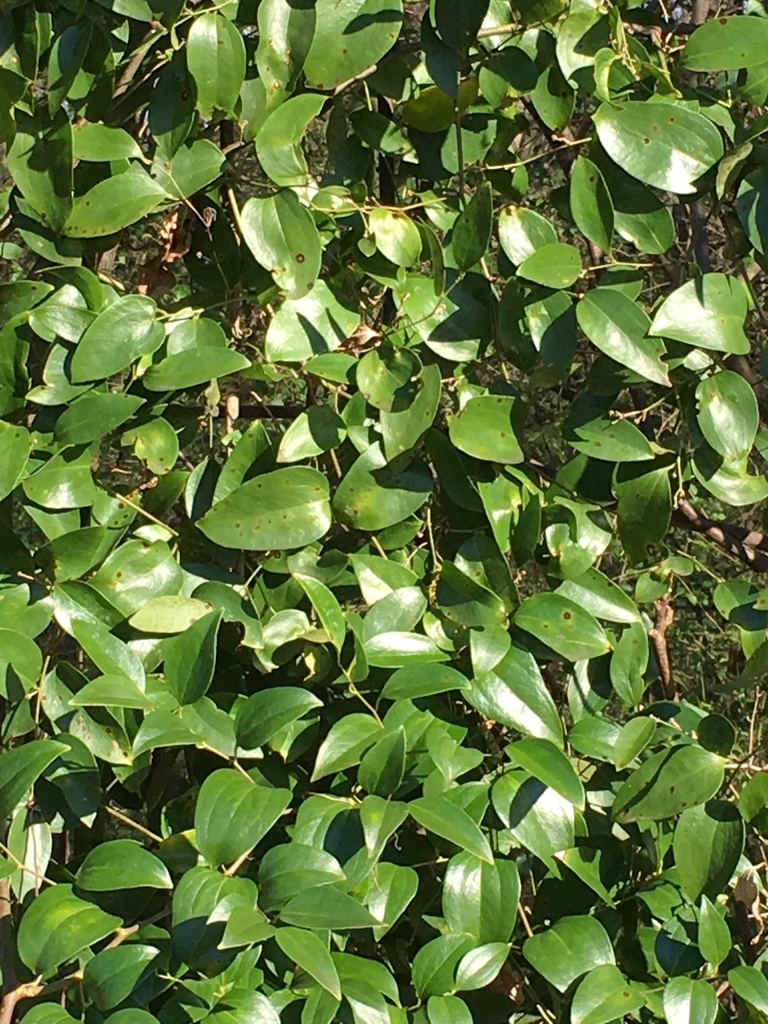
Smilax smallii, known as Lanceleaf Greenbrier, Jackson vine or Jackson brier, is an evergreen, high-climbing native vine of the southeastern coastal plain and Gulf states. Its stout lower stems are armed with prickles, but its upper branches are mostly smooth and carry dense sprays of glossy, narrow, lance-shaped leaves that stay green all year. It climbs with paired tendrils high into trees, and it often drapes over shrubs and fences in thick evergreen curtains.
It is one of the most ornamental greenbriers. In the South, cut sprays of its evergreen foliage were long used for holiday garlands and for decorating porches, churches and dining tables, and it was sometimes trained over arbors and porches near homes. In summer it bears small, fragrant, yellowish-green flowers, followed by clusters of berries that take about a year to ripen, turning from dull brick-red to dark reddish-brown.
Like other greenbriers it is excellent for wildlife, providing evergreen cover and long-lasting fruit for birds and mammals. This guide covers how to identify it, where it grows, how to grow and manage it, and why it matters to wildlife.
Identification
Lanceleaf greenbrier can be recognized by its evergreen, narrowly lance-shaped leaves, mostly smooth upper branches held at right angles, prickly lower stems, and red-brown berries that hang on through winter and spring.
Stems
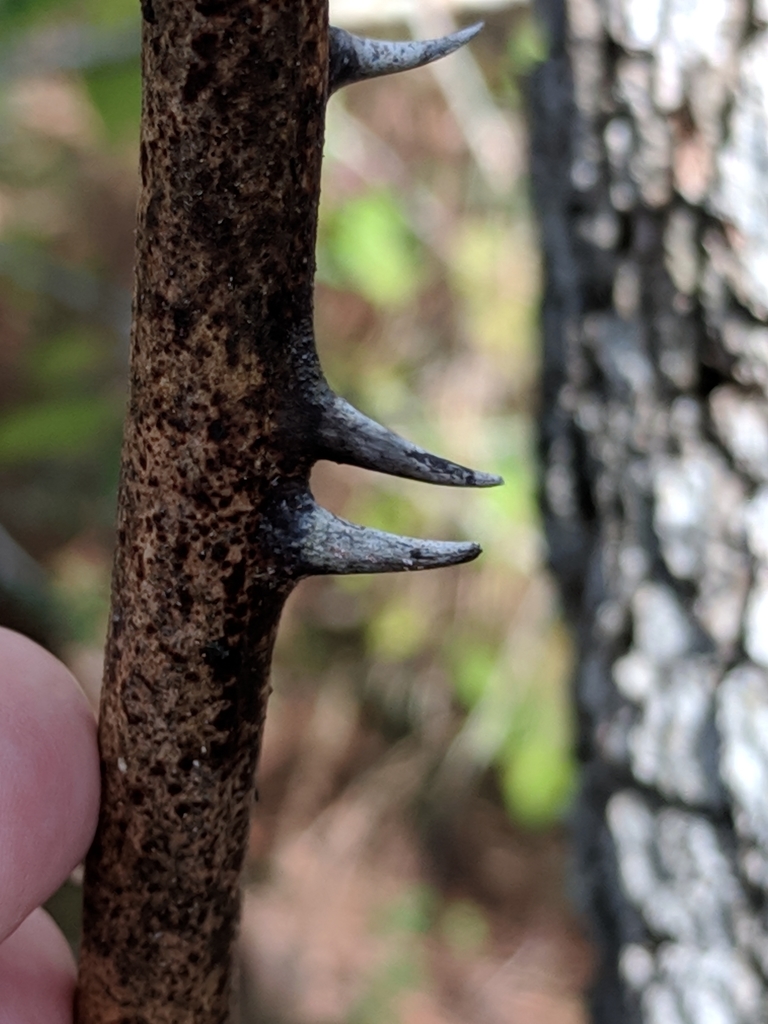
The stems are green, round and wiry, climbing by paired tendrils at the base of the leaf stalks. Lower stems near the ground become thick and woody and carry scattered stout, dark, recurved prickles; the upper branches are mostly without prickles and often branch at right angles to the main stem. Older vines grow from large, knobby, tuber-like rhizomes.
Leaves
The leaves are alternate, evergreen, thin but leathery, glossy medium to light green, narrowly lance-shaped to elliptic, about 2 to 4 inches long and less than 1½ inches wide, with three main veins running lengthwise. They lack the whitish underside of laurel greenbrier and the broad, rounded shape of common greenbriers.
Flowers
From about May to July, small, rounded, umbrella-like clusters of tiny yellowish-green flowers form in the leaf axils toward the ends of the branches. The flowers are fragrant. Like all greenbriers, male and female flowers grow on separate plants.
Fruit
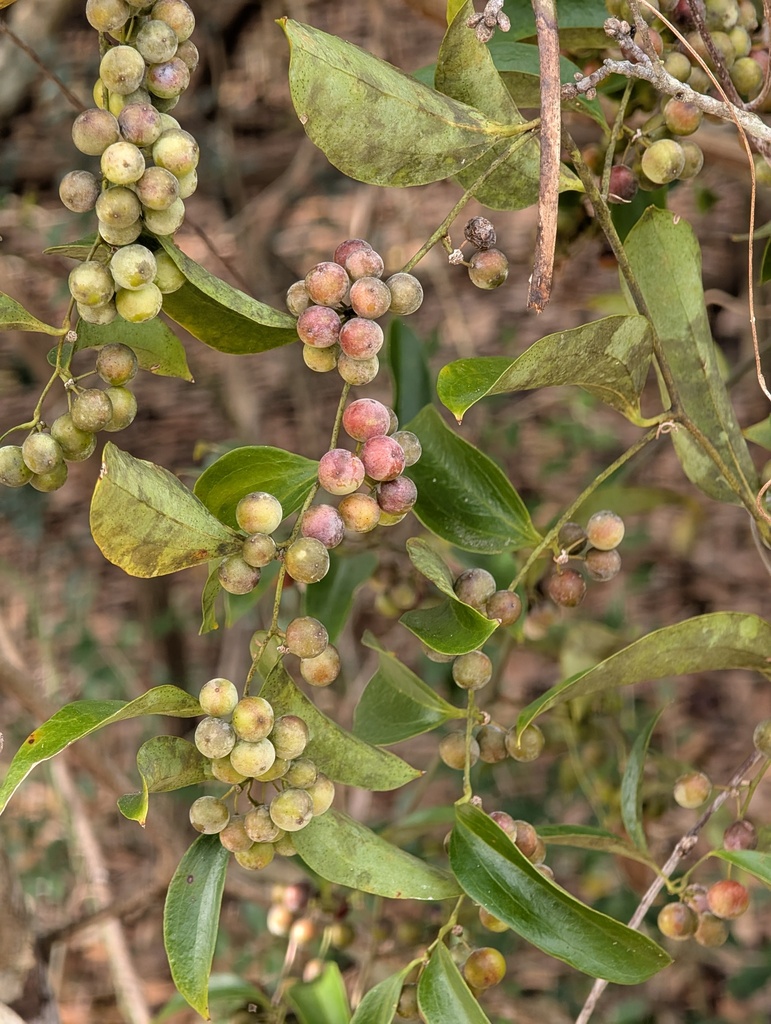
Female plants bear clusters of small, round berries about ¼ inch across. They ripen slowly, remaining a dull brick-red for a long time before turning dark reddish-brown to nearly black by the next spring, so the previous year’s fruit is often present along with new flowers.
Similar Species
Laurel greenbrier (Smilax laurifolia) has thicker, leathery leaves with a single prominent midvein and black berries, and grows in wetter, acidic swamps. Saw greenbrier (Smilax bona-nox) and roundleaf greenbrier (Smilax rotundifolia) have broader, often deciduous leaves and more prickles. Earleaf greenbrier (Smilax auriculata) of coastal dunes has leaves with rounded lobes at the base. Coral greenbrier (Smilax walteri) has bright coral-red berries and deciduous leaves.
Quick Facts
| Scientific Name | Smilax smallii (syn. Smilax lanceolata) |
| Family | Smilacaceae (greenbrier family) |
| Plant Type | Evergreen woody vine |
| Mature Height | Climbs 10–30 ft or more into trees |
| Mature Spread | Spreads by rhizomes; vines drape widely over shrubs |
| Growth Rate | Moderate to fast once established |
| Sun Exposure | Full sun to part shade |
| Water Needs | Moderate; moist soil |
| Soil Type | Moist, sandy or alluvial soils |
| Soil pH | Acidic, about 5.0–6.5 |
| Bloom Time | May–July |
| Flower Color | Yellowish-green (small, fragrant) |
| Fall Color | Evergreen |
| Fruit | Berries ripening from brick-red to dark reddish-brown over about a year |
| Deer Resistant | No; deer browse the young shoots and leaves |
| USDA Hardiness Zones | 7–9 |
Native Range
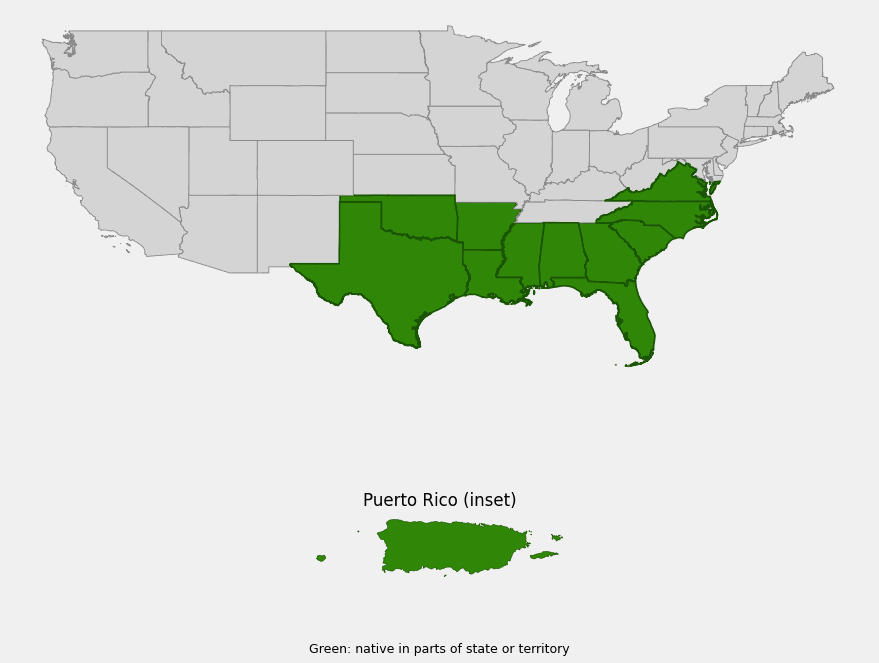
Lanceleaf greenbrier is native to the southeastern United States, mainly on the Atlantic and Gulf coastal plains. It ranges from extreme southeastern Virginia south through the Carolinas and Georgia to Florida, and west through Alabama, Mississippi and Louisiana to southern Arkansas, southeastern Oklahoma and eastern Texas, reaching inland to the Lost Pines region of Bastrop County, Texas.
USDA PLANTS also records it as native in Puerto Rico. That is an outlying record well away from the main continental range, and the species is rarely reported there.
It grows in moist, sandy and alluvial woods, along stream banks and river bottoms, in hammocks, maritime forests, pine-hardwood forests and fencerows, usually in acidic soils. It often climbs high into the canopy of oaks, magnolias and pines.
📋 Regional plant lists featuring Lanceleaf Greenbrier: Maryland, Virginia & West Virginia · Alabama, Georgia & Mississippi · North & South Florida · Puerto Rico · North & South Carolina · Arkansas, Louisiana, Eastern Oklahoma & Eastern Texas
Growing & Care Guide
Lanceleaf greenbrier is usually encountered as a wild vine rather than planted, but it is a handsome evergreen climber for large, naturalistic properties within its range. Its prickly lower stems and spreading rhizomes mean it needs thoughtful placement.
Light
It grows in full sun to part shade. It is denser and fruits more heavily with good light, but it tolerates the shade of woodland edges.
Soil & Water
It prefers moist, acidic, sandy or alluvial soils and has only modest drought tolerance. Water during dry spells until it is established.
Planting Tips
Plant it where it can climb a sturdy fence, arbor or large tree, or cover a woodland edge, away from paths where the prickly lower stems could snag people. It pairs naturally with wax myrtle, American holly and southern magnolia. Plant male and female plants if you want fruit.
Pruning & Maintenance
Prune in late winter to keep it in bounds, wearing heavy gloves. Cut sprays for winter decoration at any time. To remove unwanted vines, cut repeatedly at ground level or dig out the tuberous rhizomes; pulling seldom works because of the large underground tubers.
Propagation
Sow cleaned seed from ripe berries outdoors in fall; germination can be slow and may take more than a year. It can also be propagated from sections of rhizome with a bud, dug in late winter.
Landscape Uses
- Wildlife plantings: evergreen cover and long-lasting berries for birds
- Naturalistic screens: an evergreen curtain on fences and woodland edges
- Arbors and pergolas: trained on sturdy structures in large gardens
- Cut greenery: glossy evergreen sprays for winter decoration
- Woodland edges: within its native range on the southeastern coastal plain
Wildlife & Ecological Value
Greenbriers are among the most valuable wildlife plants of southeastern forests, and lanceleaf greenbrier’s evergreen foliage and long-lasting fruit make it especially useful in winter.
For Pollinators
Its small, fragrant flowers are visited by small bees, flies and other insects in early summer.
For Birds
The berries hang on the vine through winter and into spring and are eaten by many birds, including mockingbirds, catbirds, thrushes, cardinals and wild turkeys. The dense, evergreen, prickly tangles provide safe cover and nest sites for songbirds.
For Mammals
White-tailed deer browse the tender shoots and leaves, and raccoons, opossums and other mammals eat the fruit. Thick vines give cover to rabbits and other small animals.
Ecosystem Role
As a long-lived, rhizomatous vine it binds soil on stream banks and woodland edges, and its evergreen leaves provide winter food and shelter at a time when deciduous plants offer little.
Cultural & Historical Uses
The species is named for John Kunkel Small, the botanist whose Flora of the Southeastern United States documented much of the region’s plant life. Older references often call it Smilax lanceolata, a name now considered a synonym.
Under the traditional name Jackson vine, it has long been used in the South as decorative greenery. Long, glossy sprays were cut in winter for holiday garlands, wreaths and table decorations, because the leaves stay fresh for a long time after cutting.
The young, tender shoot tips of many greenbriers have been eaten as a cooked or raw vegetable in the Southeast, and the tuberous roots of some species were used by Native peoples for food. If you forage, be certain of identification and gather only from sites free of pesticides.
Frequently Asked Questions
Is lanceleaf greenbrier thorny?
Its thick lower stems have scattered stout prickles, but the upper branches are mostly smooth, which is one reason it was favored for cut greenery.
Is lanceleaf greenbrier evergreen?
Yes. Its glossy, lance-shaped leaves stay green through the winter.
Why is it called Jackson vine?
The name is traditional in the South, where the evergreen sprays were widely used for decorating at Christmas and other occasions.
Do birds eat greenbrier berries?
Yes. Many birds, including mockingbirds, catbirds, thrushes and wild turkeys, eat the berries, which hang on into spring when other food is scarce.
How do I control unwanted greenbrier?
Cut the stems repeatedly at ground level or dig out the large underground tubers. Because it is a valuable native wildlife plant, consider keeping some where it does not interfere with paths.

Looking for a nursery that carries Lanceleaf Greenbrier?
Browse our native plant nursery directory: Alabama & Arkansas · Florida & Georgia · Louisiana & Mississippi · North Carolina & Oklahoma · South Carolina, Texas & Virginia