
Earleaf Greenbrier (Smilax auriculata)
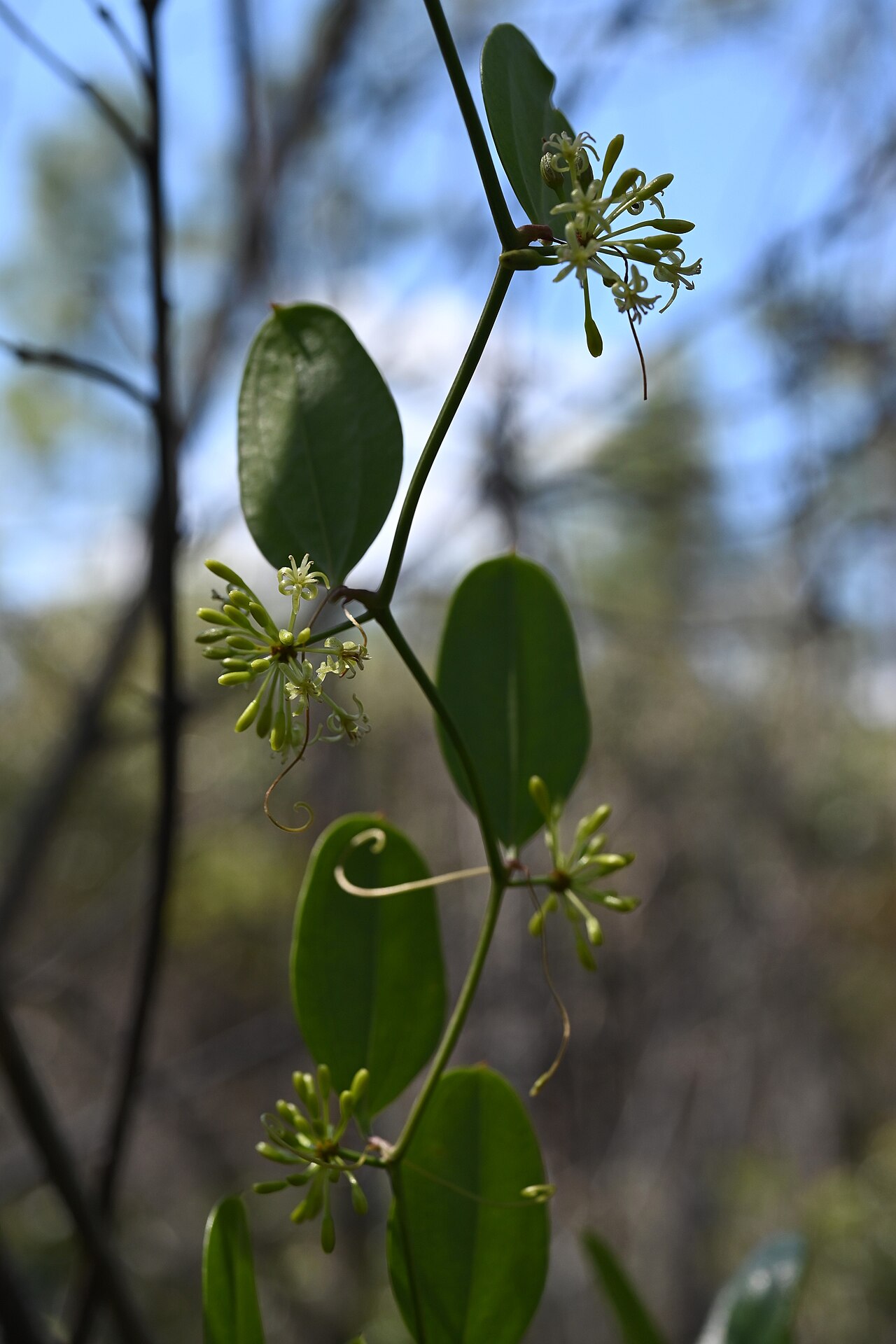
Smilax auriculata, Earleaf Greenbrier, also called wild-bamboo, is an evergreen, prickly climbing vine of the southeastern Coastal Plain. It belongs to the greenbrier family (Smilacaceae) and is especially characteristic of coastal sand dunes, maritime forests, scrub and sunny, sandy pinelands from North Carolina to Florida and west along the Gulf Coast. Its tough, zigzag green stems scramble over shrubs and dunes or climb into trees with the help of paired tendrils, reaching up to about 30 feet.
The common name comes from its leaves. Many of them, especially on vigorous shoots, have rounded lobes at the base that look like small ears (auriculata means “eared”). The leaves are thick, leathery and evergreen, a useful adaptation to the salt spray, heat and drought of coastal dunes. In spring it bears small greenish flowers, and by fall female plants carry clusters of dark purple-black berries.
Like other greenbriers, earleaf greenbrier is often unwelcome in a garden because of its prickles and spreading rhizomes. In natural areas, though, it is an important plant: it helps stabilize dunes, forms dense thickets that shelter wildlife, and its berries feed birds through the winter. This guide covers how to identify it, where it grows, and how to manage or use it in coastal landscapes.
Identification
The Southeast has many greenbriers, and telling them apart takes attention to leaf shape, prickles and habitat. Earleaf greenbrier is the common evergreen greenbrier of coastal dunes and sandy scrub, and its eared leaves, flattened prickles and dark fruits identify it.
Stems & Roots
The stems are green, tough and woody, branching in a zigzag pattern and climbing by paired tendrils that arise from the leaf stalks. They carry flattened, rigid prickles about 1/8 to 1/6 inch long, usually scattered rather than densely bristly. Underground, the plant spreads by long rhizomes and sometimes forms knobby tubers, which allow it to resprout quickly after fire, storms or cutting and to form large colonies on dunes.
Leaves
The leaves are alternate, evergreen, thick and leathery, up to about 3½ inches long. They are narrowly ovate to oblong or lance-shaped, with three to five prominent veins running lengthwise, and are not whitened or waxy beneath. Many leaves, especially lower ones, have a pair of rounded lobes at the base that give the plant its “earleaf” name, though some leaves lack them.
Flowers
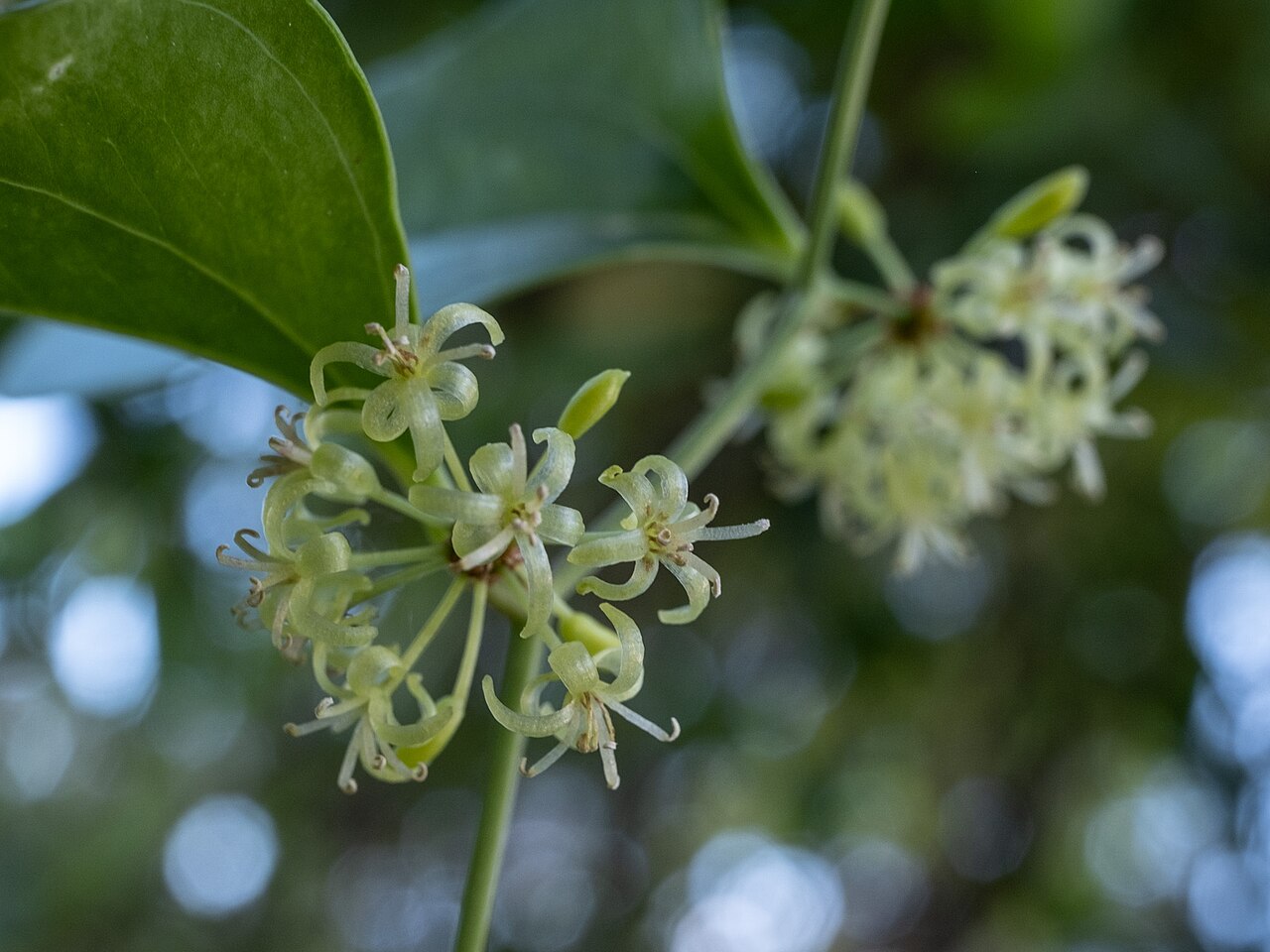
Flowering occurs mainly from April into July. The small greenish to cream flowers are borne in rounded clusters (umbels) on short stalks at the leaf axils. Each flower has six narrow tepals. Male and female flowers grow on separate plants, so only female plants produce berries.
Fruit & Look-alikes
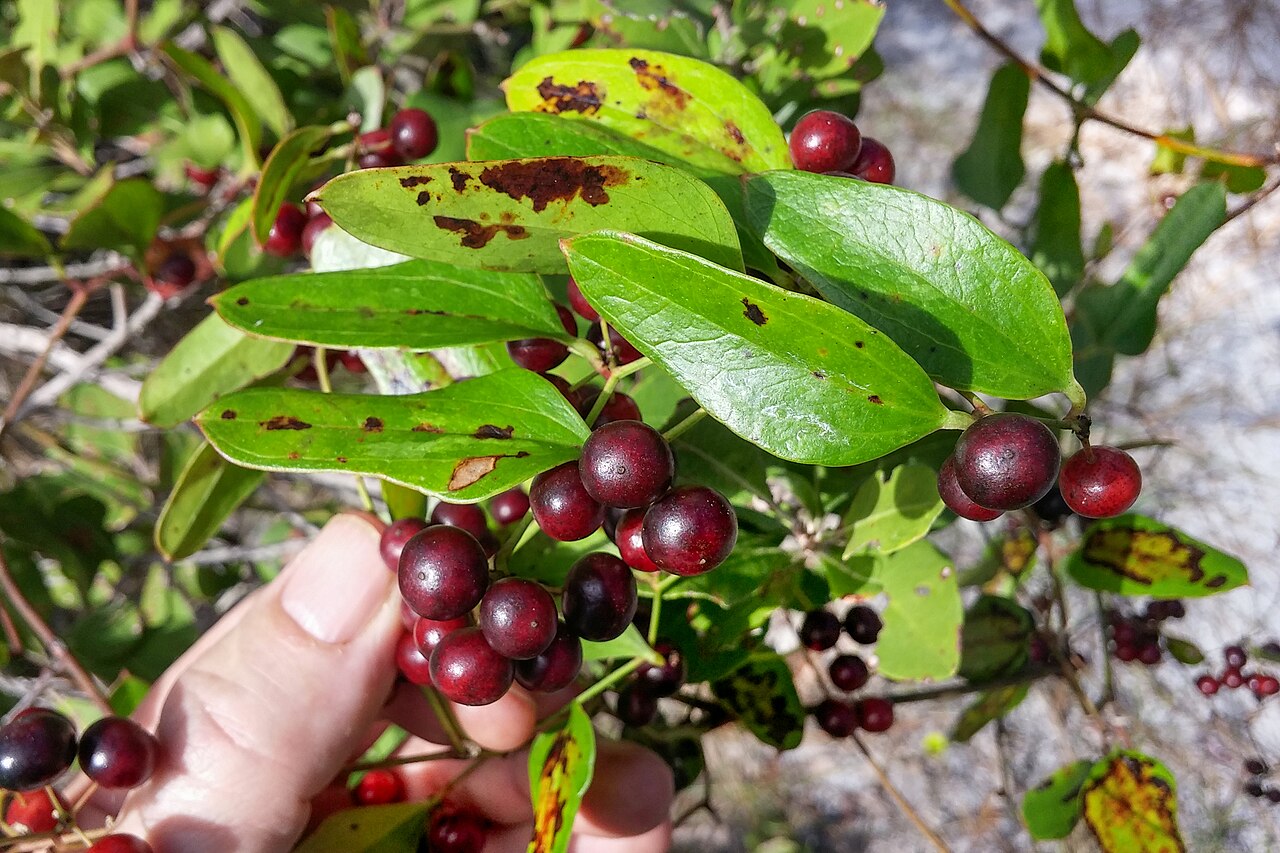
The round berries are about ¼ inch across and ripen from green through red to dark purple or nearly black in fall, usually holding one to three seeds. Laurel Greenbrier also has leathery evergreen leaves but grows in wet swamps and bays and has leaves without ears. Saw Greenbrier has leaves with prickly, thickened margins and is often mottled. Roundleaf Greenbrier is deciduous to semi-evergreen and has broad, rounded leaves.
Quick Facts
| Scientific Name | Smilax auriculata |
| Family | Smilacaceae (greenbrier family) |
| Plant Type | Evergreen woody climbing vine with prickles and tendrils |
| Mature Height | Climbs or sprawls to 10–30 ft |
| Mature Spread | Forms thickets and colonies by rhizomes |
| Growth Rate | Moderate to fast |
| Sun Exposure | Full sun to part shade |
| Water Needs | Low; drought and salt-spray tolerant once established |
| Soil Type | Sandy, well-drained soil; dunes, scrub and sandy woods |
| Soil pH | About 5.0–8.0 |
| Bloom Time | April–July |
| Flower Color | Greenish to cream |
| Fall Color | Evergreen |
| Fruit | Purple-black berry about ¼ in across, ripening in fall |
| Deer Resistant | No; deer browse the new shoots |
| USDA Hardiness Zones | 8–11 |
Native Range
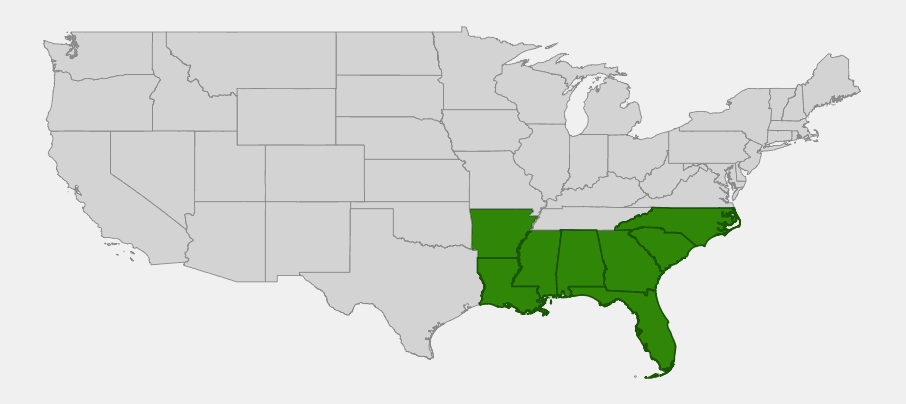
Earleaf greenbrier is a plant of the southeastern Atlantic and Gulf Coastal Plain. USDA PLANTS lists it as native in North Carolina, South Carolina, Georgia, Florida, Alabama, Mississippi, Louisiana and Arkansas. Beyond the United States it grows in the Bahamas and the Turks and Caicos Islands.
It is most abundant along the coast, on barrier islands, dunes and in maritime forests, and throughout peninsular Florida in scrub, sandhills, pine flatwoods and pine rocklands, including the pinelands of Everglades National Park. It is typically found at low elevations, under about 330 feet. Inland records are fewer. The Arkansas record listed by USDA lies well away from the coastal core of its range and should be treated as an outlying occurrence.
Within its range, earleaf greenbrier favors sunny or lightly shaded, sandy, well-drained ground. It often forms dense tangles on the landward side of foredunes, around the edges of scrub thickets and along sandy roadsides and trails.
📋 Regional plant lists featuring Earleaf Greenbrier: Alabama, Georgia & Mississippi · North & South Florida · North & South Carolina · Arkansas, Louisiana, Eastern Oklahoma & Eastern Texas
Growing & Care Guide
Earleaf greenbrier is seldom planted on purpose, and most gardeners meet it as a volunteer. In naturalistic coastal landscapes, dune restorations and wildlife plantings it can be a valuable, tough evergreen. Elsewhere, decide where you want it and manage it early, because established colonies are hard to remove.
Light
It grows in full sun on open dunes and in part shade in maritime forests and scrub. Plants in full sun are denser and fruit more heavily.
Soil & Water
Earleaf greenbrier needs well-drained, sandy soil and tolerates low fertility, drought and salt spray. Once established it needs no irrigation or fertilizer. It does not do well in constantly wet soils.
Planting Tips
If you want it for a wildlife thicket or dune planting, start from container-grown plants or rooted rhizome divisions from a legal source and give it a fence, shrub or tree to climb. Plant it where its prickly stems will not be a nuisance near paths, play areas or windows. Wear heavy gloves when handling.
Pruning & Maintenance
Cut stems back as needed to keep it off paths and out of shrubs you want to protect. Repeated cutting of the green shoots slowly weakens the rhizomes. Digging out an established plant requires removing the rhizomes and tubers, which can be deep and extensive. Avoid herbicides in natural dune areas, where nearby native plants and wildlife are easily harmed.
Propagation
Propagate by dividing rhizomes in the cool season or by seed. Clean seeds from ripe berries and sow them outdoors in fall; germination can be slow and irregular, often taking more than one season. Birds spread seeds widely, so seedlings often appear on their own beneath perches.
Landscape Uses
- Dune stabilization: rhizomes and dense growth help hold sand on secondary dunes within its native range
- Wildlife thickets: a prickly evergreen tangle offering safe cover and nesting sites for birds
- Bird gardens: berries persist into winter and feed many birds
- Coastal naturalistic landscapes: salt- and drought-tolerant evergreen cover for fences and rough ground
- Barrier and screening plantings: a living, prickly barrier along property edges
Wildlife & Ecological Value
Greenbriers are among the most important wildlife plants in southeastern forests and scrub, and earleaf greenbrier plays that role in coastal habitats, where food and cover are limited.
For Pollinators
The small greenish flowers are visited by small bees, flies and other insects. Greenbrier flowers are modest, but they add to the spring nectar and pollen supply in coastal scrub and dunes.
For Birds
Greenbrier berries are eaten by many birds, including catbirds, mockingbirds, thrashers, thrushes and wild turkeys. Because the berries often persist into winter, they are a valuable late-season food for wintering and migrating birds. The dense, prickly thickets provide protected nesting and roosting sites.
For Mammals
White-tailed deer browse the tender new shoots and leaves, and rabbits and other small mammals shelter in and feed on the thickets. Raccoons and other mammals eat the fruits.
Ecosystem Role
On dunes and in scrub, earleaf greenbrier binds sand with its rhizomes and, as an evergreen, provides year-round cover. Its underground tubers let it resprout quickly after fire, hurricanes and overwash, so it helps coastal plant communities recover after disturbance.
Cultural & Historical Uses
Earleaf greenbrier was described by the botanist Thomas Walter in his Flora Caroliniana (1788), one of the first floras of the southeastern United States, based on plants from the South Carolina coastal plain. The name “wild-bamboo,” used for several greenbriers, refers to the jointed-looking green stems, although the plant is not related to bamboo.
The young, tender shoot tips of many greenbriers have long been eaten as a wild vegetable, and the starchy rhizomes of some species were used by Indigenous peoples of the Southeast as a source of food. Use of any wild plant for food requires careful identification and local knowledge, and collecting should never damage natural dune vegetation, which is protected in many coastal areas.
For most coastal residents, earleaf greenbrier is simply a familiar tangle on the way to the beach. For birds and other wildlife, it is food and shelter, and for dune ecologists it is one of the many plants that hold the shifting sands of barrier islands in place.
Frequently Asked Questions
Why is it called earleaf greenbrier?
Many of its leaves have a pair of rounded lobes at the base that resemble small ears. The scientific name auriculata also means “eared.” Not every leaf has the lobes, so check several.
Is earleaf greenbrier evergreen?
Yes. Its thick, leathery leaves stay green year-round, which helps distinguish it from several deciduous greenbriers of the Southeast.
Is earleaf greenbrier invasive?
No. It is native to the southeastern Coastal Plain. It spreads by rhizomes and can form dense thickets, and birds spread its seeds, so it can be hard to control in gardens, but it is a natural part of dune and scrub plant communities.
How do I remove greenbrier from my yard?
Cut the stems to the ground repeatedly to weaken the plant, and dig out the rhizomes and tubers where possible. Gloves are essential because of the prickles. Persistence over several seasons is usually needed.
Do birds eat greenbrier berries?
Yes. Greenbrier berries are eaten by many birds, including catbirds, mockingbirds, thrushes and wild turkeys, and they often remain on the vines into winter when other food is scarce.

Looking for a nursery that carries Earleaf Greenbrier?
Browse our native plant nursery directory: Alabama & Arkansas · Florida & Georgia · Louisiana & Mississippi · North Carolina · South Carolina