
Mountain Jewelflower (Streptanthus tortuosus)
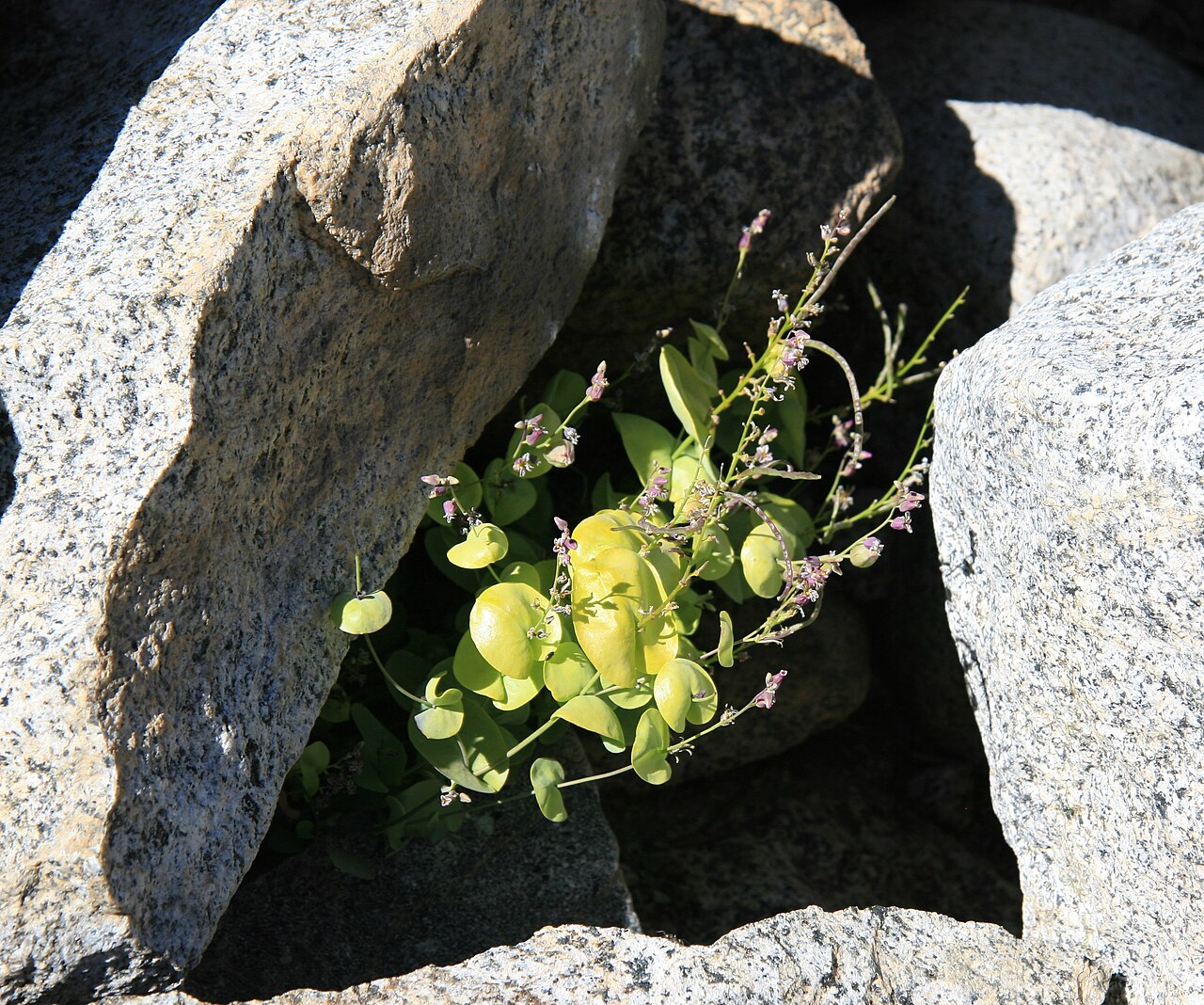
Streptanthus tortuosus, known as Mountain Jewelflower, shieldplant or shieldleaf, is a wildflower of the mustard family (Brassicaceae) from the mountains of California, reaching just into southwestern Oregon and western Nevada. Its most striking feature is its upper leaves: round, waxy and clasping the stem like small shields, often turning bright yellow as they age. Above them, slender, zigzag stems carry odd, flask-shaped flowers in shades of purple, cream or yellowish green.
It is one of the most widespread and variable members of the jewelflower genus, a group famous for its many local species, some of them rare and restricted to serpentine soils. Mountain jewelflower grows on rocky and sandy ground from the foothills to above timberline. It can be an annual, a biennial or a short-lived perennial, depending on the population and the site. USDA PLANTS uses the common name shieldplant; mountain jewelflower is the name used by the Lady Bird Johnson Wildflower Center and many field guides.
In gardens it is a curiosity for dry, rocky sites in California and southern Oregon: a small, unusual plant for rock gardens and naturalistic plantings rather than a big display flower. It is rarely sold as plants, but seed is offered by some California native seed suppliers.
Identification
Look for a hairless, often waxy, bluish to yellow-green plant on rocky ground, with round leaves that clasp the stem and small, urn-shaped flowers spaced along wiry stems, followed by very long, thin, curving pods.
Growth Habit
Plants range from a few inches tall in high, exposed sites to about 3 feet in sheltered foothill sites. Stems are smooth and often bent in a zigzag pattern (the name tortuosus means twisted), and may branch from the base. Some forms are annual or biennial, while others live for several years from a woody base.
Leaves
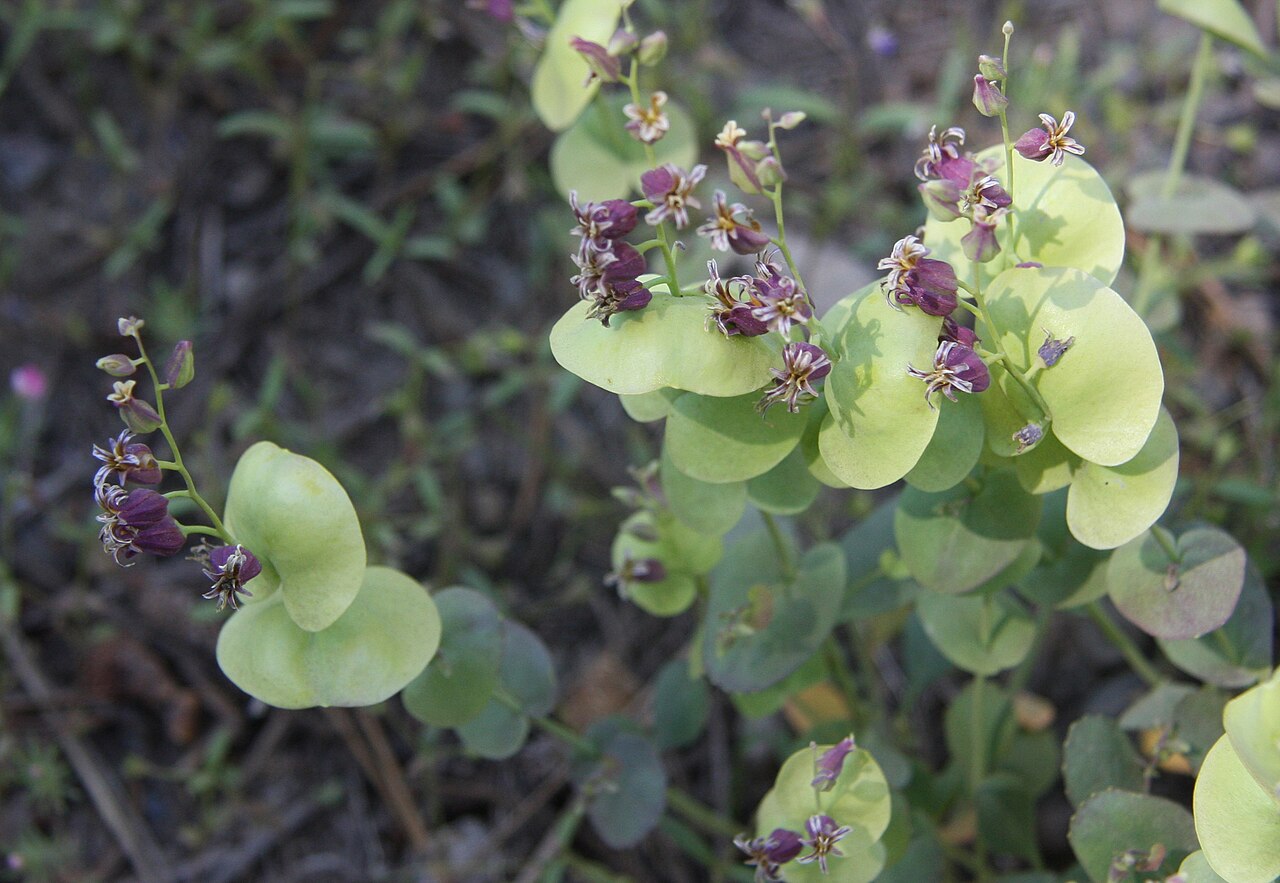
The lower leaves are oval to spoon-shaped, on winged stalks, and often wither by flowering time. The upper stem leaves are rounded to heart-shaped and wrap around the stem so that the stem seems to pass through them. They are thick, smooth and waxy, green to bluish green, and turn yellow, orange or purplish with age.
Flowers
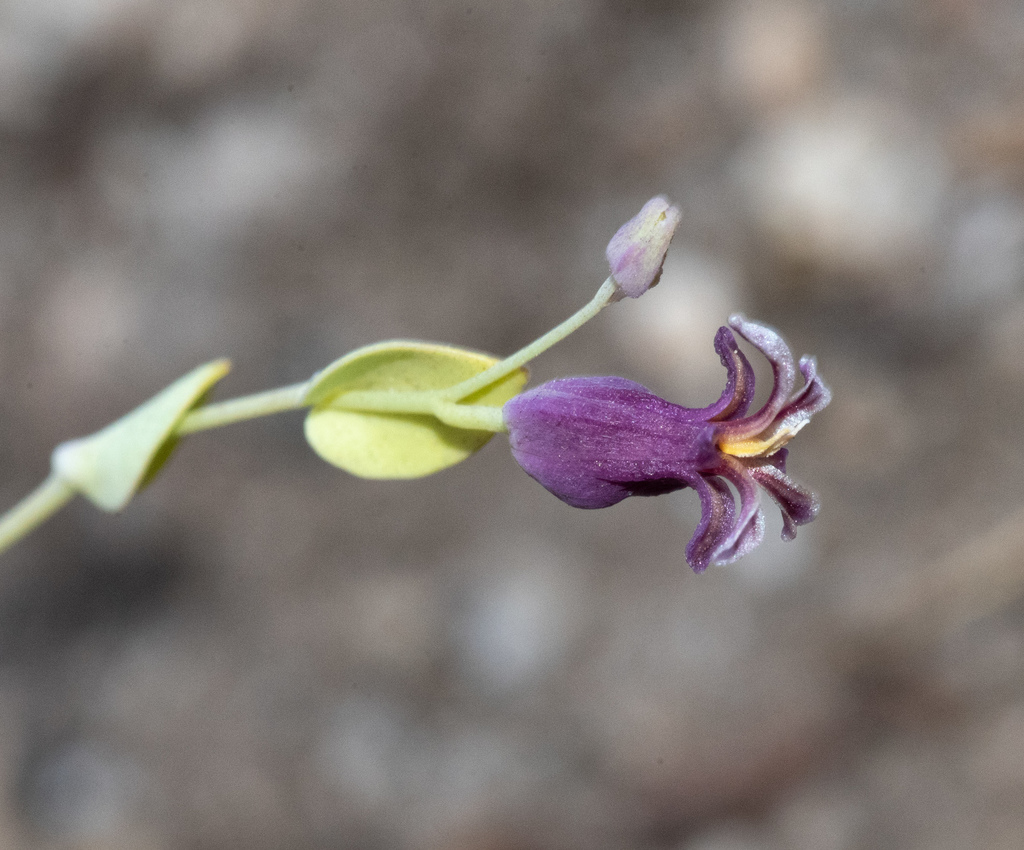
The flowers are spaced along the upper stems from about May to August, depending on elevation. Each is about 1/4 to 1/2 inch long. The sepals form a swollen, flask- or urn-shaped calyx that is purple, yellowish green or cream, and four narrow, wavy petals with purple veins curl out from its tip.
Fruit
The fruit is a very long, narrow, flattened pod (silique), 2 to 6 inches long, that often curves or arches outward and holds a row of small, flat, winged seeds. The arching pods often stay on the plant into fall.
Look-alikes
Heartleaf jewelflower (Streptanthus cordatus) is very similar but grows mainly east of the Sierra Nevada and Cascades, on the Great Basin side, and has different pod and flower details. Many other jewelflowers in California are rare local species of serpentine or other specialized soils. Western wallflower, another mountain mustard, has showy, flat, four-petaled orange or yellow flowers.
Quick Facts
| Scientific Name | Streptanthus tortuosus |
| Family | Brassicaceae (mustard family) |
| Plant Type | Annual, biennial or short-lived perennial wildflower |
| Mature Height | 4 in–3 ft (often 1–2 ft) |
| Mature Spread | 6–18 in |
| Growth Rate | Moderate |
| Sun Exposure | Full sun to part shade |
| Water Needs | Low; dry in summer |
| Soil Type | Rocky, gravelly or sandy, well-drained |
| Soil pH | Slightly acidic to neutral (about 5.5–7.5) |
| Bloom Time | May–August, depending on elevation |
| Flower Color | Purple, cream or yellowish green with purple veins |
| Fall Color | Upper leaves turn yellow to orange or purplish |
| Fruit | Long, slender, curving pods |
| Deer Resistant | Usually little browsed |
| USDA Hardiness Zones | 5–9 |
Native Range
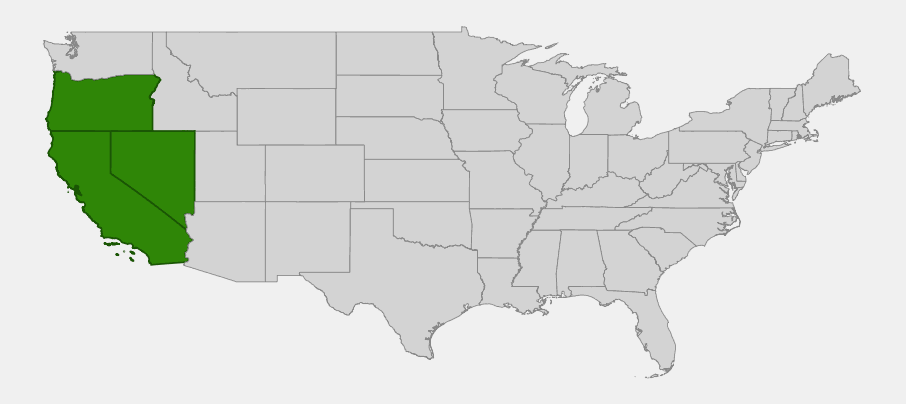
Mountain jewelflower is centered in the mountains of northern and central California. USDA PLANTS lists it as native in California, Nevada and Oregon. In California it grows in the Sierra Nevada, the southern Cascades, the Klamath Mountains and the North Coast Ranges, with scattered populations in the Coast Ranges farther south.
Its range barely extends beyond California. In Oregon it reaches the Siskiyou Mountains and nearby rocky ground in the southwestern corner of the state, west of the Cascade crest. In Nevada it grows in the Carson Range and nearby mountains on the east side of the Lake Tahoe Basin, at the eastern edge of the Sierra Nevada.
It grows on rocky and sandy slopes, granite outcrops, talus, road cuts and openings in chaparral, oak woodland and conifer forest, from the foothills to subalpine and alpine slopes above 9,000 feet in the Sierra Nevada. Populations at different elevations differ in size, flowering time and life span, which makes the species a favorite subject for research on how plants adapt to climate.
📋 Regional plant lists featuring Mountain Jewelflower: Western Oregon & Western Washington · California & Nevada
Growing & Care Guide
Mountain jewelflower is easiest to grow from seed in a sunny, rocky spot that stays dry in summer. Seed from a source near you (and near your elevation) will be best adapted to your garden.
Light
Full sun to light part shade. In hot, low-elevation gardens, a little afternoon shade helps.
Soil & Water
Use gritty, fast-draining soil such as decomposed granite, gravel or a rock garden mix. It is adapted to dry summers: water seedlings and young plants in spring, then let them dry out. Heavy, wet soil and summer irrigation cause rot.
Planting Tips
Sow seed in fall on the surface of a gravelly bed or in pots left outdoors over winter, and cover lightly. Mountain populations generally need a period of cold, moist conditions before they germinate. Transplant seedlings while small; they form a taproot. Use it among boulders, in a rock garden or on a dry slope with buckwheats, penstemons and manzanitas.
Pruning & Maintenance
Little care is needed. Leave the pods until they split and drop their seed if you want volunteers. Remove the dry stems afterward if you prefer a neater look. Plants are often short-lived, so allow some reseeding.
Propagation
Grows from seed. Collect pods as they dry and start to split in late summer or fall. Wild seed should be collected only in small amounts and only where permitted.
Landscape Uses
- Rock gardens: an unusual accent for gravel beds and boulders
- Dry slopes: tolerates lean, rocky soil and summer drought
- Mountain and foothill gardens: suits gardens within its native range
- Pollinator gardens: visited by native bees
- Education: a striking example of clasping leaves and jewelflower diversity
Wildlife & Ecological Value
Mountain jewelflower is a small but interesting part of the plant life of rocky mountain slopes in California.
For Pollinators
The flowers are visited mainly by native bees, which crawl into the narrow calyx for nectar. Some plants also set seed by self-pollination.
For Birds
Seed-eating birds may take seeds from the open pods, although the plant is rarely a major food source.
For Mammals
Like other mustards, it contains sharp-tasting glucosinolate compounds, and it is usually little browsed by deer.
Ecosystem Role
Like other wild mustards, it can serve as a larval food plant for white and orangetip butterflies, whose caterpillars are adapted to mustard chemistry. As a pioneer of rocky ground, it helps cover thin, disturbed soils after fire and on road cuts.
Cultural & Historical Uses
The genus name Streptanthus comes from Greek words meaning twisted flower, referring to the wavy, twisted petals. The species name tortuosus means twisted or tortuous, for the zigzag stems. Albert Kellogg, one of the founders of the California Academy of Sciences, described the species in the 1860s.
California is the center of diversity for jewelflowers, with dozens of species and varieties. Many of them grow only on serpentine soil, and several are rare. Mountain jewelflower is one of the most common and widespread of the group.
Because its populations grow over such a wide range of elevations, from warm foothills to cold alpine slopes, mountain jewelflower has become a model plant for studies of how plant life cycles and flowering time respond to climate, including research by University of California scientists along Sierra Nevada elevation gradients.
Frequently Asked Questions
Why is it called shieldplant?
Its round upper leaves clasp the stem, so the stem seems to pass through a small shield. USDA PLANTS lists its common name as shieldplant; it is also called shieldleaf.
Is mountain jewelflower a mustard?
Yes. It belongs to the mustard family (Brassicaceae), like wallflowers and rock cresses, and has the long, narrow pods typical of that family.
Is it annual or perennial?
It varies. Some populations are annual or biennial, and others are short-lived perennials, especially at higher elevations.
Where can I see mountain jewelflower?
Look on rocky slopes and granite outcrops in the Sierra Nevada, the Klamath Mountains and the North Coast Ranges of California, from late spring through summer.
Can I grow mountain jewelflower outside California?
It is best suited to dry-summer gardens in California, southwestern Oregon and the Lake Tahoe area. It needs sharp drainage and dislikes humid summers.

Looking for a nursery that carries Mountain Jewelflower?
Browse our native plant nursery directory: California · Nevada · Oregon