
Wart-Stemmed Ceanothus (Ceanothus verrucosus)
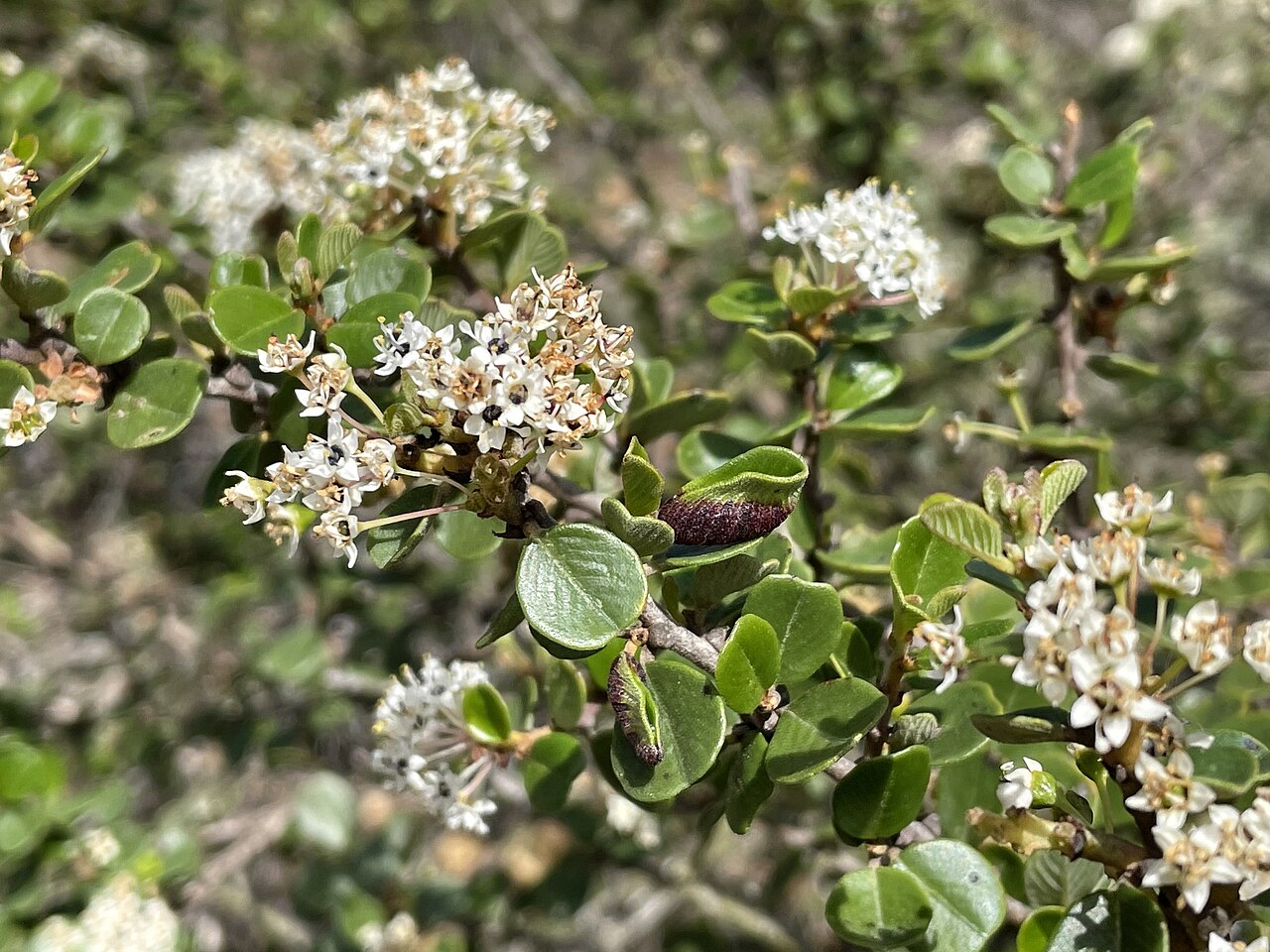
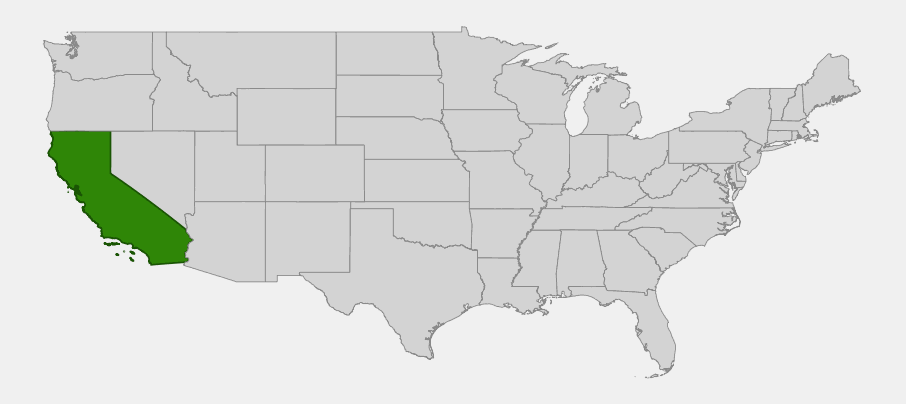
Ceanothus verrucosus, known as Wart-Stemmed Ceanothus, barranca brush, wart-stem ceanothus or white coast ceanothus, is an evergreen shrub of the buckthorn family (Rhamnaceae). USDA PLANTS lists it under the common name barranca brush. In the United States it grows only in coastal San Diego County, California, and it continues south along the Pacific coast of Baja California, Mexico.
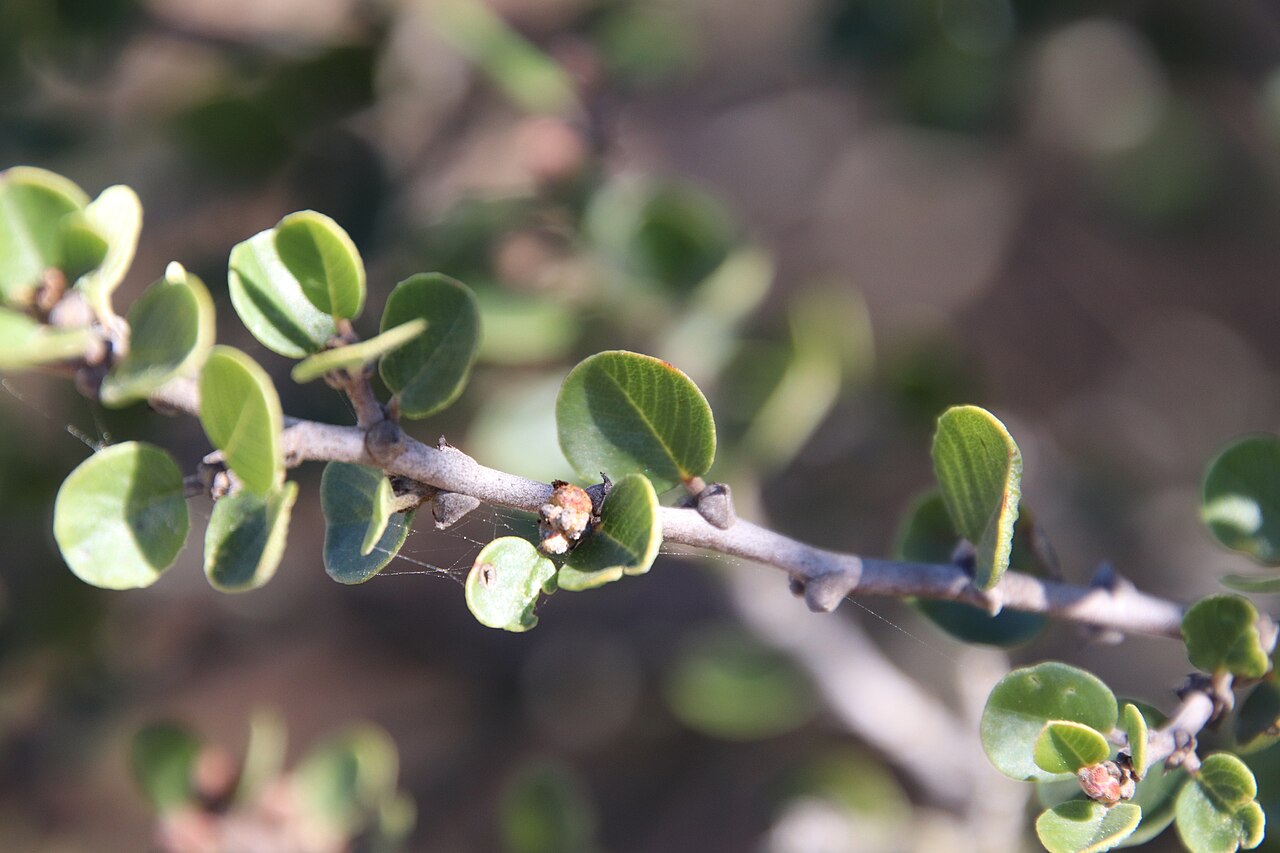
It is an upright, open to rounded shrub usually 4 to 10 feet tall, with stiff gray-brown branches and small, thick, dark green leaves with a notched tip. Its name comes from the corky, wart-like stipules that dot the stems at the base of each leaf. From about December to May it covers itself in rounded clusters of tiny white flowers with dark centers, which have a mild, sweet scent.
Wart-stemmed ceanothus is on the California Native Plant Society’s Inventory of Rare and Endangered Plants with California Rare Plant Rank 2B.2, meaning it is rare in California but more common elsewhere (in Baja California). Much of its coastal San Diego habitat has been lost to development. Never collect plants or cuttings from the wild; nursery-propagated plants are sold by California native nurseries and make an excellent low-water garden shrub.
Identification
Look for a stiff, gray-stemmed coastal shrub with small, alternate, notch-tipped leaves and bumpy, wart-like knobs along the stems, covered in white flower clusters with dark centers in late winter.
Growth Habit
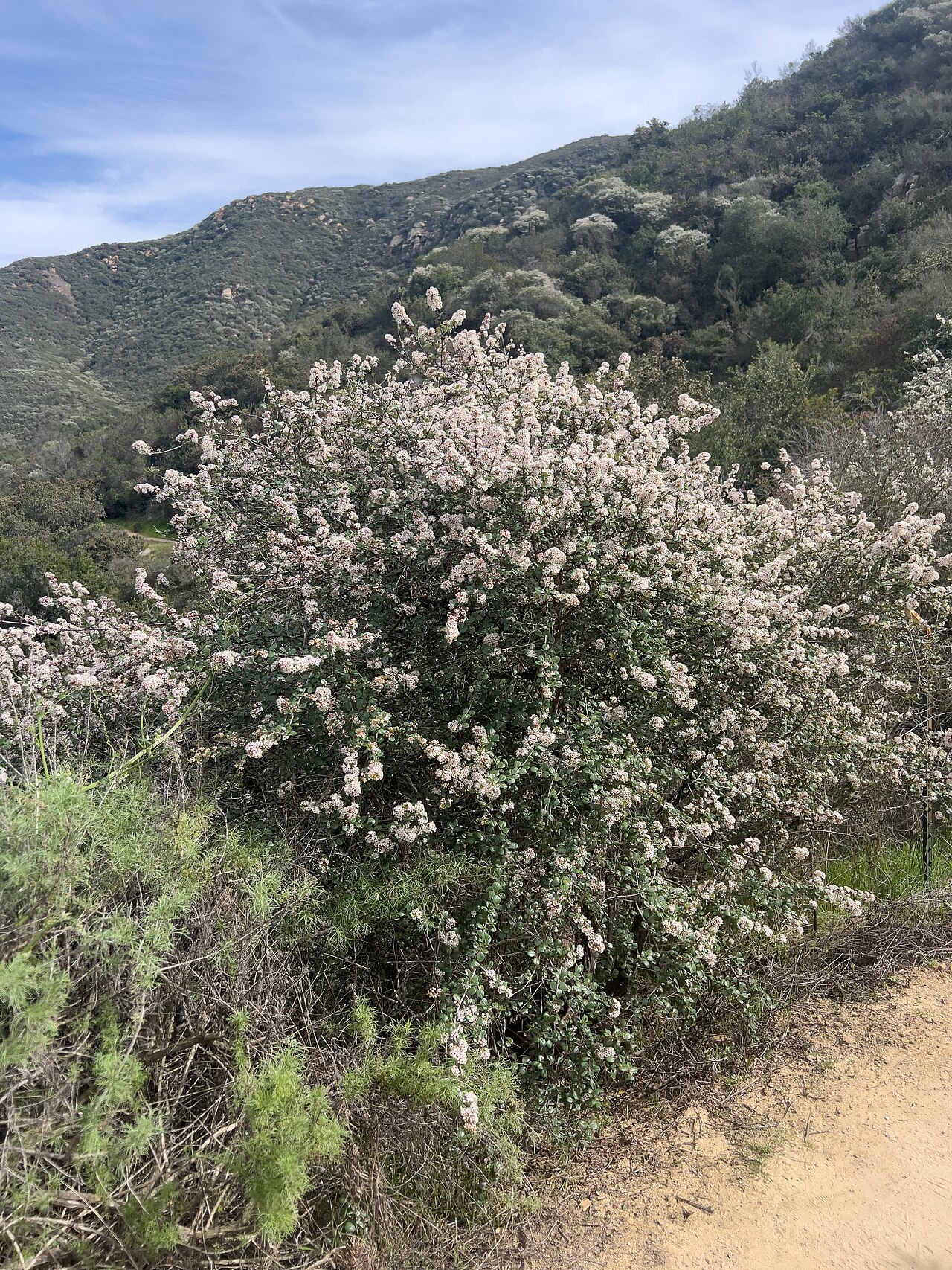
This is an evergreen shrub, usually 4 to 10 feet tall and about as wide, with an upright, fanned-out or rounded form. The branches are rigid and gray-brown, with short side twigs. It belongs to the Cerastes group of ceanothus: it has no burl at the base, so fire kills the shrub, but its seeds germinate in large numbers after a fire.
Leaves
The leaves are alternate, about 1/4 to 1/2 inch long, thick and leathery, dark glossy green above and paler below. They are rounded to wedge-shaped with a blunt or notched tip, and the edges are smooth or finely toothed. At the base of each leaf is a pair of corky, wart-like stipules; these persist on the stems and give the plant its common name.
Flowers
Flowers appear from about December to May, peaking in late winter and early spring. They are tiny and white, borne in dense, rounded clusters along the branches. The center of each flower, the nectar disk and ovary, is dark, giving the clusters a speckled look. The flowers have a light, sweet fragrance often compared to sweet alyssum.
Fruit & Seeds
The fruit is a small, rounded capsule about 1/4 inch across, often with small horns. When ripe it splits explosively and flings out hard seeds that can lie dormant in the soil for years until heat from a fire breaks their dormancy.
Look-alikes
Bigpod ceanothus also has alternate leaves and white flowers but has larger fruits and grows mostly farther north. Hoaryleaf ceanothus and buckbrush have opposite leaves; hoaryleaf ceanothus has thick, toothed leaves that are white-woolly underneath. The alternate, notch-tipped leaves together with conspicuous warty stipules identify wart-stemmed ceanothus.
Safety Notes
Wart-stemmed ceanothus is not known to be toxic. Its stiff branches can scratch, so wear long sleeves when pruning.
Quick Facts
| Scientific Name | Ceanothus verrucosus |
| Family | Rhamnaceae (buckthorn family) |
| Plant Type | Evergreen shrub |
| Mature Height | 4–10 ft |
| Mature Spread | 4–8 ft |
| Growth Rate | Moderate |
| Sun Exposure | Full sun |
| Water Needs | Very low; no more than monthly summer water once established |
| Soil Type | Well-drained sandstone, gabbro or other rocky soils; tolerates some clay |
| Soil pH | About 6.0–8.0 |
| Bloom Time | December–May |
| Flower Color | White with dark centers |
| Fall Color | Evergreen; dark green leaves |
| Fruit | Small horned capsules |
| Deer Resistant | Moderately; deer may browse new growth |
| USDA Hardiness Zones | 10–11 (to about 30 °F) |
Native Range
Wart-stemmed ceanothus is native to coastal San Diego County, California, and northwestern Baja California, Mexico. USDA PLANTS lists it as native only in California among U.S. states. In Baja California it ranges along the Pacific coast from Tijuana to around El Rosario and also grows on Cedros Island.
In California it is ranked 2B.2 in the CNPS Inventory of Rare and Endangered Plants. The CNPS inventory lists it from about 5 to 1,245 feet in elevation and notes that it is threatened by development. Several populations are protected, including at Torrey Pines State Natural Reserve and in San Diego County open space preserves such as Elfin Forest.
It grows in chaparral and coastal scrub on dry hills, mesas, canyons, marine terraces and coastal bluffs. It is a characteristic shrub of southern maritime chaparral, a rare type of chaparral on sandstone soils near the coast, where it often grows with chamise, bush rue, laurel sumac, lemonade berry and mission manzanita.
📋 Regional plant lists featuring Wart-Stemmed Ceanothus: California & Nevada
Growing & Care Guide
Calscape rates wart-stemmed ceanothus as one of the easier ceanothus species to grow in southern California. It handles drought better than most of its relatives and keeps its green leaves through long, dry summers. Buy nursery-grown plants only.
Light
Plant it in full sun. In shade it becomes sparse and flowers poorly.
Soil & Water
It prefers fast-draining soils but tolerates moderate drainage. Give it about monthly deep water during its first summer, then little or none once established; at most a monthly summer watering. It tolerates a bit more summer water than many southern California ceanothus, but overwatering still shortens its life.
Planting Tips
Plant in fall or winter so roots establish with the rains. Space plants 6 to 8 feet apart for a hedge or screen. It suits coastal and mild inland gardens in southern California; it is frost-tender below about 30 °F. Use it as an informal hedge, a background shrub or in a chaparral-style planting with manzanita, sages and lemonade berry.
Pruning & Maintenance
It tolerates normal pruning. Trim lightly right after flowering to shape it; avoid cutting deep into old, leafless wood. Do not fertilize. Mulch with gravel or coarse wood chips kept away from the trunk.
Propagation
Calscape notes that seed germinates best after a hot-water treatment followed by 2 to 3 months of cold, moist stratification, mimicking the heat of a wildfire. Softwood or semi-hardwood cuttings can also root. Use only seed or cuttings from nursery or garden plants, never from wild populations.
Landscape Uses
- Informal hedges and screens: dense, evergreen and drought-tolerant
- Coastal native gardens: salt-breeze tolerant shrub for mild coastal sites
- Pollinator gardens: abundant early-season flowers for native bees
- Habitat restoration: southern maritime chaparral and coastal scrub in San Diego County
- Fire-adapted landscapes: part of the native chaparral community; keep defensible-space spacing near buildings
Wildlife & Ecological Value
Because it blooms in winter and early spring, wart-stemmed ceanothus provides food for insects at a time of year when few other shrubs are flowering.
For Pollinators
Native bees, honey bees, flies and small butterflies visit the fragrant flower clusters. Ceanothus species are also larval food plants for several butterflies and moths, such as the California tortoiseshell and ceanothus silk moth.
For Birds
The dense, stiff shrubs provide nesting and escape cover for birds of coastal scrub such as California thrashers, wrentits and California towhees. Birds such as quail eat the seeds.
For Mammals
Deer may browse the foliage, and small mammals such as woodrats and mice take shelter beneath the shrubs and eat the seeds.
Ecosystem Role
Like other ceanothus, it hosts nitrogen-fixing bacteria in root nodules, adding nitrogen to poor soils. As a fire-following shrub that regrows from seed, it helps rebuild maritime chaparral after a fire.
Cultural & Historical Uses
Thomas Nuttall described Ceanothus verrucosus from plants collected at San Diego during his visit to California in the 1830s. Some of his herbarium sheets were mislabeled “St. Barbara,” which for many years caused confusion about the species’ range. The name verrucosus is Latin for “warty,” for the bumpy stems.
The name “barranca brush” refers to its habit of growing in barrancas, the Spanish word for ravines or gullies, along the coast. Another name, “white coast ceanothus,” describes its white flowers and coastal range.
Although it is rare in California, wart-stemmed ceanothus is a well-loved garden shrub in San Diego and is kept in the conservation seed banks of several California botanical gardens.
Frequently Asked Questions
Is wart-stemmed ceanothus rare?
Yes, in California. It has California Rare Plant Rank 2B.2 in the CNPS inventory, meaning it is rare in California but more common in Baja California, Mexico. Never collect it from the wild.
Why is it called wart-stemmed?
The stems are dotted with corky, wart-like stipules at the base of each leaf, which remain on the branches after the leaves drop.
When does it bloom?
From about December to May, mostly in late winter and early spring, with white flowers that have dark centers.
Is it easy to grow?
It is one of the easier ceanothus species for southern California gardens. Give it full sun, good drainage and little water once established. It is frost-tender below about 30 °F.
Does it come back after fire?
The shrubs are killed by fire, but the seeds stored in the soil germinate after fire, so new plants regrow the stand.

Looking for a nursery that carries Wart-Stemmed Ceanothus?
Browse our native plant nursery directory: California

