
Cliff Saxifrage (Saxifraga michauxii)
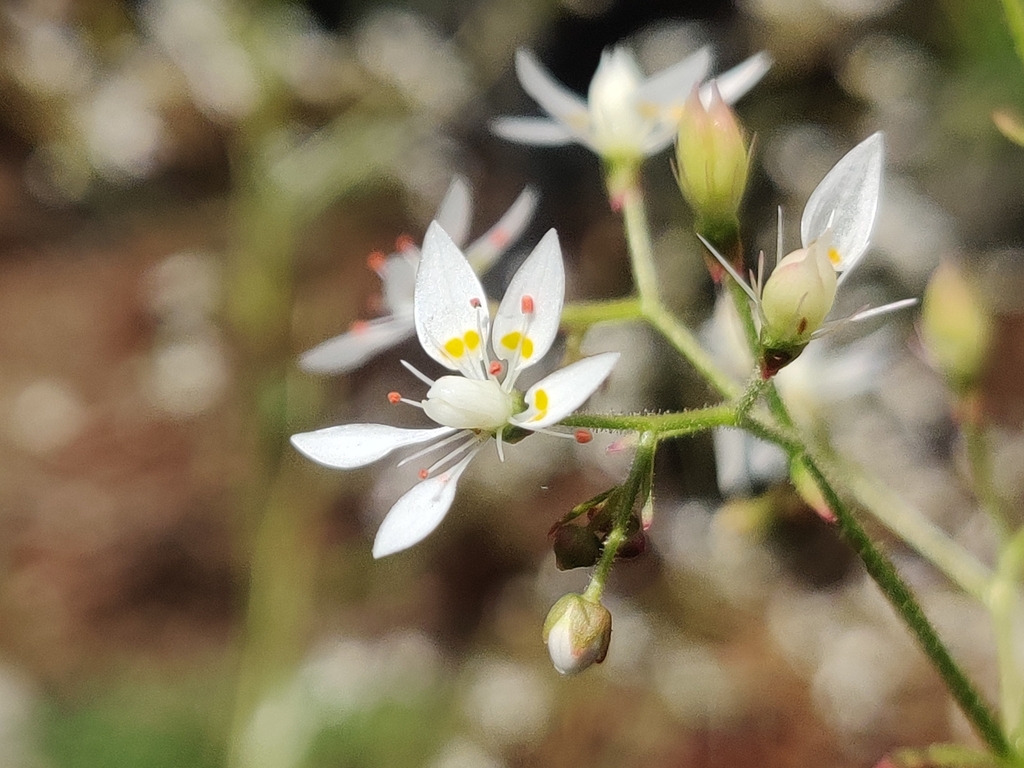
Saxifraga michauxii, known as Cliff Saxifrage or Michaux’s saxifrage (the USDA name), is a small perennial wildflower of rocky cliffs and outcrops in the southern Appalachian Mountains. It belongs to the saxifrage family (Saxifragaceae). Many newer references call it Micranthes petiolaris, and Weakley’s Flora of the Southeastern United States treats it as Hydatica petiolaris; all three names refer to the same plant.
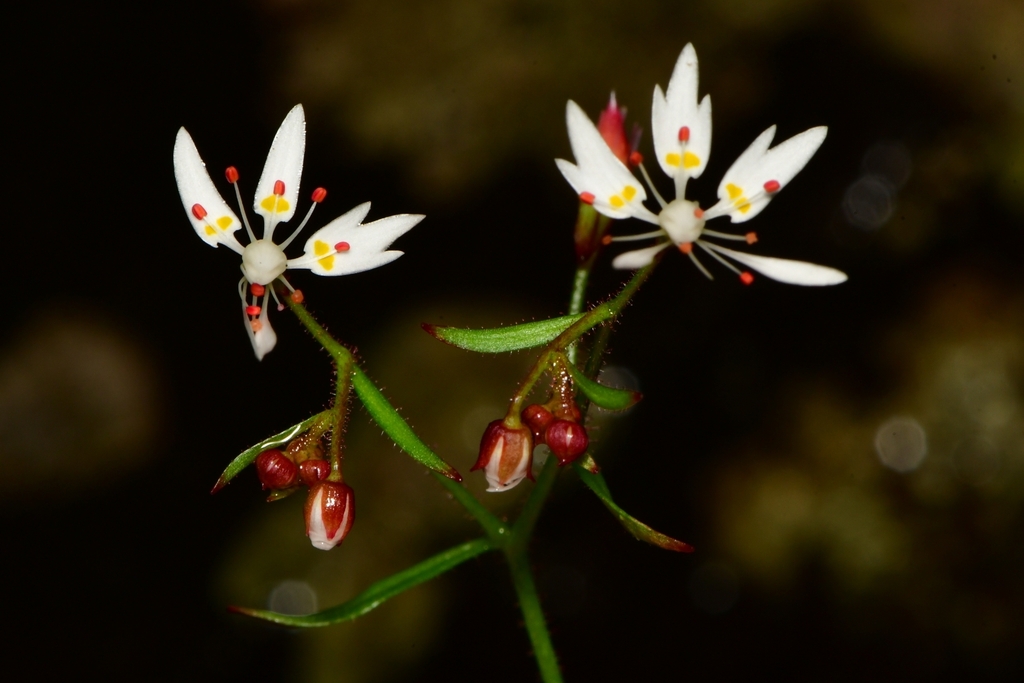
It forms a flat rosette of coarsely toothed, hairy leaves, often tinged red, wedged into rock crevices. In summer it sends up a sticky, branching stalk with many small, white, star-like flowers. Each flower has three broad petals marked with two yellow spots and two narrower, unspotted petals, a lopsided pattern that sets it apart from most other saxifrages.
Cliff saxifrage is a characteristic plant of high-elevation rock faces, seepy ledges and waterfall spray zones from Virginia and West Virginia to northern Georgia. It is rarely grown, but it is a delightful find for hikers along the Blue Ridge Parkway and other mountain trails in summer.
Identification
Look for a rosette of hairy, coarsely toothed leaves on rock, with a branching, sticky stalk of small white flowers whose three larger petals each carry two yellow spots.
Growth Habit
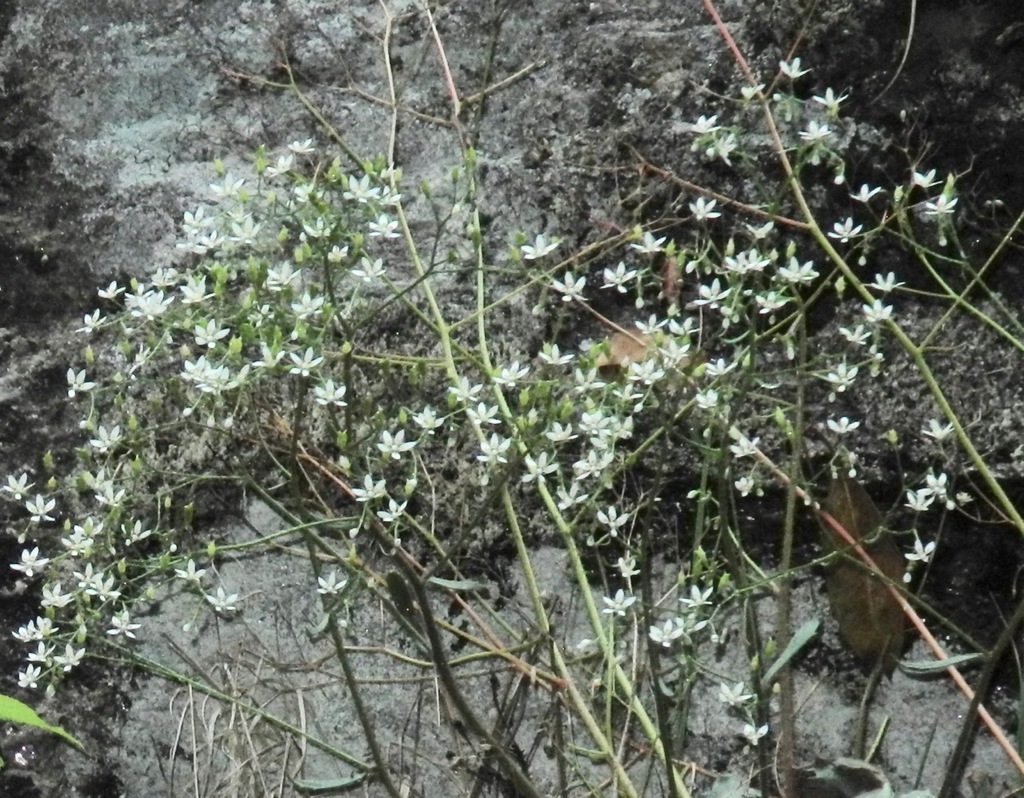
Cliff saxifrage is a herbaceous perennial that grows from a short rootstock. It forms a basal rosette of leaves, from which one or more branching, leafless flowering stalks rise 4 to 20 inches tall. The stalks are covered with sticky, glandular hairs. Plants usually grow singly or in small groups on rock.
Leaves
The leaves are all basal, oblong to spoon-shaped, about 2 to 6 inches long, narrowing to a broad, winged stalk. The edges have large, sharp, irregular teeth. Both surfaces are hairy, and the leaves are often red or purplish, especially underneath and in sun.
Flowers
Flowers appear from about late May to August, in an open, widely branching cluster. Each flower is about 1/2 inch across, with five white petals of unequal size: three broad, clawed petals each with two yellow (sometimes greenish) spots near the base, and two narrower, unspotted petals. The stamens and the developing fruit are often reddish.
Fruit & Seeds
The fruit is a small, two-beaked capsule, reddish when young, that splits open to release many tiny seeds. Fruits ripen in summer and fall.
Look-alikes
Early saxifrage (Micranthes virginiensis) also grows on rocks but blooms in early spring, with compact clusters of small white flowers whose petals are all equal and unspotted. Lettuce saxifrage (Micranthes micranthidifolia) grows along mountain streams and has long, lettuce-like leaves and tiny white flowers. Alumroots (Heuchera) have rounded, lobed leaves and tiny, bell-shaped flowers.
Safety Notes
Cliff saxifrage is not known to be toxic, but it is not a food plant. Its cliff habitat can be dangerous; view it from safe trails and overlooks.
Quick Facts
| Scientific Name | Saxifraga michauxii |
| Family | Saxifragaceae (saxifrage family) |
| Plant Type | Herbaceous perennial wildflower |
| Mature Height | 4–20 in (in flower) |
| Mature Spread | 4–8 in (rosette) |
| Growth Rate | Slow |
| Sun Exposure | Full sun to part shade |
| Water Needs | Moderate; seepy, well-drained rock |
| Soil Type | Thin, gritty soil in rock crevices; acidic |
| Soil pH | About 4.5–6.0 |
| Bloom Time | Late May–August |
| Flower Color | White with yellow spots |
| Fall Color | Leaves often red or purplish |
| Fruit | Small, two-beaked capsules |
| Deer Resistant | Yes; grows mostly out of reach on rock |
| USDA Hardiness Zones | 5–7 |
Native Range
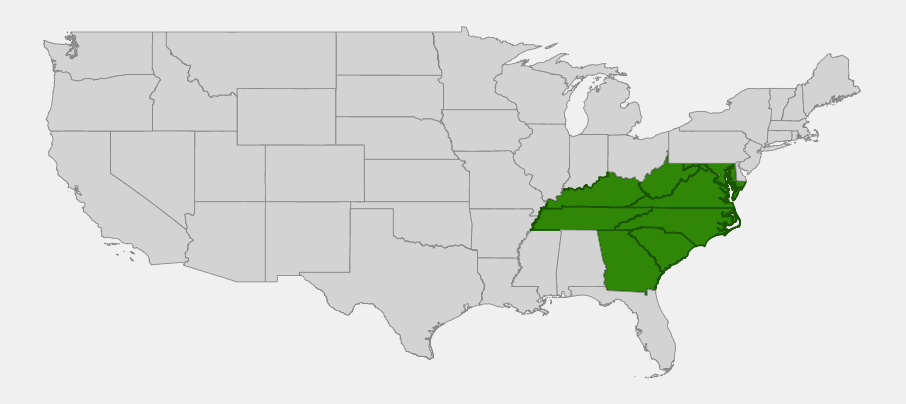
Cliff saxifrage is endemic to the southern and central Appalachian Mountains of the eastern United States. USDA PLANTS lists it as native in Georgia, Kentucky, Maryland, North Carolina, South Carolina, Tennessee, Virginia and West Virginia. It is not found in Canada or Mexico.
It is most common in the Blue Ridge of western North Carolina, southwestern Virginia and eastern Tennessee, including the Great Smoky Mountains, and reaches the mountains of northeastern Georgia and northwestern South Carolina. Records from eastern Kentucky, West Virginia and Maryland are at the northern and western edges of its range and are scattered and local.
Typical habitats are open, rocky places at middle to high elevations: cliffs, ledges and crevices of granite, gneiss and other acidic rocks, seepy rock faces, the spray zones of waterfalls, rocky summits and balds, and road cuts. It often grows where water trickles over rock but the roots never sit in standing water.
📋 Regional plant lists featuring Cliff Saxifrage: Alabama, Georgia & Mississippi · North & South Carolina · Maryland, Virginia & West Virginia · Kentucky & Tennessee
Growing & Care Guide
Cliff saxifrage is almost never sold and is a challenging plant outside its mountain home. It is best enjoyed in the wild. Never dig plants from cliffs or outcrops; they rarely survive transplanting, and their rocky habitats are fragile.
Light
In the wild it grows in full sun to partial shade on rock faces. In gardens, give it bright light with protection from hot afternoon sun.
Soil & Water
It needs a very gritty, acidic, fast-draining medium that stays evenly moist, like a seepy rock crevice. It dislikes both drought and soggy soil, and struggles in hot, humid lowland summers.
Planting Tips
Only specialist rock gardeners in cool, moist climates are likely to succeed, planting nursery- or seed-grown plants in a vertical crevice, tufa or a trough with gritty, acidic mix and protection from summer heat.
Pruning & Maintenance
Remove spent flowering stalks if you want to keep the rosette tidy. Keep the crown free of fallen leaves and debris that could cause rot.
Propagation
Grow it from seed. Sow the tiny seeds on the surface of a gritty mix in fall or winter and leave them outdoors for natural cold stratification. Collect seed only with permission and in small amounts, never by removing plants.
Landscape Uses
- Wildflower viewing: summer blooms on Blue Ridge cliffs, overlooks and waterfalls
- Specialist rock gardens: crevice or trough culture in cool climates
- Conservation: protect cliff and outcrop habitats from trampling
- Native plant study: an Appalachian endemic with unusual spotted petals
- Photography: striking star-shaped flowers against dark rock
Wildlife & Ecological Value
Cliff saxifrage is part of the specialized, fragile plant life of Appalachian cliffs and outcrops.
For Pollinators
The open, star-like flowers, with yellow spots that may act as nectar guides, are visited by small flies, small bees and other insects. The flowers are easy to reach for short-tongued insects.
For Birds
Birds do not feed heavily on the plant, but insects drawn to the flowers on cliffs feed small insect-eating birds.
For Mammals
Growing on steep rock faces, it is out of reach of most grazing animals.
Ecosystem Role
Cliff saxifrage is one of a small group of plants adapted to life on seepy, high-elevation rock faces. Together with mosses, lichens, ferns and other cliff plants, it helps build and hold the thin layers of soil in rock crevices. These cliff communities are sensitive to trampling and rock climbing.
Cultural & Historical Uses
Nathaniel Lord Britton gave the plant the name Saxifraga michauxii in honor of the French botanist André Michaux, who explored the southern Appalachians in the late 1700s and collected many of its plants. The plant had earlier been described as Saxifraga petiolaris by Constantine Rafinesque, which is the source of the names Micranthes petiolaris and Hydatica petiolaris used today.
Saxifraga comes from Latin words meaning “stone breaker,” for the habit of many species of growing in rock crevices. The genus Micranthes, now often separated from Saxifraga, includes most of the eastern North American saxifrages.
Hikers and photographers on the Blue Ridge Parkway, in the Great Smoky Mountains and around Highlands, North Carolina, know cliff saxifrage as one of the summer flowers that brighten wet rock faces and waterfall walls.
Frequently Asked Questions
Why does cliff saxifrage have several scientific names?
Botanists disagree about how to divide the saxifrages. USDA uses Saxifraga michauxii; many newer references use Micranthes petiolaris, and Weakley’s flora uses Hydatica petiolaris. All refer to the same plant.
How can I recognize cliff saxifrage?
Look for a rosette of hairy, coarsely toothed leaves on rock, and small white flowers whose three larger petals each have two yellow spots, while the two smaller petals are plain.
When does cliff saxifrage bloom?
From about late May to August, later than the spring-blooming early saxifrage.
Can I grow cliff saxifrage in my garden?
It is very difficult outside cool mountain climates and is almost never sold. Never dig it from the wild. Experienced rock gardeners may try seed-grown plants in a moist, gritty crevice.
Where can I see cliff saxifrage?
On cliffs, outcrops, seepy road cuts and waterfall walls in the southern Appalachians, such as along the Blue Ridge Parkway and in the Great Smoky Mountains.

Looking for a nursery that carries Cliff Saxifrage?
Browse our native plant nursery directory: Georgia · Kentucky & Maryland · North Carolina · South Carolina, Tennessee & Virginia · West Virginia

