
Carolina Woollywhite (Hymenopappus scabiosaeus)
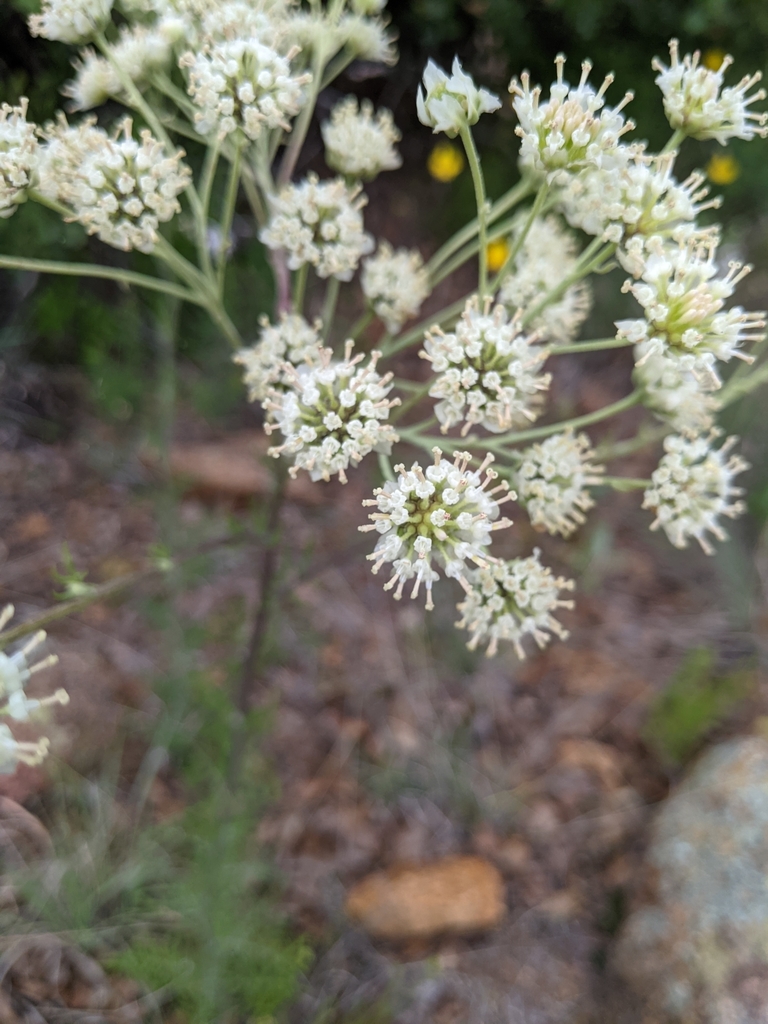
Hymenopappus scabiosaeus, known as Carolina Woollywhite or old plainsman, is a biennial wildflower of sandy prairies, open woods and roadsides across the southern Great Plains and the Southeast. It belongs to the aster family (Asteraceae).
In spring and early summer it raises branching stems 1 to 3 feet tall, occasionally taller, topped with loose, flat-topped clusters of rounded, creamy white flower heads. The heads have no ray petals; instead, each is cupped in papery bracts with broad white margins, giving the clusters a soft, frosted look. The leaves are deeply divided and often woolly underneath, especially on the first-year rosette.
Carolina woollywhite is common in Texas, Oklahoma and Kansas and scattered east through Missouri and Arkansas to Florida, Georgia and South Carolina, with outlying northern populations in sandy areas of Illinois and Indiana. It is a good native plant for sandy, sunny meadows and pollinator plantings, where it attracts many small bees and butterflies.
Identification
Look in spring for a branching plant on sandy, open ground with deeply divided leaves and loose clusters of rayless, creamy white flower heads cupped by white, papery bracts.
Growth Habit
Carolina woollywhite is a biennial or short-lived perennial. In its first year it forms a low rosette of divided leaves; in the second spring it sends up one or several stout, leafy, branching stems, usually 1 to 3 feet tall and sometimes up to about 4 or 5 feet. The plant dies after setting seed.
Leaves
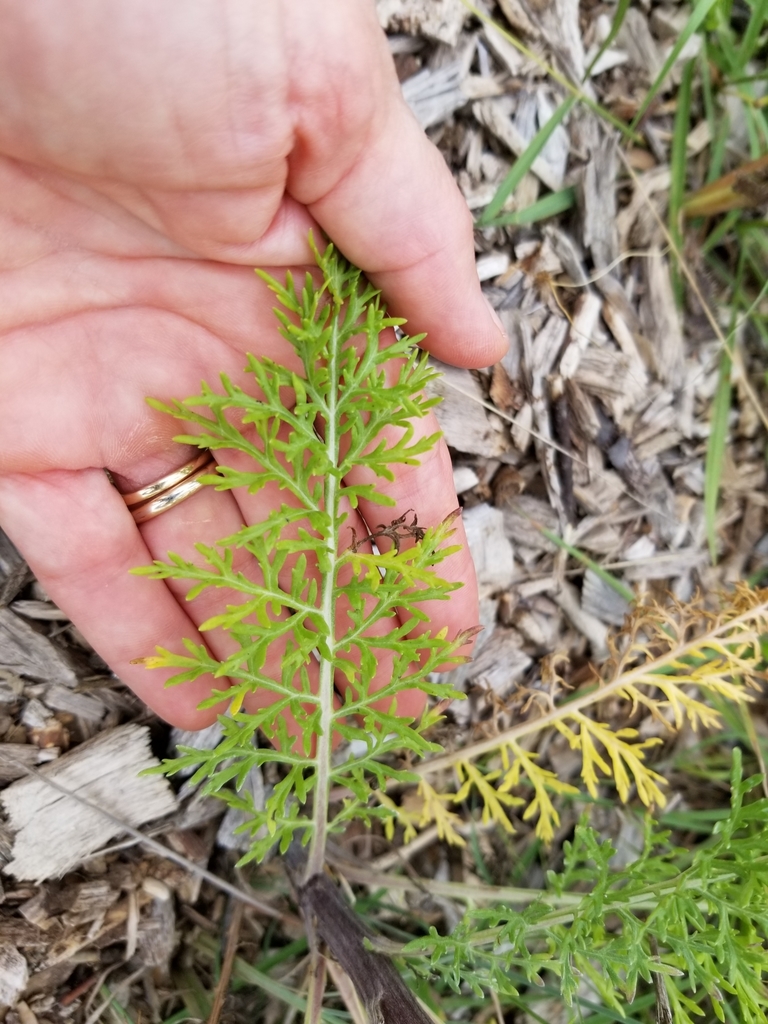
The basal and lower stem leaves are 2 to 6 inches long and pinnately divided once or twice into narrow segments, somewhat like a carrot or yarrow leaf. Upper leaves are smaller and less divided. Leaves are green and nearly smooth above and often grayish-woolly beneath, especially when young; the woolliness gives the plant its common name.
Flowers
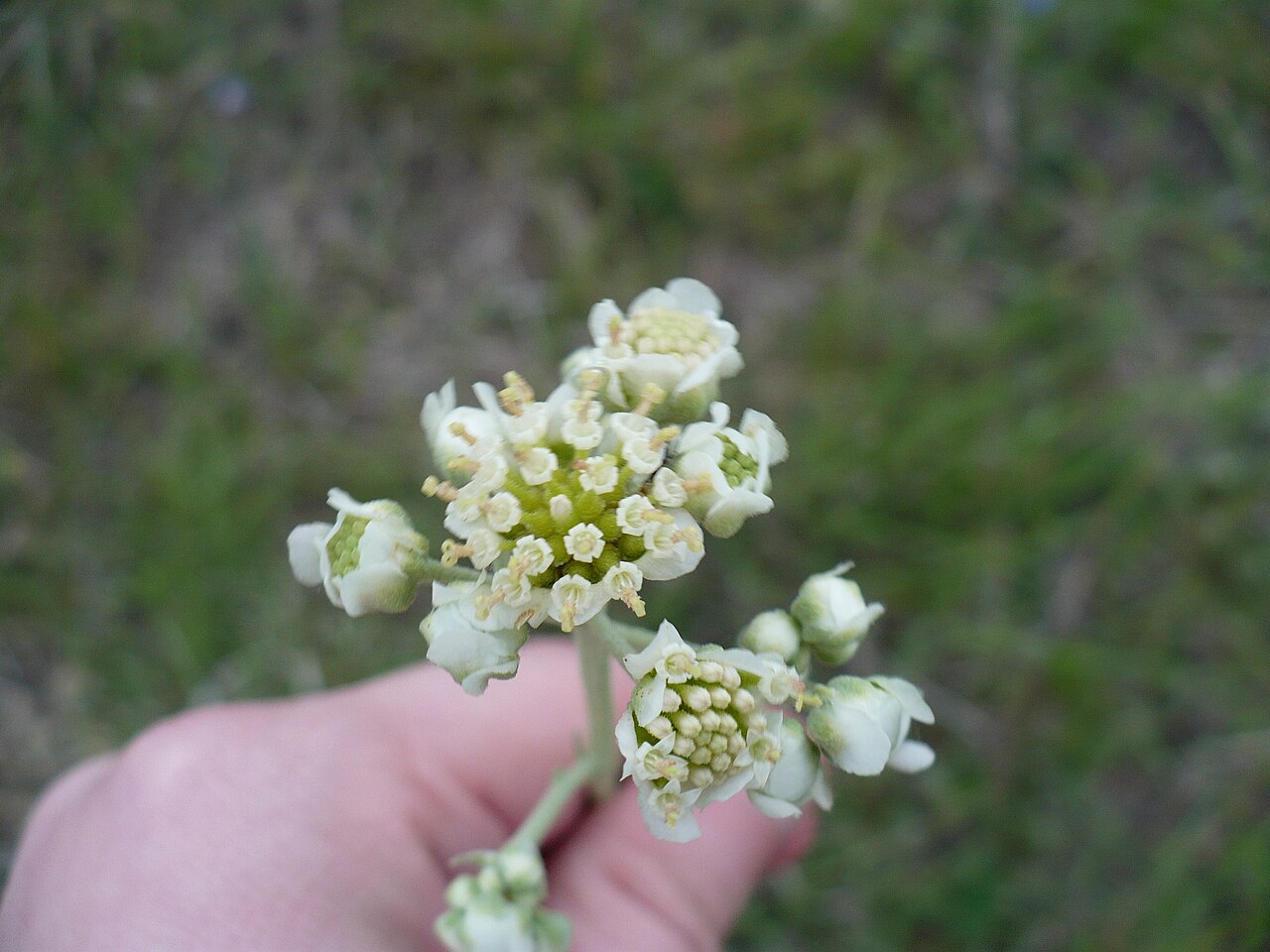
Flowers bloom from about March to July, mainly April to June. Rounded heads about 1/2 inch across are held in loose, flat-topped or rounded clusters at the branch tips. Each head has many small, tubular, white to cream disk flowers with dark anthers, and no rays. Surrounding each head are about 8 to 12 bracts with broad, white, papery, petal-like margins, which make the heads look like tiny white cups.
Fruit & Seeds
The fruits are small, four-sided, hairy achenes topped with a crown of short, papery scales. They ripen in early to midsummer and drop near the parent plant.
Look-alikes
Woolly-white (Hymenopappus artemisiifolius) of East Texas, Louisiana and Arkansas is very similar, and the two have sometimes been combined. It has its leaves crowded mostly near the base, a less leafy flowering stem, and disk flowers that are often pinkish or purplish. Wild carrot and other members of the carrot family have similar lacy leaves and white, flat-topped clusters, but their tiny flowers have five separate petals and are arranged in umbrella-like umbels. Yarrow has aromatic, feathery leaves and heads with small white rays.
Safety Notes
Carolina woollywhite is not known to be toxic, but it is not an edible plant. As with other members of the aster family, handling it may cause skin irritation in people sensitive to composites.
Quick Facts
| Scientific Name | Hymenopappus scabiosaeus |
| Family | Asteraceae (aster family) |
| Plant Type | Biennial wildflower |
| Mature Height | 1–3 ft (occasionally to 5 ft) |
| Mature Spread | 12–18 in |
| Growth Rate | Moderate (rosette first year, blooms second year) |
| Sun Exposure | Full sun to light shade |
| Water Needs | Low; dry to moderately moist soil |
| Soil Type | Sandy, gravelly or loamy; well-drained |
| Soil pH | About 5.5–8.0 |
| Bloom Time | March–July (mainly April–June) |
| Flower Color | White to cream |
| Fall Color | None; rosettes are green into winter |
| Fruit | Small, hairy achenes with papery scales |
| Deer Resistant | Moderately |
| USDA Hardiness Zones | 5–9 |
Native Range
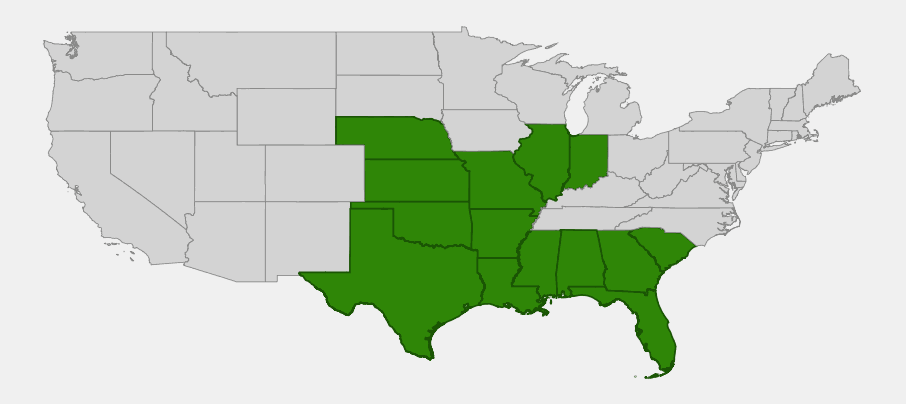
Carolina woollywhite is native to the south-central and southeastern United States. USDA PLANTS lists it as native in Alabama, Arkansas, Florida, Georgia, Illinois, Indiana, Kansas, Louisiana, Missouri, Mississippi, Nebraska, Oklahoma, South Carolina and Texas. It is not found in Canada.
It is most abundant on the sandy prairies and woodlands of central and eastern Texas, Oklahoma and southern Kansas, and in the sandhills of Georgia and Florida. It is scattered elsewhere. The populations in Illinois and Indiana are disjunct, on sand deposits and sand prairies in the northern parts of those states, and are considered rare there. The Louisiana record is an outlying USDA record.
Two varieties are usually recognized: var. scabiosaeus, mainly in the Southeast and Midwest, and var. corymbosus, the common form of the southern Great Plains and Texas. It grows on sandy prairies, sand hills, sandy oak and pine woodlands, glades, roadsides, old fields and other open, well-drained ground.
📋 Regional plant lists featuring Carolina Woollywhite: Ohio & Indiana · Nebraska, Kansas & Eastern Colorado · Illinois, Iowa & Missouri · Alabama, Georgia & Mississippi · North & South Florida · North & South Carolina · Arkansas, Louisiana, Eastern Oklahoma & Eastern Texas · South & West Texas
Growing & Care Guide
Carolina woollywhite is easy to grow from seed in sunny, sandy or well-drained ground and is sometimes included in native seed mixes for Texas and the southern Plains. As a biennial, it needs to reseed to stay in a planting.
Light
Full sun is best. It tolerates light shade in open woodland but flowers less and gets lanky.
Soil & Water
Plant it in sandy, gravelly or loamy, well-drained soil. It is drought tolerant once established and does not need extra water in most of its range. Avoid heavy, wet clay and regular irrigation, which can rot the rosettes over winter.
Planting Tips
Sow seed in fall on bare or lightly disturbed soil, so seedlings form rosettes over winter and the cycle starts right away. To have flowers every year, sow seed two years in a row or plant a mix of first- and second-year plants. It works well in meadow plantings with grasses such as little bluestem and spring wildflowers such as Indian blanket and coreopsis.
Pruning & Maintenance
No pruning is needed. Let at least some plants drop their seed before cutting the stems in summer. Keep areas near the plants open, since seedlings need bare soil and light to establish.
Propagation
Grow it from seed, which ripens in early to midsummer. Sow it fresh in fall outdoors, or store it dry and sow in late winter; seeds germinate without special treatment, though a short cold period can help. Plants transplant poorly once their taproot develops, so move only young rosettes.
Landscape Uses
- Sandy meadows and prairie plantings: a frothy white accent in spring
- Pollinator gardens: many small bees, flies, beetles and butterflies visit the flowers
- Roadside and rights-of-way seeding: thrives on sandy, disturbed ground
- Dry, sunny borders: a soft white contrast to bright spring wildflowers
- Restoration of sandhill and prairie sites: a native component of sandy grasslands
Wildlife & Ecological Value
Carolina woollywhite is a busy pollinator plant in spring, when its many small flowers offer easily reached nectar and pollen.
For Pollinators
The open, tubular disk flowers are visited by many small native bees, honey bees, wasps, flies, beetles and butterflies such as hairstreaks and skippers. The long bloom period in spring and early summer helps support pollinators between early spring flowers and summer bloomers.
For Birds
Seed-eating birds such as sparrows and finches may pick at the small achenes, and birds forage for insects that visit the flower clusters.
For Mammals
It is grazed lightly by deer and livestock, but it is not a major forage plant. Small mammals may eat the seeds.
Ecosystem Role
As a biennial that colonizes open, sandy ground, it helps fill gaps in prairies and woodland openings after fire or soil disturbance and contributes to the diversity of spring-blooming forbs that support pollinator communities.
Cultural & Historical Uses
The species was described in 1788 by the French botanist Charles Louis L’Héritier de Brutelle, who also named the genus. Hymenopappus means “membrane pappus,” for the thin, papery scales on top of the seeds. The species name scabiosaeus likens the flower heads to those of pincushion flowers (Scabiosa).
The common name “Carolina woollywhite” refers to the Carolinas, part of its southeastern range, and to the woolly hairs on its leaves. In Texas and Oklahoma it is widely called “old plainsman,” a name shared with its close relatives.
Its creamy, rayless flower heads make it easy to overlook among showier spring wildflowers, but native plant enthusiasts value it as a dependable early-season plant for sandy soils and pollinators.
Frequently Asked Questions
Why is it called woollywhite?
The leaves and young stems, especially the first-year rosette, are covered in grayish, woolly hairs, and the flower heads are white.
Is Carolina woollywhite the same as old plainsman?
Yes. “Old plainsman” is a common name used for Hymenopappus scabiosaeus in Texas and Oklahoma, and also for some related Hymenopappus species.
Is Carolina woollywhite a perennial?
It is usually a biennial: it forms a rosette the first year, blooms the second, and then dies after setting seed. It persists in plantings by reseeding.
How is it different from woolly-white (Hymenopappus artemisiifolius)?
The two are close relatives. Hymenopappus artemisiifolius has leaves mostly at the base and often pinkish or purplish disk flowers, while Carolina woollywhite has leafier stems and white to cream flowers.
Does Carolina woollywhite attract pollinators?
Yes. Its many small, open flowers attract small native bees, flies, beetles and butterflies in spring and early summer.

Looking for a nursery that carries Carolina Woollywhite?
Browse our native plant nursery directory: Alabama & Arkansas · Florida & Georgia · Illinois, Indiana & Kansas · Louisiana, Mississippi & Missouri · Nebraska & Oklahoma · South Carolina & Texas

