
Vanillaleaf (Carphephorus odoratissimus)
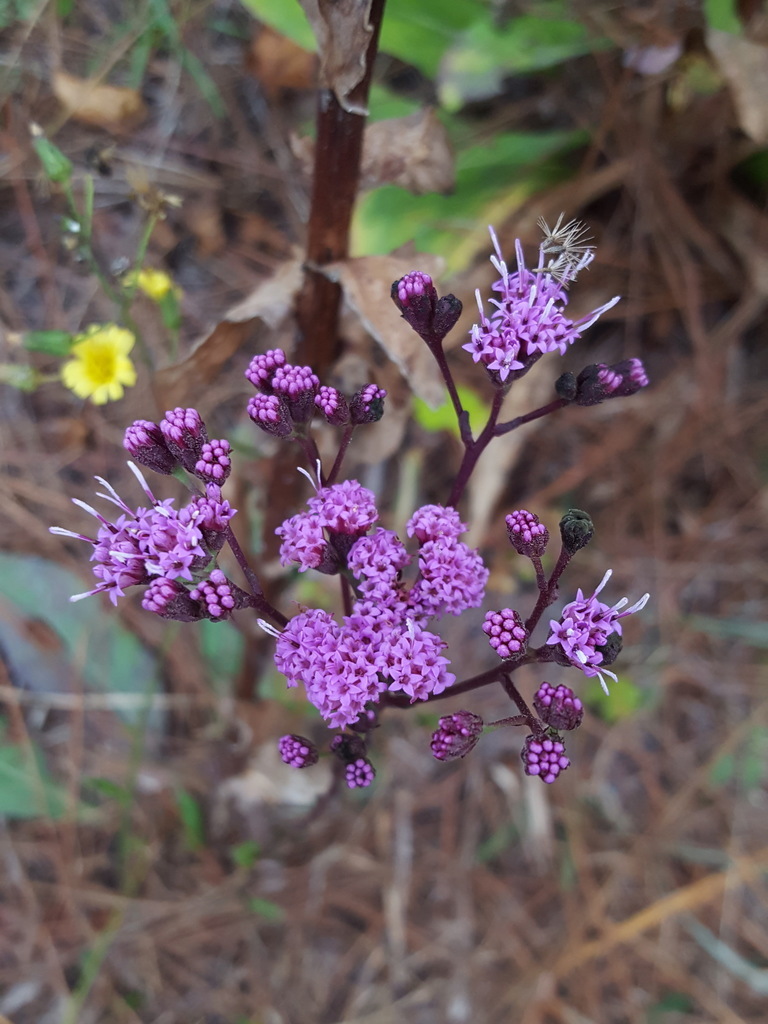
Carphephorus odoratissimus, known as Vanillaleaf, deer’s tongue or vanilla plant, is a late-blooming wildflower of the pine flatwoods and savannas of the southeastern Coastal Plain. It grows from a rosette of broad, smooth, fleshy leaves, and in late summer and fall sends up a purplish stem 2 to 5 feet tall that ends in a wide, branched cluster of small rose-purple to lavender flower heads.
Its names come from its leaves. Fresh, they have little odor, but as they dry they release a strong, sweet scent of vanilla, caused by the compound coumarin. For more than a century the dried leaves were gathered from southern pinelands and sold to flavor tobacco. The species belongs to the aster family (Asteraceae) and is closely related to the chaffheads (Carphephorus) and blazing stars (Liatris). Older references and some current floras, including iNaturalist, place it in the small genus Trilisa as Trilisa odoratissima.
Vanillaleaf is not the same plant as Vanilla Leaf (Achlys triphylla), an unrelated woodland plant of the Pacific Northwest whose dried leaves also smell of vanilla. This guide covers how to identify vanillaleaf, where it grows, how to grow it in a southern wildflower garden, and its long history in the tobacco trade.
Identification
In fall, vanillaleaf is one of the most conspicuous purple wildflowers of the southeastern pinelands. Its broad basal leaves, smooth stems and wide, flat-topped to rounded flower clusters set it apart from its relatives.
Leaves
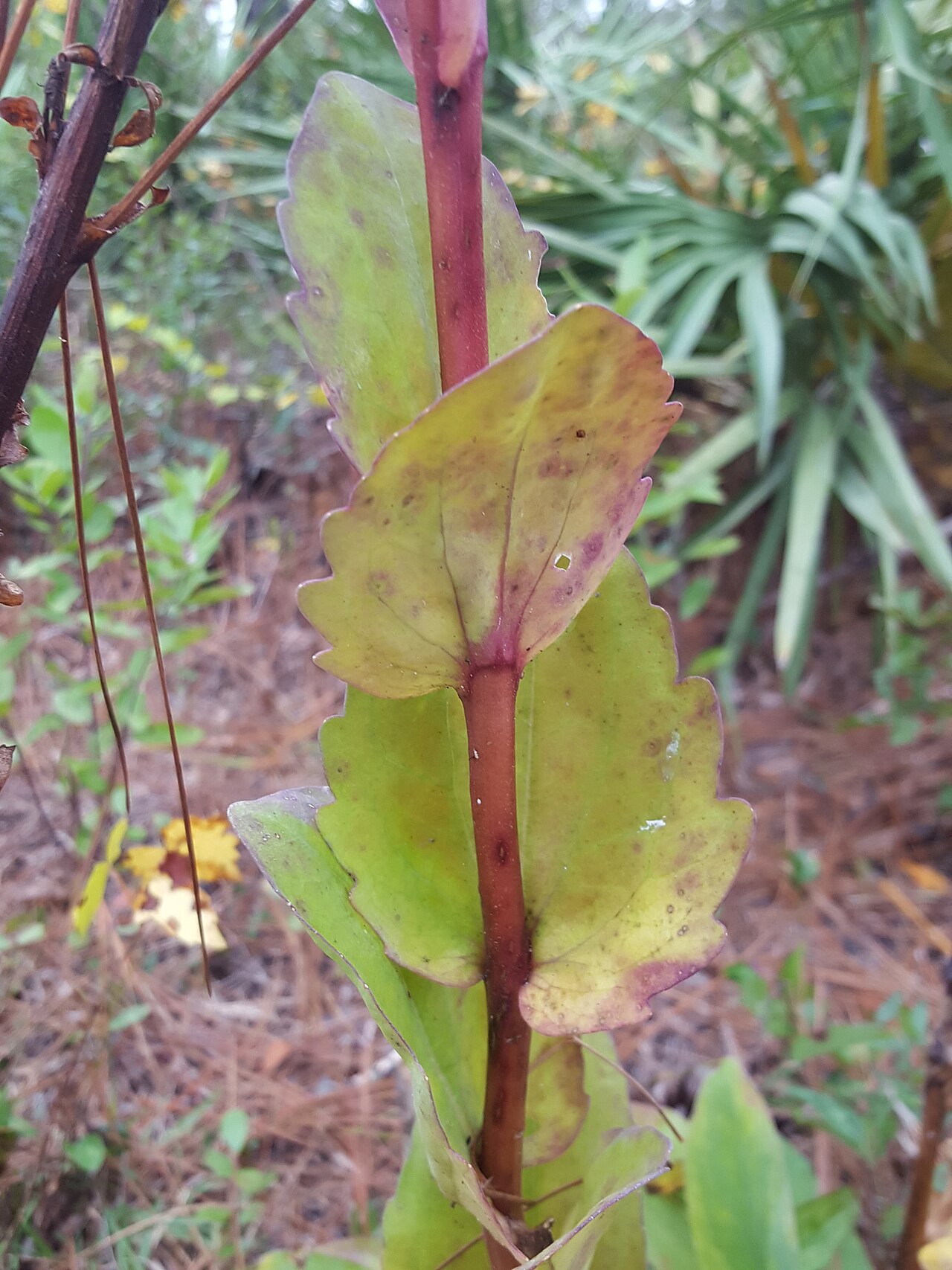
The basal leaves are large for a pineland wildflower: oblong to spoon-shaped, 4 to 10 inches or more long and up to 3 inches wide, thick, smooth and often slightly fleshy, with entire or faintly toothed edges. They are bright green to bluish green and form a loose rosette that persists through the year. The stem leaves are smaller, oval, and clasp the stem at their base, becoming much reduced toward the top. Crushed fresh leaves have only a faint scent, but dried leaves smell strongly of vanilla.
Stems
A single smooth flowering stem, 2 to 5 feet tall (occasionally taller), rises from the rosette in late summer. It is often purplish and sometimes has a whitish bloom, and it branches in the upper part to form the flower cluster.
Flowers
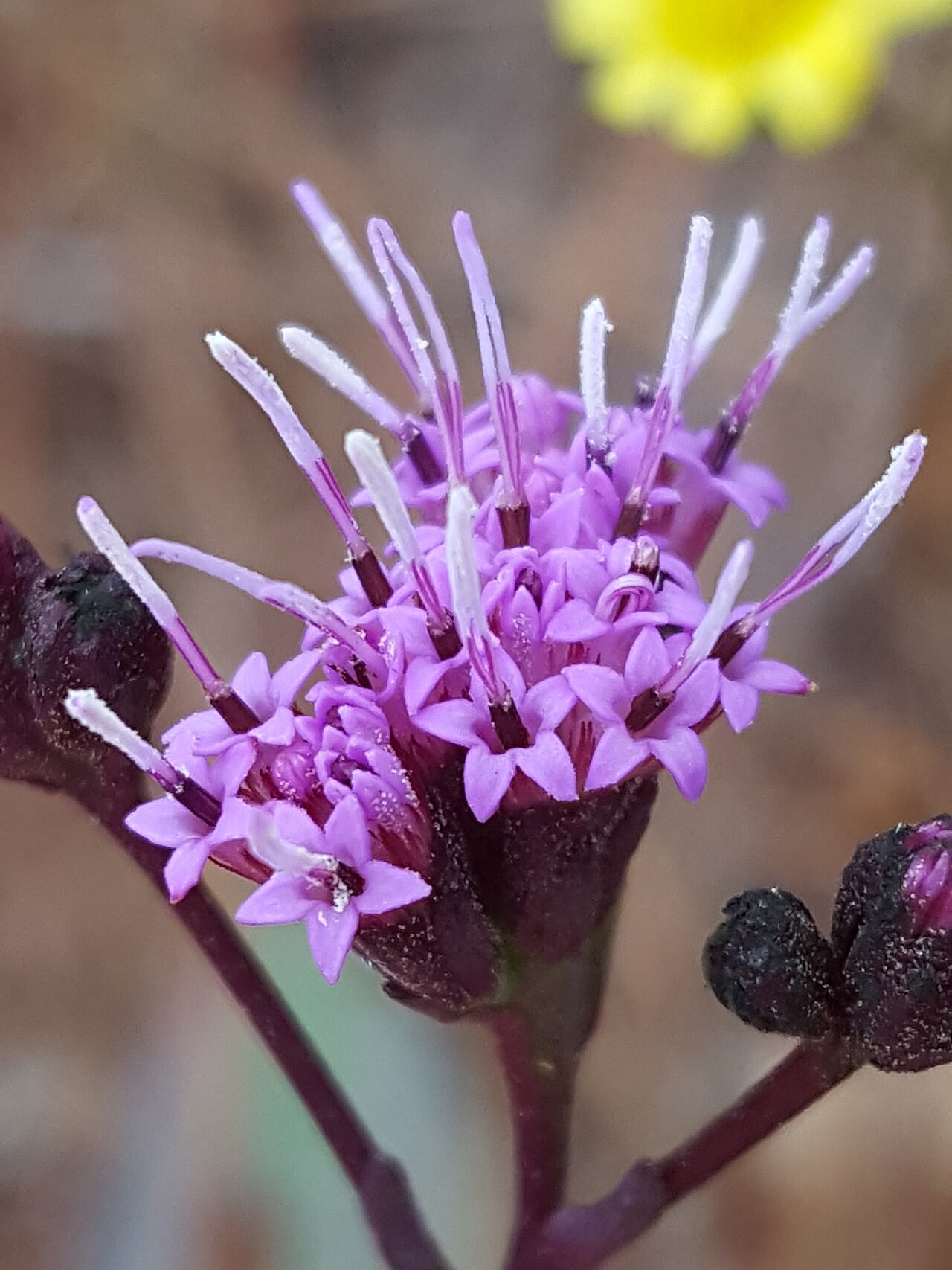
The flower heads are small, about ¼ inch across, with 7 to 10 tubular florets each and no ray flowers. The florets are rose-purple to lavender with long, threadlike styles that give the cluster a fuzzy look. Many heads are arranged in a broad, branched, flat-topped to rounded or pyramid-shaped cluster. Flowering runs from about August into October, with a peak in September and October.
Fruit & Seeds
Each floret produces a small, ribbed seed topped with a ring of tan bristles (pappus), which helps it drift on the wind. Unlike the related chaffheads, vanillaleaf has no chaffy scales among its florets, which is the main reason some botanists keep it in its own genus, Trilisa.
Look-alikes
Hairy Chaffhead (C. paniculatus) is similar in flower but has hairy, sticky stems and narrow leaves. Coastalplain Chaffhead (C. corymbosus) and Bristleleaf Chaffhead (C. pseudoliatris) have narrow or grass-like leaves and larger heads in a flat cluster. Pineland Chaffhead (C. carnosus) is a smaller Florida species. None has the broad, smooth basal leaves of vanillaleaf.
Quick Facts
| Scientific Name | Carphephorus odoratissimus (syn. Trilisa odoratissima) |
| Family | Asteraceae (aster family) |
| Plant Type | Herbaceous perennial |
| Mature Height | 2–5 ft in flower; basal leaves under 1 ft |
| Mature Spread | 1–2 ft |
| Growth Rate | Moderate |
| Sun Exposure | Full sun to light shade |
| Water Needs | Moderate to high; moist sandy soil |
| Soil Type | Acid sand or sandy peat; pine flatwoods soils |
| Soil pH | About 4.5–6.0 (acidic) |
| Bloom Time | August–October |
| Flower Color | Rose-purple to lavender |
| Fall Color | None; basal leaves persist |
| Fruit | Small ribbed seeds with tan bristles |
| Deer Resistant | Moderate; leaves are sometimes browsed |
| USDA Hardiness Zones | 8–10 |
Native Range
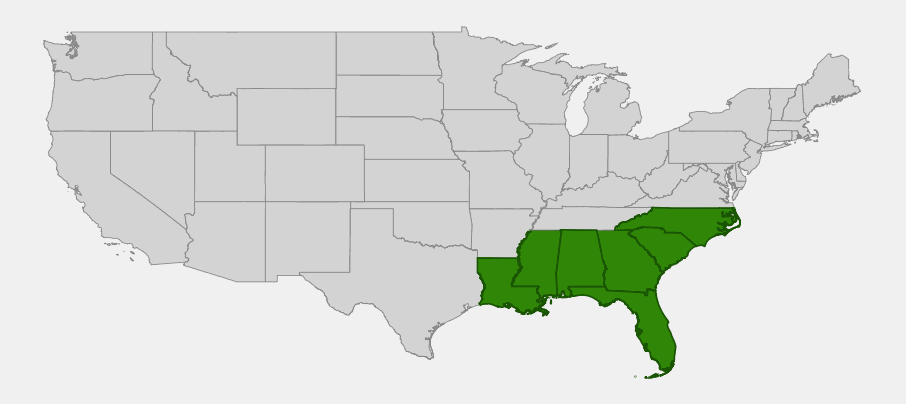
Vanillaleaf is native to the Coastal Plain of the southeastern United States. USDA PLANTS records it from North Carolina and South Carolina south through Georgia to Florida and west along the Gulf Coast through Alabama and Mississippi to Louisiana. It is most common in Florida, where it occurs through most of the peninsula and panhandle, and in southern Georgia and the outer Coastal Plain of the Carolinas.
It grows in pine flatwoods, longleaf pine savannas, wet to mesic pinelands, the edges of bay swamps and cypress domes, and moist, sandy clearings. It does best in open, fire-maintained pinelands with a ground cover of wiregrass and saw palmetto, and often flowers heavily in the year after a prescribed burn.
Florida plants vary, and botanists have separated plants of the central and southern Florida peninsula as var. subtropicanum, which some treat as a separate species. The typical form, var. odoratissimus, covers the rest of the range.
📋 Regional plant lists featuring Vanillaleaf: Alabama, Georgia & Mississippi · North & South Florida · North & South Carolina · Arkansas, Louisiana, Eastern Oklahoma & Eastern Texas
Growing & Care Guide
Vanillaleaf is a fine fall-blooming perennial for southern gardens that can imitate a pineland: sun, acid sand and moisture without stagnant water. It is only occasionally available from native plant nurseries in the Southeast, and it is easiest to establish from small, nursery-grown plants.
Light
Give it full sun or light, high shade such as the open canopy of pines. In heavy shade it flowers poorly and the stems lean.
Soil & Water
It needs acid, sandy soil that stays moist through much of the year, like the damp flatwoods where it grows wild. It tolerates short dry spells and seasonal wetness, but not compacted clay or alkaline soil. Do not fertilize; rich soil encourages weeds that will crowd it out.
Planting Tips
Set out plants in fall or early spring, spacing them about 1 to 1½ feet apart, among low grasses and other pineland wildflowers rather than in heavy mulch. Groups of several plants make a better show in fall than a single specimen.
Pruning & Maintenance
Leave the flowering stems standing until the seeds have dispersed, then cut them back. The basal leaves remain through winter. In larger plantings, burning or mowing in late winter mimics the fires of its native pinelands and keeps competition down.
Propagation
Sow fresh seed on the surface of moist sandy soil in fall. Germination can be uneven, and seedlings take a year or two to reach flowering size. Large clumps can occasionally be divided in winter. Do not dig plants from the wild; buy from nurseries that grow their own stock.
Landscape Uses
- Pineland and savanna gardens: a classic fall wildflower for gardens that recreate southern pine flatwoods
- Pollinator gardens: late-season nectar for butterflies and bees when few other plants are blooming
- Moist meadows and rain garden edges: suits moist, acidic, sandy soils at the margins of wet areas
- Fire-managed restoration: a characteristic forb of longleaf and slash pine flatwoods in its native range
- Fragrant leaves: dried leaves keep their vanilla scent and have long been used in sachets
Wildlife & Ecological Value
Vanillaleaf blooms late in the season, at a time when many pineland insects are looking for nectar before winter.
For Pollinators
The rose-purple flower clusters attract many butterflies, including skippers, sulphurs, gulf fritillaries and migrating monarchs, along with bees, wasps and flies. Like the related blazing stars, its long, slender florets suit butterflies especially well.
For Birds
Small seed-eating birds may take the seeds, and the flowers attract insects that feed birds of the pinelands, such as Bachman’s sparrows and eastern bluebirds.
For Mammals
Deer occasionally browse the leaves, and the plants are otherwise of minor importance to mammals.
Ecosystem Role
Vanillaleaf is adapted to frequent fire. Its rosettes survive burns and resprout quickly, and flowering is often heaviest in the year after a fire. Its presence is a sign of an open, fire-maintained pineland ground cover.
Cultural & Historical Uses
The species was first described in the eighteenth century, and its species name, odoratissimus, means “most fragrant.” Its scent comes from coumarin, the same compound that gives sweetgrass, sweet woodruff and tonka beans their vanilla-like smell.
The dried leaves, called deer’s tongue in the trade, were long collected from the wild in Florida, Georgia and the Carolinas and sold to tobacco companies, who used them to flavor pipe and cigarette tobacco. People in rural pineland communities gathered and cured the leaves for cash income. They were also used to scent linens and keep insects out of clothing.
Coumarin can damage the liver if consumed in quantity, and it is restricted as a food and flavoring additive in the United States. Vanillaleaf should not be used to make teas or flavorings. Its value today is as a beautiful fall wildflower and a reminder of the cultural history of the southern pinelands.
Frequently Asked Questions
Why is it called vanillaleaf?
Its dried leaves give off a strong vanilla-like scent, caused by the compound coumarin. Fresh leaves have little smell.
Is vanillaleaf the same as vanilla leaf (Achlys triphylla)?
No. Achlys triphylla is an unrelated plant of Pacific Northwest forests in the barberry family. Both have dried leaves that smell of vanilla, which explains the shared name.
Is it Carphephorus or Trilisa?
Both names are in use. USDA PLANTS lists it as Carphephorus odoratissimus, while some floras and iNaturalist use Trilisa odoratissima. They refer to the same plant.
When does vanillaleaf bloom?
From late summer into fall, mostly August to October. It is one of the showiest fall wildflowers in southern pinelands.
Can I use vanillaleaf for flavoring?
No. Coumarin can harm the liver and is restricted as a food additive in the United States. Enjoy the scent of dried leaves in sachets, but do not eat them or make tea from them.

Looking for a nursery that carries Vanillaleaf?
Browse our native plant nursery directory: Alabama · Florida & Georgia · Louisiana & Mississippi · North Carolina · South Carolina

