
Sea Bindweed (Calystegia soldanella)
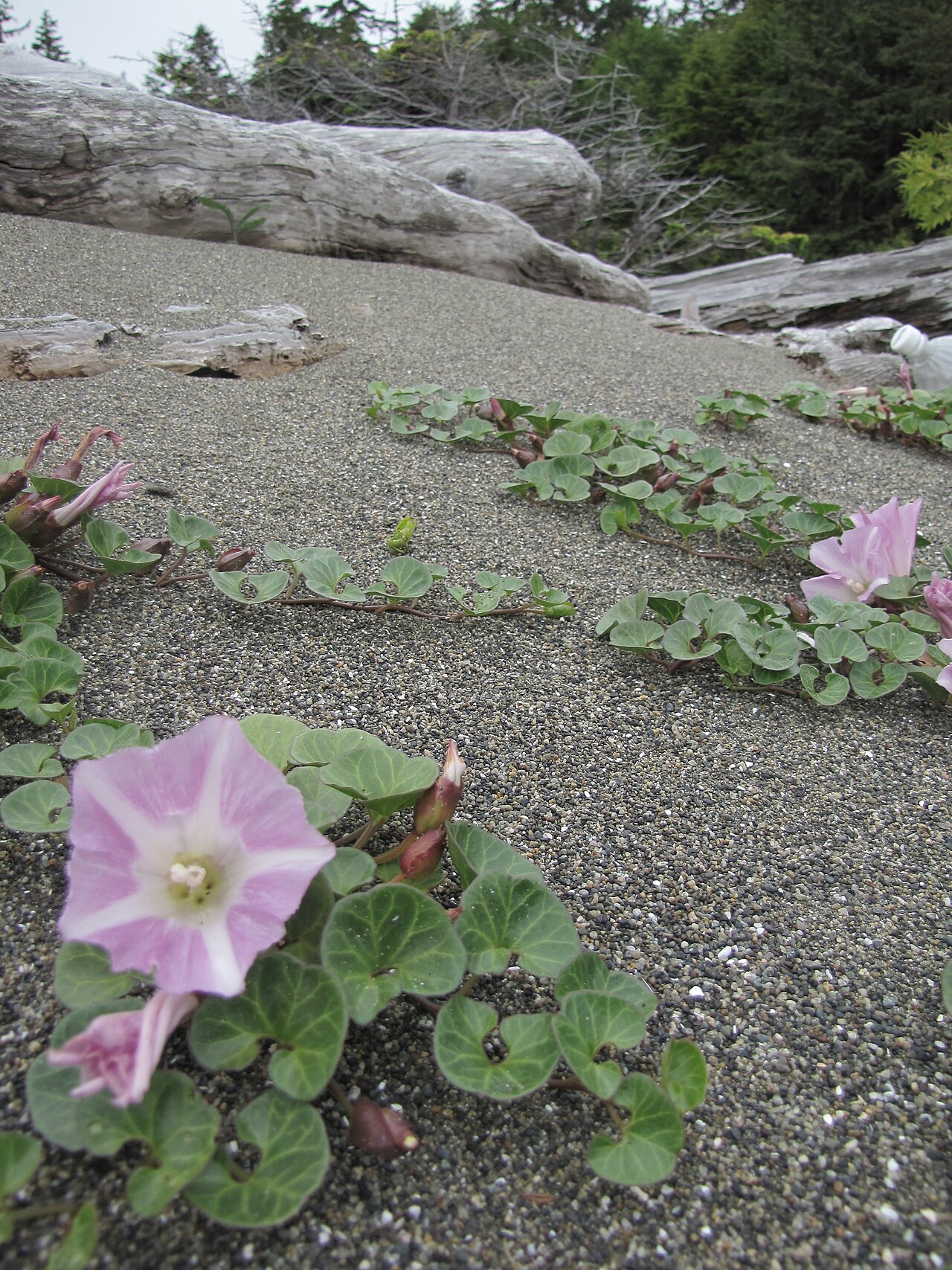
Calystegia soldanella, known as Sea Bindweed, beach morning glory, shore bindweed or seashore false bindweed, is a low, trailing perennial of the morning glory family (Convolvulaceae) that grows on sandy beaches and coastal dunes. In North America it is mainly a plant of the Pacific coast, from British Columbia south through Washington and Oregon to southern California, with a few small, scattered populations on Atlantic beaches in Virginia and North Carolina.
Unlike its climbing relatives, sea bindweed does not twine. Its fleshy stems creep across the sand from deep, spreading underground rhizomes, carrying thick, glossy, kidney-shaped leaves and large, funnel-shaped pink flowers striped with white. On a cool, gray coastal morning the flowers stand out against the sand like small pink trumpets.
Sea bindweed is one of the native pioneer plants of the upper beach and foredune, where its runners help hold loose sand. It is a good plant for coastal native gardens and dune restoration, but it needs pure sand, sun and good drainage. This guide covers how to identify it, where it grows, how to grow it, and its value for wildlife.
Identification
Look for a low mat of thick, shiny, kidney-shaped leaves on beach sand, with pink-and-white morning glory flowers held just above the leaves. The stems lie on the ground and do not climb.
Growth Habit
Sea bindweed is a herbaceous perennial that spreads by deep, white, branching rhizomes buried in the sand. From these it sends up short, trailing or sprawling stems, usually 4 to 20 inches long, that lie flat on the sand and rarely rise more than a few inches. Over time one plant can form a loose patch several feet across. The stems contain a milky sap, as in many members of the morning glory family.
Leaves
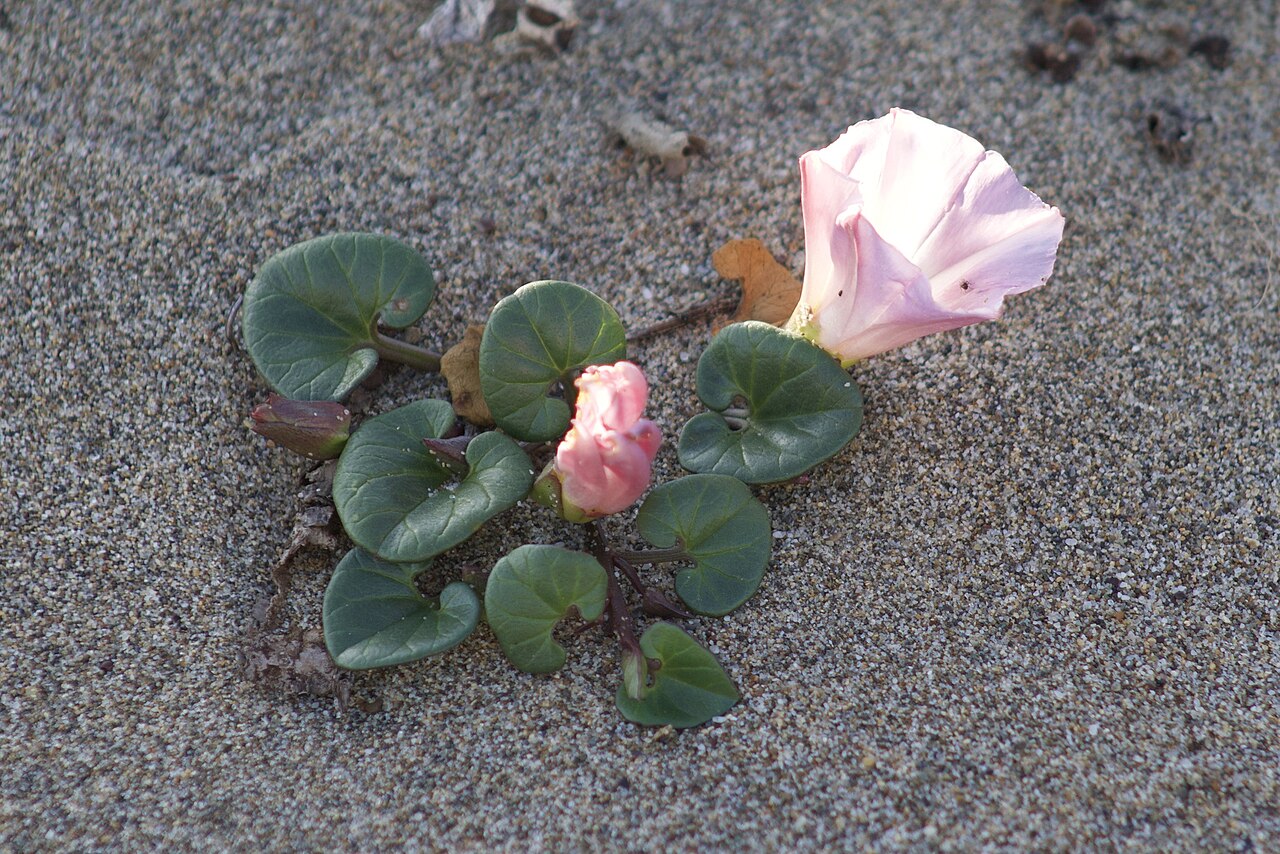
The leaves are the easiest way to recognize it even when it is not in bloom. They are thick, somewhat fleshy and glossy, kidney-shaped to broadly heart-shaped, about 1 to 2 inches wide and often wider than long, with a smooth or slightly wavy edge. They sit on long stalks, so the blades are held up and facing the sun. The fleshy leaves help the plant cope with salt spray and dry sand.
Flowers
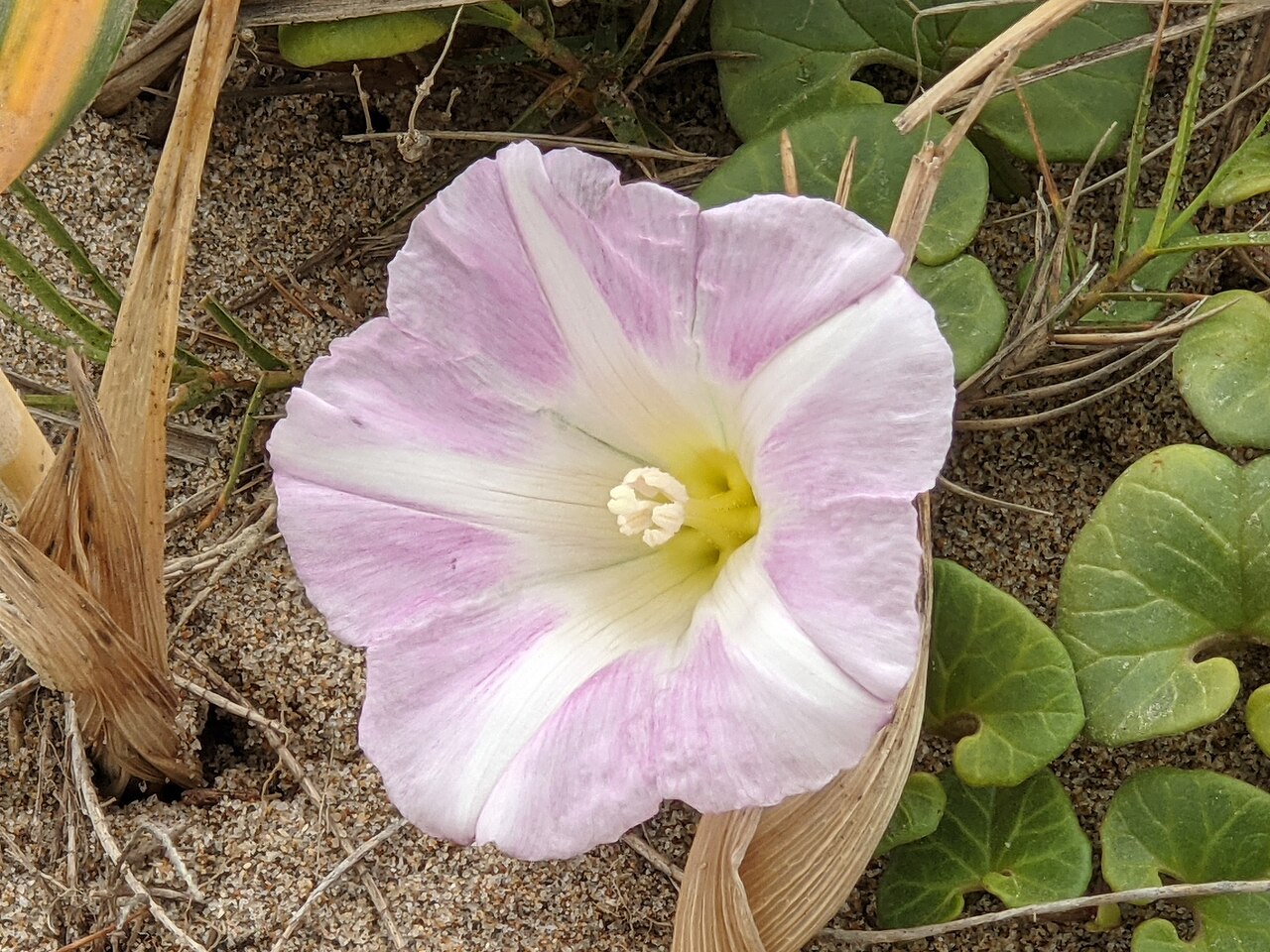
The flowers are single, on long stalks from the leaf axils. Each one is a broad funnel 1 1/2 to 2 inches across, pink to rose-lavender with five pale or white stripes radiating from a white to yellowish throat. Two large, rounded, green bracts sit just below the flower and hide the small sepals, a feature of the genus Calystegia. In California and the Pacific Northwest it blooms mainly from April to September.
Fruit & Seeds
After flowering it forms a round capsule about 1/2 inch long, enclosed by the persistent bracts, holding up to four large, dark seeds. The seeds can float in seawater, which helps the species spread along coastlines.
Look-alikes
On Pacific beaches the closest look-alike is another bindweed, but upland species such as chaparral false bindweed (Calystegia occidentalis) grow away from the beach, have narrower, arrow-shaped leaves and white to cream flowers, and twine over shrubs. In the Southeast, railroad vine (Ipomoea pes-caprae) also creeps across dunes, but it has notched, two-lobed leaves and deep magenta flowers, and its runners can grow many feet long.
Quick Facts
| Scientific Name | Calystegia soldanella (L.) R. Br. |
| Family | Convolvulaceae (morning glory family) |
| Plant Type | Trailing herbaceous perennial with deep rhizomes |
| Mature Height | 2–6 in |
| Mature Spread | 1–3 ft or more (spreads by rhizomes) |
| Growth Rate | Moderate |
| Sun Exposure | Full sun |
| Water Needs | Low |
| Soil Type | Loose, sharply drained beach or dune sand |
| Soil pH | About 6.0–8.0 |
| Bloom Time | April–September |
| Flower Color | Pink to rose-lavender with white stripes |
| Fall Color | None; leaves die back in cold winters |
| Fruit | Round capsule with up to 4 large dark seeds |
| Deer Resistant | Not well documented |
| USDA Hardiness Zones | 7–10 |
Native Range
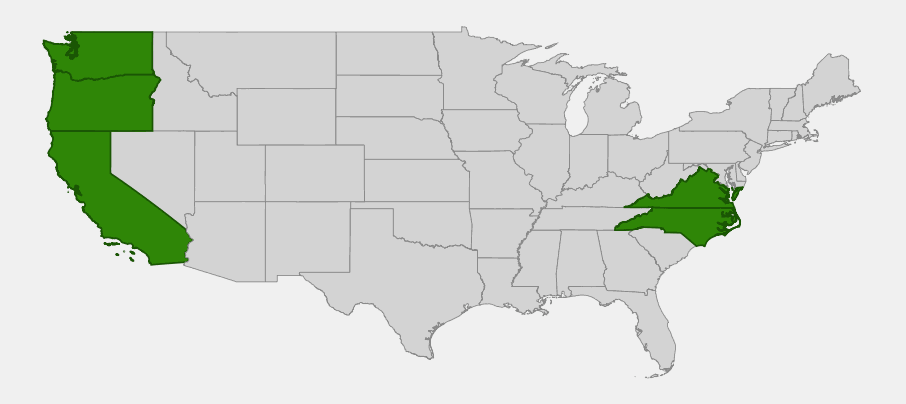
Sea bindweed grows on temperate coasts around much of the world, including Europe, East Asia, Australia, New Zealand and South America. In North America, USDA PLANTS lists it as native to California, Oregon and Washington on the Pacific coast, and to Virginia and North Carolina on the Atlantic coast. It also grows on the coast of British Columbia.
Its main range is the Pacific shoreline, from Vancouver Island and the outer coast of Washington south along the Oregon dunes and the California coast to southern California. The Atlantic populations are small and scattered. Herbarium specimens document it on dunes of the Eastern Shore of Virginia in Accomack County, and there are scattered records from the Outer Banks area of North Carolina. These outlying eastern records are far from the main range and are rare.
It grows almost exclusively on sand near the ocean: on the upper beach above the high-tide line, on foredunes and in open dune hollows. It tolerates salt spray, wind and shifting sand, and its rhizomes can grow upward when sand buries them.
📋 Regional plant lists featuring Sea Bindweed: Maryland, Virginia & West Virginia · North & South Carolina · Western Oregon & Western Washington · California & Nevada
Growing & Care Guide
Sea bindweed is a specialist of beach sand. It is a good choice for coastal gardens, dune restoration and sandy seaside landscapes on the Pacific coast, where it forms a low, flowering groundcover. Inland, in heavy or rich garden soil, it rarely does well.
Light
Plant it in full sun. In the wild it grows on open sand with no shade at all, and it flowers poorly in shade.
Soil & Water
It needs loose, deep, sharply drained sand. It tolerates salt spray, salty sand and poor soil, and it does not need fertilizer. Once established it needs little or no supplemental water in coastal climates, because its deep rhizomes reach moisture below the surface. Rich, heavy or constantly wet soil causes rot.
Planting Tips
Plant it in spring in pure sand or a very sandy mix, on a dune, sandy bank or large container. Give it room to spread; it moves slowly outward by rhizomes. It combines well with dunegrass, sand verbenas and beach strawberry. Never dig plants from beaches or dunes. Many dune areas are protected, and digging damages the dune. Buy plants or seed from native plant nurseries.
Pruning & Maintenance
It needs almost no care. Remove weeds such as European beachgrass or iceplant that can crowd it out. Its stems may die back in winter in colder areas and regrow in spring from the rhizomes. It does not climb, so it will not smother nearby plants the way some weedy bindweeds do.
Propagation
Grow it from seed or from rhizome cuttings. The seeds have a hard coat; nick or sand them, or soak them in warm water before sowing, and sow in sand. Pieces of rhizome with a growing point can be planted in moist sand in spring.
Landscape Uses
- Coastal gardens: a low, flowering groundcover for sandy seaside gardens
- Dune restoration: a native pioneer that helps hold loose sand on upper beaches and foredunes
- Pollinator plantings: large pink flowers visited by bees on the coast
- Containers: can be grown in a deep, sandy container in a sunny spot
- Wild areas: a characteristic plant of Pacific beaches to look for on coastal walks
Wildlife & Ecological Value
Sea bindweed is part of the small, specialized community of native plants that can live on open beach sand, where few other plants survive.
For Pollinators
The large, open flowers are pollinated by insects, mainly bees, which crawl into the funnel to reach the nectar at the base. On cool coastal days, the flowers can stay open most of the day.
For Birds
It is not a major bird food, but the low cover of dune plants shelters insects that shorebirds and songbirds eat along the upper beach.
For Mammals
Small mammals of the dunes may shelter among dune vegetation. Sea bindweed is not known as an important food plant for mammals.
Ecosystem Role
Its deep rhizomes and creeping stems help trap and stabilize wind-blown sand on the upper beach and foredune. Native dune plants like sea bindweed have declined in many areas where European beachgrass and iceplant have taken over, so protecting and restoring them helps keep native dune ecosystems healthy.
Cultural & Historical Uses
The genus name Calystegia comes from Greek words meaning “cup” and “cover”, for the two large bracts that cover the calyx. The species name soldanella refers to the rounded leaves, which resemble those of Soldanella, a small alpine plant of Europe. Linnaeus first named it Convolvulus soldanella, and some recent references have returned it to the genus Convolvulus.
Because it grows on coasts in both hemispheres, sea bindweed is one of the most widely distributed beach plants in the world. Its seeds float, and scientists think ocean currents helped carry it along coastlines over long periods.
In Scotland it is called the Prince’s Flower. According to local tradition on the island of Eriskay, Prince Charles Edward Stuart sowed its seeds there when he landed in 1745 at the start of the Jacobite rising.
Frequently Asked Questions
Is sea bindweed native to North America?
Yes. USDA PLANTS lists it as native in California, Oregon, Washington, Virginia and North Carolina, and it also grows in British Columbia. Its main range is the Pacific coast; the Atlantic populations are small and rare.
Is sea bindweed invasive like field bindweed?
No. Sea bindweed is a native beach plant that spreads slowly by rhizomes and does not climb. It is unrelated to the weedy behavior of field bindweed (Convolvulus arvensis), an introduced plant from Europe and Asia.
When does sea bindweed bloom?
On the Pacific coast it blooms mainly from April to September, with the most flowers in late spring and early summer.
Can I grow sea bindweed in my garden?
Yes, if you have deep, sandy, well-drained soil and full sun, ideally near the coast. It does poorly in heavy or rich soil.
How is it different from railroad vine?
Railroad vine (Ipomoea pes-caprae) of southern beaches has notched, two-lobed leaves, deep magenta flowers and very long runners. Sea bindweed has kidney-shaped leaves, paler pink striped flowers and shorter stems.

Looking for a nursery that carries Sea Bindweed?
Browse our native plant nursery directory: California · North Carolina · Oregon · Virginia · Washington

