
Touch-me-not Balsam (Impatiens noli-tangere)
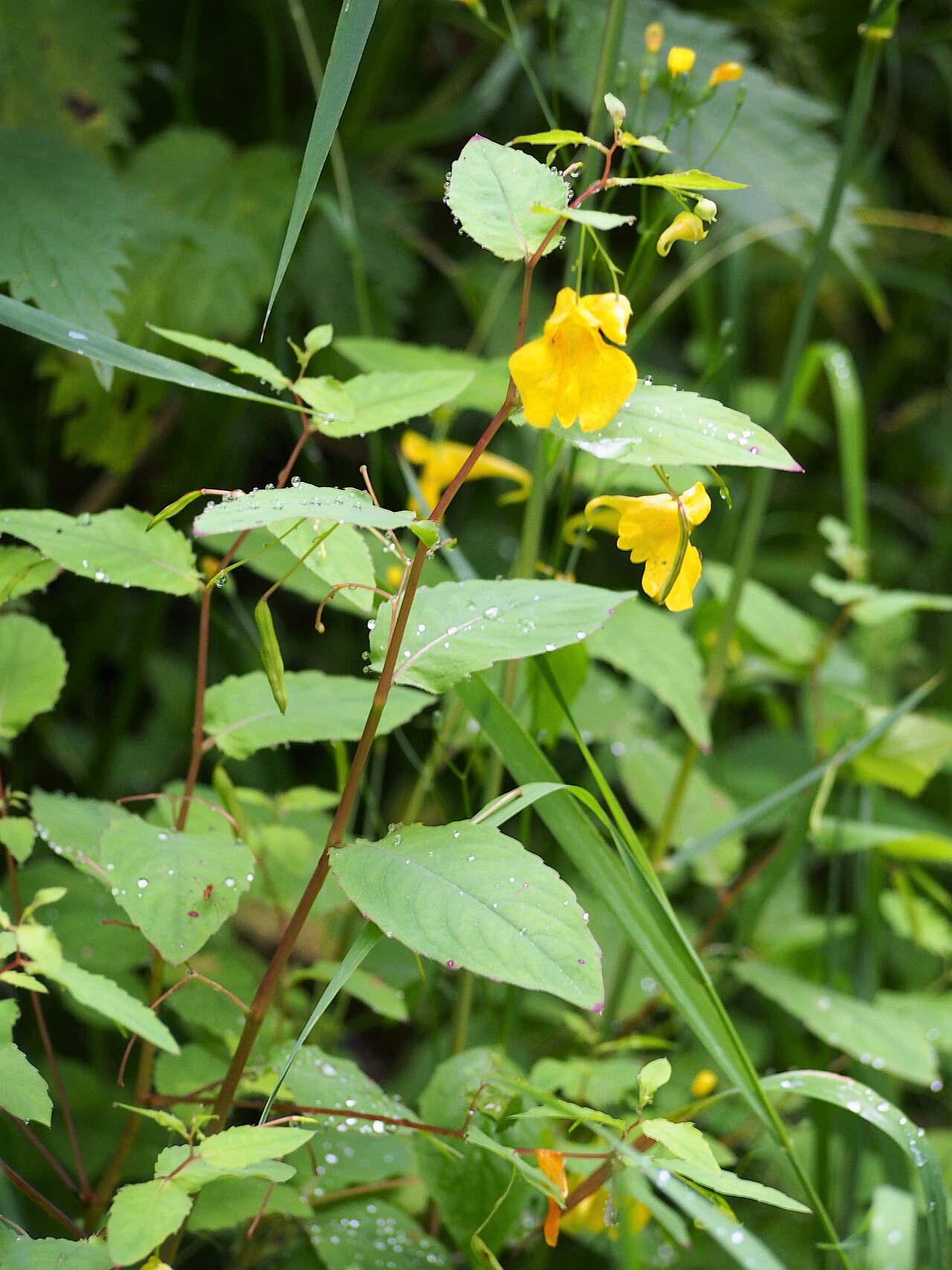
Impatiens noli-tangere, Touch-me-not Balsam, is a native annual jewelweed with bright yellow, slipper-shaped flowers. In North America it is often called western touch-me-not or yellow balsam, since its American range lies in Alaska, western Canada and the Pacific Northwest, far from the eastern jewelweeds most gardeners know. It is also native across Europe and northern Asia, which makes it one of the few jewelweeds found on both sides of the Pacific.
Both of its names refer to the seed pods. Impatiens means “impatient,” and noli tangere is Latin for “do not touch.” When the slender pods are ripe, the slightest touch makes them split and curl back in an instant, flinging the seeds several feet. Children (and plenty of adults) find them irresistible.
Touch-me-not balsam grows in cool, moist, shady places: stream banks, wet woods, alder and willow thickets, and spring seeps. It is a short-lived but self-sustaining plant that reseeds every year. This guide covers how to tell it apart from the other jewelweeds and the invasive balsams of the West, where it grows in the United States, how to grow it in a shade or rain garden, and what it does for bumblebees and other wildlife.
Identification
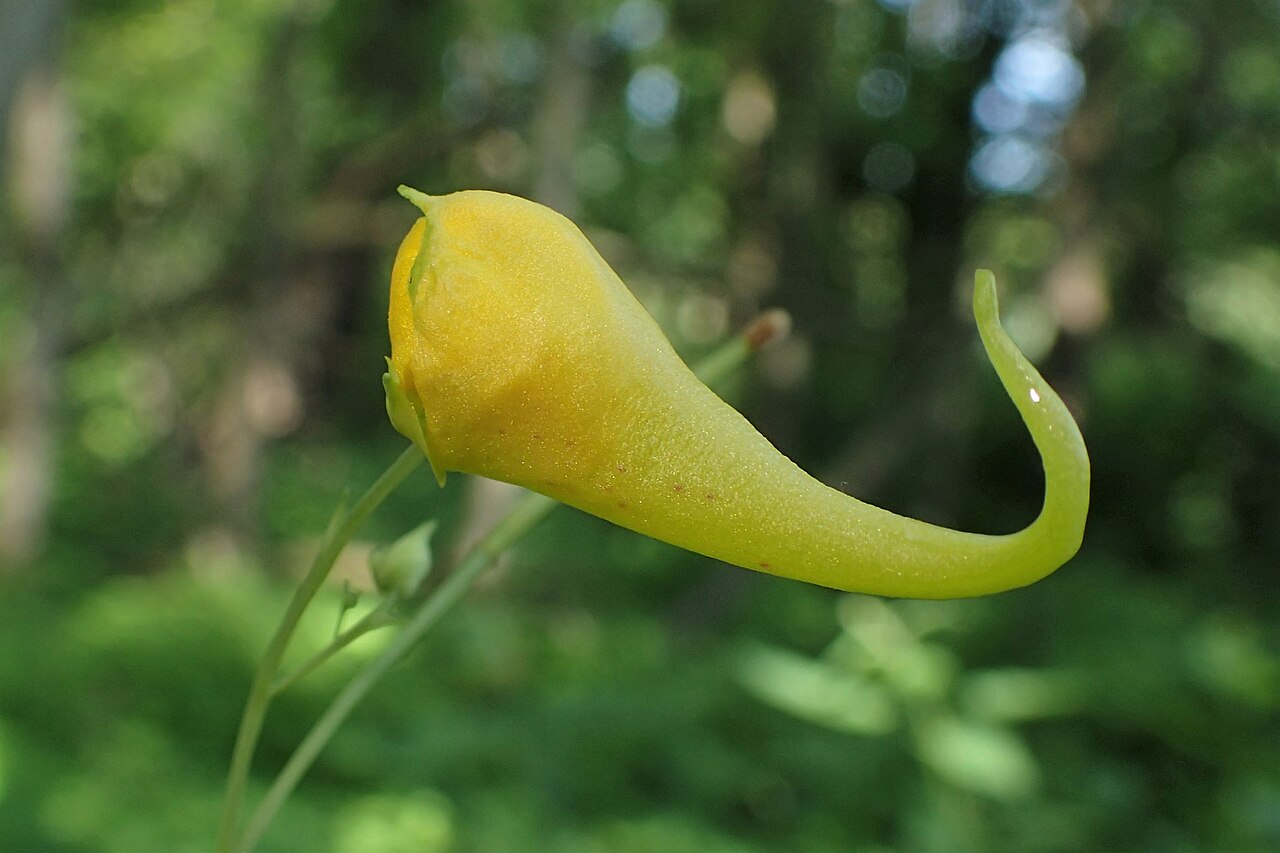
Touch-me-not balsam has the typical jewelweed look: succulent, translucent stems, soft toothed leaves, and pendant flowers with a curved spur. The clear lemon-yellow flowers with a long, down-curved spur are the best field marks.
Stems
It is an annual, growing each year from seed to a height of about 1 to 3 feet, occasionally more in rich, wet soil. The stems are smooth, branching, pale green and succulent, almost translucent, and swollen at the nodes. They break easily and are watery inside.
Leaves
The leaves are alternate, thin, and oval to elliptic, about 1½ to 4 inches long, with stalks. Their edges have coarse, rounded or blunt teeth, and the lower surface is pale and slightly bluish. Water beads up on the leaves in silver droplets, a jewelweed trademark. The upper leaves are often crowded toward the stem tips.
Flowers
Flowers hang on thread-like stalks below the leaves, from midsummer to early fall (about July to September). Each is roughly 1 to 1½ inches long and clear yellow, often with small reddish-brown dots in the throat. Most of the flower is a single large, sac-shaped sepal that tapers into a long spur. In touch-me-not balsam the spur curves downward and slightly backward, but it does not bend sharply forward under the flower. Plants also make tiny, closed flowers that never open and pollinate themselves (cleistogamous flowers), which guarantee seed even in poor seasons.
Fruit & Seeds
The fruit is a slender, smooth green capsule about an inch long. When ripe, its five valves are under tension, and a touch, a raindrop or a passing animal makes them coil back explosively, scattering the seeds up to several feet. The seeds are oblong and ridged.
Look-alikes
Eastern Jewelweed (I. capensis) has orange flowers spotted with red, and its spur is sharply bent forward under the flower. Pale Jewelweed (I. pallida) has pale yellow flowers with a short spur bent at a right angle. Neither is native in the Pacific Northwest. In the West, the spurless touch-me-not (I. ecornuta) has orange-yellow flowers with no spur at all. Two Eurasian balsams are invasive in parts of the Pacific Northwest: Himalayan balsam (I. glandulifera), a tall plant with large pink or purplish flowers, and small balsam (I. parviflora), with small, pale yellow, straight-spurred flowers.
Quick Facts
| Scientific Name | Impatiens noli-tangere |
| Family | Balsaminaceae (balsam family) |
| Plant Type | Herbaceous annual wildflower |
| Mature Height | 1–3 ft |
| Mature Spread | 1–2 ft |
| Growth Rate | Fast |
| Sun Exposure | Partial shade to full shade |
| Water Needs | High; consistently moist to wet soil |
| Soil Type | Rich, moist loam, alluvial and humusy forest soils |
| Soil pH | About 5.5–7.5 |
| Bloom Time | July–September |
| Flower Color | Yellow, often with reddish-brown spots in the throat |
| Fall Color | None; plants die at first hard frost |
| Fruit | Explosive capsule that flings seeds several feet |
| Deer Resistant | Low; deer browse the succulent stems |
| USDA Hardiness Zones | 2–8 (annual; reseeds) |
Native Range
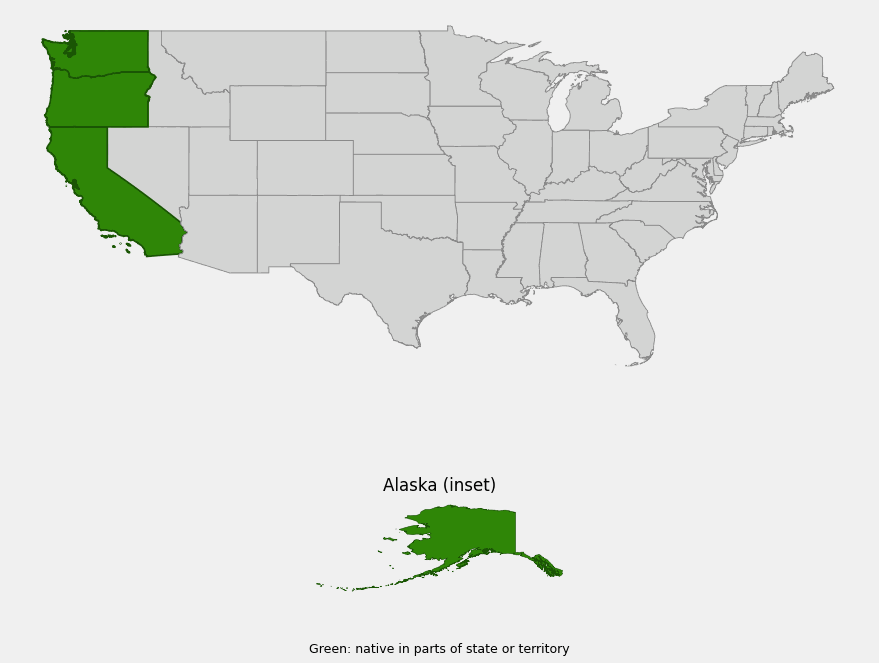
Touch-me-not balsam is native across much of temperate and boreal Eurasia, from Britain and Scandinavia east through Siberia to Japan, and in northwestern North America. USDA PLANTS and the Lady Bird Johnson Wildflower Center record it as native in four U.S. states: Alaska, Washington, Oregon and California. In Canada it occurs in British Columbia, Alberta and Saskatchewan, and it extends north into Yukon.
In the United States it is most widespread in Alaska, where it grows along streams and in moist woods in the interior and the southern coastal regions. In Washington and Oregon it is much more local, with scattered populations in moist forests and along streams. The California records are outlying ones at the southern edge of its range.
Western Impatiens have a complicated taxonomic history, and some plants in the Pacific Northwest have at times been placed under other names such as I. ecornuta. Where native touch-me-nots grow, look carefully at spur shape and flower color to separate them from each other and from the introduced balsams.
📋 Regional plant lists featuring Touch-me-not Balsam: Alaska · Western Oregon & Western Washington · California & Nevada
Growing & Care Guide
Touch-me-not balsam is an annual, so you plant it once from seed and then let it reseed. In a cool, moist, shady corner it will come back on its own year after year. It is best suited to gardens within or near its native range in the Northwest and Alaska.
Light
Partial to full shade is ideal. It tolerates morning sun where the soil stays wet, but in hot sun the succulent stems wilt quickly.
Soil & Water
Give it rich, humusy soil that stays consistently moist to wet: a stream bank, the edge of a pond, a rain garden in shade, or a low spot under trees. It will not tolerate drought; plants simply collapse in dry soil.
Planting Tips
Sow fresh seed in fall directly where you want plants, barely covering it. The seed needs a period of cold, moist conditions over winter to germinate, and it does not store well dry. Seedlings appear in spring and can be thinned or moved while small. Collect seed by enclosing a ripe pod in your hand or a small bag before touching it.
Pruning & Maintenance
No pruning is needed. Leave the dead plants in place in fall so the last seeds can drop, and avoid heavy mulch where you want seedlings to come up. If it reseeds where you don’t want it, the shallow-rooted seedlings pull out easily.
Propagation
Grow it from seed only. Sow outdoors in fall, or stratify seed in moist sand in the refrigerator for about 2 to 3 months before spring sowing. Like other jewelweeds it is hard to grow in pots for long; plant seedlings out early.
Landscape Uses
- Shade and woodland gardens: a cheerful late-summer bloomer for wet shade
- Rain gardens and stream banks: in shaded, consistently moist sites within its native range
- Pollinator gardens: a nectar source for bumblebees in late summer
- Naturalizing: self-sows into moist ground under trees and shrubs
- Children’s and educational gardens: the exploding seed pods are a memorable lesson in seed dispersal
Wildlife & Ecological Value
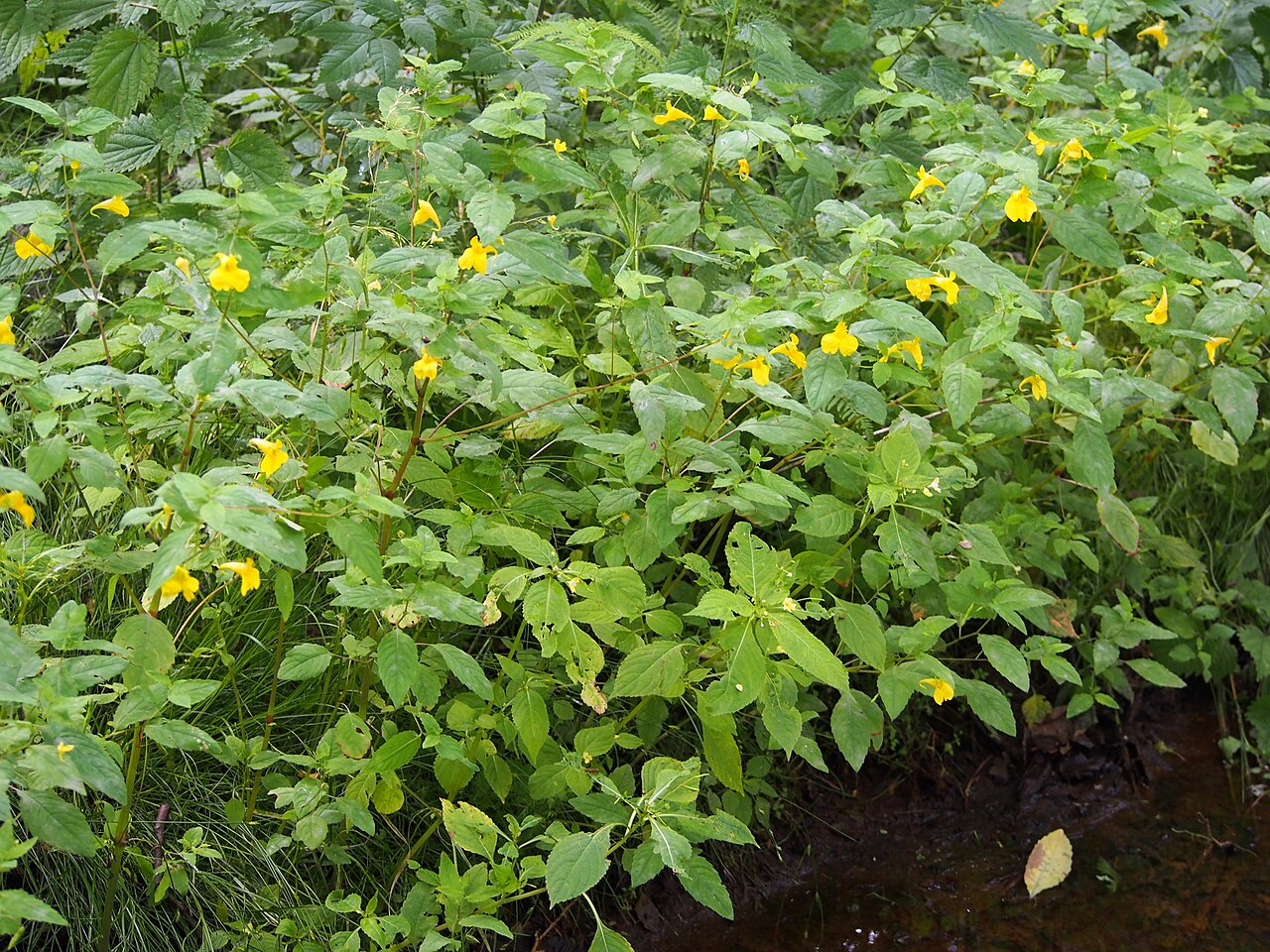
Touch-me-not balsam is a small annual, but in moist western forests its flowers fill a gap in late summer, when many woodland plants have finished blooming.
For Pollinators
The deep, spurred flowers are built for long-tongued bees. Bumblebees crawl into the sac to reach the nectar in the spur, brushing against the anthers and stigma at the top of the flower. Some short-tongued bees “rob” nectar by biting a hole through the spur. Several moth caterpillars feed on balsam leaves in its native range.
For Birds
Seed-eating birds eat some of the seeds that the capsules scatter, and the dense stands give ground cover for thrushes, wrens and other birds that forage on moist forest floors.
For Mammals
Deer and other browsers eat the soft stems and leaves, and small rodents eat the seeds. Bears forage in the same streamside habitats, but the plant is a minor food for mammals.
Ecosystem Role
As a fast-growing annual of moist, disturbed ground, it quickly covers fresh soil along streams after floods and in forest openings. Its explosive pods spread seeds short distances, and streams carry them farther downstream, which is why it often lines riverbanks.
Cultural & Historical Uses
Linnaeus named Impatiens noli-tangere in 1753, and its Latin epithet echoes the words noli me tangere, “touch me not,” a phrase long used in European art and literature. The plant has been well known in Europe for centuries, and the common name touch-me-not was used there long before it was applied to the American jewelweeds.
Jewelweeds have a long history in folk medicine. The crushed stems of eastern jewelweed are widely used as a home remedy for poison ivy and nettle stings, and touch-me-not balsam was used in similar ways in parts of Europe and Asia. Controlled studies have not shown a clear benefit. The plants contain compounds that can irritate the stomach, so they should not be eaten in quantity.
In North America the plant is mostly an Alaskan and northwestern wildflower, familiar to people who hike salmon streams and boreal woods. It is also a reminder that “native” and “invasive” can both apply within one genus: two close relatives from Eurasia, Himalayan balsam and small balsam, have become invasive weeds in the same region where touch-me-not balsam grows naturally.
Frequently Asked Questions
Is touch-me-not balsam the same as jewelweed?
It is a jewelweed (genus Impatiens), but not the same species as the common eastern jewelweed (I. capensis). Touch-me-not balsam has clear yellow flowers with a long, down-curved spur, and in North America it is native to Alaska and the Pacific Coast states.
Why do the seed pods explode?
As the capsule ripens, tissue in its walls builds up tension. When the pod is ripe, a light touch releases that tension and the five valves coil back in a fraction of a second, throwing the seeds away from the parent plant.
Is touch-me-not balsam an annual?
Yes. It grows from seed each spring, flowers in late summer and dies at the first hard frost. It reseeds itself readily in moist, shady ground, so a patch persists from year to year.
Is it invasive?
Not in its native range. It is native in Alaska, Washington, Oregon and California. The invasive balsams of the Northwest are Himalayan balsam, with large pink flowers, and small balsam, with small pale yellow flowers.
Can I eat touch-me-not balsam?
It is not recommended. Jewelweeds contain compounds that can cause stomach upset, and eating large amounts may be harmful. Admire it and use it in the garden rather than as food.

Looking for a nursery that carries Touch-me-not Balsam?
Browse our native plant nursery directory: Alaska · California · Oregon · Washington

