
Great Horsetail (Equisetum telmateia)
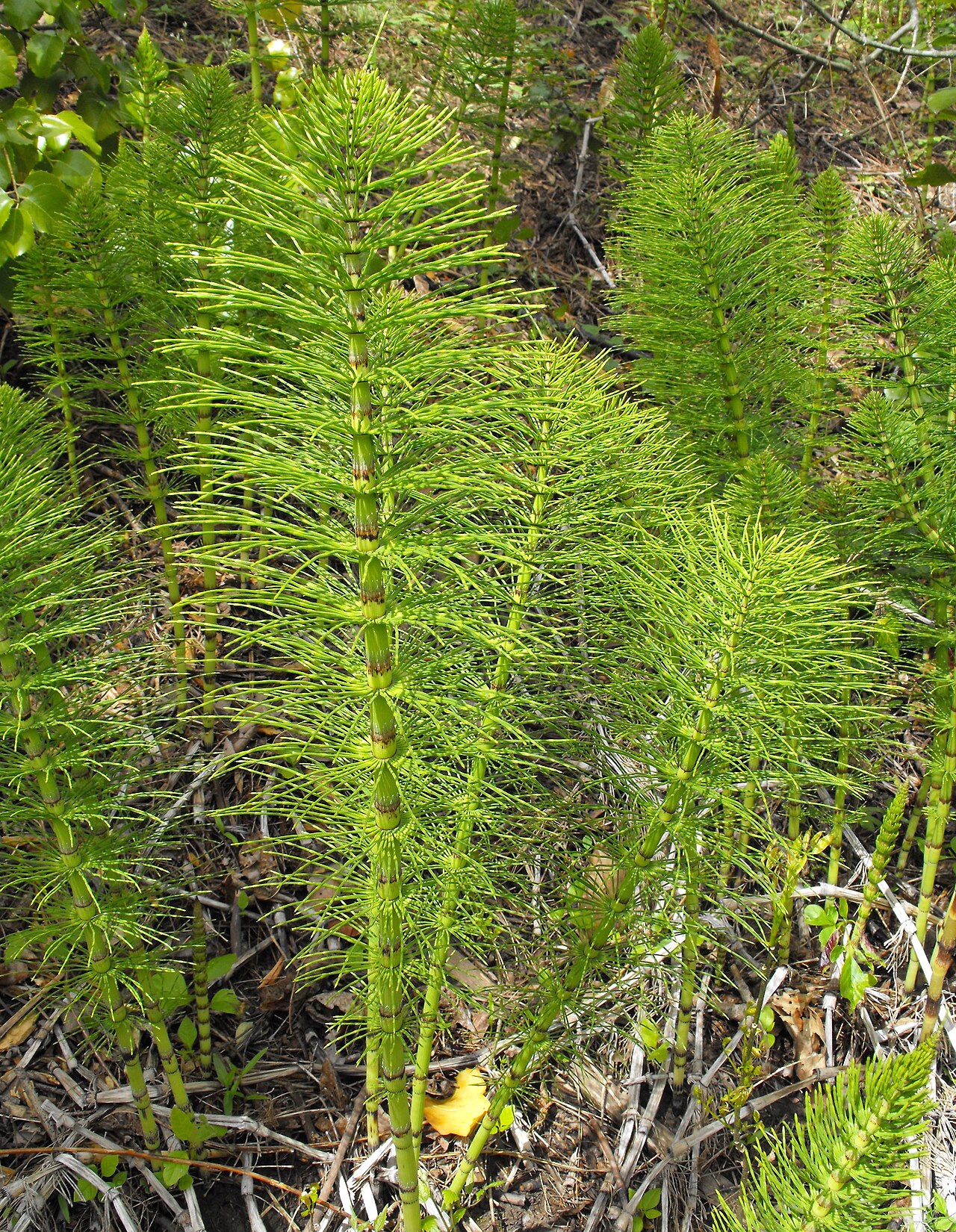
Equisetum telmateia, known as Great Horsetail or giant horsetail (the USDA PLANTS name), is the largest horsetail in temperate North America. In the Pacific Northwest and coastal California it forms dense colonies of feathery, bright green stems 2 to 6 feet tall, each ringed at every joint with a whorl of long, thin branches. In early spring, before those green stems appear, it sends up separate pale, branchless fertile stems tipped with spore-bearing cones.
Horsetails are not flowering plants. They are an ancient group of spore-bearing plants, more closely related to ferns than to anything that flowers, and they have existed for more than 300 million years. Their relatives in the coal-age swamps grew as tall as trees. Today a single genus, Equisetum, survives worldwide, and great horsetail is one of its most impressive members.
In North America, great horsetail grows along the Pacific Coast from British Columbia to California and inland to northern Idaho, with a separate population in Michigan. Many botanists now treat the North American plants as their own species, Equisetum braunii (northern giant horsetail), and restrict E. telmateia to Europe, western Asia and North Africa. USDA PLANTS treats them together, as subspecies braunii of E. telmateia, and this page follows USDA. This guide covers identification, range, its use in wet gardens, its wildlife value, and the important safety points about eating horsetails.
Identification
Great horsetail has two completely different kinds of stems at different times of year. Its size, its dense whorls of branches and its preference for wet, seepy ground set it apart from other horsetails in its range.
Fertile Stems (Spring)
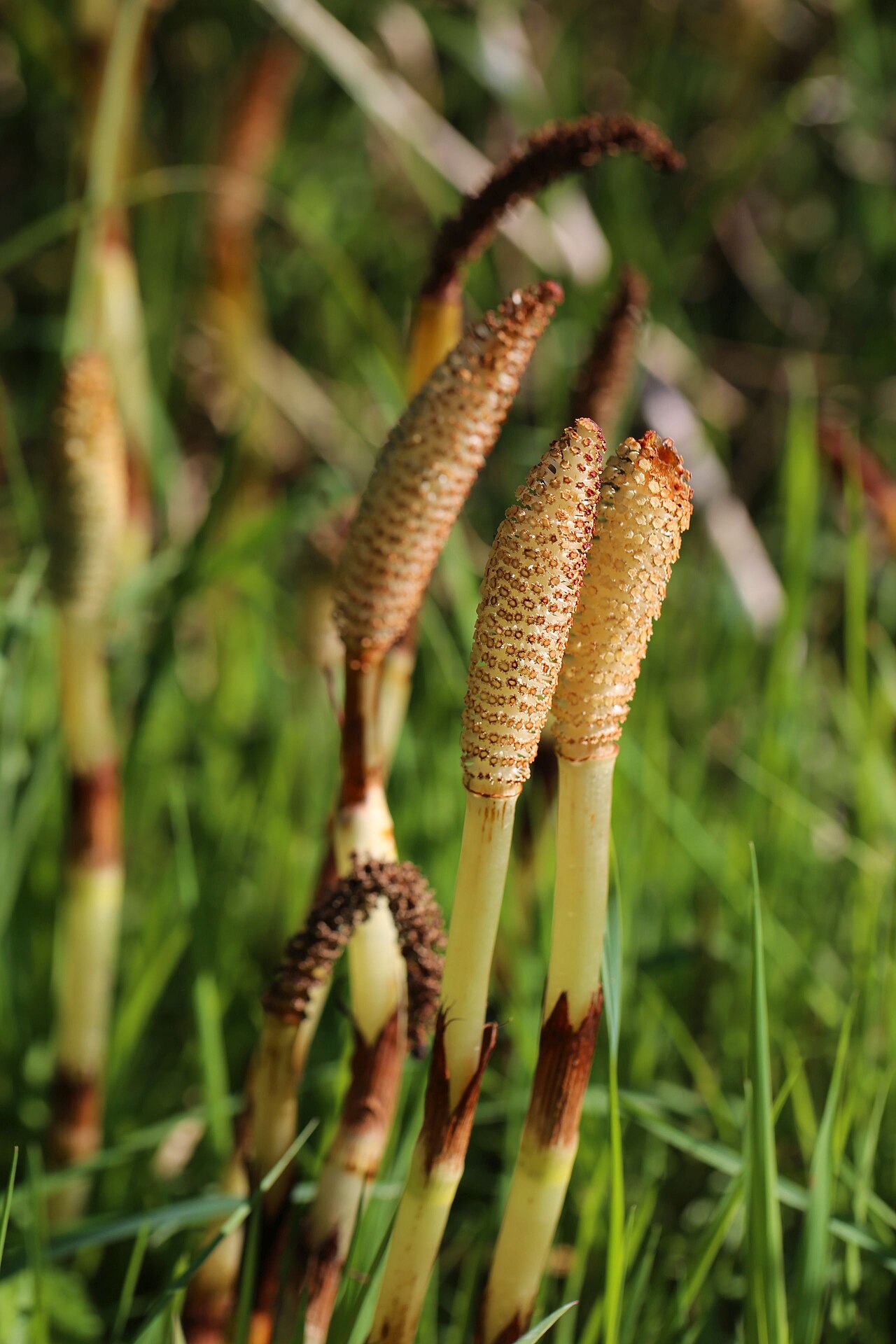
In early spring, usually from February to April depending on location, the rhizomes send up fertile stems 6 to 18 inches tall. They are thick, succulent, whitish to pale tan, without chlorophyll and without branches. Each joint is wrapped in a loose, brown, papery sheath with many pointed teeth. At the top is a cone-like strobilus 1½ to 4 inches long, made of many small six-sided shields, under which the spores develop. After releasing their green spores, the fertile stems wither within a few weeks.
Sterile Stems (Summer)
As the fertile stems fade, the green sterile stems emerge and quickly grow 2 to 6 feet tall (occasionally taller), with a main stem about a third of an inch to half an inch thick. The main stem is pale green to whitish, ribbed and hollow, with a short sheath at each joint. At each joint a dense whorl of 14 to 40 slender, green, four-angled branches spreads outward and upward, each up to about 8 inches long, giving the plant a feathery, bottlebrush look. The sterile stems die back with the first hard frosts in fall.
Rhizomes
Great horsetail spreads by thick, dark, branching rhizomes that run deep in wet soil, often 2 to 4 feet down, and sometimes form small tubers. This deep rhizome system is why colonies are so persistent and why horsetails often reappear after the surface vegetation is cut or burned.
Spores
Like other horsetails, it reproduces sexually by green spores, each with four ribbon-like arms (elaters) that coil and uncoil with changes in humidity and help the spores move through the air. The spores are short-lived and need constantly moist, bare soil to grow into tiny independent plants. In practice, most new stems come from spreading rhizomes.
Look-alikes
Field Horsetail (Equisetum arvense) also has separate fertile and sterile stems, but it is much smaller, usually under 2 feet, with fewer branches per whorl (usually fewer than 20) and greener main stems. Scouring Rush (Equisetum hyemale) has stiff, dark green, unbranched evergreen stems with cones on the same stems.
Quick Facts
| Scientific Name | Equisetum telmateia (North American plants: subsp. braunii, also treated as Equisetum braunii); USDA common name giant horsetail |
| Family | Equisetaceae (horsetail family) |
| Plant Type | Spore-bearing perennial (horsetail), spreading by deep rhizomes |
| Mature Height | 2–6 ft (sterile stems); fertile stems 6–18 in |
| Mature Spread | Spreads indefinitely by rhizomes into colonies |
| Growth Rate | Fast |
| Sun Exposure | Full sun to part shade |
| Water Needs | High; wet to saturated soil, seeps and stream banks |
| Soil Type | Wet clay, silt, loam or sand; seepage slopes and springs |
| Soil pH | About 5.5–8.0 |
| Bloom Time | Does not flower; spore cones in early spring (Feb–Apr) |
| Flower Color | None (pale tan spore cones) |
| Fall Color | Stems turn yellowish brown and die back in fall |
| Fruit | None; reproduces by spores and rhizomes |
| Deer Resistant | Yes; rarely browsed by deer |
| USDA Hardiness Zones | 6–9 |
Native Range
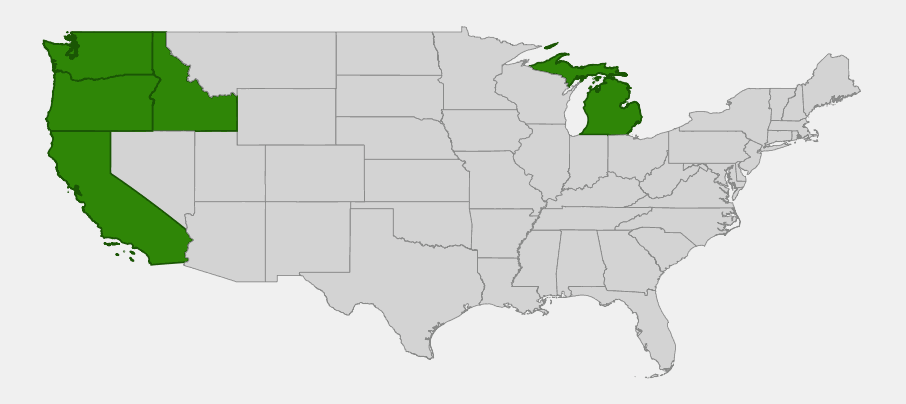
In North America, great horsetail is mainly a plant of the Pacific Coast. USDA PLANTS records it as native in Washington, Oregon, California, Idaho and Michigan, and in British Columbia. It also grows in southeastern Alaska according to some sources. Most populations lie west of the Cascades and Sierra Nevada, from Vancouver Island and the Puget Sound lowlands south through western Oregon and along the California Coast Ranges.
Away from the coast it is scattered. It follows wet canyons and river corridors into the Columbia River Gorge and reaches northern Idaho. The Michigan population, far from the rest of the range near the Great Lakes, is a small, isolated outlier far from the rest of the range.
Great horsetail grows in wet places with moving groundwater: springs, seepage slopes, stream banks, ditches, wet roadcuts, alder thickets and the edges of marshes. It favors heavy, often clayey soils that stay saturated, and it is especially common on coastal bluffs where groundwater seeps out of the slope. It is mainly a lowland plant, growing from sea level into the foothills.
📋 Regional plant lists featuring Great Horsetail: Idaho, Eastern Oregon & Eastern Washington · Michigan, Wisconsin & Eastern Minnesota
Growing & Care Guide
Great horsetail is a striking plant for wet ground, but it should be planted only where its spreading can be welcomed or contained. Its rhizomes run deep and wide, and once established it is very hard to remove. In the right place, such as a seep, a pond margin or a wet slope, it is a tough, handsome native with a prehistoric look.
Light
It grows in full sun to fairly deep shade. In sun it is shorter and denser, and in shade it is taller and more open. It does well under red alder and in the dappled shade of riparian woodland.
Soil & Water
It needs constantly moist to saturated soil and does best where groundwater flows near the surface. Heavy clay and silty soils suit it well. It tolerates seasonal flooding, but it is not a true aquatic and does poorly in standing deep water. In dry garden soil it struggles.
Planting Tips
Plant rhizome sections or potted plants in spring in wet soil, setting rhizome pieces 2 to 4 inches deep. In small gardens, grow it only in a large container with no drainage holes or sunk in a pond, because the rhizomes can travel under paths and into neighboring beds. On wet slopes and seeps, it can be planted freely as a soil stabilizer.
Pruning & Maintenance
Cut back the dead stems in late fall or winter if you want a tidy look, or leave them as winter cover. Removing unwanted shoots only weakens the plant slowly, because the deep rhizomes resprout. Do not use herbicides near water. Pests and diseases are rarely a problem.
Propagation
Propagate by dividing rhizomes in early spring, before the fertile stems appear, making sure each piece has at least one node. Stem sections with nodes can sometimes root when laid in wet soil. Growing from spores is possible but slow and difficult, because they are short-lived and need constantly wet, sterile conditions.
Landscape Uses
- Seeps, springs and wet slopes: stabilizes saturated soil and coastal bluffs with its deep rhizomes
- Pond and stream margins: a bold, feathery vertical accent at the water’s edge
- Riparian restoration: an early colonizer of wet, disturbed ground in its native range
- Container water gardens: contained in a large pot or tub to prevent spreading
- Educational and “living fossil” gardens: shows an ancient plant lineage that reproduces by spores
Wildlife & Ecological Value
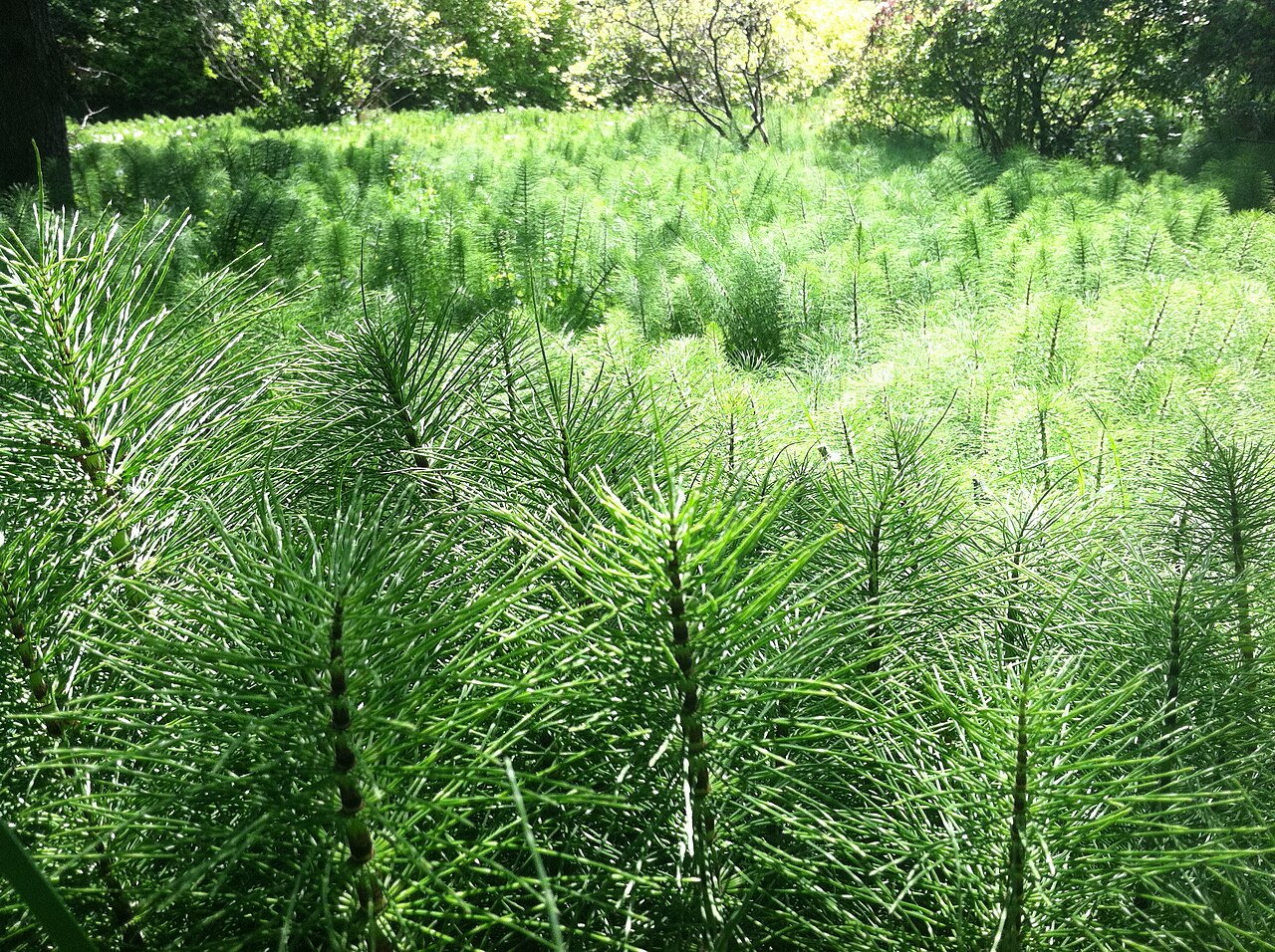
Great horsetail offers no nectar or fruit, but its dense colonies are an important part of wet, shady habitats along the Pacific Coast.
For Pollinators
As a spore-bearing plant, great horsetail has no flowers and no nectar or pollen, so it does not feed bees or butterflies. Its dense, moist stands do provide shelter for insects, spiders and amphibians, and many small invertebrates live in the leaf litter and wet soil beneath it.
For Birds
Dense horsetail thickets provide cover for wrens, song sparrows and other birds that forage in wet ground, and they shelter the insects these birds eat. The plant itself is not an important food source for birds.
For Mammals
Deer rarely browse horsetails, partly because of their high silica content and partly because of compounds that can be harmful in large amounts. Black bears are known to eat the young shoots of horsetails in spring, and small mammals use the dense stands for cover.
Ecosystem Role
Great horsetail stabilizes wet, unstable soils on stream banks, seepage slopes and coastal bluffs, and it is often one of the first plants on landslides and wet roadcuts. Its stems accumulate large amounts of silica, and its ancient body plan makes it a valuable living link to the plant life of the Carboniferous swamps.
Cultural & Historical Uses
Many Indigenous peoples of the Pacific Northwest Coast ate the young fertile shoots of great horsetail in early spring. The papery sheaths were stripped off and the juicy stems eaten raw, or the shoots were cooked. Some groups also ate the small tubers on the rhizomes. The rough, silica-rich stems of horsetails were widely used as fine sandpaper for polishing wood, bone and stone tools, which is the origin of the related name “scouring rush.”
The species name telmateia comes from the Greek for “of muddy or marshy places,” a fitting name for a plant of seeps and wet ground. The North American plants were named for the German botanist Alexander Braun when they were described as Equisetum braunii in the 19th century, and that name has come back into use as botanists have recognized differences between American and European great horsetails.
Safety note: Horsetails contain thiaminase, an enzyme that destroys vitamin B1, as well as high levels of silica, and they are known to poison horses and other livestock that eat them in hay. Do not eat the mature green stems, and do not take horsetail as a supplement in large or prolonged amounts. The traditional use of young fertile shoots as a seasonal food should not be taken as evidence that the plant is safe to eat in quantity.
Frequently Asked Questions
Is great horsetail invasive?
It is native along the Pacific Coast, but it spreads aggressively by deep rhizomes and is very difficult to remove once established. Plant it only in wet areas where it has room, or in a container without drainage holes.
Why does great horsetail have two kinds of stems?
The pale, branchless stems that appear first in spring are fertile stems that produce spores in their cones. They wither soon after shedding spores. The tall, green, branched stems that follow are sterile stems that photosynthesize and feed the rhizomes for the rest of the season.
Is great horsetail poisonous?
Horsetails can be harmful in large amounts. They contain thiaminase, which breaks down vitamin B1, and they have poisoned horses and livestock that ate them in hay. Young fertile shoots were traditionally eaten in small amounts in spring, but horsetail should not be eaten casually or in quantity.
Is great horsetail the same as Equisetum braunii?
Yes, in North America. USDA PLANTS calls the North American plants Equisetum telmateia subsp. braunii. Many botanists now treat them as a separate species, Equisetum braunii, or northern giant horsetail, and restrict E. telmateia to Europe, western Asia and North Africa.
Does great horsetail have flowers?
No. Horsetails are spore-bearing plants related to ferns. They reproduce by spores released from cone-like structures at the tips of the fertile stems, and they spread by rhizomes. They never produce flowers or seeds.

Looking for a nursery that carries Great Horsetail?
Browse our native plant nursery directory: California · Idaho · Michigan · Oregon · Washington