
Field Horsetail (Equisetum arvense)
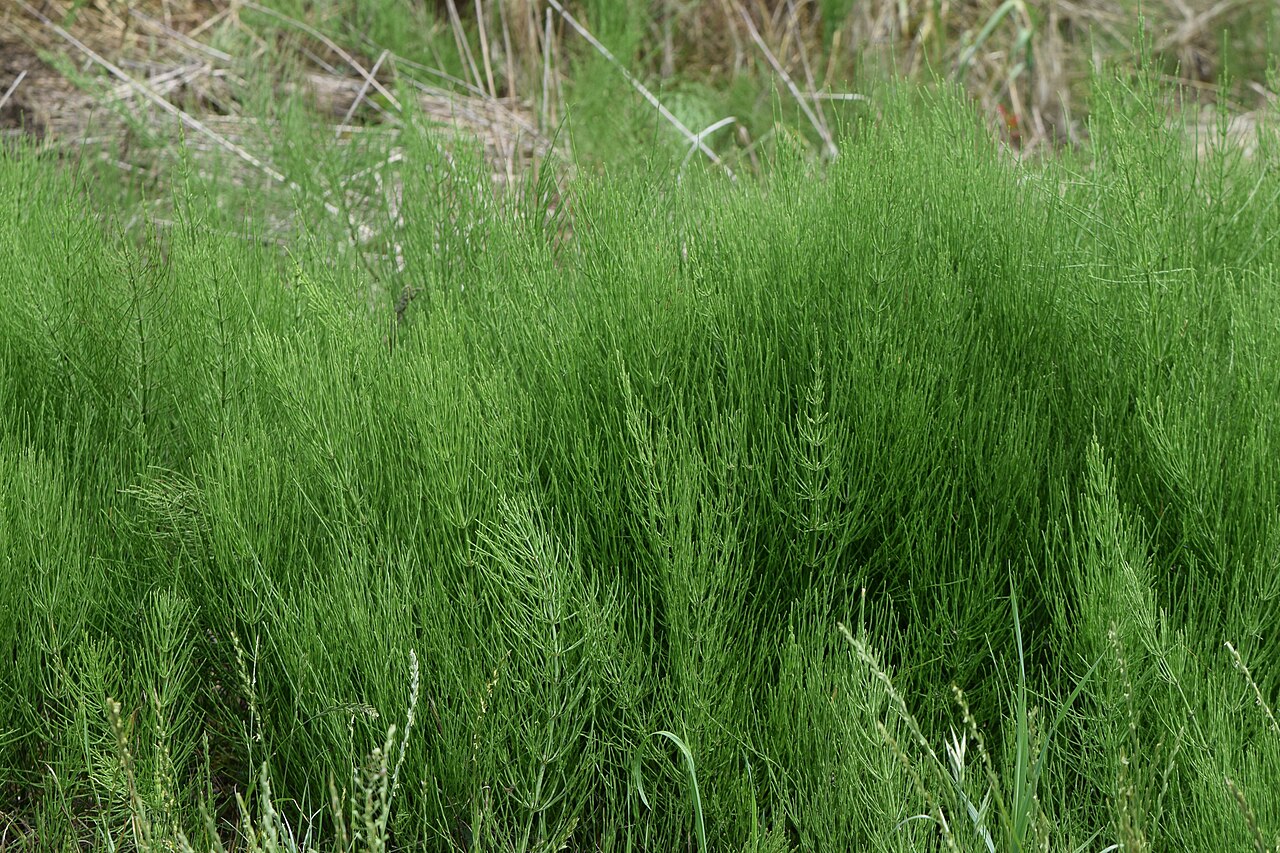
Equisetum arvense, known as Field Horsetail or common horsetail, is a primitive, spore-producing plant that grows across almost all of North America, as well as Europe and Asia. It produces two very different kinds of shoots. In early spring, pale tan, unbranched fertile stems appear, each tipped with a cone that releases spores. A few weeks later come the familiar green sterile shoots, 8 to 24 inches tall, with whorls of thin, jointed branches that make them look like little green bottlebrushes or a horse’s tail.
Horsetails belong to the family Equisetaceae and are related to ferns. Their ancestors include giant tree-sized horsetails that dominated swamp forests more than 300 million years ago, and the coal beds of eastern North America formed partly from them. Today’s horsetails are small, but they still have the same basic design: hollow, jointed, ridged stems stiffened with silica, tiny leaves fused into sheaths at each joint, and no flowers or seeds.
Field horsetail is a tough native plant of moist, sandy and disturbed ground: stream banks, wet meadows, roadsides, railroad beds and fields. It spreads by deep, branching rhizomes, which makes it valuable for holding soil but also a notoriously persistent weed in gardens and farm fields. It is also toxic to livestock, especially horses. This guide covers how to identify it, where it grows, and how to manage it, whether you want to use it or control it.
Identification
Field horsetail is easy to recognize as a horsetail. Distinguishing it from other horsetail species depends mainly on the branches, the stem sheaths, and the separate fertile and sterile shoots.
Fertile Shoots
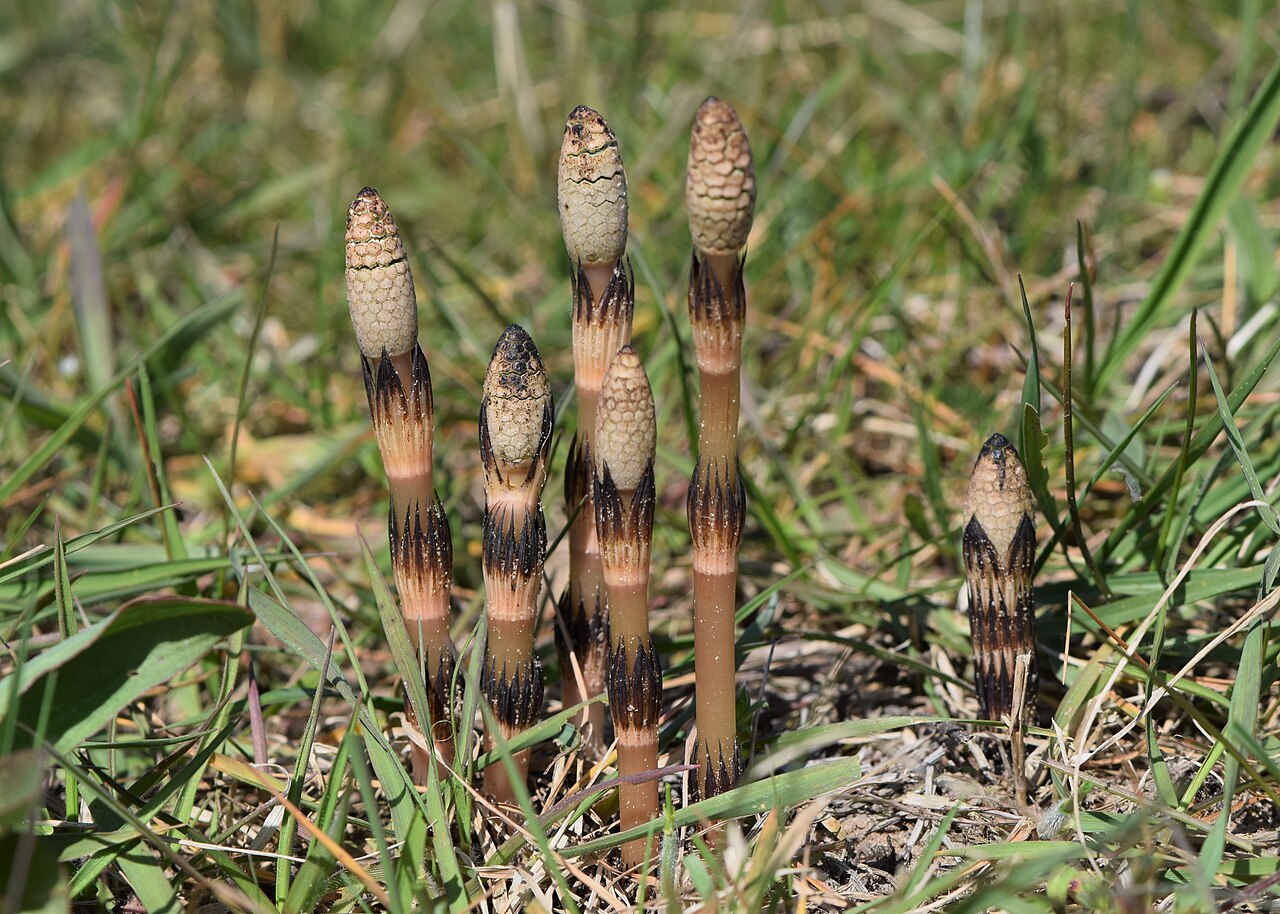
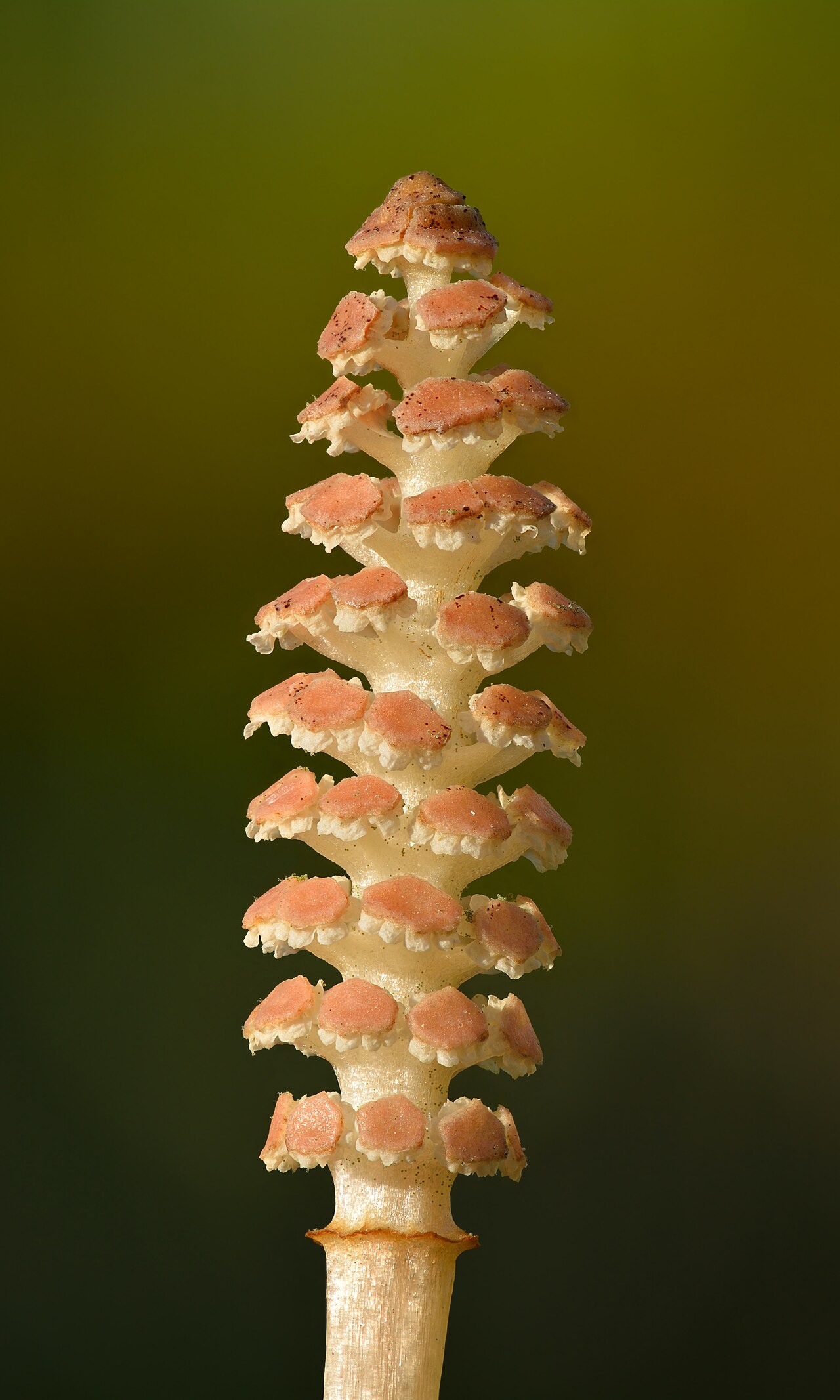
Fertile shoots appear in early spring, often in March or April, before the sterile shoots. They are 4 to 12 inches tall, unbranched, pale tan to pinkish brown and lack chlorophyll. At each joint is a loose, brownish sheath with 8 to 12 dark, pointed teeth. At the top is a cone (strobilus) about a half-inch to 1½ inches long, made of many shield-shaped plates that carry spore sacs. The green spores are released within a few days, and the fertile shoots then wither and disappear.
Sterile Shoots
The green sterile shoots appear in late spring and last until frost. They are usually 8 to 24 inches tall, hollow, with 6 to 19 ridges, and they may stand upright or sprawl. At each joint is a whorl of slender, solid, three- or four-angled, green branches that usually point upward or outward and are often branched again. The tiny leaves are reduced to a green sheath with dark brown, pointed teeth around the stem at each joint. A good field mark: on field horsetail, the first segment of each branch is longer than the stem sheath right beside it.
Roots & Rhizomes
The plant grows from dark, branching rhizomes that can run 3 feet or more below the surface and spread widely. Small, rounded tubers form on the rhizomes and store food. Even small rhizome pieces can produce new plants, which is why field horsetail recovers quickly after plowing or digging.
Look-alikes
Scouring rush (Equisetum hyemale) has thick, evergreen, unbranched stems with a cone at the tip of the same green stem. Meadow horsetail (E. pratense) and woodland horsetail (E. sylvaticum) have branched green shoots but their fertile shoots later turn green and branch, unlike field horsetail’s, and woodland horsetail’s branches are themselves branched and droop. Giant horsetail (E. telmateia) of the Pacific Coast is much larger, with whitish stems. Young sterile shoots are sometimes mistaken for a pine or spruce seedling, but the jointed, hollow stem gives them away.
Quick Facts
| Scientific Name | Equisetum arvense L. |
| Family | Equisetaceae (horsetail family) |
| Plant Type | Perennial horsetail (fern relative); reproduces by spores and rhizomes |
| Mature Height | 8–24 in (sterile shoots); fertile shoots 4–12 in |
| Mature Spread | Spreads indefinitely by rhizomes |
| Growth Rate | Fast; aggressive in moist soil |
| Sun Exposure | Full sun to part shade |
| Water Needs | Medium to high; moist to wet soil |
| Soil Type | Sand, gravel, loam or clay; tolerates poor, compacted and disturbed soil |
| Soil pH | About 5.0–8.0; tolerates acidic to alkaline soil |
| Bloom Time | None (no flowers); spore cones in early spring |
| Flower Color | None; fertile shoots tan to pinkish brown |
| Fall Color | Green shoots turn yellow-brown and die back at frost |
| Fruit | None; reproduces by green spores and rhizomes |
| Deer Resistant | Yes; rarely eaten, and toxic to livestock |
| USDA Hardiness Zones | 2–9 |
Native Range
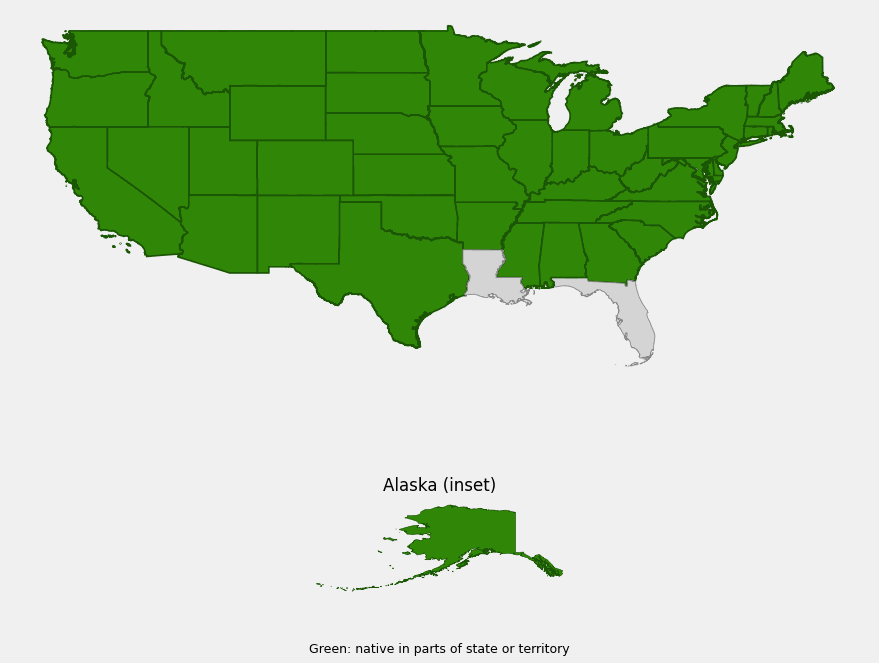
Field horsetail is one of the most widespread plants in North America. USDA PLANTS records it from 47 states, every state except Florida, Louisiana and Hawaii, plus the District of Columbia. It grows throughout Canada, from Newfoundland and Labrador to British Columbia, the Yukon, the Northwest Territories and Nunavut, and in Greenland. Beyond North America it is native across Europe and northern and central Asia, making it a circumboreal species.
It is most common in the northern half of the continent and in the mountains, where it grows in wet meadows, along streams and lakes, in moist forest openings, and on gravel bars and sandy banks. In Alaska and northern Canada it reaches the Arctic tundra. Toward the south it becomes patchier, usually limited to stream banks, seeps, and moist sandy or disturbed ground, and it is rare in the Gulf Coast states.
Field horsetail is a pioneer species. It moves quickly onto bare, moist soil after floods, landslides and construction, and it is common along railroad embankments, road ditches, borrow pits and the edges of fields. It was one of the first plants to return to the volcanic deposits after the eruption of Mount St. Helens in 1980, sprouting from rhizomes buried deep beneath the ash.
📋 Regional plant lists featuring Field Horsetail: New York, Pennsylvania & Northern New Jersey · Idaho, Eastern Oregon & Eastern Washington · Ohio & Indiana · Montana & Wyoming · Michigan, Wisconsin & Eastern Minnesota · Kentucky & Tennessee · Nebraska, Kansas & Eastern Colorado · Utah & Western Colorado · Connecticut, Massachusetts & Rhode Island · New Hampshire, Maine & Vermont · Maryland, Virginia & West Virginia · Delaware, Southern New Jersey & Long Island · Arizona & New Mexico · Illinois, Iowa & Missouri · Alabama, Georgia & Mississippi · Alaska
Growing & Care Guide
Field horsetail is rarely planted on purpose, and most gardeners know it as a weed that is hard to get rid of. It does have uses: it stabilizes moist, sandy soil and grows where few other plants will. If you want it, plant it only where its spread is welcome or where it can be fully contained, and never near pastures, hay fields or horse paddocks, because it is poisonous to livestock.
Light
It grows in full sun to part shade. In deep shade the shoots are thin and sparse.
Soil & Water
It prefers moist to wet, sandy or gravelly soil but tolerates almost any soil, including compacted clay and poor fill. It thrives where the water table is high and tolerates periodic flooding. Fertilizer is unnecessary.
Planting Tips
If you do plant it, use a container or a pond basket set into the ground, or a bed with a deep root barrier, so the rhizomes cannot escape. It suits rain garden edges, stream bank stabilization and sandy, wet spots where nothing else grows. Do not plant it in mixed perennial borders, vegetable gardens or near farm fields.
Pruning & Maintenance
To control unwanted horsetail, focus on the conditions it likes. Improve drainage where possible and raise soil pH and fertility, since thick, healthy competing plants slowly crowd it out. Pull or cut shoots repeatedly throughout the season to weaken the rhizomes; this must be continued for several years. Tilling only breaks the rhizomes into more pieces. Because the stems are coated with silica and wax, many herbicides are not very effective on it.
Propagation
It spreads easily from rhizome pieces planted in moist soil in spring. Spores are short-lived and germinate only on moist, bare soil, so propagation by spores is rarely practical outside the lab.
Landscape Uses
- Erosion control: its deep rhizomes hold moist sand and gravel on stream banks, ditches and slopes
- Restoration of disturbed ground: a native pioneer on wet, bare and disturbed soil
- Container and water gardens: a contained clump adds an interesting fine texture
- Nature study: a living example of an ancient plant group that dates back to the coal age
Wildlife & Ecological Value
Field horsetail has few direct partnerships with wildlife, since it has no flowers, nectar or fruit, but it plays a role in colonizing and stabilizing wet, disturbed ground.
For Pollinators
Horsetails are not pollinated. They reproduce by spores, which are carried by wind, and by spreading rhizomes. They offer no nectar or pollen to pollinators.
For Birds
Some waterfowl and grouse eat horsetail shoots, and Canada geese graze on the young shoots in spring. Dense stands provide some cover for ground-nesting birds in wet meadows.
For Mammals
Field horsetail contains thiaminase, an enzyme that destroys vitamin B1, along with alkaloids and silica, and it is toxic to livestock, especially horses, when eaten in quantity, for example in contaminated hay. Wild mammals generally eat little of it, although bears, muskrats and some other animals feed on the shoots or rhizomes at times.
Ecosystem Role
Field horsetail is one of the first plants to colonize bare, moist mineral soil after floods, landslides, glaciers and volcanic eruptions. Its rhizomes bind the soil and help other plants become established. It also accumulates silica and other minerals from deep in the soil and returns them to the surface when the shoots die.
Cultural & Historical Uses
Linnaeus named the species in 1753. Equisetum comes from the Latin equus, horse, and seta, bristle, and arvense means “of fields.” Because the stems contain silica, horsetails were used for centuries to scour pots and polish wood and metal, which is the origin of the names scouring rush and pewterwort, although the stiffer scouring rush works better for this.
Many Indigenous peoples of North America, including the Blackfoot, Cree, Dene and many Pacific Northwest nations, ate the young fertile shoots after peeling them in spring, used the plant in medicine, and used the stems for polishing and as toys. In Japan the young fertile shoots, called tsukushi, are still eaten as a spring food after careful preparation.
A safety note: field horsetail contains thiaminase and other compounds and is poisonous to livestock, particularly horses. Herbal supplements made from it are sold, but they can interfere with vitamin B1 and other medications. Do not eat it or use it as a remedy without medical advice, and keep it out of pastures and hay.
Frequently Asked Questions
Is field horsetail native?
Yes. It is native across almost all of North America, including 47 U.S. states and every Canadian province and territory, as well as Europe and Asia. It behaves like a weed in gardens and fields, but it is not an introduced species.
How do I get rid of horsetail in my garden?
Repeatedly pull or cut the shoots during the growing season for several years to exhaust the rhizomes, improve drainage, and grow dense, vigorous plants to compete with it. Tilling usually makes the problem worse by spreading rhizome pieces.
Is horsetail poisonous?
It is toxic to livestock, especially horses, when eaten in large amounts, usually in hay. It contains thiaminase, an enzyme that breaks down vitamin B1. People should not use it as a food or supplement without medical advice.
Why does horsetail have two different kinds of stems?
The pale, unbranched spring stems are fertile and produce spores, then die. The green, branched summer stems are sterile and do the photosynthesis for the plant. Both come from the same rhizome system.
Is field horsetail related to ferns?
Yes. Horsetails are a distinct ancient group, but genetic studies place them in the same broad lineage as ferns. Like ferns, they reproduce by spores instead of seeds.

Looking for a nursery that carries Field Horsetail?
Browse our native plant nursery directory: Alabama, Alaska, Arizona & Arkansas · California · Colorado, Connecticut, Delaware & Georgia · Idaho, Illinois, Indiana, Iowa & Kansas · Kentucky, Maine, Maryland, Massachusetts, Michigan, Minnesota, Mississippi, Missouri & Montana · Nebraska, Nevada, New Hampshire, New Jersey, New Mexico, New York, North Carolina, North Dakota, Ohio & Oklahoma · Oregon · Pennsylvania, Rhode Island, South Carolina, South Dakota, Tennessee, Texas, Utah, Vermont & Virginia · Washington · West Virginia, Wisconsin & Wyoming