Sensitive Fern (Onoclea sensibilis)
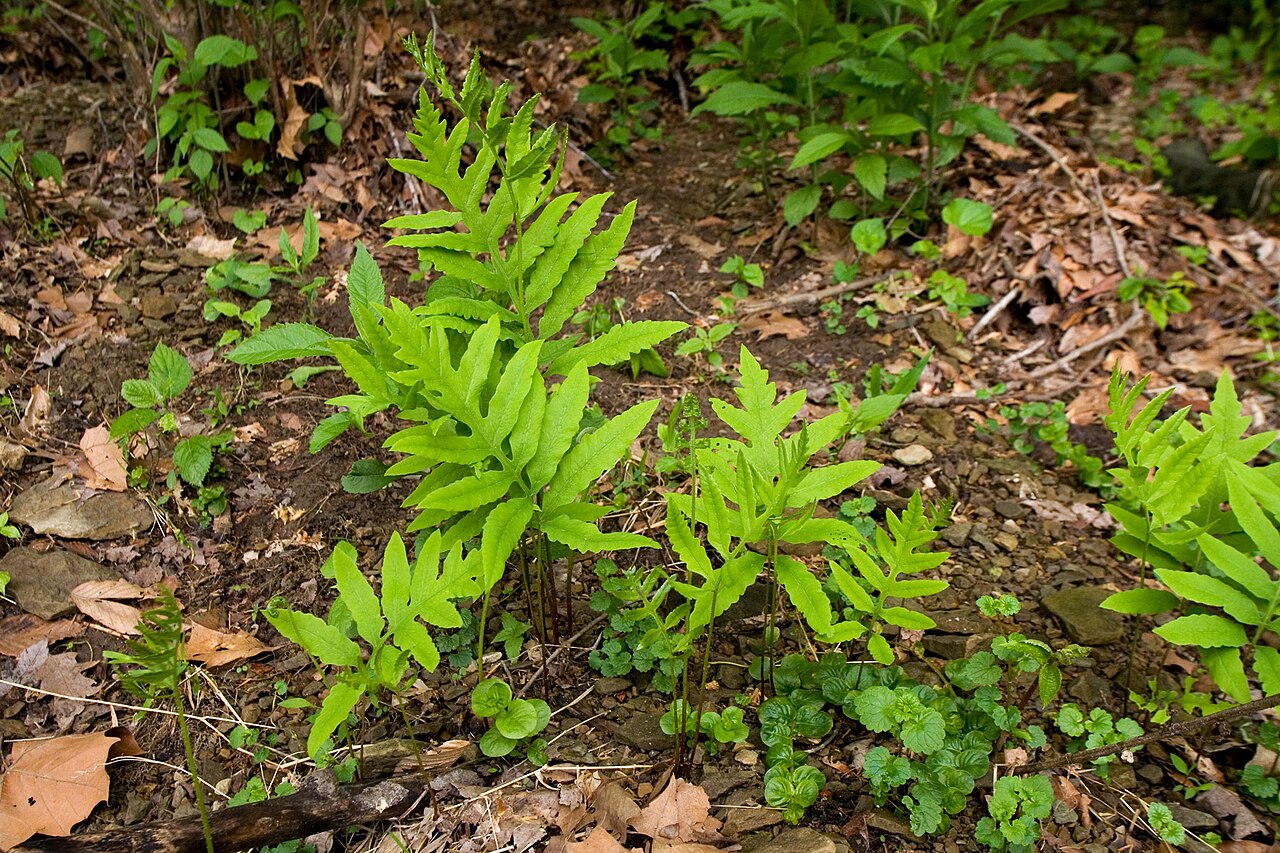
Sensitive fern (Onoclea sensibilis) brings broad, light-green fronds to damp ground where a finer woodland fern may struggle. Its leaves are deeply lobed but not finely lacy, so a patch reads as a bold, almost tropical texture at ground level. The effect is especially useful along a shaded swale, a moist woodland edge or the upper margin of a pond, provided the site stays damp through summer.
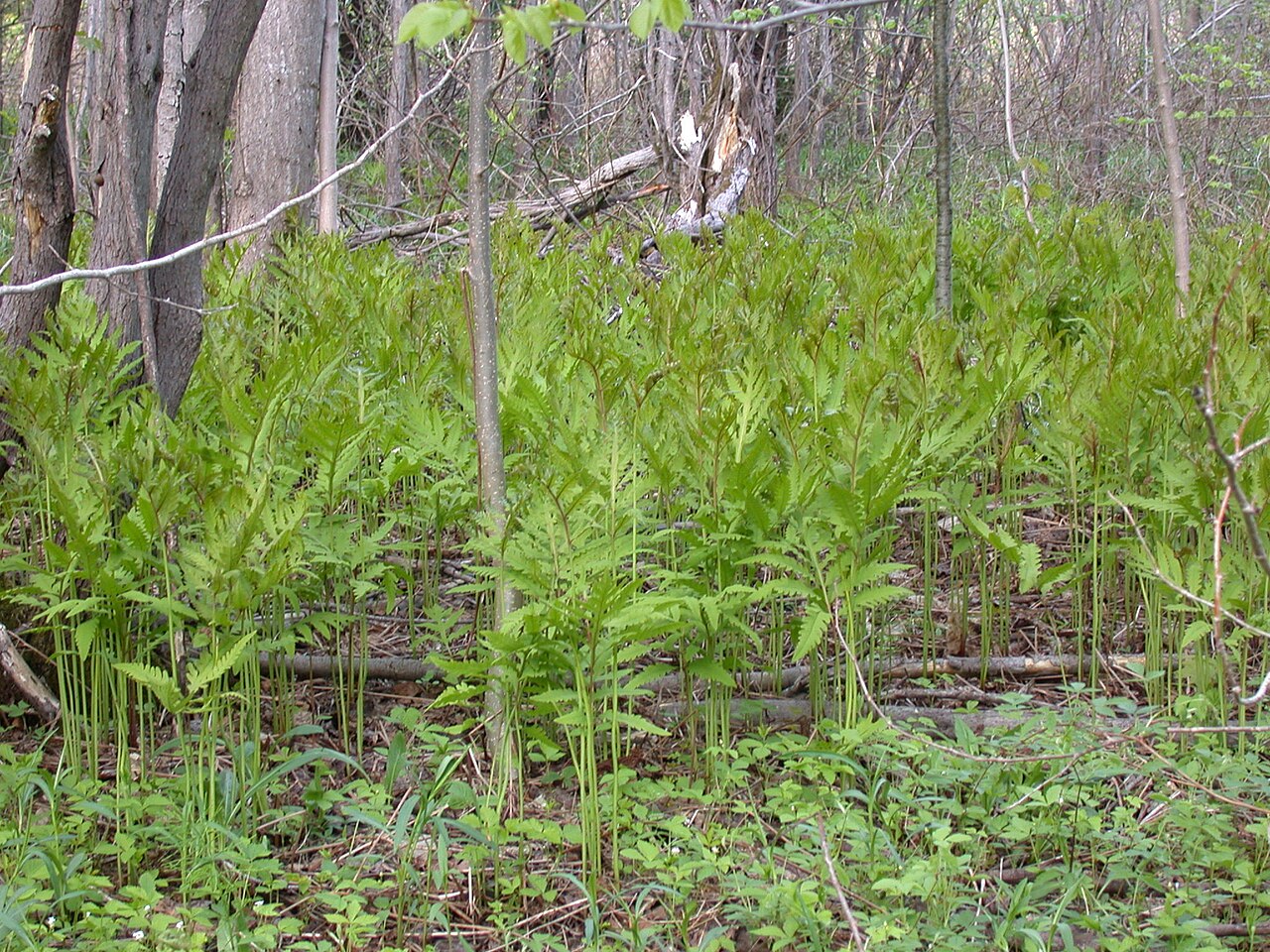
The common name describes foliage that is readily damaged by frost or drought, not a plant that is difficult to grow everywhere. Underground rhizomes survive the dormant season and send up new fronds when conditions are suitable. In the right place, sensitive fern spreads willingly. Plan for a colony rather than expecting a single pot to remain permanently in the exact footprint where it was planted.
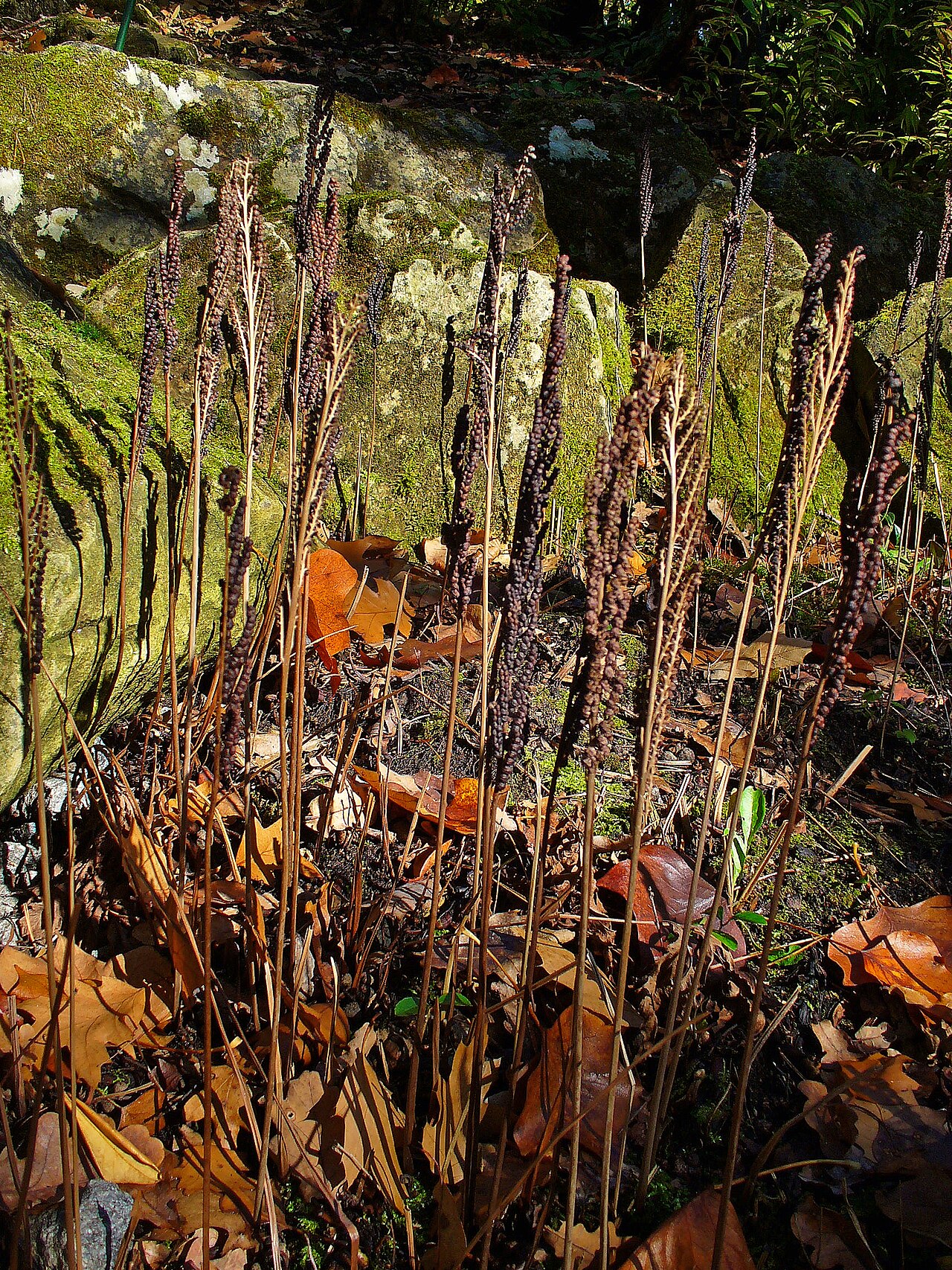
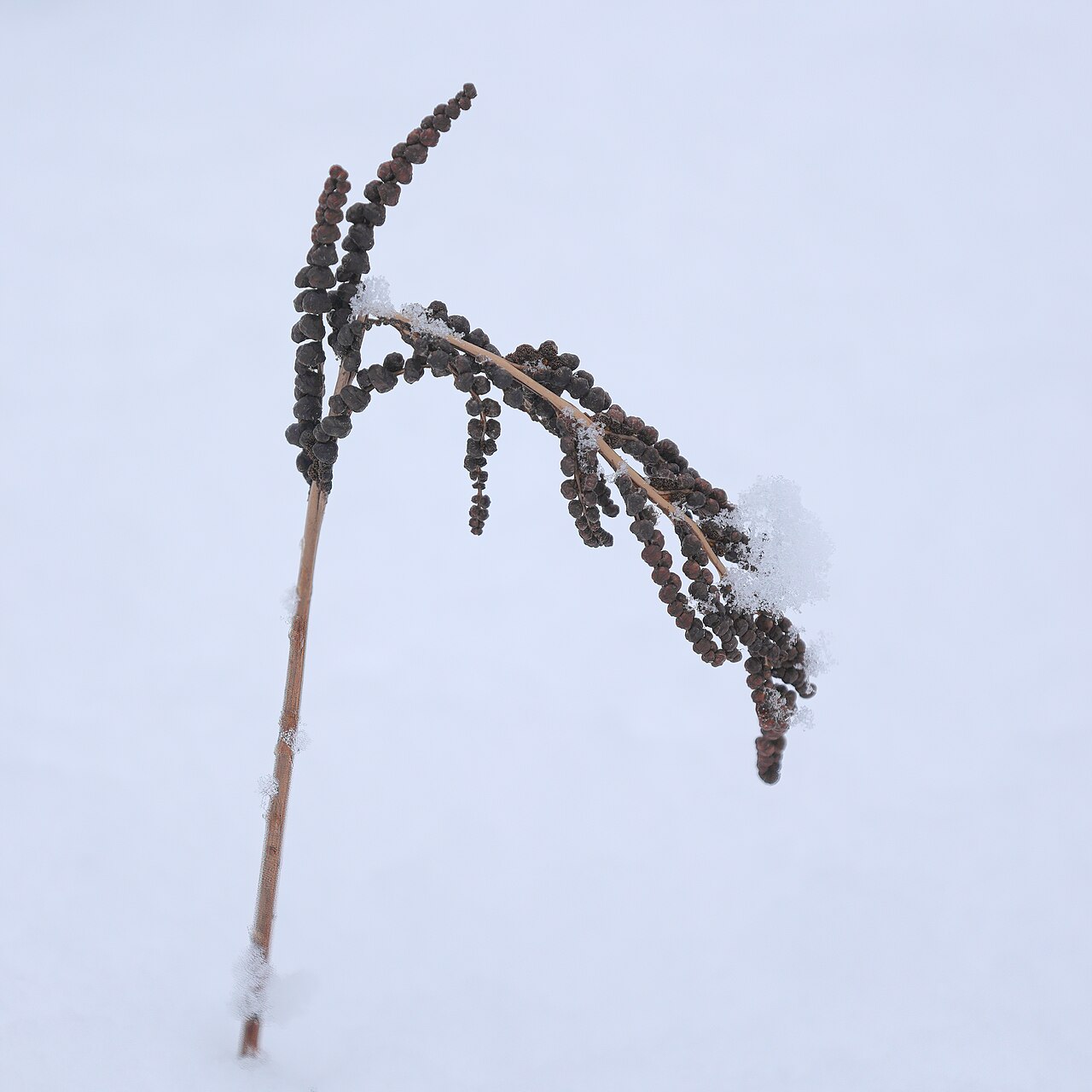
Two very different frond forms give this fern a long season of interest. The broad green sterile fronds make the summer display; narrow, stiff fertile fronds carry bead-like structures that turn brown and often remain after the green leaves collapse. Those winter “beads” are a useful identification feature and should not be confused with seeds or berries. This is a spore-producing fern, not a flowering groundcover.
Identification
Rhizomes and emerging shoots
Creeping rhizomes connect the shoots below the surface. New fronds unfurl from the soil in spring, and shoots can appear beyond the original clump as the colony expands. A planting may look sparse during establishment, then fill nearby open ground once the rhizomes have developed. Leave room for that change rather than adding more plants into every initial gap.
Sterile fronds
The green sterile fronds are broad, triangular in overall outline and divided into rounded or pointed lobes along a central axis. The lobes are much coarser than the tiny divisions of hay-scented fern. Their thin texture and fresh green color make them conspicuous in moist woodland. Veins form a network within the segments, which can be easier to see in transmitted light or a close photograph.
Many garden plants stand around 1–2 feet, while favorable mature stands can reach 3–4 feet. Size varies with growing conditions and source, so allow space above the usual low groundcover layer. The larger colony footprint matters as much as the height when placing it beside smaller plants.
Fertile fronds
Separate, narrower fertile fronds carry tightly contracted divisions enclosing the spore-bearing structures. These look like strings or clusters of beads rather than normal leaflets. They mature brown and can stand through winter after sterile foliage has disappeared. Their persistence adds structure to a quiet winter bed and helps identify the plant outside its main growing season.
Similar ferns
Netted chain fern can be confused with sensitive fern because both have broad sterile fronds and different fertile fronds. Netted chain fern usually has more pointed, finely toothed segments and chain-like sori along the narrow fertile divisions, rather than the closed-looking bead arrangement of sensitive fern. Examine both frond types if possible. A photograph of a single damaged sterile leaf is a weaker basis for identification than a whole plant with fertile growth.
Quick Facts
| Scientific Name | Onoclea sensibilis |
| Family | Onocleaceae (included in broader Aspleniaceae in some classifications) |
| Plant Type | Deciduous, rhizomatous fern with distinct fertile fronds |
| Mature Height | Commonly 12–24 in; favorable mature stands can reach 3–4 ft |
| Mature Spread | 2–3 ft or more; rhizomes extend the colony |
| Growth Rate | Moderate, spreading where moisture is reliable |
| Sun Exposure | Partial shade; full sun only with adequate moisture |
| Water Needs | Moist to wet; avoid prolonged drying |
| Soil Type | Organic, moisture-retaining loam or clay |
| Soil pH | Acidic preferred |
| Bloom Time | Non-flowering; beadlike fertile fronds mature seasonally |
| Flower Color | None; broad light-green sterile fronds |
| Fall Color | Yellow or russet, then frost-killed foliage |
| Fruit | None; persistent fertile beads enclose spore-bearing structures |
| Deer Resistant | Generally resistant; not suitable as livestock forage |
| USDA Hardiness Zones | Commonly grown in 3–9; published ratings vary with source and provenance |
Native Range
Sensitive fern has a wide native range across central and eastern North America. The distribution account used here includes the eastern states, parts of the Great Plains and western outliers in Colorado and Wyoming. Those western records are included on the map rather than omitted simply because the fern is most familiar in eastern gardens. State-level shading does not imply that dry uplands across the entire state support the species.
In Alabama, Georgia and Mississippi it belongs in suitable moist habitats, not in a generic dry shade bed. Wet woods, stream margins, damp thickets, meadows and low ground offer the kinds of moisture patterns that explain its garden behavior. An area that floods briefly after a storm but then dries hard for six weeks may not be a suitable rain-garden site without supplemental water.
The range extends through much of central and eastern Canada, including Manitoba, Ontario, Québec and Atlantic provinces, and the species also occurs naturally in eastern Asia. The map shows the U.S. portion only. For a southeastern native garden, ask for regionally appropriate North American stock and match the provenance and habitat rather than assuming that a broad global range makes all planting material interchangeable.
Native Range at a Glance
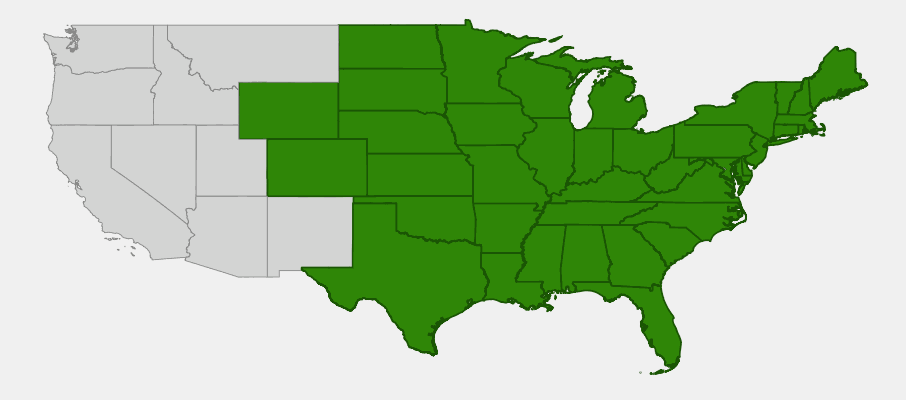
| U.S. States | Alabama, Arkansas, Colorado, Connecticut, Delaware, Florida, Georgia, Iowa, Illinois, Indiana, Kansas, Kentucky, Louisiana, Massachusetts, Maryland, Maine, Michigan, Minnesota, Missouri, Mississippi, North Carolina, North Dakota, Nebraska, New Hampshire, New Jersey, New York, Ohio, Oklahoma, Pennsylvania, Rhode Island, South Carolina, South Dakota, Tennessee, Texas, Virginia, Vermont, Wisconsin, West Virginia, Wyoming |
| Canada / Other Native Regions | Manitoba, Ontario, Québec and eastern/Atlantic Canada; native also in eastern Asia |
| Ecoregion | Eastern and central wet woods, damp meadows and riparian habitats |
| Elevation Range | Varies across the range; no single numeric interval established by the sources used here |
| Habitat | Moist woodland, stream margins, damp thickets and low ground |
| Common Associates | Moisture-loving native sedges, wetland herbs and suitable riparian shrubs |
| Distribution Sources | Kew Plants of the World Online; USDA (County-Level Data) |
Map: U.S. state-level native occurrence based on Kew, not county coverage or a guarantee of garden suitability. Canadian and other native regions are described in the text.
📋 See the Alabama, Georgia & Mississippi native plant list for regional context.
Growing & Care Guide
Light
Partial shade or dappled light is a forgiving choice. Sensitive fern can grow in sun where the soil remains reliably moist, but exposed foliage loses water quickly in heat. A moist open meadow and a sunny, fast-draining raised bed are therefore very different planting situations. In a hot southern garden, afternoon shade can reduce stress and help maintain the summer display.
Dense shade is not a remedy for a completely dry root zone. If the fern repeatedly browns during summer, check moisture below the surface and competition from tree roots. Moving it into deeper shade without changing a dry site may leave the underlying problem unresolved. Choose the combination of light and water, not one factor in isolation.
Soil and water
Consistently moist, organic soil is the central requirement. Loam and moisture-retentive clay can work, and the plant can tolerate wet periods. A humus-rich root zone that stays damp is more useful than a shallow pocket of peat surrounded by dry compacted soil. Observe water movement across the whole bed before deciding where the colony should go.
The regional moisture codes W and A–W mean wet or average-to-wet soil conditions. They are not drought-tolerance grades. This distinction matters especially for sensitive fern: extended drying can collapse the green foliage even when the rhizomes remain alive. During establishment, water before the root ball dries hard and maintain a light organic surface cover without burying the emerging crowns.
Planting tips
Use nursery-grown plants or divisions from a known cultivated colony. Set the rhizome at its existing soil level and water thoroughly so soil settles around the roots. Plant when moderate weather makes it easier to keep moisture steady. Leave space for lateral growth and avoid surrounding the new fern with small, slow-growing plants that cannot compete with a mature colony.
Place it beside, rather than within, a path that receives regular foot traffic. Wet soil is especially susceptible to compaction, and walking through the bed can damage emerging fronds and reduce pore space. A stepping stone or clear maintenance route makes it easier to inspect the planting without repeatedly disturbing its root zone.
Pruning and maintenance
The first frost can blacken or collapse sterile fronds. This is expected seasonal behavior, not a reason to discard the plant. Remove dead green-frond remains when convenient, but retain the brown fertile fronds if you want winter interest and natural spore release. Cutting every brown stalk at the first sign of autumn eliminates one of the species’ most distinctive features.
Thin unwanted rhizome growth at the edge of the planting while it is accessible. Sensitive fern can make a handsome ground layer, but it should not be allowed to obscure all neighboring plants by default. Keep it out of animal forage areas; regional references warn about livestock toxicity, including a risk to horses when foliage is eaten in quantity. It is an ornamental habitat plant, not pasture forage or a fiddlehead vegetable.
Propagation
Division of cultivated rhizomes is the most practical way to establish another garden patch. Each division should have living buds and a usable root system. Replant promptly and keep moisture consistent while new roots develop. Dividing in a hot dry period creates avoidable stress even for a fern that is otherwise easy to grow in a wet garden.
Spore propagation is possible but includes a separate gametophyte stage and requires more control than simply scattering “seed” in a bed. The beads on a fertile frond are not seeds to sow like beans or wildflowers. A fern specialist can provide a suitable method if you want to study the complete life cycle; for predictable planting, identified nursery material is simpler.
Landscape uses
- A moist woodland edge where broad fronds contrast with finer sedges and more delicate foliage.
- A damp swale or rain-garden zone that retains summer moisture rather than becoming dry between storms.
- The moist, shaded upper margin of a pond or stream, with room for a spreading colony.
- A winter-interest planting where the bead-bearing fertile fronds remain visible after the green canopy disappears.
Wildlife & Ecological Value
Pollinators
Sensitive fern has no flowers and supplies no floral nectar or pollen. Its value in a habitat planting comes from cover and ground-layer structure. Add suitable native flowering plants in nearby spaces if pollinator food is an objective, while allowing enough separation that the fern’s rhizomes do not overwhelm smaller companions.
Birds and small animals
A moist fern patch contributes shelter near the ground and helps create a shaded microhabitat within the larger garden. Small animals use dense vegetation and surrounding leaf litter, and birds can forage in the associated invertebrate community. This does not make the fertile “beads” a berry crop: they are reproductive fern structures, not fleshy bird fruit.
Deer and livestock
The species is often described as resistant to heavy deer damage, but local browsing can vary. Resistance should not be confused with suitability as animal food. Keep plantings away from horses and other grazing livestock and do not put removed fronds into feed or hay. The existing regional table warning is retained because a decorative fern should not be promoted as harmless forage.
Wet ground and plant diversity
Rhizomatous cover can protect a planted soil surface and add visual continuity to a damp area. Nevertheless, a diverse wet garden benefits from several appropriate species rather than one uninterrupted fern stand. Maintain boundaries, monitor the spread and reserve space for flowering wetland plants or sedges suited to the same hydrology. The goal is a functioning plant community, not merely rapid coverage.
Cultural & Historical Uses
“Sensitive fern” is a descriptive name rooted in the visible response of the leaves to frost and drought. It provides a useful lesson in separating the fate of a leaf from the fate of the perennial plant beneath it. A collapsed autumn frond does not mean that the rhizome has failed, just as a fresh green spring frond does not reveal the full extent of the underground colony.
“Bead fern” describes the fertile stalks that persist beyond the summer display. Gardeners sometimes keep those stalks for their texture, and they are useful in teaching the difference between fern reproduction and the flowers, fruits and seeds of flowering plants. Leave some in place if the aim is to observe the seasonal cycle rather than collecting all of them for decoration.
This profile does not recommend eating or medicinally using the plant. The common habit of calling any unfurling fern shoot a “fiddlehead” can conceal very different species and safety considerations. Appreciate sensitive fern as an identifiable native ornamental in the correct wet habitat, not as an interchangeable ingredient gathered from a damp patch.
Frequently Asked Questions
Why did the leaves collapse after the first frost?
The sterile foliage is frost-sensitive and normally dies back. Healthy rhizomes can persist and produce new growth the next season. Leave the planting undisturbed and assess its return in spring rather than digging it out solely because the leaves have fallen.
What are the brown beads in winter?
They are parts of the fertile frond enclosing spore-bearing structures. They are neither berries nor insect galls. Their distinctive shape and persistence are among the most useful identification features of sensitive fern.
Can it grow in full sun?
Yes, in a site with reliable moisture, but part shade is often easier in hot climates. If the site dries out during summer, increasing exposure will usually make the foliage more vulnerable. Choose light and hydrology together.
Does it spread too much for a small garden?
It can. Creeping rhizomes form colonies, so use a bounded, accessible planting area or select a less vigorous fern where space is tight. Regular edge management is easier than removing a mature patch from between valuable small plants.
Is it safe in a horse pasture?
Do not use it as forage or plant it where horses can graze it. Botanical references report toxicity to horses when eaten in quantity. Keep ornamental plantings and removed fronds separate from pasture and feed.
Sources & Further Reading
- NC State Extension — Sensitive Fern
- Kew Plants of the World Online — native distribution and taxonomy
- USDA PLANTS — ONSE
- Illinois Wildflowers — sensitive fern and fauna
- Native Plant Trust — sensitive fern
- Missouri Botanical Garden — sensitive fern mature size
Find Native Plants Near You
Ask for nursery-propagated, accurately identified plants and a seed or stock source suited to your region. Browse native plant nurseries in Alabama, Georgia, and Mississippi. Confirm local nativity and site suitability before ordering.