New York Fern (Thelypteris noveboracensis)
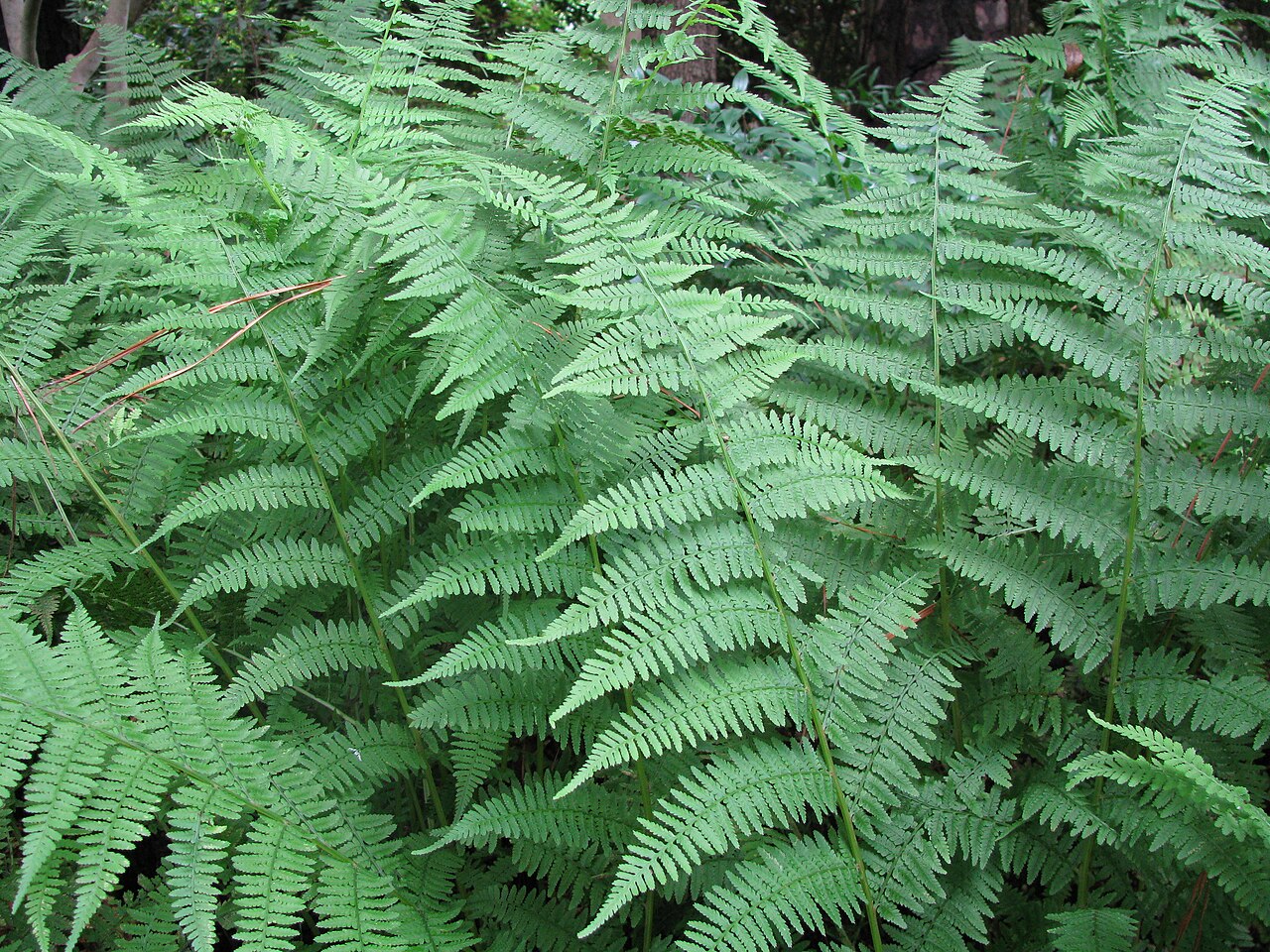
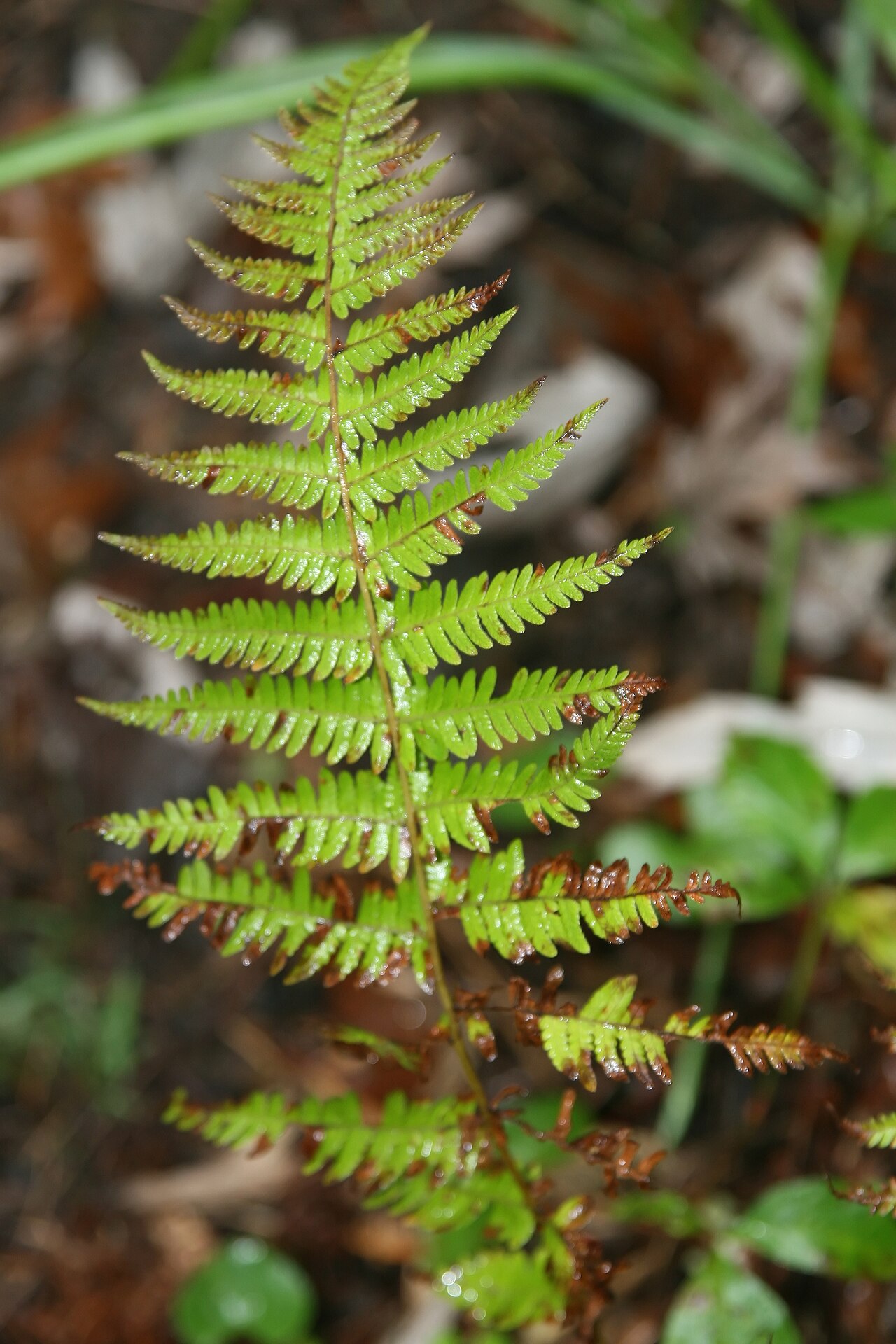
New York fern (Thelypteris noveboracensis) is a soft-textured native fern that can make a luminous green ground layer in an eastern woodland garden. Its narrow fronds taper toward both the tip and the base, a useful distinction from several other common lacy ferns. A colony often looks particularly attractive where filtered sunlight falls through a gap in the deciduous canopy.
The common name should not be read as a geographic limit. This fern is native well beyond New York, including parts of Alabama, Georgia and Mississippi. In the South, however, habitat matters more than the state label: moist, acidic woodland soil and shelter from severe drying are much better guides than simply assuming that a native fern will thrive anywhere in the garden.
New York fern spreads through slender rhizomes and can fill open ground over time. It is useful where a flowing colony is wanted, but it deserves space and occasional boundary management. Put it where the fresh spring and summer fronds can be seen, leave room for its seasonal expansion, and avoid treating it as a fixed-size accent among tiny woodland specimens.
Identification
Rhizomes and frond arrangement
Brownish, scaly, creeping rhizomes send up individual fronds that together form a colony. The shoots are not organized into a single large vase-like crown. Looking at the distribution of fronds across the soil helps distinguish a spreading fern from a tightly clumping one, and it also tells you how the plant is likely to behave after a few years in a garden.
Tapered blades
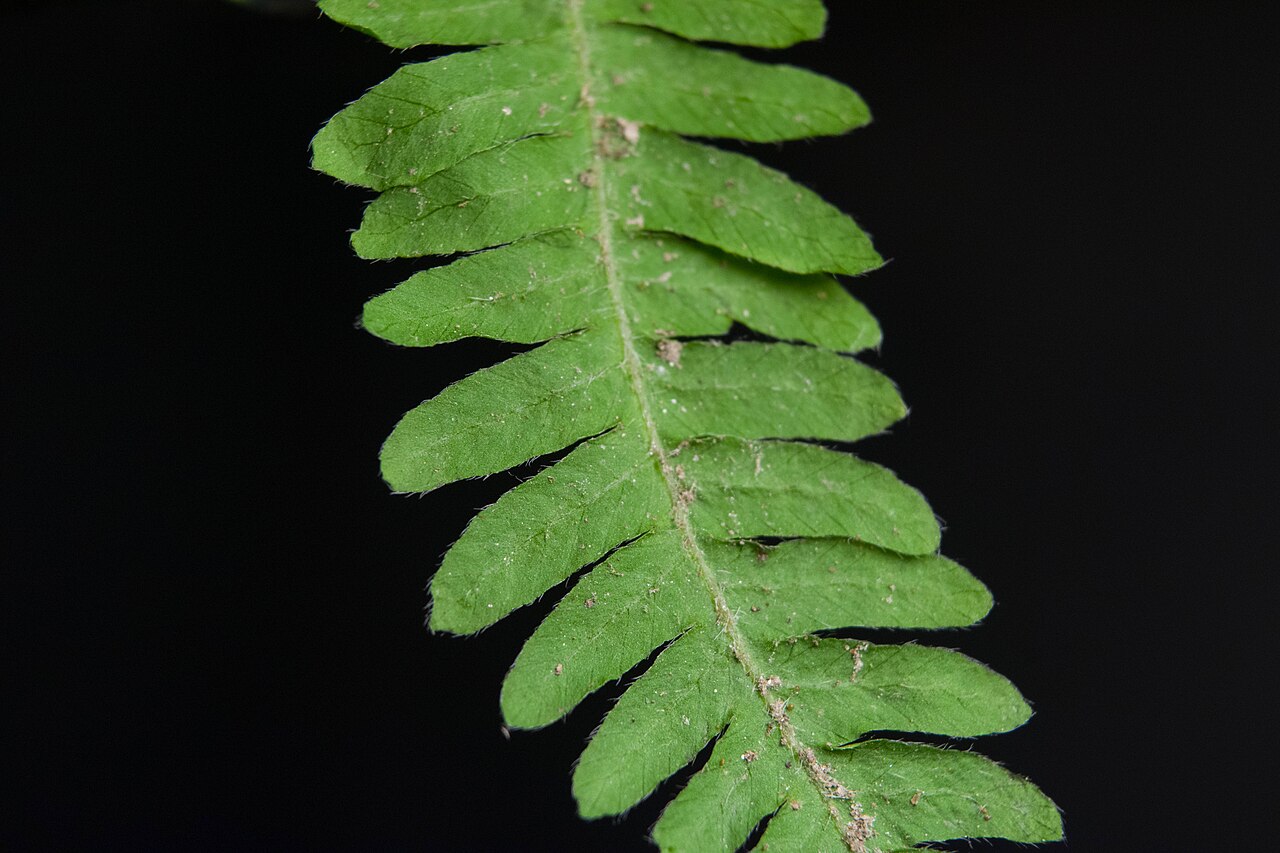
The most useful field character is the gradual reduction of the lower pinnae toward the frond base. The blade becomes narrower toward both ends rather than ending abruptly in large basal leaflets. The effect gives a complete frond a tapered, elongated outline. Examine a frond from its tip all the way down toward the stalk; a photograph that crops off the lower portion removes an important clue.
Leaflets are finely divided and usually light or yellowish green. Typical garden growth is around 1–2 feet, with the regional table’s 12–18 inches describing the smaller part of that range. Color alone is not diagnostic, because moisture, age and lighting alter the appearance. The combined pattern of frond shape, lower leaflet size and colony habit is more dependable.
Spores and fertile foliage
New York fern does not make conspicuous separate bead-bearing fronds like sensitive fern. Spores develop in small sori on the lower surface of fertile leaves. A hand lens can make these structures easier to see, but their absence on a young or sterile frond does not rule out the species. There are no flowers, berries or seedpods at any stage.
Similar woodland ferns
Hay-scented fern can form a similarly pale, spreading colony, but its blades are generally broad toward the base, its axes have conspicuous fine hairs, and bruised foliage has the characteristic hay scent. Lady ferns and other finely divided woodland species can also resemble New York fern at a glance. Use a regional fern key for uncertain plants rather than naming every delicate colony from its general appearance.
Quick Facts
| Scientific Name | Thelypteris noveboracensis |
| Family | Thelypteridaceae (included in broader Aspleniaceae in some classifications) |
| Plant Type | Deciduous, rhizomatous woodland fern |
| Mature Height | 12–18 in in the regional list; commonly 1–2 ft |
| Mature Spread | 1–2 ft initially; colonies expand through creeping rhizomes |
| Growth Rate | Moderate, with ongoing colony expansion |
| Sun Exposure | Partial shade to shade; dappled woodland light |
| Water Needs | Average; established plants tolerate occasional dryness |
| Soil Type | Acidic, humus-rich, moist soil with drainage |
| Soil pH | Acidic |
| Bloom Time | Non-flowering; spores on the lower surface of fertile fronds |
| Flower Color | None; pale to yellow-green fronds |
| Fall Color | Seasonal yellowing and browning before dormancy |
| Fruit | None; sori rather than seeds or fruit |
| Deer Resistant | Generally deer resistant; local browsing varies |
| USDA Hardiness Zones | 3–8 |
Native Range
The North American range extends through much of the eastern United States and eastern Canada, with the Appalachian and northeastern regions forming a familiar part of its distribution. Kew’s account, used for the state map, includes southern states such as Louisiana and Mississippi as well as Alabama and Georgia. It is a broad distribution of suitable habitats, not a continuous carpet across every landscape in those states.
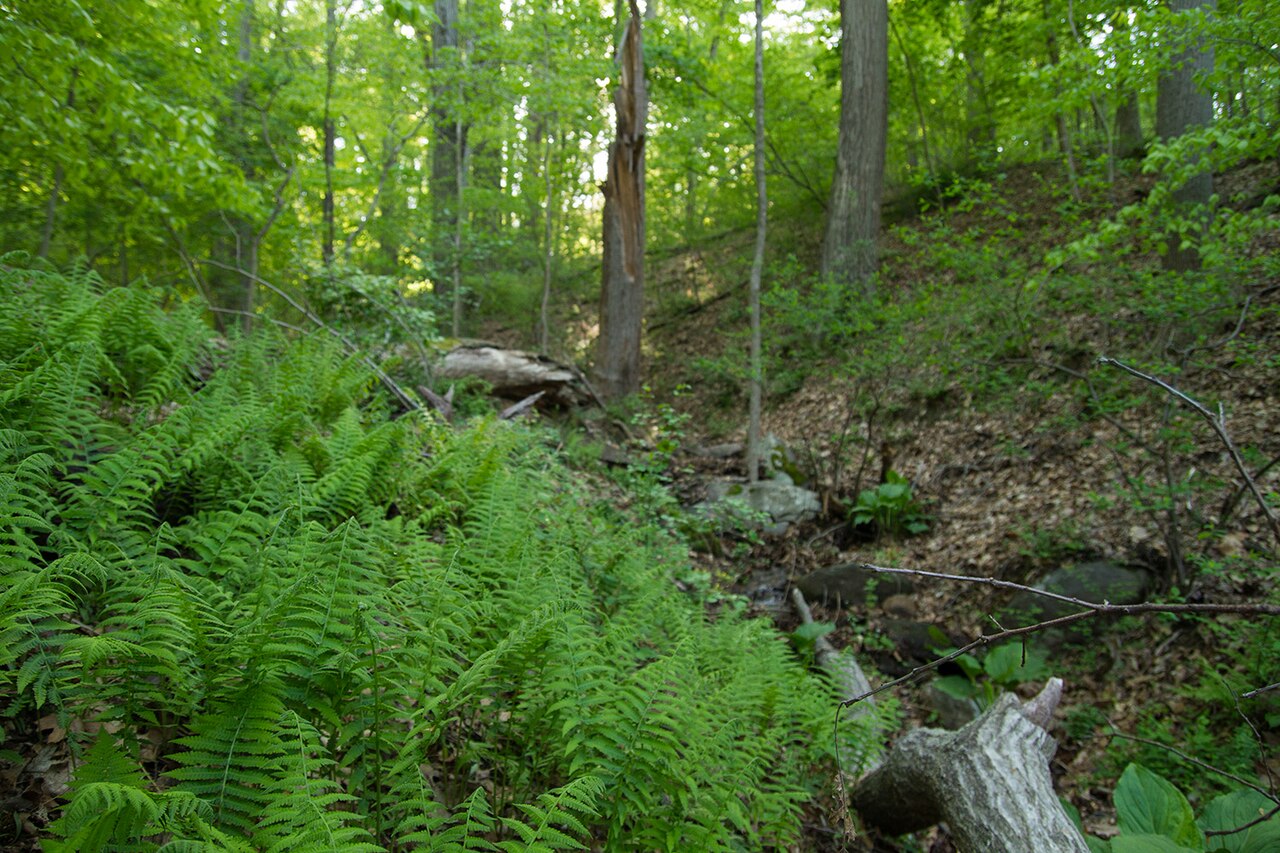
Mesic woods, sheltered forest slopes, low woods and some moist edges provide the basic setting. The plant favors acidic soils and can endure occasional dryness after establishment, but a persistently dry root zone beneath thirsty trees is not the same as a mesic woodland. In southeastern gardens, consider the actual summer moisture pattern and the degree of shelter before choosing a location.
Canadian occurrences extend from Ontario and Québec through Atlantic provinces. Some broad taxonomic treatments also include eastern Asian populations; the map here deliberately shows only the native U.S. distribution rather than presenting itself as a complete global range map. For a North American restoration or native garden, source plants of appropriate North American provenance and consult local records at range margins.
Native Range at a Glance
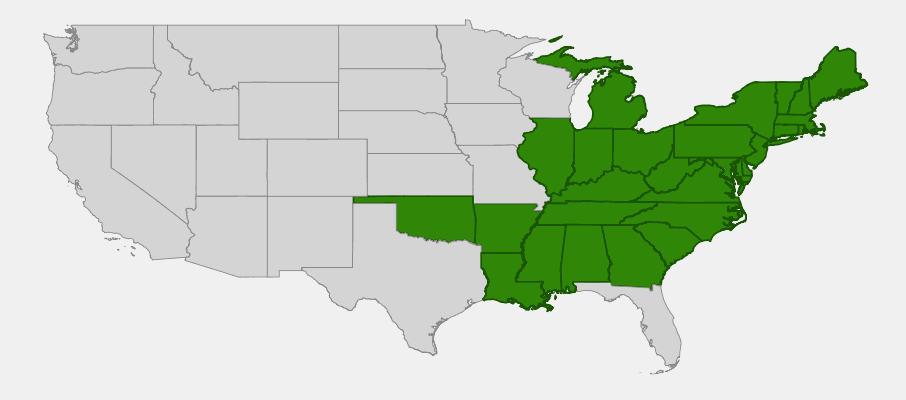
| U.S. States | Alabama, Arkansas, Connecticut, Delaware, Georgia, Illinois, Indiana, Kentucky, Louisiana, Massachusetts, Maryland, Maine, Michigan, Mississippi, North Carolina, New Hampshire, New Jersey, New York, Ohio, Oklahoma, Pennsylvania, Rhode Island, South Carolina, Tennessee, Virginia, Vermont, West Virginia |
| Canada / Other Native Regions | Ontario, Québec, New Brunswick, Nova Scotia, Prince Edward Island and Newfoundland |
| Ecoregion | Eastern mesic forests, Appalachian woodlands and Atlantic-region forests |
| Elevation Range | Varies across the range; no single numeric interval established by the sources used here |
| Habitat | Moist woods, sheltered forest slopes, low woods and some woodland edges |
| Common Associates | Deciduous woodland trees and compatible woodland perennials, with space for rhizomes |
| Distribution Sources | Kew Plants of the World Online; USDA (County-Level Data) |
Map: U.S. state-level native occurrence based on Kew, not county coverage or a guarantee of garden suitability. Canadian and other native regions are described in the text.
📋 See the Alabama, Georgia & Mississippi native plant list for regional context.
Growing & Care Guide
Light
Dappled sun, partial shade and woodland shade suit New York fern. Patches of light through the canopy can support vigorous growth, while afternoon shelter helps reduce drying in hot weather. Avoid interpreting its occurrence in woodland openings as a recommendation for an exposed, reflected-heat planting beside a south-facing wall.
A deep-shade location may be workable if moisture and soil structure are good, but darkness does not compensate for compacted, droughty soil. If neighboring trees have dense surface roots, inspect the root zone before planting. A garden fern should be matched to the conditions available, not expected to correct a difficult tree-root situation by itself.
Soil and water
Acidic, humus-influenced soil that retains moisture while draining excess water is the best starting point. The regional table’s A–D moisture code describes average to drier conditions, not a promise that new plants require no watering. Once established, this species can tolerate occasional dry periods; during establishment, keep the root system from drying completely.
Do not automatically add lime to a woodland bed. New York fern’s preference for acidic conditions is an important part of its site selection. If other plants in the same bed require a very different soil chemistry, separate the plantings rather than trying to satisfy incompatible preferences in one small pocket. A soil test is more informative than changing pH by guesswork.
Maintain a modest leaf-litter layer and avoid piling coarse mulch over emerging shoots. In a woodland-style planting, decomposing leaves protect the surface and fit the natural setting. Water the root zone during prolonged dry spells, especially in the first season, but avoid creating a stagnant depression that stays waterlogged after every rain.
Planting tips
Plant nursery-grown stock or divisions from an identified cultivated colony during a season with moderate temperatures. Keep the rhizome close to its existing depth and settle soil around the roots without burying the growing points. A small division may not produce a full display immediately; judge establishment by healthy new growth and persistence, not by instant density.
Give the plant enough room to spread and reserve an accessible route for inspection. It can be attractive as a connecting layer between larger woodland plants, but close planting around slow-growing orchids or trilliums invites future crowding. Design with the mature colony in mind rather than treating every pot as a permanent isolated clump.
Pruning and maintenance
The foliage is deciduous in the normal seasonal cycle. Allow green fronds to function through the growing season, then remove fully dead growth if needed. There is no flowering stem to deadhead. A light cleanup is usually enough; repeated cutting of healthy fronds reduces the display without providing a corresponding benefit.
Inspect the advancing edge of the colony and lift unwanted rhizomes before they become entangled with valuable neighboring plants. If summer fronds decline, check heat and moisture before adding fertilizer. The goal is a stable, appropriately sized ground layer, not maximum possible growth. In a natural woodland, preserve diversity rather than replacing every other ground-layer species with fern.
Propagation
Division is a practical method for gardeners with an established cultivated patch. Use a section containing healthy rhizome buds and roots, replant it promptly, and maintain adequate moisture as it establishes. Avoid taking anonymous divisions from a mixed fern bed unless the donor plant has been identified through its whole frond and reproductive features.
Spore propagation is also possible, but the life cycle passes through a tiny gametophyte stage before recognizable fern plants appear. It requires a more controlled approach than ordinary seed sowing. Beginners who mainly want a reliable planting are better served by propagated nursery plants, while experienced fern growers may enjoy studying the additional stage.
Landscape uses
- A soft-textured ground layer in a moist, acidic woodland garden with room for gradual expansion.
- A naturalistic path edge where whole fronds can be viewed from tip to tapered base.
- A summer companion near spring ephemerals, with enough separation to prevent the fern from smothering them.
- A shaded transition between larger native shrubs and an open woodland floor, where an irregular colony looks more appropriate than a formal clipped border.
Wildlife & Ecological Value
Pollinators
There are no flowers to supply nectar or pollen. New York fern contributes habitat structure rather than a floral food resource. Combine it with suitable native flowering plants in a larger garden design, allowing each enough light and space to fulfill its role. “Native” and “pollinator flower” are not synonymous categories.
Birds and small animals
Extension descriptions note the use of fern material in nesting and the value of the ground layer for cover. A moist, shaded patch also provides a sheltered setting within the broader leaf-litter community. These benefits depend on the surrounding habitat; one isolated pot on bare gravel does not function like a woodland colony with litter, neighboring plants and undisturbed soil.
Deer and competing growth
New York fern is commonly described as deer resistant, though no plant is guaranteed never to be sampled. Where deer remove more palatable neighbors, ferns may become a larger share of the understory. A gardener should still monitor diversity and competition. The fact that a fern remains when other plants disappear is not, by itself, a reason to encourage it to fill every remaining opening.
A seasonally changing ground layer
The fronds help shade the soil surface while green, then return organic material as they die back. Leaving an appropriate amount of litter supports a more natural seasonal cycle than scraping the bed bare each autumn. Avoid intensive cultivation through the rhizomes, and keep invasive vines and groundcovers from using the fern patch as an unnoticed entry point into the woodland garden.
Cultural & Historical Uses
The epithet noveboracensis refers to New York, but the plant is part of a much wider eastern woodland flora. That difference between a name and a range is useful to remember when reading plant labels. A familiar place-name can be historically meaningful without identifying the only region where a species belongs.
Fern classification has changed as relationships have been studied more closely. This species may be listed as Thelypteris noveboracensis, Parathelypteris noveboracensis or Amauropelta noveboracensis, depending on the reference. Those names are treated as referring to the same New York fern here. They should not generate three separate pages, plant-list entries or purchases of supposedly different species.
No food or medicinal harvest is recommended in this guide. Its value is as a garden and teaching plant: the tapered frond base, the creeping colony and the absence of flowers all provide clear opportunities to observe how ferns differ from flowering perennials. Careful identification and site matching are more useful than attaching generalized folklore about ferns to a particular species without evidence.
Frequently Asked Questions
What is the easiest identification clue?
Look at a complete frond. The lower leaflets gradually become smaller toward the base, and the blade also tapers toward the tip. Combine that outline with the pale, finely divided foliage and creeping colony habit; do not rely on color alone.
Is New York fern native in the Southeast?
Yes, native-distribution sources include several southeastern states, including Alabama, Georgia and Mississippi. It still needs suitable woodland conditions. State-level nativity does not mean that a dry, exposed or heavily compacted site will support it.
Is it the same as hay-scented fern?
No. They are different species with different identification features, even though both can form fine-textured colonies. Hay-scented fern generally has broader basal portions, conspicuous fine hairs and a hay-like scent when bruised. Examine the whole frond when distinguishing them.
Can it tolerate dry shade?
Established plants can handle occasional dryness, but moist, acidic woodland soil is a better default. A newly planted division or a site that remains dry through summer needs more care or a different species. Do not interpret an A–D table code as “never water.”
Which scientific name should I search when buying it?
Search Thelypteris noveboracensis and its synonyms Parathelypteris noveboracensis and Amauropelta noveboracensis. Confirm the common name and frond characteristics with the nursery. Different genus treatments do not make these three distinct garden plants.
Sources & Further Reading
- NC State Extension — New York Fern
- Kew Plants of the World Online — native distribution and taxonomy
- USDA PLANTS — THNO
- ITIS — New York fern synonymy
Find Native Plants Near You
Ask for nursery-propagated, accurately identified plants and a seed or stock source suited to your region. Browse native plant nurseries in Alabama, Georgia, and Mississippi. Confirm local nativity and site suitability before ordering.