Hay-scented Fern (Dennstaedtia punctilobula)
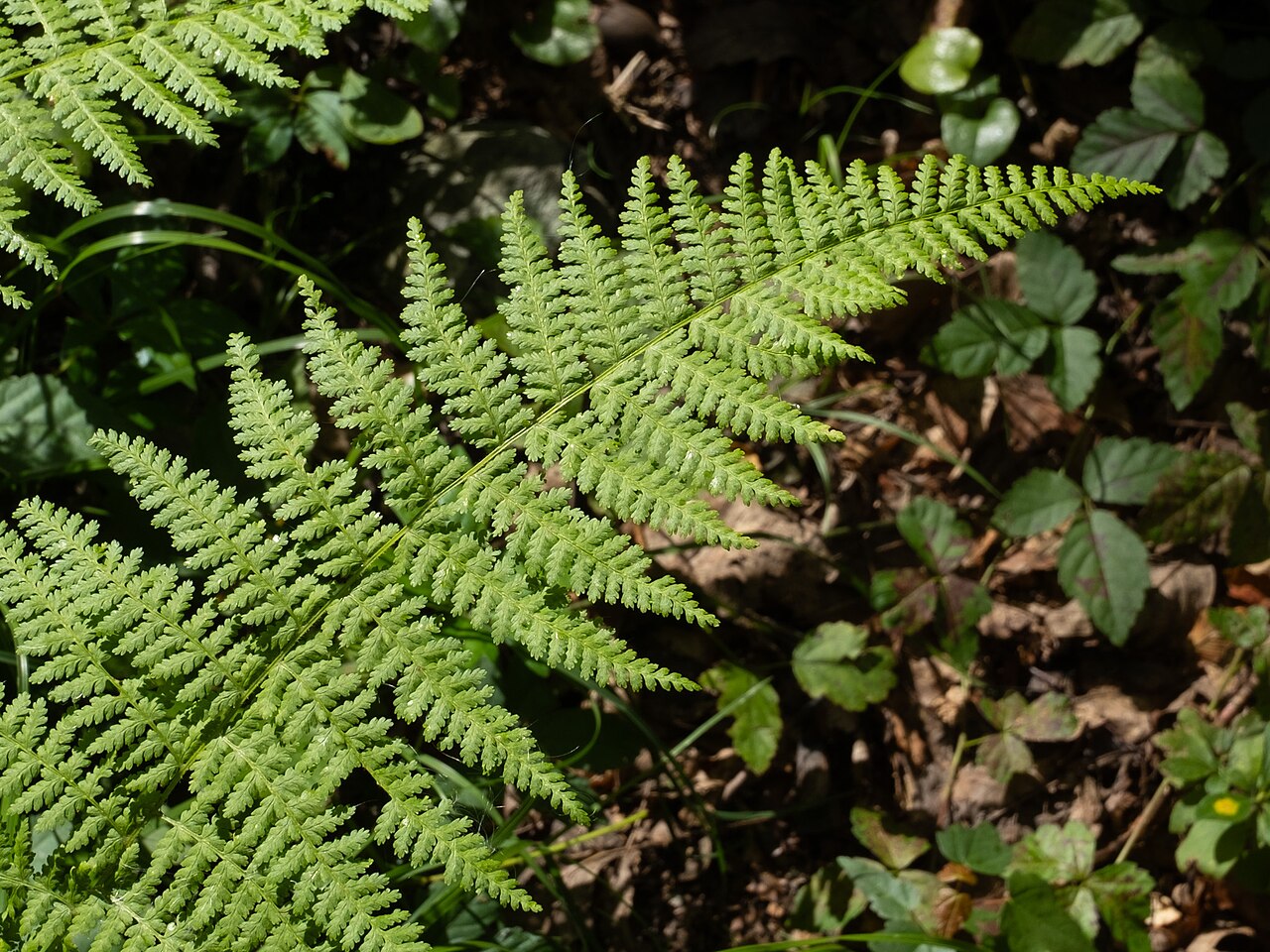
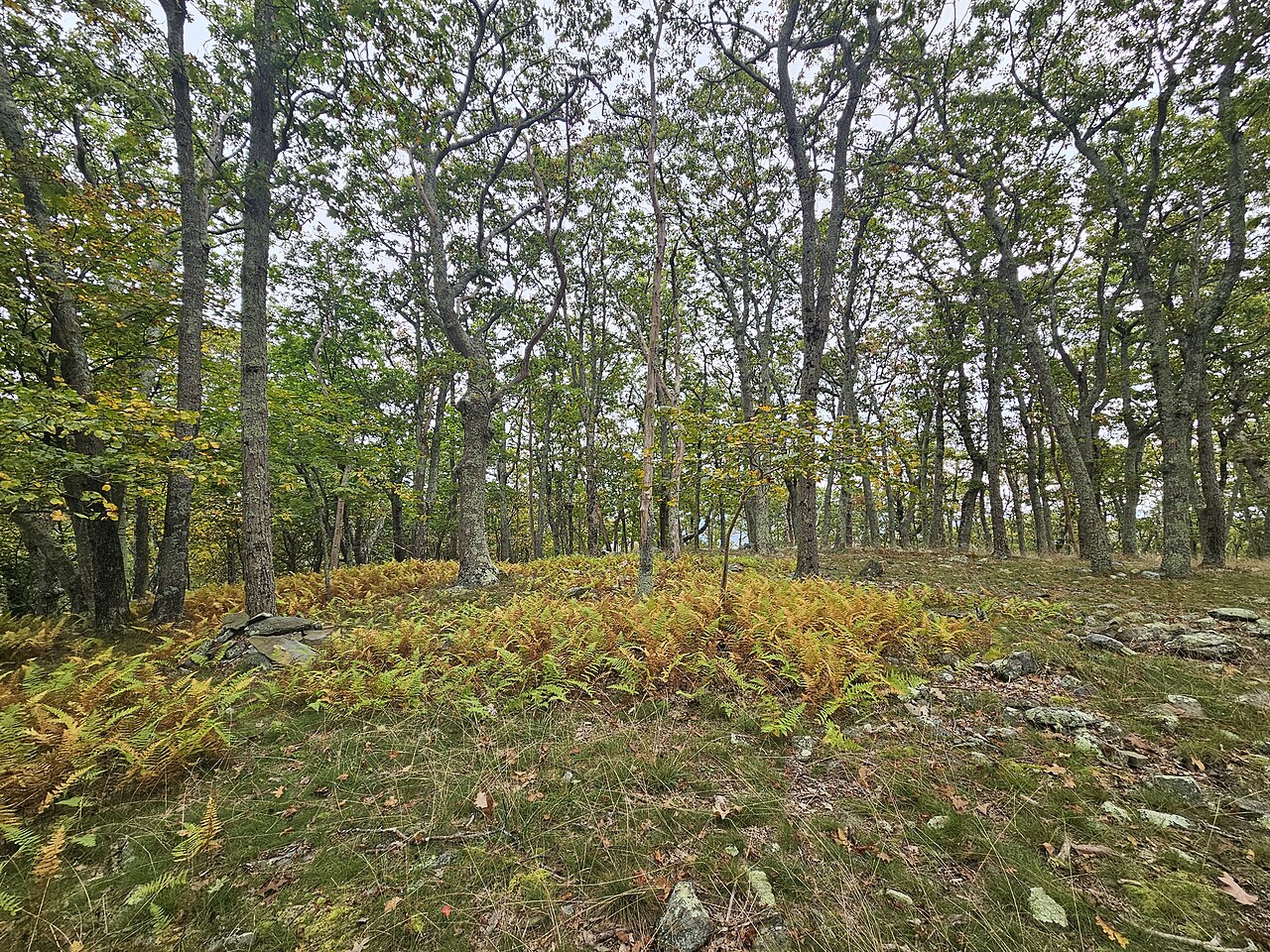
Hay-scented fern (Dennstaedtia punctilobula, also treated as Sitobolium punctilobulum) creates a fine-textured, yellow-green layer beneath eastern woodland trees. Its fronds release the scent of cut hay when bruised, and an established patch can turn golden in autumn. The delicate appearance is deceptive: this is a vigorous spreading fern, not a restrained specimen for a tightly packed collection of small woodland flowers.
Choose it for a place where a colony is genuinely wanted. A broad woodland edge or a contained shaded bank can make good use of its ability to fill space. A bed of slow-growing trilliums, orchids or tiny spring ephemerals is a different matter. Dense hay-scented fern can shade and crowd neighboring plants, and it can impede tree seedling establishment in a forest understory. Native status does not eliminate those management concerns.
For the Alabama, Georgia & Mississippi regional list, this is chiefly an upland and Appalachian choice rather than a plant to recommend indiscriminately across the Deep South. The native distribution used here includes Alabama and Georgia but not Mississippi. In a hot garden, part shade and dependable soil moisture are safer starting points than the hottest exposed slope, even though established plants tolerate drier conditions than many other ferns.
Identification
Rhizomes and colony pattern
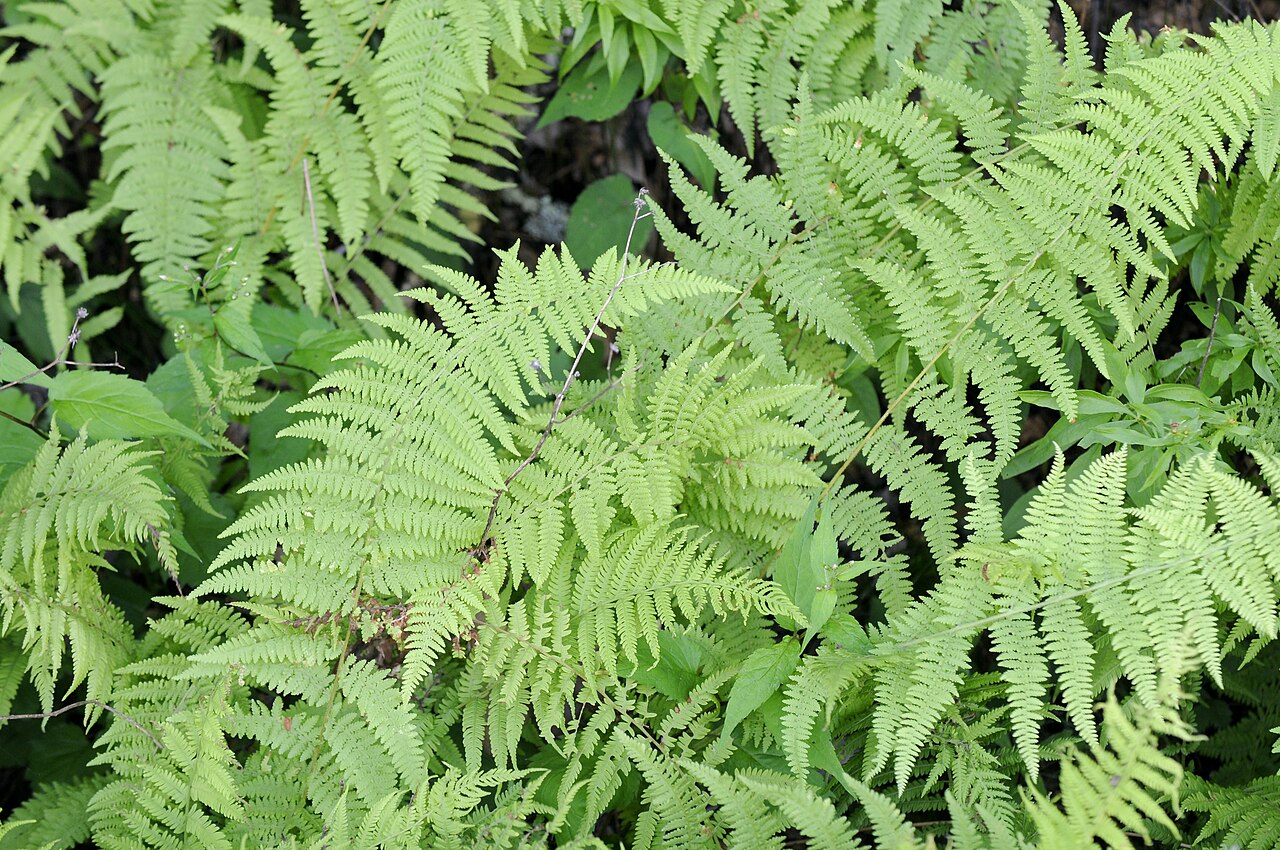
Long, creeping rhizomes send up many separate-looking fronds, allowing a small start to become a broad patch. The fronds do not all arise in one large, tidy vase. Follow the pattern across the ground: a loose colony of similar fronds is an important clue to the plant’s growth strategy and to the space it will need in a garden.
Fronds and hairs
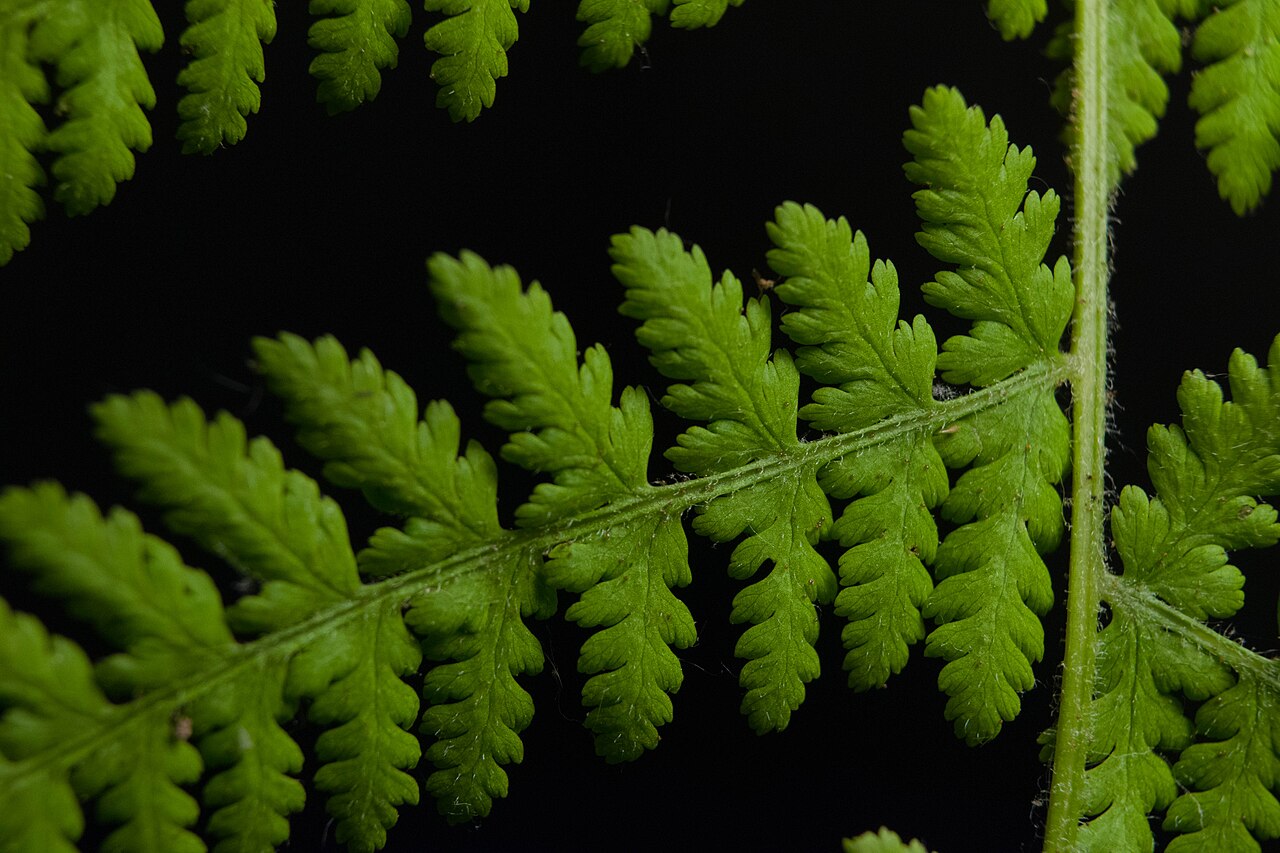
Fronds are finely divided, generally narrow-triangular to lance-shaped, and often yellow-green. The blade is broad toward its lower portion and narrows to a pointed tip. Tiny hairs on the rachis and leaflet axes are useful identification details, best seen with a hand lens or close photograph. The fine divisions give the fern its soft appearance, but a correct identification still requires looking beyond “lacy green fern.”
Typical garden height is around 1–2 feet, with longer arching fronds possible in favorable conditions. Consider both height and horizontal spread when placing it beside other plants. A compact new division does not convey the space a mature colony can occupy.
Scent and seasonal color
The hay-like scent is noticeable when foliage is brushed, bruised or drying. It supports an identification already based on frond structure, but there is no need to crush handfuls of a wild colony to test it. In autumn the fronds turn yellow, then tan or brown and die back. Heat and dry weather can produce earlier decline in gardens near the warm end of its range.
Spore-bearing structures
Fertile and sterile fronds are broadly similar in overall appearance. Small round sori lie near the margins of the lower frond surface, associated with cup-like protective structures. This is unlike sensitive fern, which makes a visibly separate, bead-bearing fertile frond. Hay-scented fern has no flower, fruit or seed capsule; its fine brown reproductive structures are part of the fern life cycle.
Quick Facts
| Scientific Name | Dennstaedtia punctilobula |
| Family | Dennstaedtiaceae |
| Plant Type | Deciduous, rhizomatous, colony-forming fern |
| Mature Height | Usually 12–24 in; frond length can be greater in favorable sites |
| Mature Spread | Often 3–4 ft or more; colonies continue spreading |
| Growth Rate | Rapid rhizome spread once established |
| Sun Exposure | Partial shade to shade; sun tolerated with adequate moisture |
| Water Needs | Average; established plants tolerate occasional dryness |
| Soil Type | Humus-influenced loam, sand, clay or rocky soil with drainage |
| Soil pH | Acidic to neutral |
| Bloom Time | Non-flowering; spores develop on fertile fronds |
| Flower Color | None; finely divided yellow-green fronds |
| Fall Color | Yellow to golden-brown before dormancy |
| Fruit | None; marginal sori on the underside of fronds |
| Deer Resistant | Usually avoided by deer; dense colonies can outcompete neighbors |
| USDA Hardiness Zones | 3–8 |
Native Range
This fern is native to eastern North America, extending through northeastern and Appalachian forests and westward into parts of the Midwest and Arkansas. Its distribution is not equally dense across that whole area. A species that carpets a New England hillside may occur only in scattered suitable sites at the edge of its range. The state map summarizes native occurrence and should not be used as a county-level planting prescription.
In the Southeast, cooler wooded slopes, upland banks and openings provide the strongest habitat model. The plant tolerates a range of light levels and can persist in rocky or relatively lean soil, but that flexibility is different from adaptation to prolonged coastal heat or permanently flooded ground. Shade and a buffered root zone are particularly useful in southern garden settings.
The Canadian range includes Ontario, Québec, New Brunswick, Nova Scotia, Prince Edward Island and Newfoundland. Kew’s native distribution is the basis of the U.S. map; introduced records elsewhere are not shaded as native. The appearance of the same fern under Sitobolium punctilobulum in a modern flora reflects a taxonomic treatment, not a second plant that should be added separately to the garden or list.
Native Range at a Glance
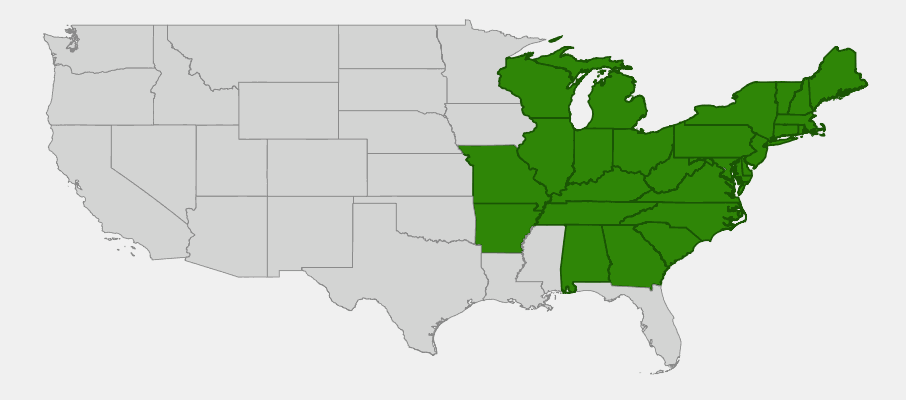
| U.S. States | Alabama, Arkansas, Connecticut, Delaware, Georgia, Illinois, Indiana, Kentucky, Massachusetts, Maryland, Maine, Michigan, Missouri, North Carolina, New Hampshire, New Jersey, New York, Ohio, Pennsylvania, Rhode Island, South Carolina, Tennessee, Virginia, Vermont, Wisconsin, West Virginia |
| Canada / Other Native Regions | Ontario, Québec, New Brunswick, Nova Scotia, Prince Edward Island and Newfoundland |
| Ecoregion | Eastern forests, Appalachian uplands and northeastern woodland openings |
| Elevation Range | Varies across the range; no single numeric interval established by the sources used here |
| Habitat | Woods, banks, rocky slopes, clearings and forest edges |
| Common Associates | Woodland trees and robust ground-layer plants; keep away from delicate seedlings |
| Distribution Sources | Kew Plants of the World Online; USDA (County-Level Data) |
Map: U.S. state-level native occurrence based on Kew, not county coverage or a guarantee of garden suitability. Canadian and other native regions are described in the text.
📋 See the Alabama, Georgia & Mississippi native plant list for regional context.
Growing & Care Guide
Light
Part shade is a practical default, especially in warm regions. Established colonies can grow in more sun where soil moisture remains adequate, and they also tolerate substantial shade. Read a “sun tolerant” label together with the water and climate requirements. A sunny, cool northeastern bank and an exposed Georgia planting beside dark pavement impose very different demands.
If a garden colony becomes increasingly thin, look for changing canopy density, competition and moisture patterns rather than automatically assuming a nutrient shortage. Conversely, a sudden increase in light after tree loss can accelerate growth or dry the bed. Observe the fern after site changes before deciding whether to expand or reduce it.
Soil and water
Acidic to neutral, humus-influenced soil with drainage suits the species. It accepts clay, loam, sand and rocky ground when the overall site is workable. It likes moisture, yet established plants can tolerate occasional dryness. Newly planted divisions have fewer roots and need closer attention; drought tolerance is not a reason to let a small start dry completely before it has established.
Avoid planting in a permanently submerged basin. A slope that sheds excess rain but retains organic matter is a more appropriate model than stagnant water. Light leaf litter can protect the root zone, while a thick, smothering mulch layer is unnecessary. Do not heavily fertilize a spreading colony: faster growth is rarely the missing ingredient in hay-scented fern management.
Planting tips
Plant propagated divisions at their existing soil depth with roots spread into surrounding soil. Allow generous horizontal room rather than placing a small pot between valuable slow-growing perennials. Water the planting thoroughly and follow its response during the first dry period. New fronds and a stable root system are better signs of success than the immediate appearance of a large, dense patch.
Design the boundary before planting. A maintained path, an accessible lawn edge or another clearly inspected limit is more useful than an imaginary line inside a crowded woodland bed. Rhizomes can cross planting boundaries; give yourself physical access to find and remove encroaching growth without disturbing the entire garden.
Pruning and maintenance
Leave fronds until they senesce, then remove dead material only if needed for access or tidiness. The plant does not require trimming to induce flowers because it does not flower. If a colony advances into unwanted ground, lift or cut back the invading rhizomes with attention to nearby roots. Repeated small adjustments are easier than recovering a bed after years of unchecked spread.
Do not plant it around young trees that are expected to regenerate naturally without first considering competition. Forestry research and extension guidance identify dense understory fern layers as a barrier to seedling establishment. In a garden, the same principle applies to small desirable seedlings and spring flowers: attractive cover can still become excessive cover.
Propagation
Division of an established garden colony is usually the simplest route for gardeners. Select a healthy piece with viable rhizome buds and roots, replant promptly, and maintain moisture while it settles. Work in a cool season appropriate to the local climate rather than dividing during a hot, dry spell. Take material from cultivated stock, not from protected woodland populations.
Spores provide another route but require the separate gametophyte stage common to ferns. They should not be treated as ordinary packet seed planted in a border. For a home planting where the goal is a predictable patch, propagated divisions from an identified source are easier to manage. Accurate labeling is important because many lacy ferns look similar when very young.
Landscape uses
- A roomy naturalistic woodland edge where a broad colony is acceptable and its boundary can be inspected.
- A shaded or partly shaded bank with stable soil and enough moisture for establishment.
- A seasonal ground layer where fine summer texture and yellow autumn foliage are desired.
- A deliberately managed patch in a deer-browsed garden, separated from slow-growing woodland specimens and tree regeneration areas.
Wildlife & Ecological Value
Pollinators
There are no nectar-bearing flowers. Pair the fern with appropriate native flowering plants in separate or sufficiently spacious planting areas if you want a sequence of bee and butterfly resources. Calling it a pollinator plant without that distinction would obscure its real role: cover, soil-level structure and participation in the woodland community.
Birds and mammals
The fronds create shelter near the ground, and the leaf-litter layer beneath them forms part of a larger habitat mosaic. Deer often avoid the foliage, which can help it persist where more palatable plants decline. That same browsing pattern can indirectly favor fern dominance, so a dense fern carpet is not automatically proof of a healthy, diverse understory.
Forest regeneration
Hay-scented fern can form a persistent cover that competes with tree seedlings for light and space. The ecological lesson is not that this native species should be removed everywhere, but that abundance and context matter. Preserve mixed ground layers where possible and avoid introducing it into a restoration area whose immediate purpose is establishment of a diverse crop of young trees.
Responsible placement
A native fern that spreads aggressively within its own range is not the same problem as an introduced invasive species. Nevertheless, both can be poor choices for the wrong small garden. Plan for the plant’s actual behavior. Using a few suitable species in the right places provides more lasting habitat value than filling every gap with the fastest available groundcover.
Cultural & Historical Uses
The familiar scent of drying hay gives this fern an unusually sensory common name. It is a plant that can be recognized through several observations at once: a colony of finely cut fronds, tiny hairs on the axes, a characteristic smell when foliage is bruised and a yellowing autumn display. Those traits make it useful for learning fern identification without relying on flowers.
Its scientific name has appeared under several genera as fern classification has developed. The combination Dennstaedtia punctilobula remains widely used in horticulture and in major plant databases, while Sitobolium punctilobulum is used in newer specialist treatments. Both refer to the same species in this guide. Searching both names can help locate reliable nursery and botanical information.
No food or home-medicine use is recommended here. The purpose of this profile is to help gardeners distinguish a useful, vigorous native fern from a universally suitable shade solution. Its beauty is most convincing when it is given an appropriate landscape role and allowed to express its seasonal character without overwhelming the rest of the planting.
Frequently Asked Questions
Is hay-scented fern invasive?
It is native within the range shown, but can spread aggressively by rhizomes and dominate a planting. That behavior makes it unsuitable for some small or species-rich beds even though it is not an introduced invasive plant there. Evaluate the space and desired plant community before adding it.
Will it grow in sun?
It can tolerate considerable sun with adequate moisture, especially in cooler climates. In hot southern gardens, part shade is a more forgiving starting point. A sun-tolerance label should never be separated from water availability, soil depth and summer heat.
Does it stay green all winter?
No. It is deciduous. Fronds normally yellow and brown as the season ends, and the rhizomes persist underground. A winter-bare patch is part of its seasonal pattern, not evidence that the whole colony has died.
How do I stop it swallowing smaller woodland flowers?
Keep it out of the immediate planting area of slow-growing specimens, provide a maintained boundary, and remove encroaching rhizomes early. If the intended bed is small and difficult to access, choose a less aggressive fern rather than committing to continual conflict.
Is Sitobolium punctilobulum a different fern?
No; it is an alternative modern scientific treatment of the hay-scented fern discussed here. Use both names when comparing labels and references, but do not buy or list them as two separate native species.
Sources & Further Reading
- NC State Extension — Hay-scented Fern
- Kew Plants of the World Online — native distribution and taxonomy
- USDA PLANTS — DEPU2
- Missouri Botanical Garden — hay-scented fern
- Penn State Extension — fern competition and forest regeneration
Find Native Plants Near You
Ask for nursery-propagated, accurately identified plants and a seed or stock source suited to your region. Browse native plant nurseries in Alabama, Georgia, and Mississippi. Confirm local nativity and site suitability before ordering.