
Whitemouth Dayflower (Commelina erecta)
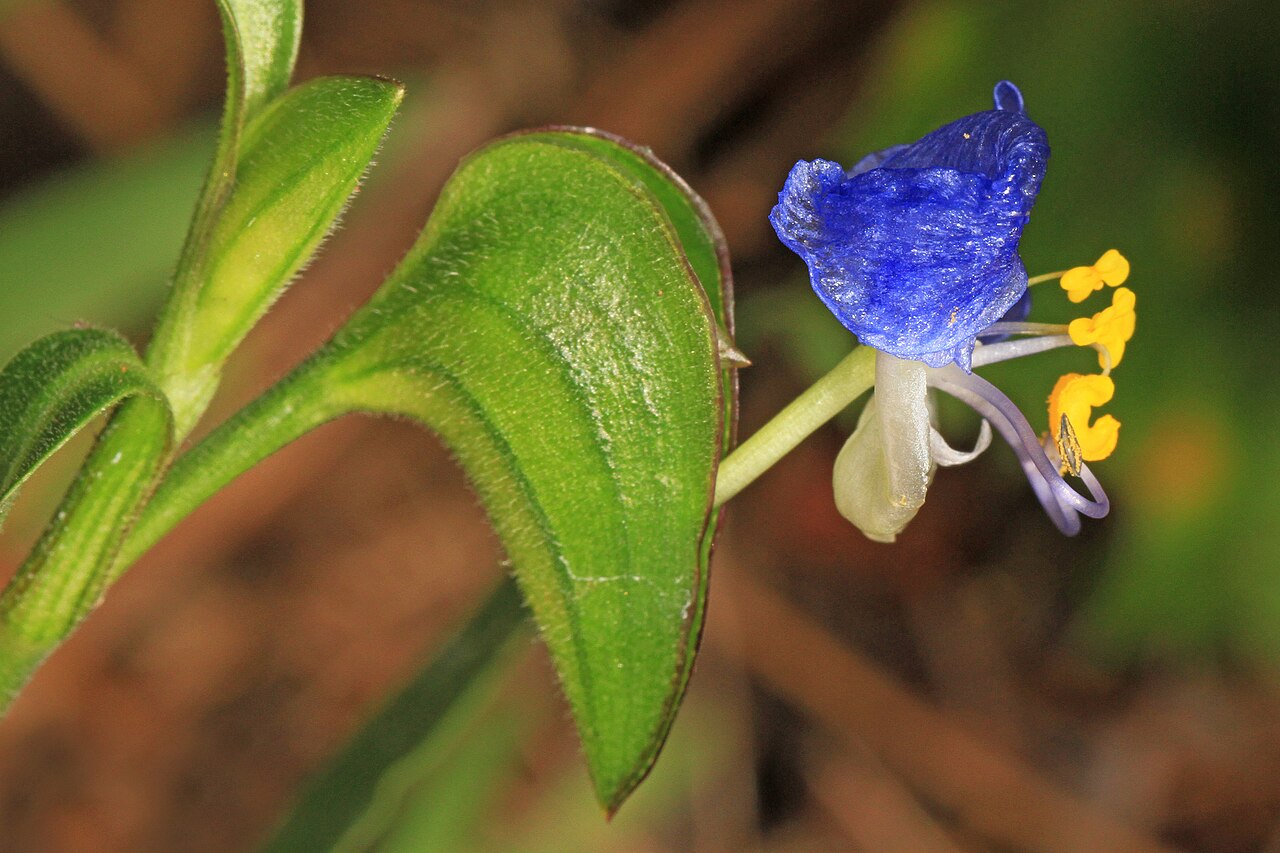
Commelina erecta, known as Whitemouth Dayflower or erect dayflower, is a native perennial of the spiderwort family (Commelinaceae). It grows in clumps of upright to sprawling, jointed stems 1 to 3 feet long, with narrow, grass-like leaves, from a cluster of thick, fleshy roots. From late spring to fall it produces small but vivid flowers with two large, rounded, sky-blue petals and a third, much smaller white petal below, the “white mouth” of its name.
Each flower lasts only a single morning. It opens around sunrise and wilts by midday, which is why the genus is called dayflowers. New flowers emerge almost daily from a folded, leafy, boat-shaped bract called a spathe, so a patch blooms for months. Whitemouth dayflower is a plant of dry, sunny, sandy places: sandhills, scrub, pine barrens, dunes, prairies, rocky glades and open woods.
Many gardeners know dayflowers only from the weedy Asiatic dayflower, a non-native annual of damp, shady ground. Whitemouth dayflower is a different, native plant, and it is well suited to dry, sandy gardens, rock gardens and native meadows. This guide covers how to identify it, where it grows, and how to grow it.
Identification
Several dayflowers grow in North America, including two common non-native weeds. Check the color of the lowest petal, the shape of the spathe and the top of the leaf sheath.
Roots & Stems
Plants grow from a cluster of thickened, somewhat tuberous roots that store water and help the plant survive drought and fire. The stems are smooth, jointed and succulent, upright when young and often leaning or sprawling as the season goes on.
Leaves
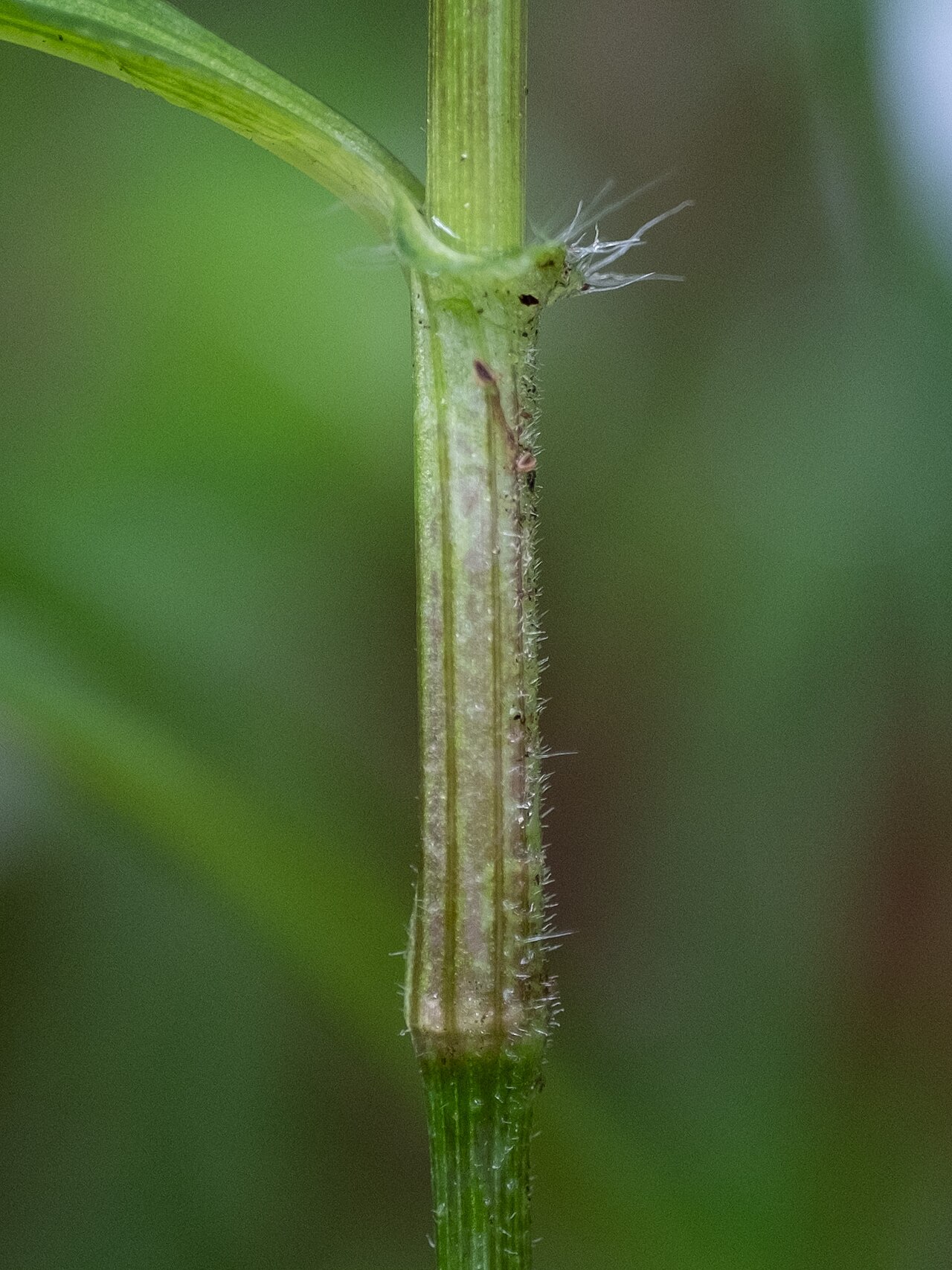
The leaves are alternate, narrowly lance-shaped to linear, about 2 to 6 inches long and less than an inch wide, with parallel veins. At its base each leaf forms a tubular sheath around the stem. At the top of the sheath are two small, rounded, ear-like lobes (auricles) fringed with long white hairs. These hairy auricles are one of the best ways to recognize the species.
Flowers
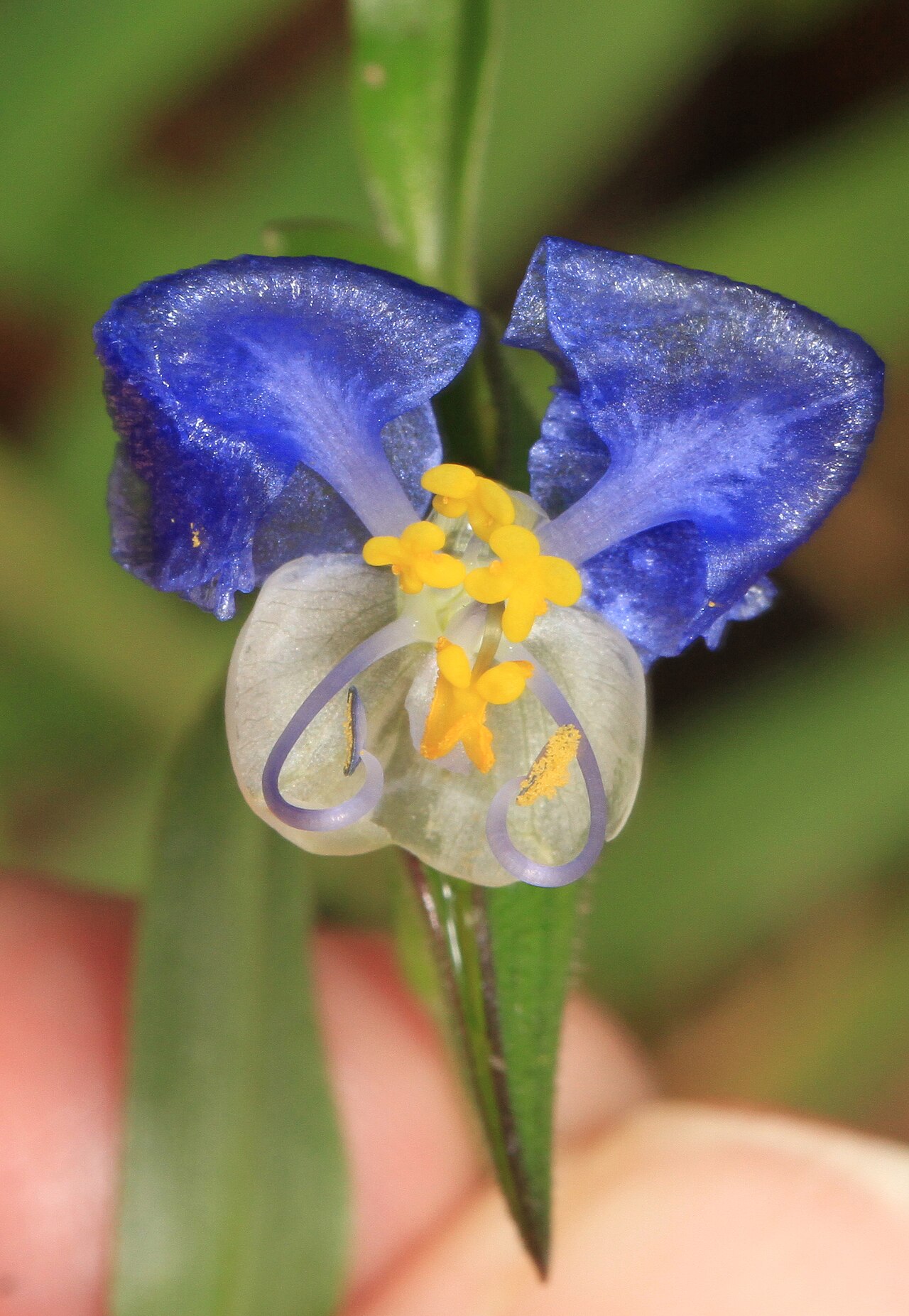
Flowers appear from late spring to fall, and almost all year in south Florida and Puerto Rico. They emerge one or two at a time from a folded, heart-shaped spathe about 1 inch long. The edges of the spathe are fused together near the base, forming a funnel that holds a slimy, clear liquid. Each flower is about 1 inch across, with two large, rounded, light to medium blue petals on top and a single tiny white petal below. Three yellow, showy but sterile stamens stand above three fertile ones that curve forward with the style.
Fruit & Seeds
After flowering, the stalk curls back into the spathe, and the fruit, a small capsule, ripens hidden inside. Each capsule holds usually three seeds, dark brown to gray and somewhat rough, which drop near the plant in late summer and fall.
Look-alikes
Asiatic dayflower (Commelina communis), a non-native annual, also has a small white lower petal, but its spathe edges are not fused and it grows in moist, shady, disturbed ground and roots at the nodes. Spreading dayflower (C. diffusa) has three blue petals. Virginia dayflower (C. virginica), a native of moist woods, is taller, with three blue petals and spathes clustered at the stem tips. Spiderworts (Tradescantia) have three equal petals.
Quick Facts
| Scientific Name | Commelina erecta (incl. var. angustifolia, var. deamiana) |
| Family | Commelinaceae (spiderwort family) |
| Plant Type | Herbaceous perennial with fleshy, tuberous roots |
| Mature Height | 1–3 ft (stems often sprawling) |
| Mature Spread | 1–2 ft |
| Growth Rate | Moderate |
| Sun Exposure | Full sun to part shade |
| Water Needs | Low; dry, well-drained soil |
| Soil Type | Sandy, gravelly or rocky; also dry loam |
| Soil pH | About 5.0–8.0 |
| Bloom Time | May–October (nearly year-round in south Florida and Puerto Rico) |
| Flower Color | Light to medium blue with a small white lower petal |
| Fall Color | None of note |
| Fruit | Small capsule hidden in the spathe, usually with three seeds |
| Deer Resistant | No; deer and rabbits browse dayflowers |
| USDA Hardiness Zones | 4–11 |
Native Range
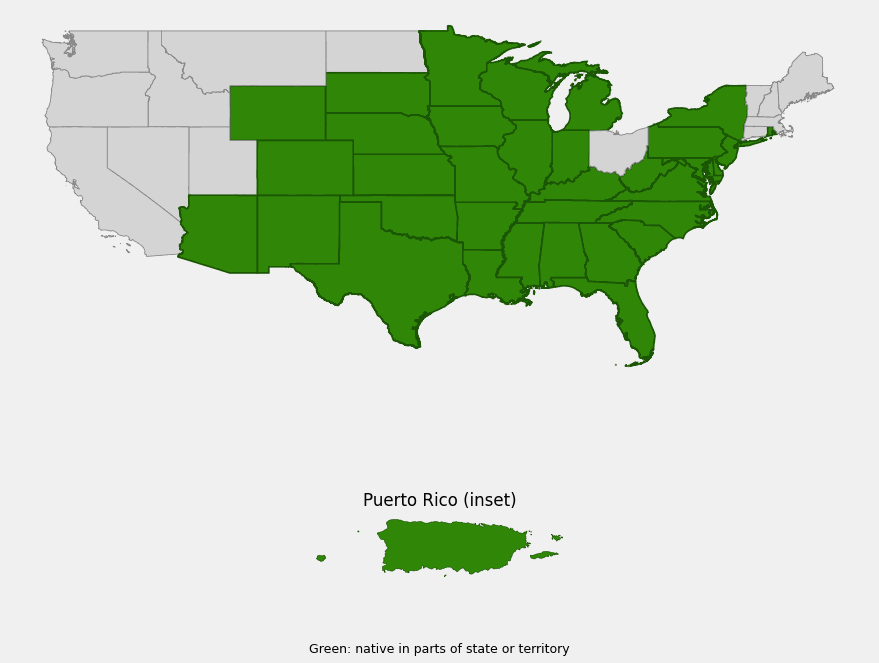
Whitemouth dayflower is one of the most widespread dayflowers of the Americas. USDA PLANTS lists it as native in the lower 48 states, Puerto Rico and the U.S. Virgin Islands, with records from 35 states and the District of Columbia. The Lady Bird Johnson Wildflower Center describes its U.S. range as Florida to New Mexico, north to New Jersey, Ohio, Illinois and southern South Dakota; USDA also records it from New York, Rhode Island, Michigan, Wisconsin, Minnesota, Colorado, Wyoming and Arizona. Beyond the United States it ranges through Mexico, the Caribbean and Central and South America, and it is also found in Africa and Asia.
It is most common in the Southeast and southern Great Plains, especially on the sandy Coastal Plain from the Carolinas through Florida to Texas. There it grows in longleaf pine sandhills, Florida scrub, coastal dunes and dry open woods. Farther north and west it grows in sand prairies, dunes, rocky glades, limestone barrens and dry hillsides, and it is local and uncommon at the northern edge of its range.
Several varieties have been named. Var. angustifolia, with very narrow leaves, is common in the West and on the Plains, while the broader-leaved var. erecta is more common in the East. Many botanists now treat the species broadly without varieties.
📋 Regional plant lists featuring Whitemouth Dayflower: New York, Pennsylvania & Northern New Jersey · Idaho, Eastern Oregon & Eastern Washington · Ohio & Indiana · Montana & Wyoming · Michigan, Wisconsin & Eastern Minnesota · Kentucky & Tennessee · Nebraska, Kansas & Eastern Colorado · Connecticut, Massachusetts & Rhode Island · New Hampshire, Maine & Vermont · Maryland, Virginia & West Virginia · Delaware, Southern New Jersey & Long Island · Arizona & New Mexico · Illinois, Iowa & Missouri · Alabama, Georgia & Mississippi · North & South Florida · Puerto Rico
Growing & Care Guide
Whitemouth dayflower is easy to grow in sunny, dry, sandy or rocky soil and needs little care once established. It is a small plant, best used in groups at the front of a dry border, in rock gardens and sandy meadows, or among native grasses where its blue flowers peek through.
Light
Full sun to part shade. It flowers most heavily in sun. In light shade, such as under open pines or oaks, it blooms well but grows taller and leans more.
Soil & Water
Give it well-drained sand, gravel or rocky soil. Its tuberous roots store water, so it tolerates long dry spells and often goes dormant in severe drought, returning with the next rains. It rots in soggy, poorly drained clay. It needs no fertilizer.
Planting Tips
Plant nursery plants or divided root clusters in spring, about 12 inches apart, setting the fleshy roots 1 to 2 inches deep. Group several plants together for a better show, since each one produces only a few flowers at a time. It combines well with low native grasses and other sandhill wildflowers.
Pruning & Maintenance
Little maintenance is needed. Cut back sprawling stems in midsummer if they look untidy; they will regrow and rebloom. Leave the old stems over winter in colder areas and remove them in early spring. Plants self-sow modestly but are not aggressive like Asiatic dayflower.
Propagation
Divide clumps of fleshy roots in early spring. Seeds can be sown outdoors in fall or in spring after a period of cold, moist stratification; germination is often slow and irregular. Stem cuttings root easily in moist sand.
Landscape Uses
- Dry, sandy gardens: a native perennial for sandhill and coastal gardens with little water
- Rock gardens: its small size and drought tolerance suit rocky, well-drained sites
- Native meadows and prairies: blue accents among bunchgrasses in dry prairie and sandhill restorations
- Pollinator gardens: a dependable pollen source for small bees through summer and fall
- Coastal landscapes: tolerates sandy dune soils, sun, heat and wind
Wildlife & Ecological Value
Dayflowers do not make nectar, but they provide pollen, seeds and foliage for a range of wildlife, and whitemouth dayflower fills that role in dry, open habitats.
For Pollinators
The flowers offer pollen only, no nectar. The showy yellow upper stamens are mostly sterile and act as a visual lure, while the lower stamens supply fertile pollen. Small bees, including sweat bees, and hover flies are the main visitors. Because each flower opens only in the morning, visits are concentrated in the early hours.
For Birds
Seeds of dayflowers are eaten by ground-feeding birds such as mourning doves, northern bobwhite and various sparrows. The plants also provide some cover in open sandy habitats.
For Mammals
White-tailed deer, rabbits and other herbivores browse the succulent stems and leaves. Small mammals eat the seeds.
Ecosystem Role
Whitemouth dayflower is part of the diverse herb layer of fire-maintained sandhills, scrub and dry prairies. Its tuberous roots let it resprout quickly after fire and drought, and it helps cover bare sand between bunchgrasses, which reduces erosion.
Cultural & Historical Uses
Carl Linnaeus named the genus Commelina after the Dutch botanists Jan and Caspar Commelijn. According to a well-known story, he also had a third family member in mind, who died before achieving anything in botany. The two large, showy petals represent the two botanists and the small, inconspicuous lower petal the third. Whitemouth dayflower, with its large blue petals and tiny white one, illustrates the story especially well.
Linnaeus described Commelina erecta in 1753. The species name means “upright,” although the stems often lean or sprawl later in the season. Young leaves and stems of several Commelina species have been eaten as cooked greens in various cultures.
Today whitemouth dayflower is valued by native plant gardeners in Florida and the South for dry, sandy landscapes, and it is sometimes offered by native plant nurseries. It is a good reminder that not every dayflower is a weed: this native species belongs to some of the most diverse plant communities in North America.
Frequently Asked Questions
Why do the flowers only last a day?
Each dayflower opens early in the morning and wilts by midday. The plant makes up for it by producing new flowers from its spathes almost every day over a long season.
Is whitemouth dayflower a weed?
No. It is a native perennial of dry, sandy and rocky habitats. The weedy dayflower common in gardens and lawns is usually Asiatic dayflower (Commelina communis), a non-native annual of moist, shady ground.
How do I tell it from Asiatic dayflower?
Both have two blue petals and a small white lower petal. In whitemouth dayflower the spathe edges are fused into a funnel at the base and the leaf sheath has ear-like lobes with long hairs. It is a perennial of dry, sunny, sandy sites, while Asiatic dayflower is an annual of moist, shady ground.
Does it grow in Puerto Rico?
Yes. USDA PLANTS lists whitemouth dayflower as native in Puerto Rico and the U.S. Virgin Islands, where it can bloom nearly all year.
Can I grow whitemouth dayflower in a pot?
Yes. Use a fast-draining sandy or gritty mix and a container with good drainage. Water sparingly; the fleshy roots store water and rot if kept wet.

Looking for a nursery that carries Whitemouth Dayflower?
Browse our native plant nursery directory: Alabama, Arizona & Arkansas · Colorado, Delaware, Florida & Georgia · Illinois, Indiana, Iowa & Kansas · Kentucky, Louisiana, Maryland, Michigan, Minnesota, Mississippi & Missouri · Nebraska, New Jersey, New Mexico, New York, North Carolina & Oklahoma · Pennsylvania, Rhode Island, South Carolina, South Dakota, Tennessee, Texas & Virginia · West Virginia, Wisconsin & Wyoming