
Coral Bead Plant (Coprosma granadensis)
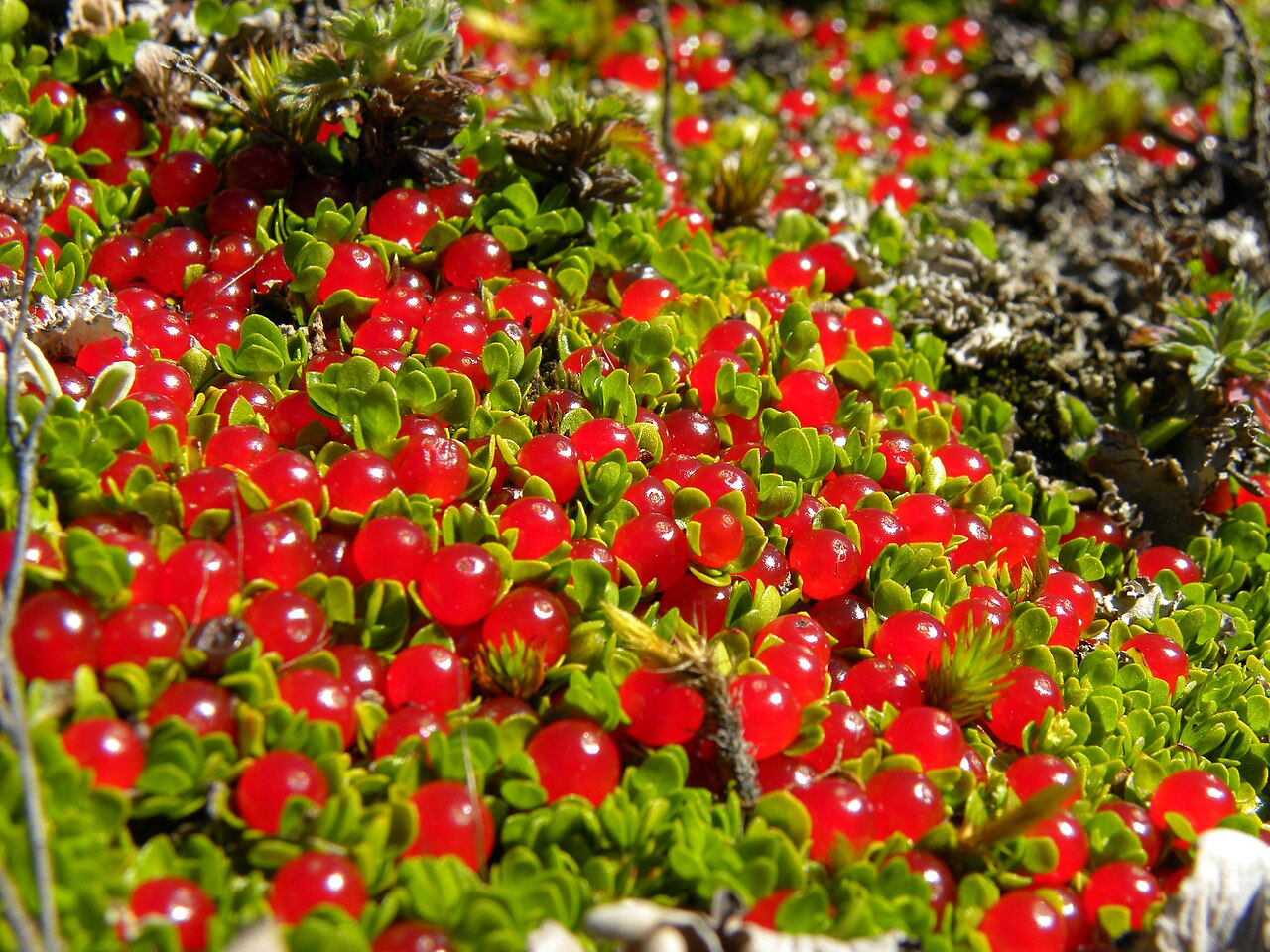
Coprosma granadensis, best known by its older name Nertera granadensis, is the Coral Bead Plant, also called beadplant, pincushion plant or coral moss, and makole in Hawaiian. It is a tiny, creeping perennial in the coffee family (Rubiaceae) that forms soft, moss-like mats only an inch or two tall. The stems are covered with small, paired, bright green leaves, and after its inconspicuous flowers it produces masses of glossy, bead-like orange to red berries that last for months.
It is native to Hawaii, where it grows in cool, wet mountain forests and bogs, and it has one of the widest natural ranges of any small flowering plant around the Pacific: from Mexico and Central America through the Andes to southern Chile, and in New Zealand, Australia, New Guinea, Southeast Asia and Taiwan.
Outside Hawaii, most people know it as a houseplant, sold in small pots covered with orange berries. It likes cool, bright, humid conditions and steady moisture, and it is not an easy houseplant to keep for long. Its berries are mildly toxic and should be kept away from small children and pets.
Identification
Look for a low, creeping, moss-like mat of tiny, paired, rounded green leaves on wet, mossy ground, covered in shiny, round orange to red berries about the size of a small pea.
Growth Habit
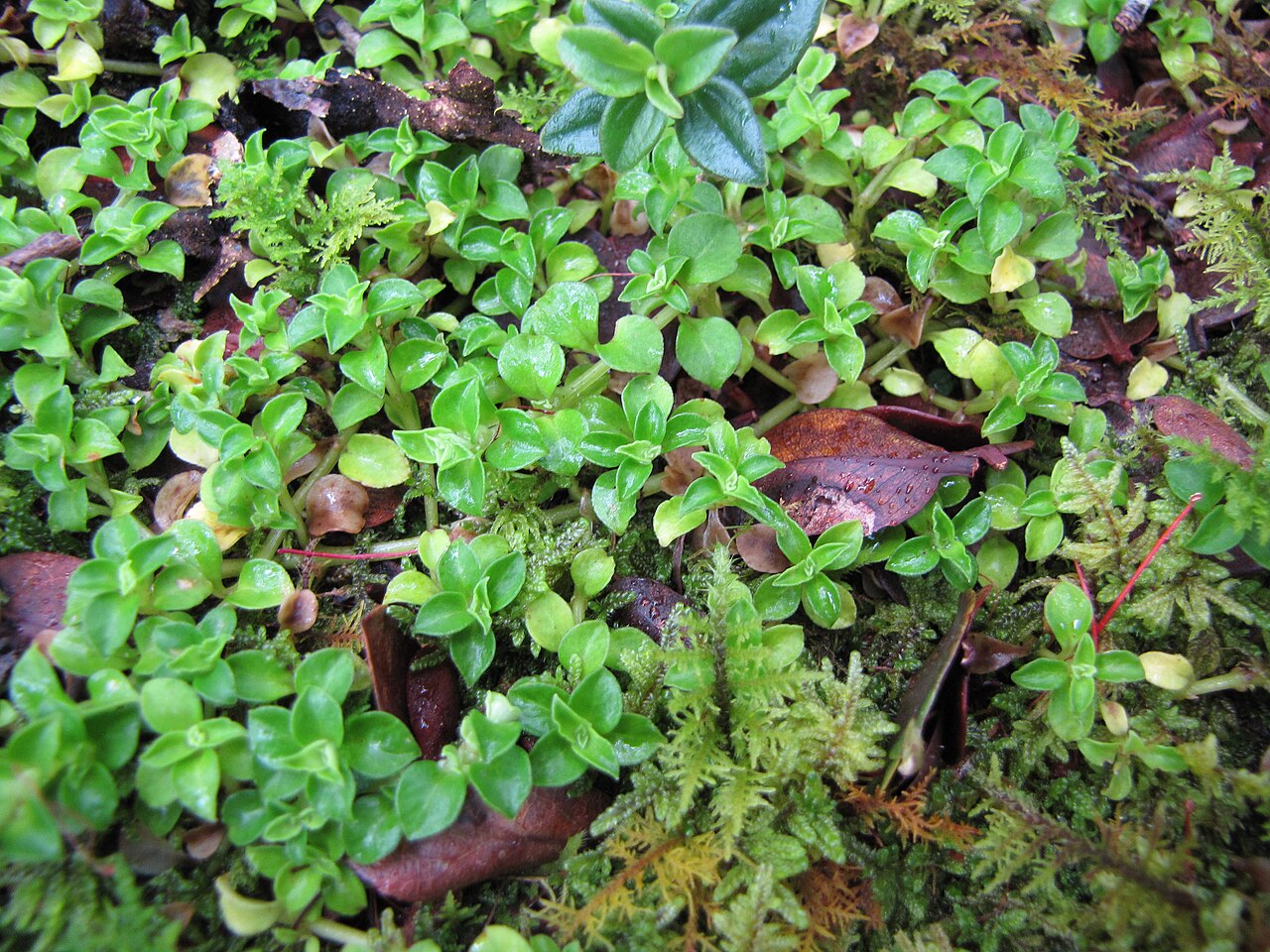
Coral bead plant is a creeping, mat-forming perennial herb. Its thin stems run along the ground and root at the nodes, forming dense mats 1 to 3 inches tall and spreading a foot or more across. In the wild it grows on wet soil, moss, banks and the bases of trees.
Leaves
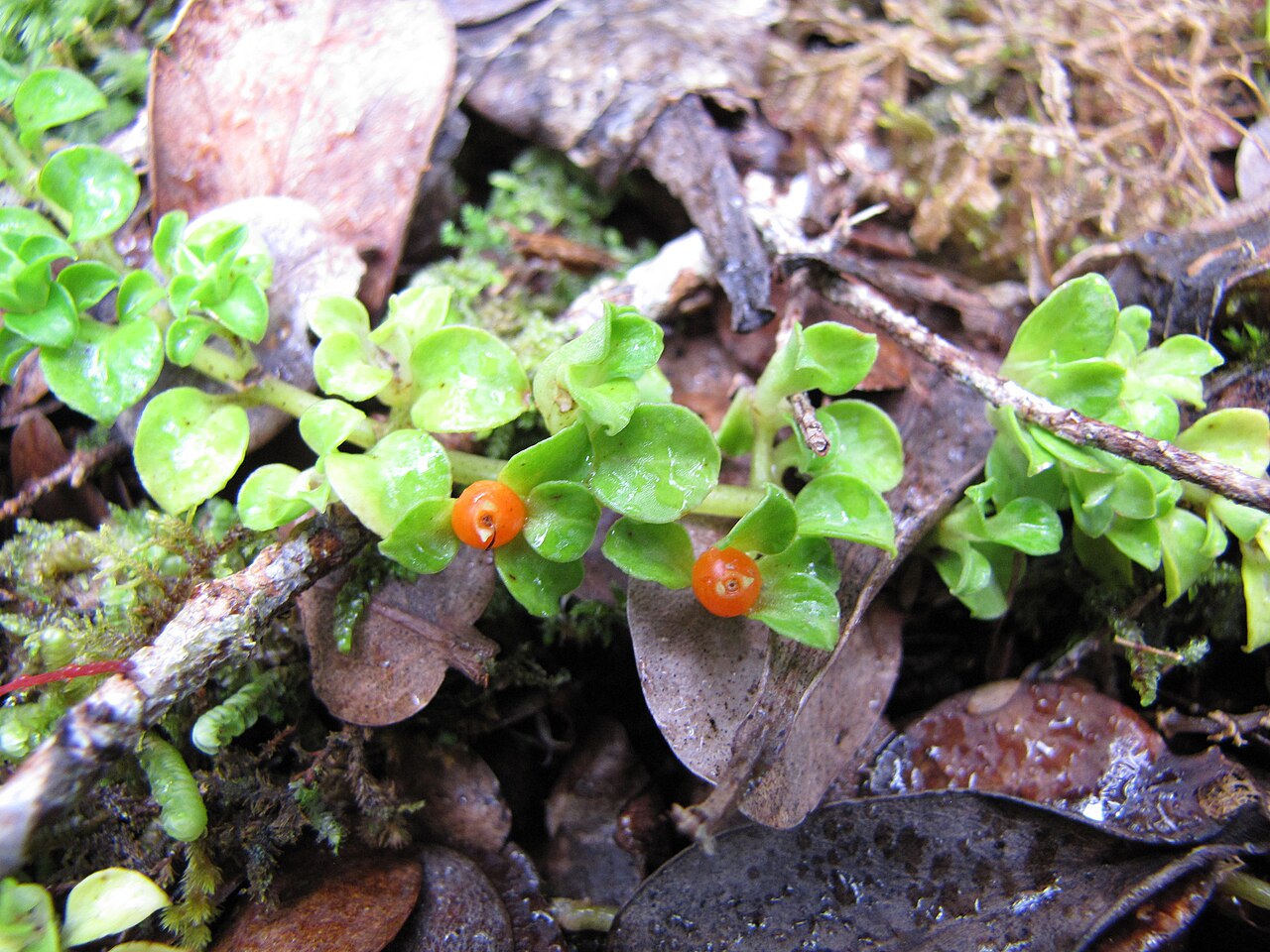
The leaves are opposite, tiny (about 1/8 to 1/2 inch long), broadly oval to nearly round, smooth, glossy and bright green, with short stalks. They are crowded along the stems, giving the mat a soft, moss-like look, which is why it is sometimes called coral moss or English baby tears.
Flowers
The flowers are tiny, greenish and easily overlooked. They sit singly at the tips of short shoots among the leaves, mostly in spring and early summer. Like other Coprosma, the flowers are small and wind-pollinated, with protruding stamens and stigmas.
Fruit & Seeds
The fruit is a round, glossy, fleshy berry, about 1/4 inch across, orange to bright red, sitting right on top of the foliage. A healthy plant can be almost hidden under its berries, which last for weeks to months. Each berry holds two small seeds.
Look-alikes
Baby’s tears (Soleirolia) forms similar mats but never has berries. Other Hawaiian ground covers in the same wet forests, such as young ohelo (Vaccinium), are woody shrubs with larger leaves. In Hawaii, the larger, woody Coprosma shrubs and trees (pilo) are close relatives with similar orange fruits but are upright plants.
Quick Facts
| Scientific Name | Coprosma granadensis (syn. Nertera granadensis) |
| Family | Rubiaceae (coffee family) |
| Plant Type | Creeping, mat-forming perennial herb |
| Mature Height | 1–3 in |
| Mature Spread | 6–18 in |
| Growth Rate | Moderate |
| Sun Exposure | Part shade; bright indirect light indoors |
| Water Needs | High; keep evenly moist |
| Soil Type | Moist, humus-rich, well-drained; mossy ground in the wild |
| Soil pH | Acidic (about 5.0–6.5) |
| Bloom Time | Spring to early summer |
| Flower Color | Greenish (inconspicuous) |
| Fall Color | None; evergreen |
| Fruit | Glossy orange to red bead-like berries lasting for months |
| Deer Resistant | Not applicable in most of its range |
| USDA Hardiness Zones | 9–11 outdoors; houseplant elsewhere |
Native Range
In the United States, coral bead plant is native only to Hawaii, where it is known as makole. It grows on several of the main islands, including Oahu and Maui, in cool, wet, montane forests, bogs and mossy openings, mostly at middle and high elevations. It is often seen in the mossy cloud forests of East Maui, such as Waikamoi, and on wet ridgetops.
Its total range is unusually wide and circles the Pacific. It grows in the high mountains of Mexico and Central America, through the Andes to southern Chile and Argentina (including the Juan Fernández Islands), and in New Zealand, eastern Australia, New Guinea, Indonesia, Malaysia, the Philippines and Taiwan. In the tropics it grows only at high elevations, where it is cool and wet.
Botanists long placed it in the genus Nertera, but DNA studies showed that Nertera belongs inside Coprosma, and USDA PLANTS now lists it as Coprosma granadensis. Gardeners and houseplant sellers still mostly use the name Nertera granadensis.
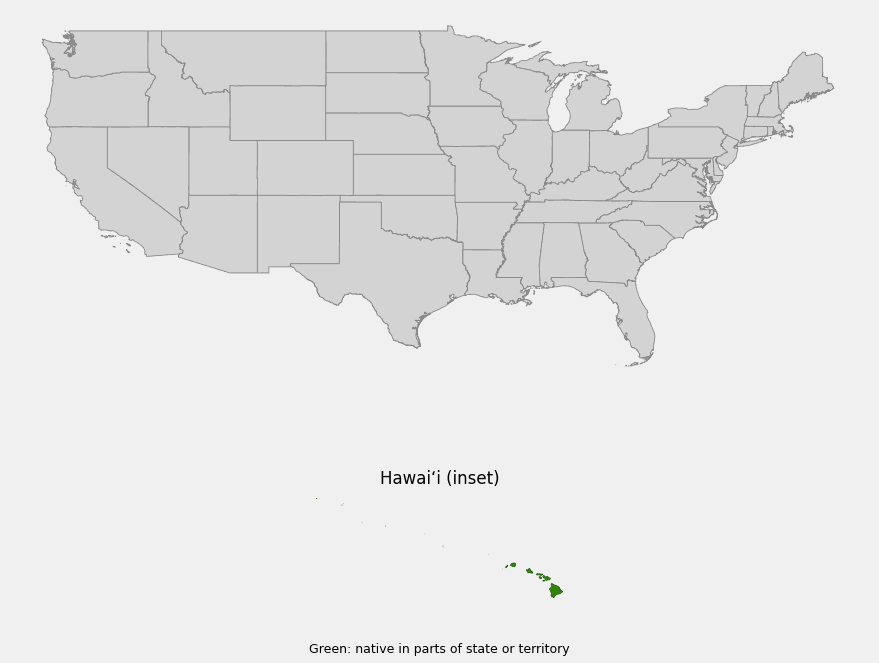
📋 Regional plant lists featuring Coral Bead Plant: Hawaii
Growing & Care Guide
Coral bead plant is usually sold as a potted houseplant for its berries. It can be kept going for years with cool, bright, humid conditions, but many plants decline after the berries fade. In Hawaii, never collect makole from native forests; buy nursery-grown plants.
Light
Give it bright, indirect light, such as an east-facing window or a spot near a bright window with sheer curtains. Avoid hot, direct sun, which scorches the tiny leaves. Too little light makes the stems stretch and reduces flowering and berries.
Soil & Water
Use a moist, peaty or humus-rich, well-drained potting mix in a shallow pot. Keep it evenly moist from spring through summer, while it is flowering and setting berries, and let the surface dry slightly between waterings in fall and winter. Water from below if possible, since the dense mat can rot if it stays wet on top. It likes high humidity; a pebble tray helps indoors.
Planting Tips
It prefers cool conditions: about 50 to 70°F, and not below about 45°F. Warm, dry rooms cause leaf drop and fewer berries. It can spend summer outdoors in a shaded, sheltered spot. In mild, frost-light climates it can be grown outdoors as a ground cover between stones or in a shady rock garden. Put it outdoors in spring so insects and air movement help it pollinate and set berries.
Pruning & Maintenance
Remove berries when they turn dark or shrivel. Feed lightly once a month in spring and early summer with a half-strength liquid fertilizer, then stop once flowering starts; too much fertilizer gives leaves but few berries. Keep it away from children and pets while it has berries.
Propagation
Divide the mat in spring, potting up small clumps with roots attached. It can also be grown from seed cleaned from ripe berries and sown on moist, fine mix in spring; seedlings are slow.
Landscape Uses
- Houseplants: a cool, bright windowsill plant with bright orange berries
- Terrariums: small enough for large open terrariums with good light
- Shady rock gardens: a tiny ground cover between stones in mild climates
- Hawaiian native gardens: a cloud-forest ground cover for cool, wet upland gardens
- Fairy and miniature gardens: tiny leaves and bead-like berries suit small-scale plantings
Wildlife & Ecological Value
In Hawaii’s wet forests, makole is part of the mossy ground layer that holds water and shelters small creatures.
For Pollinators
The tiny flowers are wind-pollinated, like those of other Coprosma, and are of little value to pollinators.
For Birds
The bright berries are eaten by birds, which spread the seeds. In Hawaii, native forest birds and introduced birds feed on Coprosma fruits, and the related pilo shrubs are an important fruit source in upland forests.
For Mammals
Hawaii has no native land mammals other than a bat. Elsewhere in its range, small mammals may eat the fallen berries.
Ecosystem Role
Makole forms part of the low, mossy carpet that covers the forest floor and banks in Hawaiian cloud forests. This layer soaks up rain and fog drip, slows runoff and erosion, and helps keep the forest floor cool and moist.
Cultural & Historical Uses
The species name granadensis refers to New Granada, the old Spanish colonial name for the region that is now mostly Colombia, where it was first collected for science. The old genus name Nertera comes from the Greek nerteros, meaning low down, for its creeping habit. In Chile it is called rucachucao.
Its wide range across the Pacific, from the Andes to Hawaii, New Zealand and Taiwan, probably reflects long-distance travel of its seeds by birds. It is one of many Hawaiian plants whose ancestors reached the islands from far away.
Safety note: the berries are attractive to children and pets. A report of children who ate them found that most had no symptoms, but some had mild tiredness, stomach pain or vomiting. Keep plants with berries out of reach and call poison control if a child eats several.
Frequently Asked Questions
Is coral bead plant native to the United States?
Yes. USDA PLANTS lists it as native to Hawaii, where it is called makole and grows in cool, wet mountain forests and bogs.
Why is it called Coprosma granadensis and not Nertera?
DNA studies showed that the small genus Nertera belongs inside the larger genus Coprosma, so botanists and USDA now use Coprosma granadensis. Most garden centers still sell it as Nertera granadensis.
Are coral bead plant berries poisonous?
They are mildly toxic. Most children who eat a few have no problems, but some get stomach upset. Keep the plant out of reach of children and pets.
Why are my coral bead plant’s berries falling off?
Berries naturally fade after a few months. Warm, dry rooms, overwatering or too little light make them drop sooner. Keep it cool, bright and evenly moist.
How do I get coral bead plant to make berries again?
Give it a cool, slightly drier rest in winter, then bright light and steady moisture in spring, and put it outdoors in a shaded spot while it flowers to help pollination.

Looking for a nursery that carries Coral Bead Plant?
Browse our native plant nursery directory: Hawaii

