
Columbia Gorge Rockcress (Arabis furcata)
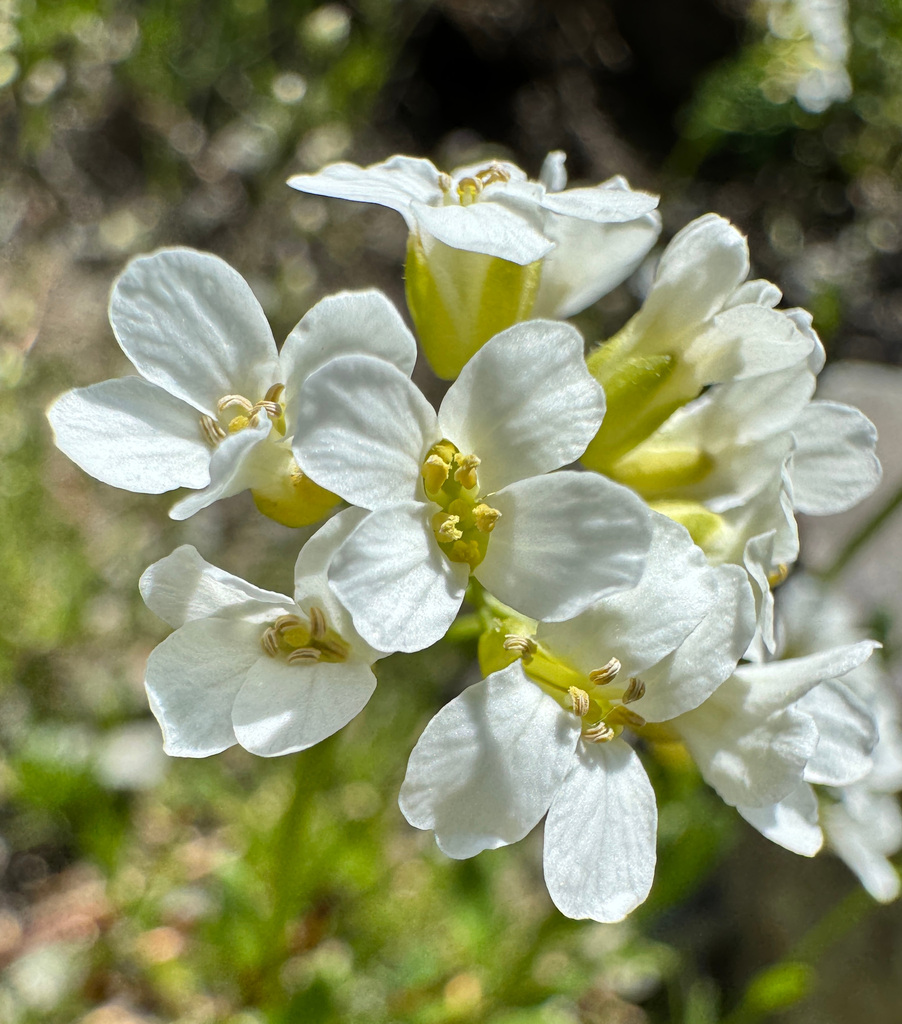
Arabis furcata, called Columbia Gorge Rockcress, is a small native perennial of cliffs, rocky slopes and mountain ridges in Oregon and Washington. From a low rosette of spoon-shaped leaves it sends up slender stems 4 to 16 inches tall, topped in spring and summer by clusters of bright white, four-petaled flowers, followed by long, narrow seed pods. It belongs to the mustard family (Brassicaceae).
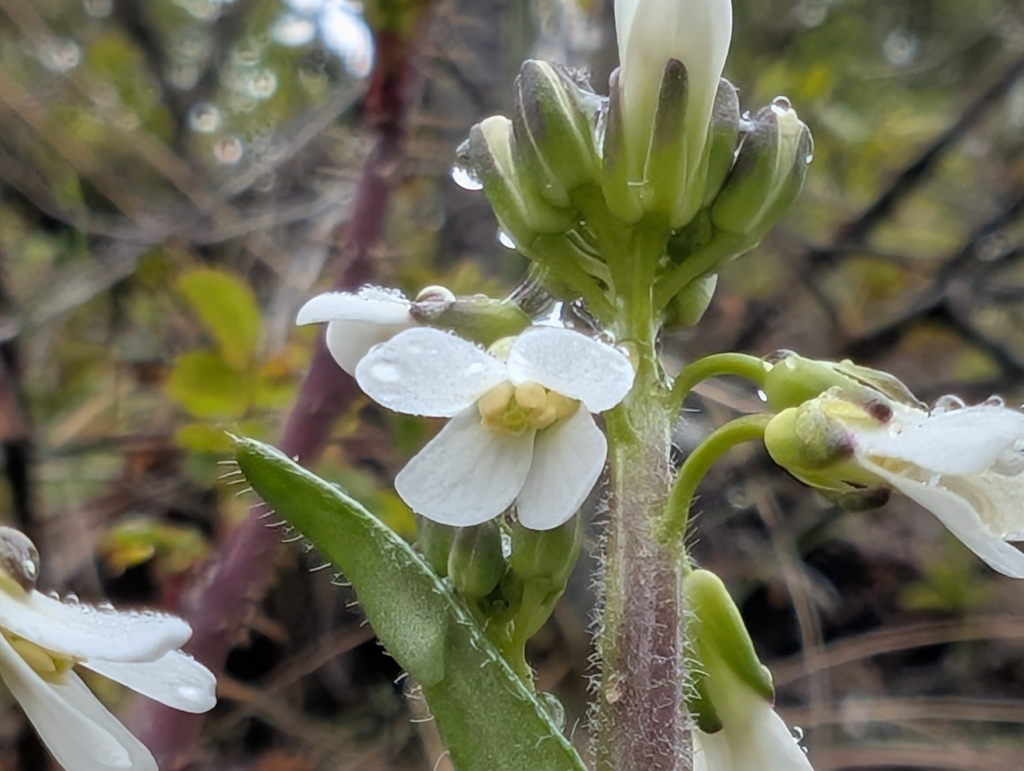
It is a Pacific Northwest endemic, found in the Columbia River Gorge, the Cascade Range and the Olympic Mountains, and nowhere else in the world. Plants in the Olympic Mountains are often separated as Arabis furcata var. olympica, the Olympic rockcress, which some botanists treat as a separate species, Arabis olympica. The species name furcata means “forked,” for the small forked hairs that often cover its leaves.
This guide covers how to recognize Columbia Gorge rockcress and its Olympic form, where it grows, and how it fits into the rock-garden flora of the Northwest. It is a wildflower to admire in place; never dig plants from the wild.
Identification
Several white-flowered rockcresses grow in the Pacific Northwest, and they can be hard to tell apart. Columbia Gorge rockcress is recognized by its combination of a basal rosette, fairly large white flowers, erect to spreading, flat pods, and a rocky habitat in the Cascades, Columbia Gorge or Olympics.
Rosette & Stems
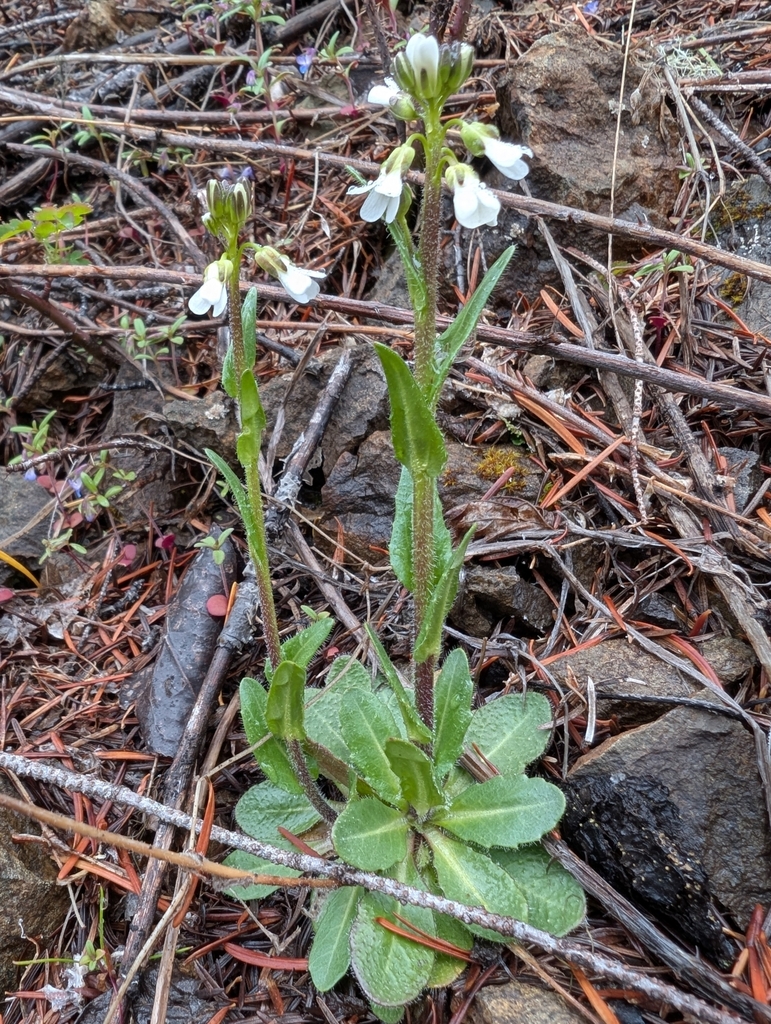
Plants grow from a short, often branched woody base (caudex), so older plants may have several rosettes. One to several flowering stems rise 4 to 16 inches tall. They are slender, mostly smooth above, and may have a few hairs near the base.
Leaves
Basal leaves form a rosette. They are spoon-shaped to oblong, about ¾ to 2½ inches long, with smooth or few-toothed edges and a long, tapering base. They range from nearly hairless to covered with small forked or branched hairs, which give the leaves a faint grayish look. Stem leaves are few, small, narrow and stalkless.
Flowers
Flowers appear from April at low elevations to August on high ridges, in a short cluster that lengthens as the pods develop. Each flower has four white petals about ⅜ inch long, arranged in a cross, the classic mustard-family pattern, with six stamens and a slender green pistil.
Fruit & Seeds
The fruits are long, narrow, flattened pods (siliques), about 1½ to 3 inches long, held erect to spreading on short stalks. When ripe they split from the bottom to release flat, winged seeds arranged in a single row, which drift short distances on the wind.
Quick Facts
| Scientific Name | Arabis furcata (incl. var. olympica; syn. A. olympica) |
| Family | Brassicaceae (mustard family) |
| Plant Type | Herbaceous perennial from a woody caudex |
| Mature Height | 4–16 in in flower |
| Mature Spread | 3–8 in |
| Growth Rate | Slow |
| Sun Exposure | Full sun to part shade |
| Water Needs | Low to medium; sharp drainage |
| Soil Type | Rocky, gravelly soil; cliff crevices and talus |
| Soil pH | About 5.5–7.5 |
| Bloom Time | April–August, depending on elevation |
| Flower Color | White |
| Fall Color | None; rosettes persist through winter under snow |
| Fruit | Long, narrow, flattened pods with winged seeds |
| Deer Resistant | Moderately; occasionally grazed by deer and mountain goats |
| USDA Hardiness Zones | 5–8 |
Native Range
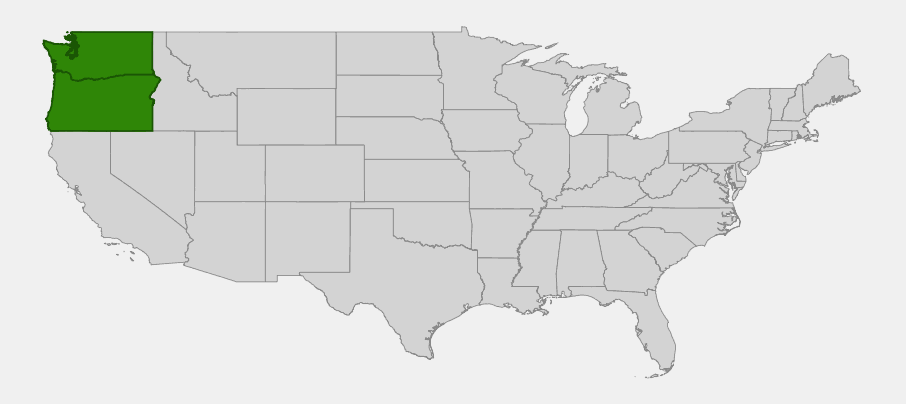
Columbia Gorge rockcress is endemic to Oregon and Washington. USDA PLANTS records it only from these two states. It grows in the Columbia River Gorge, along both slopes of the Cascade Range in Washington and northern Oregon, and in the Olympic Mountains.
It is a plant of rock. At lower elevations it grows on basalt cliffs, ledges and talus in the Columbia River Gorge. Higher up, it occurs on rocky slopes, open forest openings, subalpine meadows and windswept ridge crests in the Cascades, around peaks such as Mount Adams, Mount Rainier and the mountains of the Wenatchee and Yakima River drainages.
The Olympic rockcress, var. olympica (Arabis olympica in some floras), is known only from the Olympic Mountains of Washington, where it grows on rocky slopes and ridges in the subalpine and alpine zones. It is one of several plants restricted to that isolated range.
📋 Regional plant lists featuring Columbia Gorge Rockcress: Western Oregon & Western Washington · Idaho, Eastern Oregon & Eastern Washington
Growing & Care Guide
Columbia Gorge rockcress is rarely offered by nurseries. It can be grown from responsibly collected or nursery-produced seed by rock-garden enthusiasts in the Pacific Northwest. Never dig plants from cliffs or alpine areas, where they are slow to recover and the habitat is fragile.
Light
Grow it in full sun or bright part shade, as on open cliffs and ridges. In hot, low-elevation gardens it benefits from afternoon shade.
Soil & Water
It needs very well-drained, gritty soil: a rock garden, crevice garden or trough with a mix of coarse grit, sand and a little compost. Water during establishment and dry spells, but avoid soggy soil, especially in winter.
Planting Tips
Plant small seedlings in crevices between rocks or in a scree bed, with the crown slightly above the surrounding soil. Mulch with gravel to keep the crown dry.
Pruning & Maintenance
No pruning is needed. Remove spent flower stems after seed has dispersed if you want a tidier look. Plants are moderately long-lived but may be replaced by self-sown seedlings over time.
Propagation
Grow from seed sown in fall in pots of gritty mix left outdoors over winter, or after about 30 to 60 days of cold, moist stratification. Seedlings usually flower in their second or third year.
Landscape Uses
- Rock and crevice gardens: a delicate white-flowered perennial for gritty soils
- Troughs: a compact native for alpine trough plantings
- Native plant education: an example of a Pacific Northwest endemic wildflower
- Habitat appreciation: look for it on cliffs in the Columbia River Gorge and on mountain ridges
Wildlife & Ecological Value
On cliffs and ridges, Columbia Gorge rockcress is part of a hardy community of small plants that support pollinators in harsh, exposed sites.
For Pollinators
Its white flowers are visited by small native bees, flies and butterflies. Like other rockcresses, it is a likely larval host for mustard-feeding butterflies such as orangetips and whites, whose caterpillars eat the flowers, pods and leaves of Arabis and related plants.
For Birds
Small seed-eating birds, such as finches and rosy-finches at high elevations, may eat the seeds, but it is not an important bird food.
For Mammals
Mountain goats, deer and pikas may graze it occasionally, but its rocky, scattered habitat limits its importance as forage.
Ecosystem Role
As a perennial of cliff crevices, talus and windswept ridges, it helps stabilize small pockets of soil among rocks and contributes to the diversity of specialized rock-garden plant communities in the Northwest mountains.
Cultural & Historical Uses
The species was described by the American botanist Sereno Watson of Harvard, from plants collected in the Pacific Northwest. Charles Vancouver Piper, an early Washington botanist, later described the Olympic plants as Arabis olympica, and Reed Rollins reduced them to a variety of A. furcata.
The genus Arabis has been extensively revised in recent decades using DNA studies. Many North American species once placed in Arabis have been moved to Boechera and other genera, but Arabis furcata remains in Arabis in most current treatments.
There are no well-documented traditional uses of this species. It is valued today by botanists and wildflower enthusiasts as a characteristic plant of the Columbia River Gorge and Cascade and Olympic high country, and as a reminder of the many small endemic plants found only in the Pacific Northwest.
Frequently Asked Questions
Is Olympic rockcress the same as Columbia Gorge rockcress?
Olympic rockcress is the Olympic Mountains form of the same species. USDA PLANTS treats it as Arabis furcata var. olympica; some floras recognize it as a separate species, Arabis olympica.
Where can I see Columbia Gorge rockcress?
Look on basalt cliffs and talus in the Columbia River Gorge in spring, and on rocky slopes and ridges in the Washington and northern Oregon Cascades and the Olympic Mountains in summer.
Is Columbia Gorge rockcress rare?
It has a small range limited to Oregon and Washington, but within its habitat it is not considered especially rare. The Olympic form has a much more restricted range.
Can I grow Columbia Gorge rockcress?
Yes, from seed, in a rock garden, crevice garden or trough with very gritty, well-drained soil. Never dig plants from the wild.
Why is it called furcata?
Furcata means “forked,” referring to the small forked hairs that often cover the leaves.

Looking for a nursery that carries Columbia Gorge Rockcress?
Browse our native plant nursery directory: Oregon · Washington

