
Texas Azalea (Rhododendron oblongifolium)
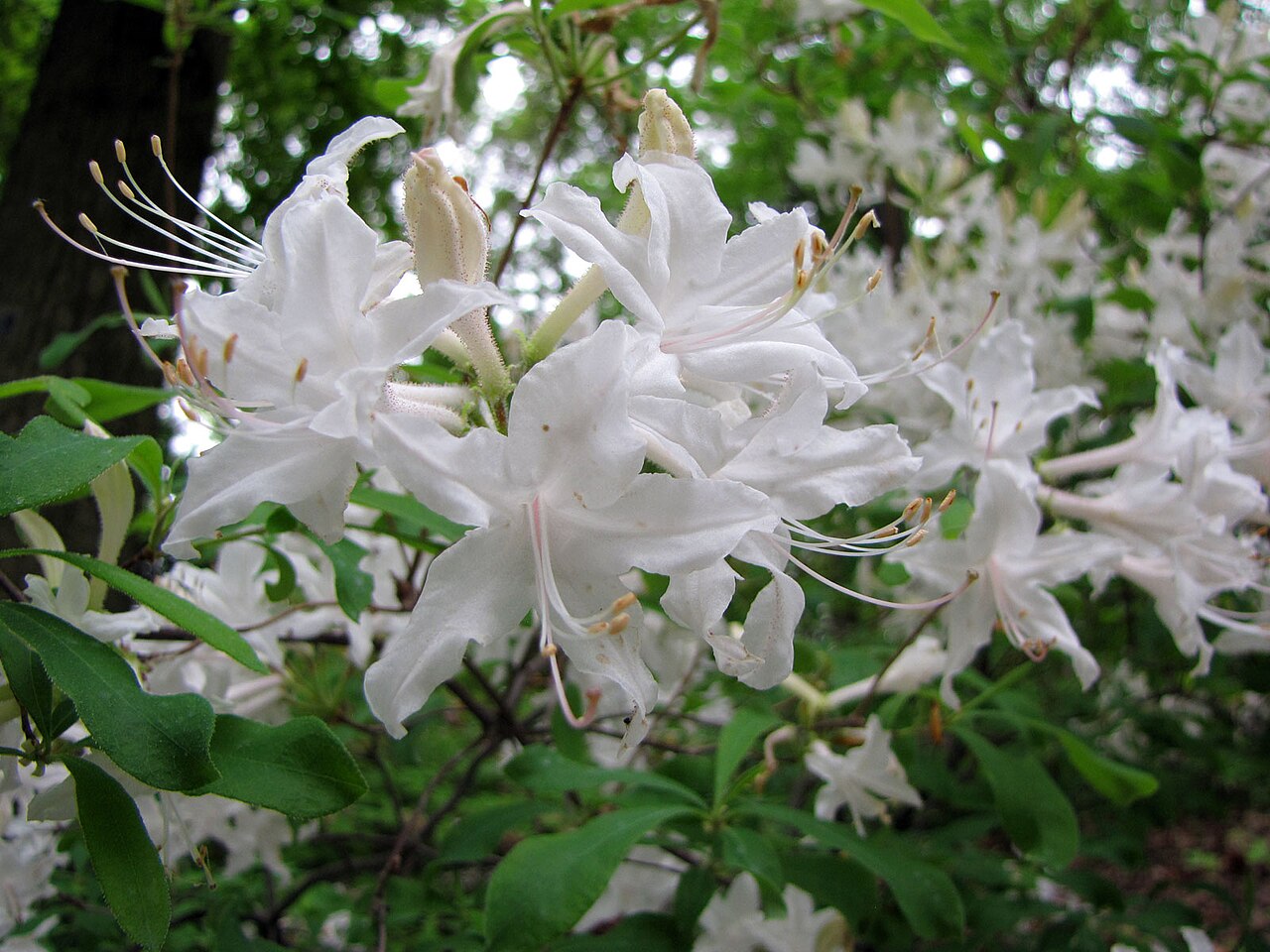
Rhododendron oblongifolium, Texas Azalea, is a deciduous native azalea of the western edge of the southern forests: the sandy stream banks, baygalls and bog margins of East Texas, southeastern Oklahoma, southern Arkansas and northwestern Louisiana. In late spring, after its leaves have expanded, it bears rounded clusters of 7 to 12 pure white, sweetly fragrant, trumpet-shaped flowers with long, arching stamens, at a time when most other azaleas have finished blooming.
It is a shrub of moderate size, usually 3 to 6 feet tall, and it belongs to the heath family (Ericaceae) with blueberries and mountain laurels. Texas azalea is closely related to Swamp Azalea (R. viscosum) and Summer Azalea (R. serrulatum). USDA PLANTS keeps it as a separate species, but some botanists, including the Flora of North America treatment, include it within a broadly defined R. viscosum. Under either name it is the westernmost white-flowered native azalea in the United States.
Safety note: like all rhododendrons and azaleas, Texas azalea contains grayanotoxins. All parts of the plant, including the leaves, flowers and nectar, are poisonous if eaten by people, pets or livestock, and honey made mostly from rhododendron nectar can also be toxic. This guide covers identification, native range, how to grow it, and its value for pollinators.
Identification
Texas azalea is the only native white azalea in most of its range. The pink Piedmont Azalea (R. canescens), which also grows in East Texas, blooms earlier, before or as its leaves appear, and has pink to pale pink flowers.
Growth Habit
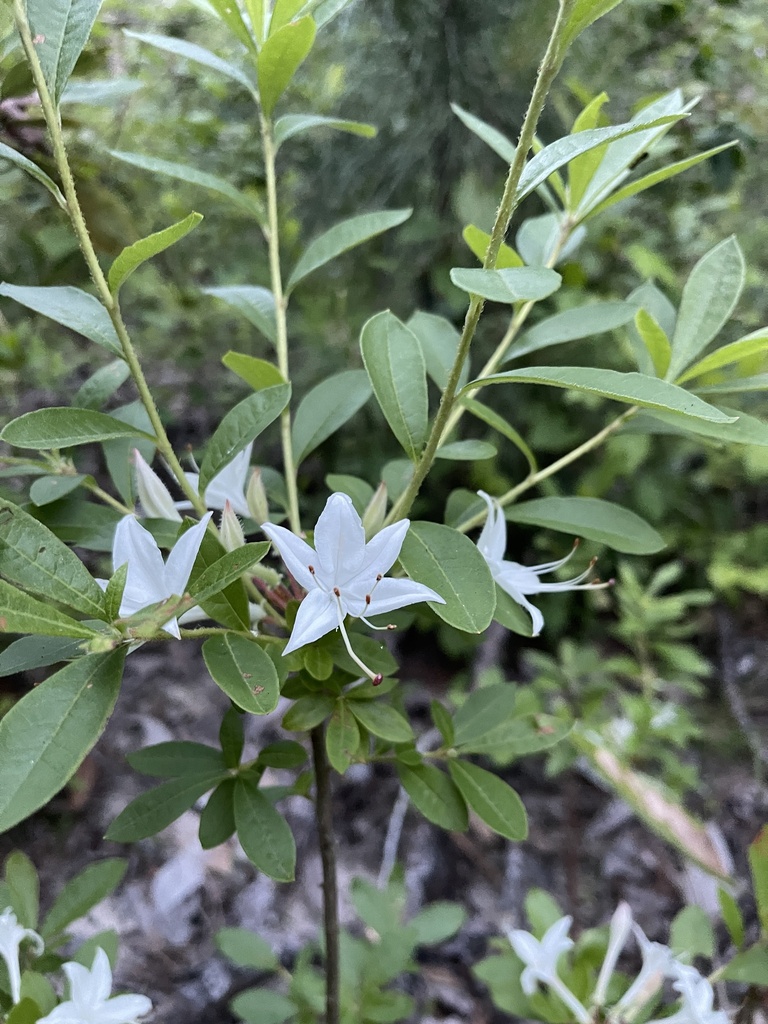
A multi-stemmed, deciduous shrub usually 3 to 6 feet tall, occasionally to about 8 feet, with an open, spreading or rounded habit. Young twigs are hairy. In moist, sandy soil it can spread slowly by underground stems to form small thickets.
Leaves
Leaves are alternate and clustered toward the branch tips, 1½ to 4 inches long, distinctly obovate to oblong (widest beyond the middle), with a rounded or bluntly pointed tip and a tapering base. The upper surface is dark green; the underside is paler and often somewhat hairy along the midrib. The narrow, oblong leaves are the source of the name oblongifolium.
Flowers
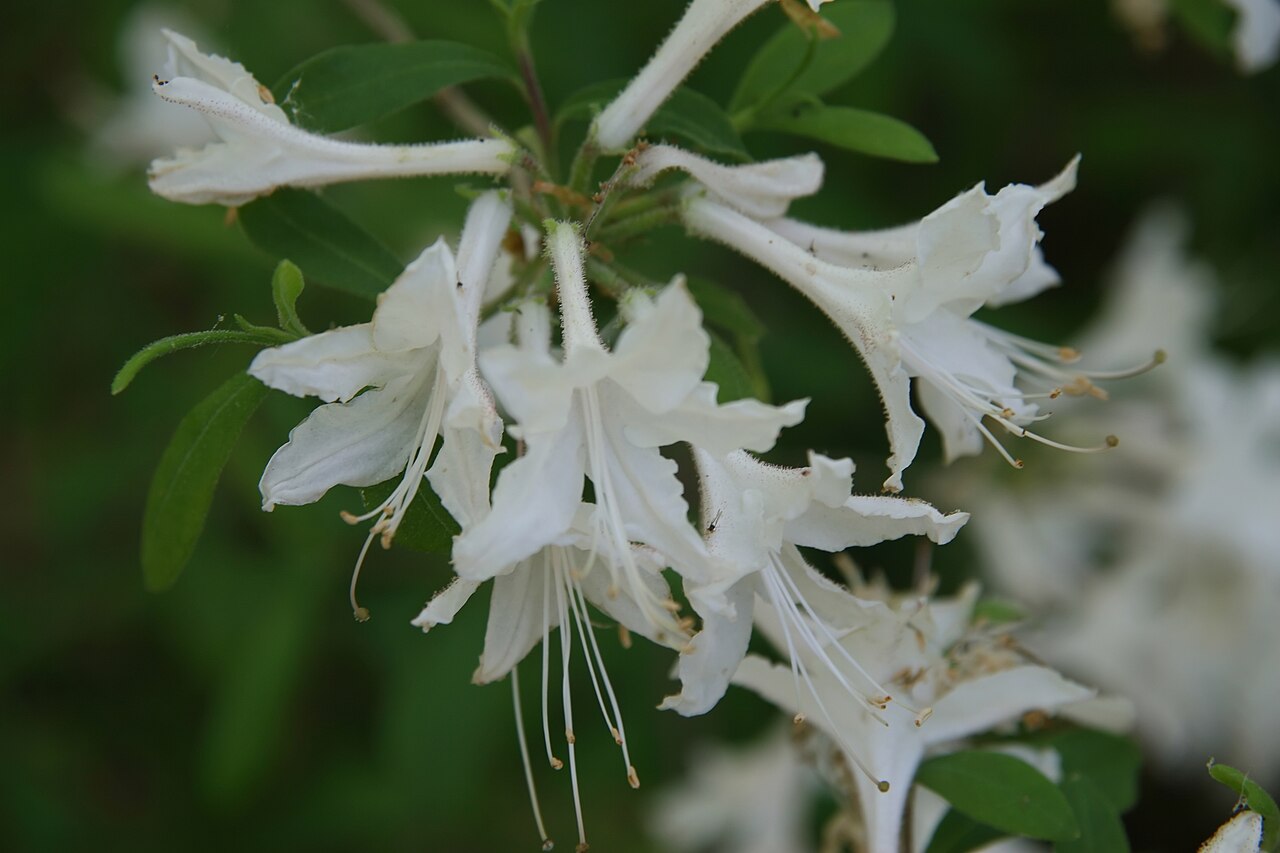
Flowers open from about May into June in East Texas, after the leaves are fully grown. Each cluster holds 7 to 12 white flowers (occasionally faintly pink-tinged), each with a slender tube about ¾ to 1 inch long that flares into five spreading lobes. The outside of the tube is covered with sticky, glandular hairs. Five long stamens and a longer style curve well beyond the petals. The flowers have a sweet, spicy fragrance.
Fruit
Flowers are followed by narrow, bristly-glandular capsules about ½ to ¾ inch long that ripen brown in fall and split into five parts, releasing many tiny, dust-like seeds.
Quick Facts
| Scientific Name | Rhododendron oblongifolium (syn. R. viscosum var. oblongifolium) |
| Family | Ericaceae (heath family) |
| Plant Type | Deciduous flowering shrub |
| Mature Height | 3–6 ft (occasionally to 8 ft) |
| Mature Spread | 3–6 ft |
| Growth Rate | Slow to moderate |
| Sun Exposure | Part shade to dappled shade |
| Water Needs | Medium to high; consistently moist but well-drained |
| Soil Type | Sandy, acidic, organic-rich soil |
| Soil pH | About 4.5–6.0 |
| Bloom Time | May–June (after the leaves) |
| Flower Color | White, occasionally tinged pink |
| Fall Color | Dull yellow to reddish |
| Fruit | Narrow glandular capsule with tiny seeds |
| Deer Resistant | Moderately; deer browse azaleas when food is scarce |
| USDA Hardiness Zones | 7–9 |
Native Range
Texas azalea has a small range west of the Mississippi River. USDA PLANTS records it from four states: eastern Texas, southeastern Oklahoma, southern and western Arkansas, and northwestern Louisiana. Within Texas it grows in the Pineywoods of the eastern part of the state; it does not occur in the Hill Country, South Texas or West Texas.
It is a plant of the West Gulf Coastal Plain and the southern Ouachita region, where it grows along sandy, acidic stream banks, at the edges of bogs and baygalls, and in moist, sandy woods under pines and hardwoods. It often grows where water seeps out of sandy hills or along small spring-fed creeks.
Because it is so closely related to swamp azalea, which ranges across the East from Maine to Texas, its exact limits depend on how botanists treat the group. Under either treatment, the white azaleas of the East Texas and western Louisiana forests are this narrow-leaved, late-blooming form.
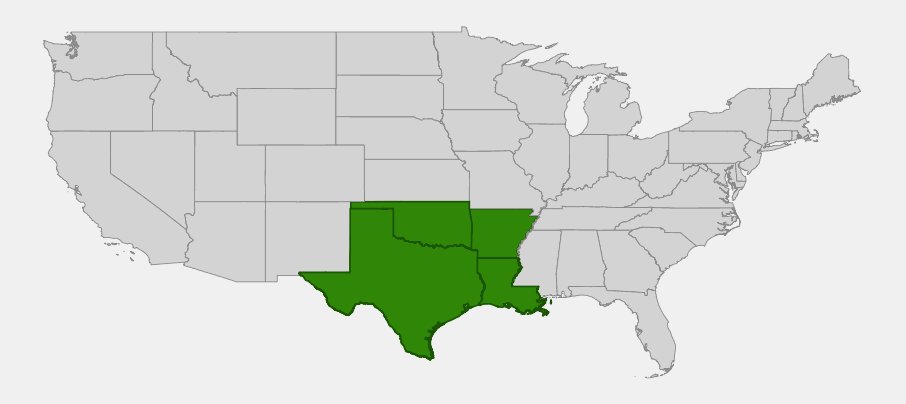
📋 Regional plant lists featuring Texas Azalea: Arkansas, Louisiana, Eastern Oklahoma & Eastern Texas
Growing & Care Guide
Texas azalea is one of the best native azaleas for gardens in East Texas, Louisiana, southern Arkansas and similar climates, and it is grown by native plant nurseries and azalea specialists in the region. Its late bloom extends the azalea season by a month or more. Buy nursery-propagated plants; wild shrubs rarely survive transplanting.
Light
Dappled or high shade, or morning sun with afternoon shade, is ideal. It blooms more heavily with more light, but full afternoon sun in the Gulf South scorches the leaves unless the soil stays moist.
Soil & Water
Grow it in acidic, sandy or loamy soil rich in organic matter, with a pH below about 6. It needs steady moisture, especially through summer, but resents waterlogged, compacted clay. In heavy soils, plant it in a raised bed amended with pine bark. A mulch of pine straw or shredded leaves keeps the roots cool and moist.
Planting Tips
Plant in fall or late winter. Set the top of the root ball slightly above the surrounding grade, as azaleas are shallow-rooted and sensitive to planting too deep. Water deeply after planting and through the first two summers.
Pruning & Maintenance
Little pruning is needed. If necessary, prune right after flowering, since next year’s buds form in summer. Avoid alkaline irrigation water and lime, and do not cultivate around the shallow roots. Fertilize sparingly, if at all, with an acid-forming product.
Propagation
Grow from seed sown on the surface of moist, milled sphagnum or fine peat under lights, or from softwood cuttings taken in late spring or early summer with rooting hormone and bottom heat. Seedlings take three or four years to bloom.
Landscape Uses
- Woodland and shade gardens: late-spring white bloom under pines and hardwoods
- Fragrance gardens: plant near paths and windows to enjoy the spicy-sweet scent in the evening
- Stream banks and rain garden edges: in moist, acidic, well-drained soil near water
- Native azalea collections: extends the bloom season after Piedmont and other spring azaleas
- Pollinator gardens: attracts butterflies, moths and bees in late spring
Wildlife & Ecological Value
Texas azalea is valued in its region both for its late-spring flowers and as part of the rich shrub layer of streamside forests.
For Pollinators
The long-tubed, fragrant white flowers are typical of plants pollinated by moths and butterflies. Sphinx moths visit at dusk, and swallowtail butterflies and other large butterflies visit by day, brushing the long stamens and style with their wings. Bumblebees also visit for nectar and pollen.
For Birds
Thickets along streams provide nesting sites and cover for songbirds. The tiny seeds have little food value.
For Mammals
Deer occasionally browse azalea twigs and leaves despite their toxicity, especially in winter. The shrub has little other food value for mammals.
Ecosystem Role
Like other members of the heath family, Texas azalea relies on root fungi (ericoid mycorrhizae) that help it absorb nutrients from acidic, nutrient-poor soils. It is part of the distinctive streamhead and baygall communities of the West Gulf Coastal Plain, which have declined with drainage, clearing and fire suppression.
Cultural & Historical Uses
The New York botanist John Kunkel Small described this azalea as Azalea oblongifolia, and it was later transferred to Rhododendron. For much of the 20th century it was known locally simply as “wild honeysuckle” or “white honeysuckle,” names also used for other native azaleas across the South.
Native azaleas have been popular in southern gardens for generations, but Texas azalea has been grown less often than the showier eastern species. Interest has grown with the native plant movement, and nurseries in East Texas and Louisiana now offer it, often noting its late bloom and heat tolerance.
Because all parts of azaleas contain grayanotoxins, they have long been recognized as livestock poisons. Poisoning of people is rare and usually involves honey made mostly from rhododendron nectar (“mad honey”), a problem known since ancient Greek times from the Black Sea region.
Frequently Asked Questions
Is Texas azalea poisonous?
Yes. All parts of Texas azalea, like other rhododendrons and azaleas, contain grayanotoxins and are toxic if eaten by people, dogs, cats, horses and livestock. Symptoms can include drooling, vomiting, weakness and heart rhythm problems. Contact a doctor, veterinarian or Poison Control (1-800-222-1222 in the U.S.) if ingestion is suspected.
Is Texas azalea the same as swamp azalea?
They are very closely related. USDA PLANTS treats Texas azalea as its own species, R. oblongifolium, while the Flora of North America includes it in swamp azalea, R. viscosum. Texas azalea has more oblong leaves and grows in eastern Texas and nearby states.
Does Texas azalea grow in Central or South Texas?
No. It is native only to the eastern part of Texas, in the Pineywoods, and nearby Oklahoma, Arkansas and Louisiana. It needs acidic, sandy, moist soil, which is rare in the limestone and alkaline soils of Central and South Texas.
When does Texas azalea bloom?
Usually in May and June in East Texas, after the leaves are out, which is later than most other native azaleas in the region.
Is Texas azalea fragrant?
Yes. Its white flowers have a sweet, spicy scent, strongest in warm, humid weather and in the evening.


