
Ox-eye Bean (Mucuna urens)
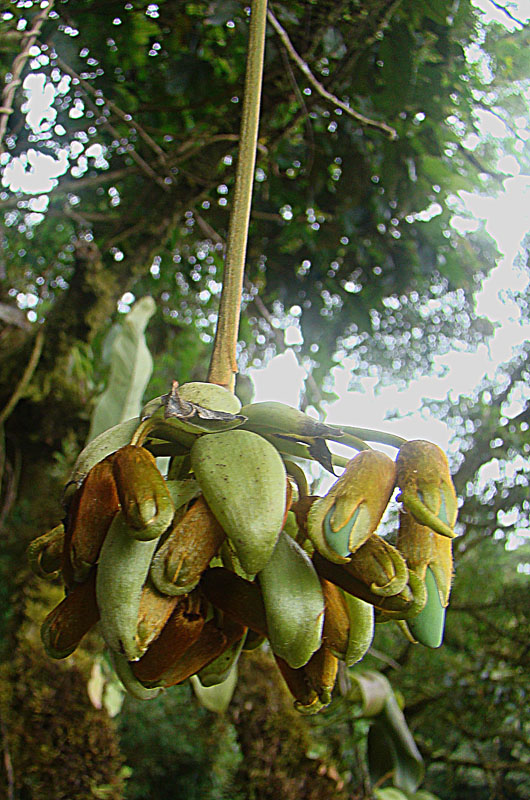
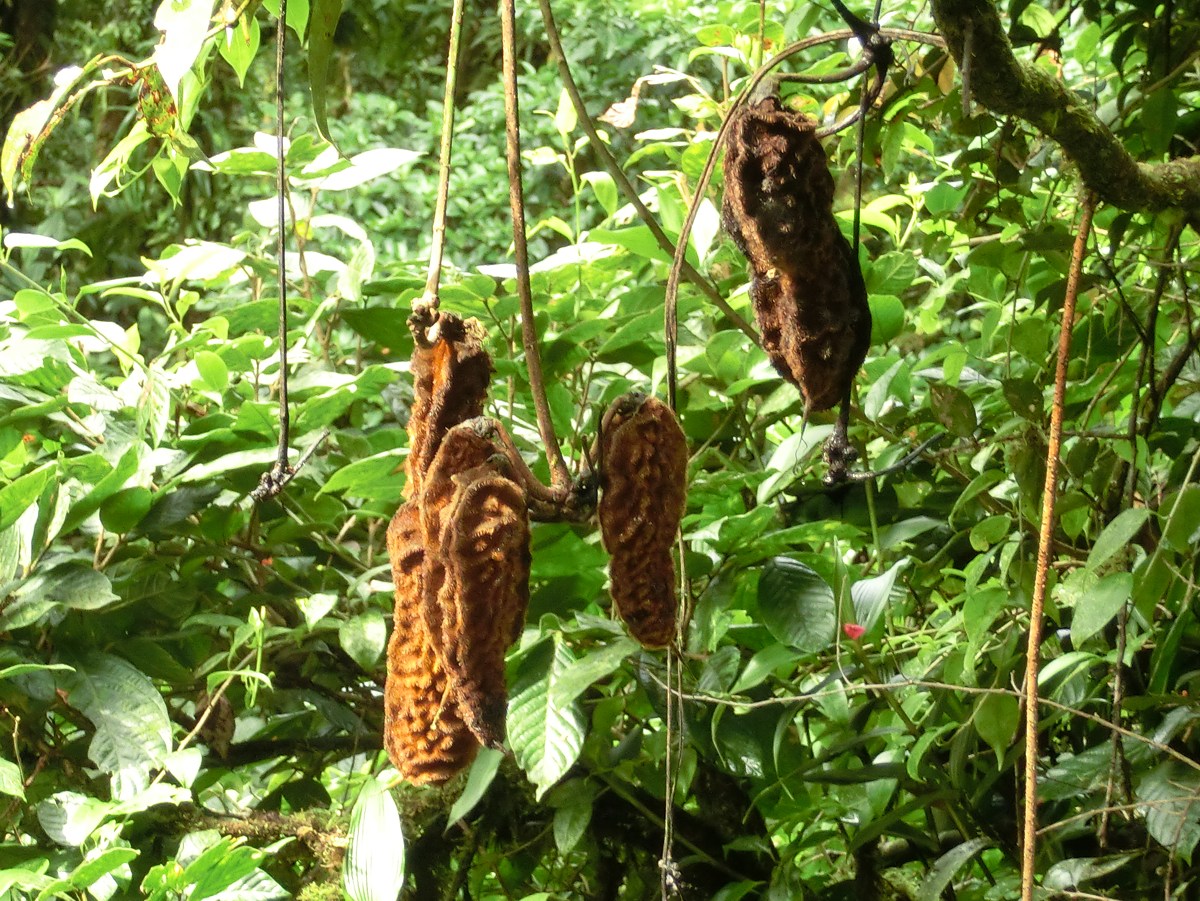
Mucuna urens, known as Ox-eye Bean, horse-eye bean or ojo de buey, is a giant tropical vine in the pea family (Fabaceae). It climbs high into the forest canopy on thick, twining stems and hangs its flowers and pods on long cords that dangle below the branches. Within the United States it is native only to Puerto Rico. Its wider range covers the West Indies and tropical Central and South America.
The plant is best known for its seeds. They are round, slightly flattened, glossy brown and about an inch across, with a broad black band (the hilum) wrapped around most of the edge. The resemblance to an animal’s eye gives the plant its common names, and the band of a related seed looks enough like a bun-and-patty to earn some Mucuna seeds the nickname “hamburger seed.” The seeds float, travel on ocean currents, and are among the “sea beans” collected by beachcombers.
Ox-eye bean comes with a warning. Its pods are covered in bristly hairs that sting and cause intense itching, and the seeds are toxic if eaten. The species name urens means “burning.” This guide explains how to identify the vine safely, where it grows in Puerto Rico, what it does in the forest, and what to consider before growing it.
Identification
Ox-eye bean is a big woody vine that is often noticed only when its pods or flower clusters hang down into view, or when its seeds wash up on a beach. Look for three-part leaves, hanging clusters of waxy yellowish flowers on very long stalks, and thick, ridged, bristly pods.
Stems & Habit
It is a vigorous, much-branched twining liana that climbs into the canopy of tall trees, often reaching 60 feet or more. Young stems are soft and green, and older ones become thick and woody. The fleshy stems hold enough water that cut sections have been used as a source of drinking water in the forest.
Leaves
The leaves are alternate and trifoliate, like a giant bean leaf, on stalks up to about 6 inches long. Each leaflet is oval to elliptic and up to about 6 inches long, with a rounded base and a short sharp tip. The two side leaflets are lopsided at the base.
Flowers
The flowers hang in clusters at the end of a cord-like stalk that can be 3 feet long or more. Each flower is a thick, waxy, pea-type flower about 2 inches long, yellowish to greenish yellow, with a short calyx tube. Several open at a time near the tip of the stalk, so the cluster looks like a hanging bunch of fat, curved buds.
Pods & Seeds
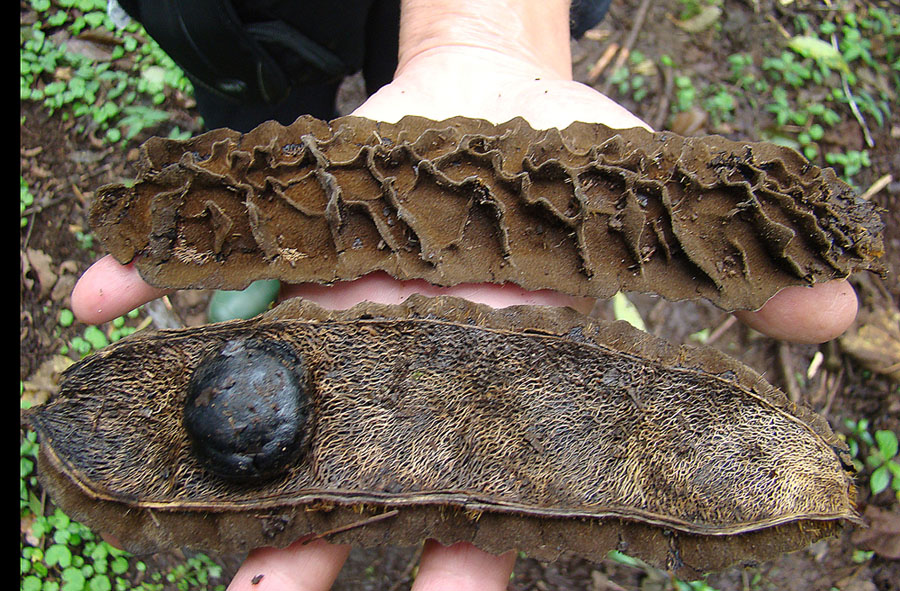
The pods are oblong, about 6 inches long and 2 inches wide, with deep crosswise ridges and two wavy wings along the edges. They are covered in orange-brown bristly hairs that break off easily and sting. Each pod holds one to four round seeds about an inch or more across, glossy brown with a black hilum band that runs around most of the edge.
Quick Facts
| Scientific Name | Mucuna urens (L.) Medik. (syn. Dolichos urens L.) |
| Family | Fabaceae (pea or legume family) |
| Plant Type | Large woody perennial vine (liana) |
| Mature Height | Climbs 30–60+ ft into the canopy |
| Mature Spread | Spreads widely over host trees |
| Growth Rate | Fast |
| Sun Exposure | Full sun at the top of the canopy; seedlings tolerate shade |
| Water Needs | Moderate to high; humid forest conditions |
| Soil Type | Moist, well-drained forest soils |
| Soil pH | Slightly acidic to neutral |
| Bloom Time | Variable; flowers can appear much of the year in the tropics |
| Flower Color | Yellowish to greenish yellow |
| Fall Color | None; evergreen |
| Fruit | Ridged pod with stinging hairs; 1–4 round brown seeds with a black band |
| Deer Resistant | Not applicable in Puerto Rico; pods are well defended by stinging hairs |
| USDA Hardiness Zones | 10–12 |
Native Range
USDA PLANTS lists ox-eye bean as native in Puerto Rico and nowhere else in the United States. Beyond Puerto Rico it is native through the West Indies and tropical Central and South America, from Panama to Peru, Ecuador, Bolivia and Brazil, growing in forests and woodlands from near sea level to about 6,000 feet.
In Puerto Rico it is a vine of moist forests, ravines and forest edges, where it climbs over trees toward the light. Because its pods and flowers hang high in the canopy, it is usually spotted along roadsides, river valleys and trails where the forest edge lets you see into the upper branches, or by finding its fallen pods and seeds on the ground.
Its seeds also travel far beyond the plant’s home. They are buoyant and survive long periods in seawater, so they drift on ocean currents and wash up on beaches around the Caribbean and sometimes in Florida and along the Gulf Coast. A seed found on a mainland beach is a traveler, not a sign that the vine grows nearby.
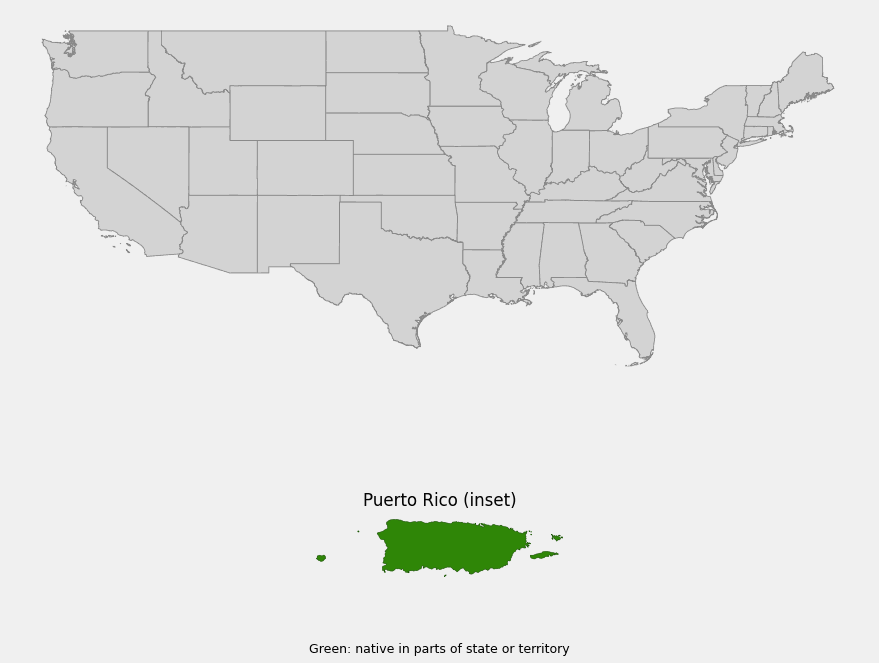
📋 Regional plant lists featuring Ox-eye Bean: Puerto Rico
Growing & Care Guide
Ox-eye bean is rarely grown on purpose. It is a huge, fast vine for frost-free climates only, and its stinging pods make it a poor choice near paths, play areas or anywhere people will brush against it. In Puerto Rico it is best appreciated in the wild. Gardeners who do grow it, usually from a sea-bean seed or a collected seed, should give it a large, sturdy support well away from foot traffic.
Safety note: the pods carry stinging, irritant hairs (the enzyme mucunain causes intense itching, redness and small pustules). Handle pods only with gloves and keep them away from your eyes. The seeds are toxic if eaten raw: like other Mucuna seeds they contain L-DOPA and other compounds that can cause poisoning. Keep seeds away from children and pets, and never eat them.
Light
Plant at the base of a tree or a strong structure where the vine can climb into full sun. Seedlings start well in partial shade.
Soil & Water
It wants deep, moist, well-drained soil and regular rainfall or watering. It does not tolerate frost or long dry periods. In zones 10 to 12 it grows quickly once established.
Planting Tips
The hard seeds germinate faster if the seed coat is nicked with a file (away from the black band) and soaked overnight. Sow about an inch deep in warm, moist potting mix. Give the young vine a tall, sturdy support at once, since it will soon need a tree or heavy pergola. Do not plant it near walkways because of the stinging pods.
Pruning & Maintenance
Prune as needed to keep it from smothering small trees and to keep pods out of reach. Wear gloves, long sleeves and eye protection when cutting back stems or handling pods, and bag pods before disposal.
Propagation
Grow from seed. Mature seeds stay viable for a long time, which is why some sea beans washed up on beaches can still sprout. Stem cuttings are possible but rarely used.
Landscape Uses
- Forest restoration in Puerto Rico: part of the natural vine layer of moist forests; let wild plants be rather than planting it near homes
- Large tropical gardens: only where a big tree or heavy structure can carry it, far from paths
- Wildlife and nature viewing: hanging flower clusters can draw nectar-feeding bats at night
- Sea bean collecting: its seeds are a classic beach find; handle only clean, dry seeds and never eat them
- Education: a vivid example of bat pollination and ocean seed dispersal
Wildlife & Ecological Value
Ox-eye bean is a canopy vine that ties together several forest animals: bats that pollinate it, insects that feed on it, and ocean currents that carry its seeds.
For Pollinators
Like other New World Mucuna with flowers hanging on long cords, it is adapted to pollination by nectar-feeding bats. The long stalks hold the flowers in open air below the foliage, where bats can reach them, and the thick, waxy flowers open when a visitor pushes into them, dusting it with pollen. Puerto Rico has several nectar-feeding bats. Large bees also visit some Mucuna flowers.
For Birds
The well-defended pods and hard, toxic seeds are not a significant bird food. The tangled vines give perches and cover in the canopy.
For Mammals
Nectar-feeding bats are its most important mammal partners. The stinging hairs on the pods discourage most other animals from feeding on them.
Ecosystem Role
As a nitrogen-fixing legume, it adds nitrogen to forest soils through bacteria in its root nodules. Its massive vines create structure in the canopy, and its floating seeds let it travel between islands and coasts on ocean currents, which helps explain its wide distribution in the Caribbean and the Americas.
Cultural & Historical Uses
The genus name comes from mucunã, an Indigenous Brazilian (Tupi) name for this plant, which the French botanist Michel Adanson adopted as a genus name in 1763. Linnaeus had described the species as Dolichos urens, and it was later moved to Mucuna. The species name urens, “burning,” refers to the stinging hairs on the pods.
People across the tropical Americas have used the vine in many ways. The stems yield strong fiber for rope, cut stems provide drinking water in the forest, and the seeds have been used in traditional medicine and, polished, as charms, beads and good-luck pieces. Its stinging hairs have also had folk uses, but they are irritating and unsafe to handle, and none of these remedies should be tried at home.
For beachcombers, ox-eye and hamburger beans are prized drift seeds. Sea bean collectors trade and display them, and beaches in the Caribbean and Florida receive drift seeds after storms. Their long journeys on ocean currents have made them a small symbol of how plants travel between continents.
Frequently Asked Questions
Is ox-eye bean poisonous?
Yes. The seeds are toxic if eaten raw; like other Mucuna seeds they contain L-DOPA and other compounds that can cause poisoning. The bristly hairs on the pods cause intense itching and skin irritation. Handle pods with gloves and never eat the seeds.
Is it the same as a “hamburger bean” or “sea bean”?
“Sea bean” is a general name for drift seeds that wash up on beaches, and ox-eye bean is one of them. “Hamburger bean” or “hamburger seed” is used for several Mucuna species whose round seeds have a dark band around the edge, including this one.
Can I grow an ox-eye bean from a seed I found on the beach?
Sometimes. Sea beans can stay viable for years. Nick the hard seed coat, soak it, and plant it in warm, moist soil. It only grows outdoors in frost-free climates, gets very large, and its pods sting, so plant it well away from paths or treat it as a short-lived curiosity in a pot.
Where can I see it in Puerto Rico?
Look in moist forests, ravines and river valleys, especially along roads and trails where you can see into the canopy. The hanging flower clusters and pods on long cords are the best clues. Admire the pods without touching them.
Does ox-eye bean grow in Florida?
It is not native to Florida or the U.S. mainland. Mucuna seeds sometimes wash up on Florida beaches after traveling on ocean currents, but the plant grows wild in the United States only in Puerto Rico.

Looking for a nursery that carries Ox-eye Bean?
Our nursery directory does not yet include Puerto Rico. Browse the native plant nursery directory by state: Alabama–Arkansas · California · Colorado–Hawaii · Idaho–Kansas · Kentucky–Montana · Nebraska–Oklahoma · Oregon · Pennsylvania–Virginia · Washington · West Virginia–Wyoming

