
Snowy Hydrangea (Hydrangea radiata)
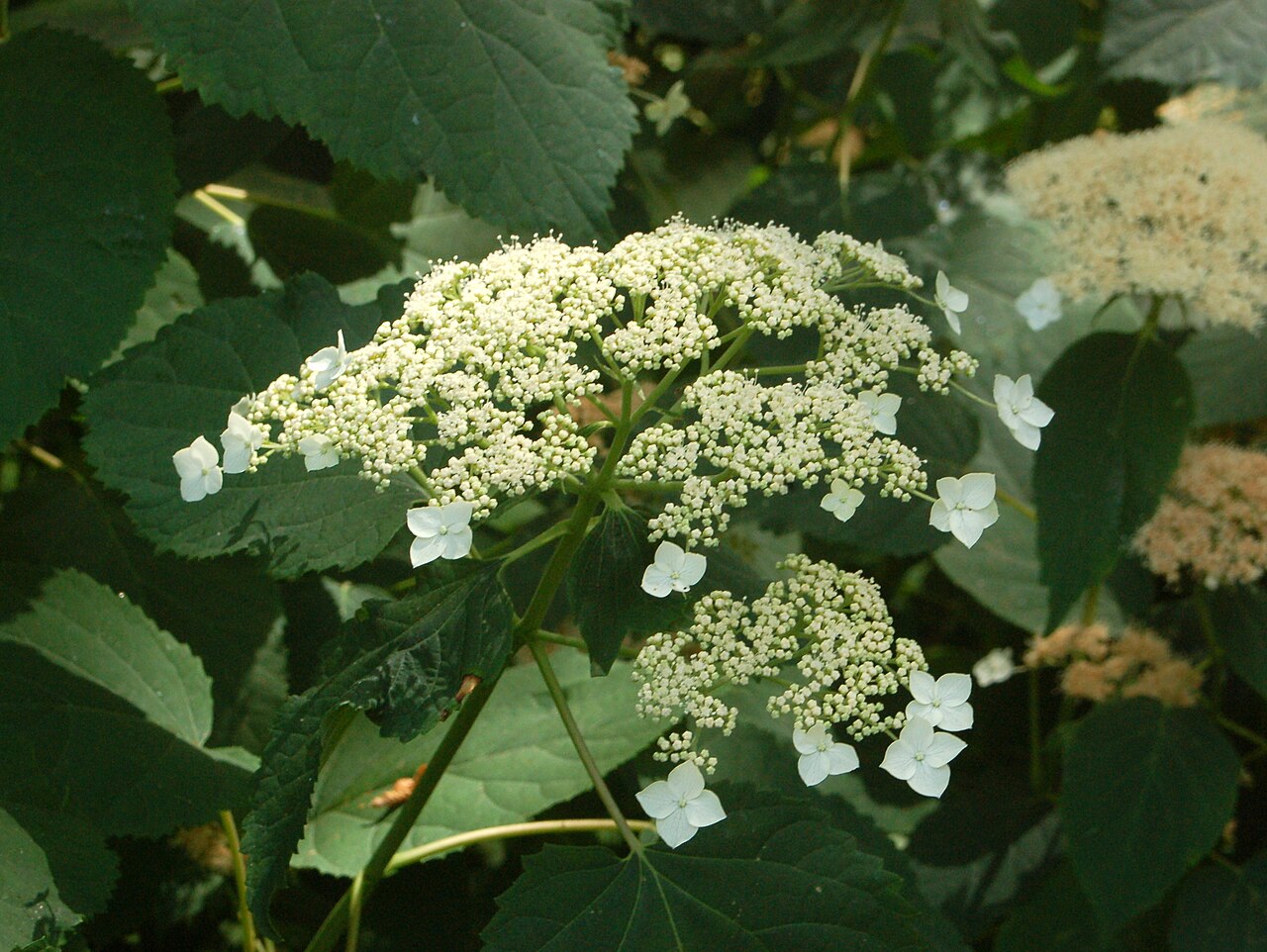
Hydrangea radiata, known as Snowy Hydrangea or silverleaf hydrangea, is a native shrub of the southern Appalachians with one striking feature: the undersides of its leaves are covered in a dense, bright white felt. When a breeze lifts the foliage, the whole shrub seems to flash silver. In early summer it carries flat clusters of creamy flowers edged with a few showy white florets.
It is a close relative of the widespread Wild Hydrangea (Hydrangea arborescens), the parent of the popular ‘Annabelle’ hydrangea. USDA PLANTS and Weakley’s Flora of the Southeastern United States treat snowy hydrangea as its own species, but many other references and nurseries list it as Hydrangea arborescens subsp. radiata. The similar Ashy Hydrangea (H. cinerea), with grayish rather than white leaf undersides, is treated the same way.
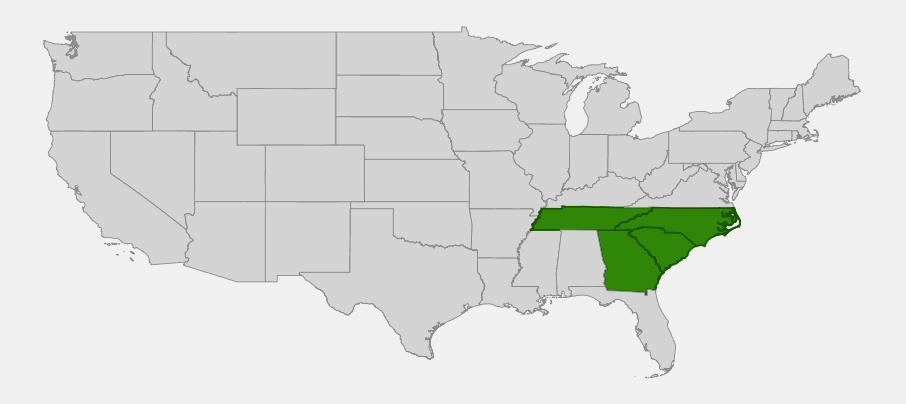
Snowy hydrangea grows wild only in a small area of the southern Blue Ridge and adjacent Piedmont in North Carolina, South Carolina, Georgia and Tennessee. This page covers how to tell it from its relatives, its native range, how to grow it, its wildlife value and a safety note, since hydrangea leaves and buds contain cyanogenic glycosides.
Identification
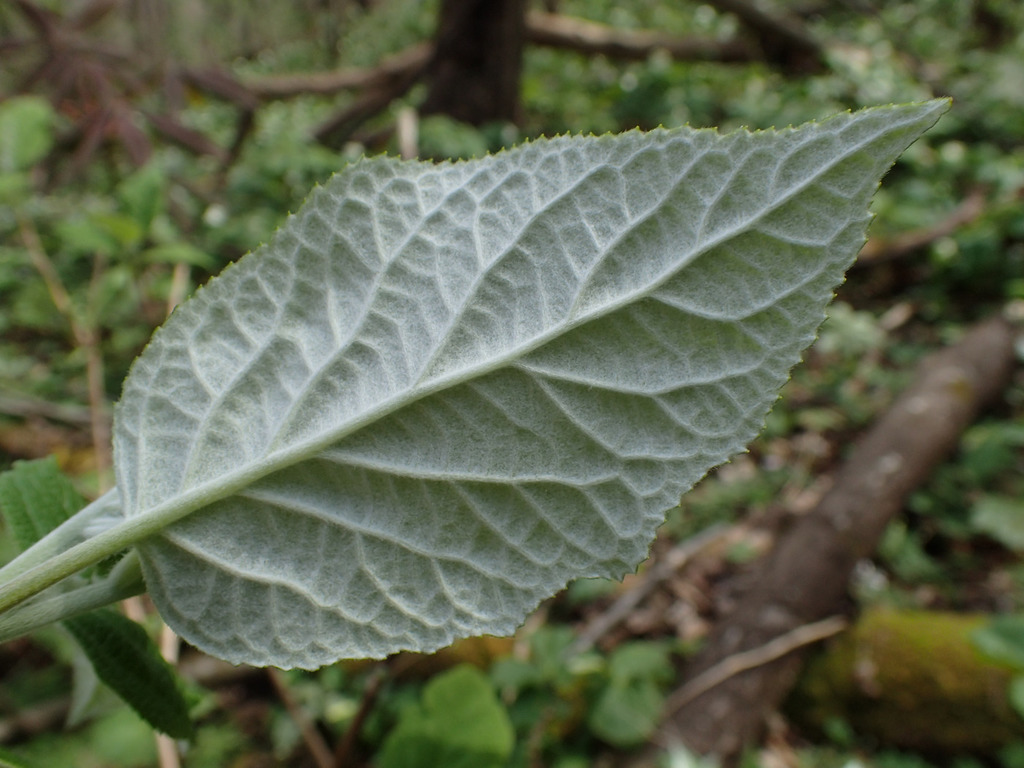
Snowy hydrangea looks much like wild hydrangea from above. Turn over a leaf: the brilliant white, felted underside is the most reliable way to recognize it.
Size & Form
It is a deciduous, multi-stemmed shrub usually 3 to 6 feet tall and as wide, with upright, somewhat arching stems and peeling, light brown bark on older wood. It spreads slowly by suckers into loose clumps.
Leaves
The leaves are opposite, oval to broadly lance-shaped, about 3 to 6 inches long, with toothed edges and a pointed tip. They are dark green and nearly smooth above. Beneath, they are covered with a dense, matted layer of white hairs that makes them look bright silvery white. The felt is thickest on new growth in spring.
Flowers
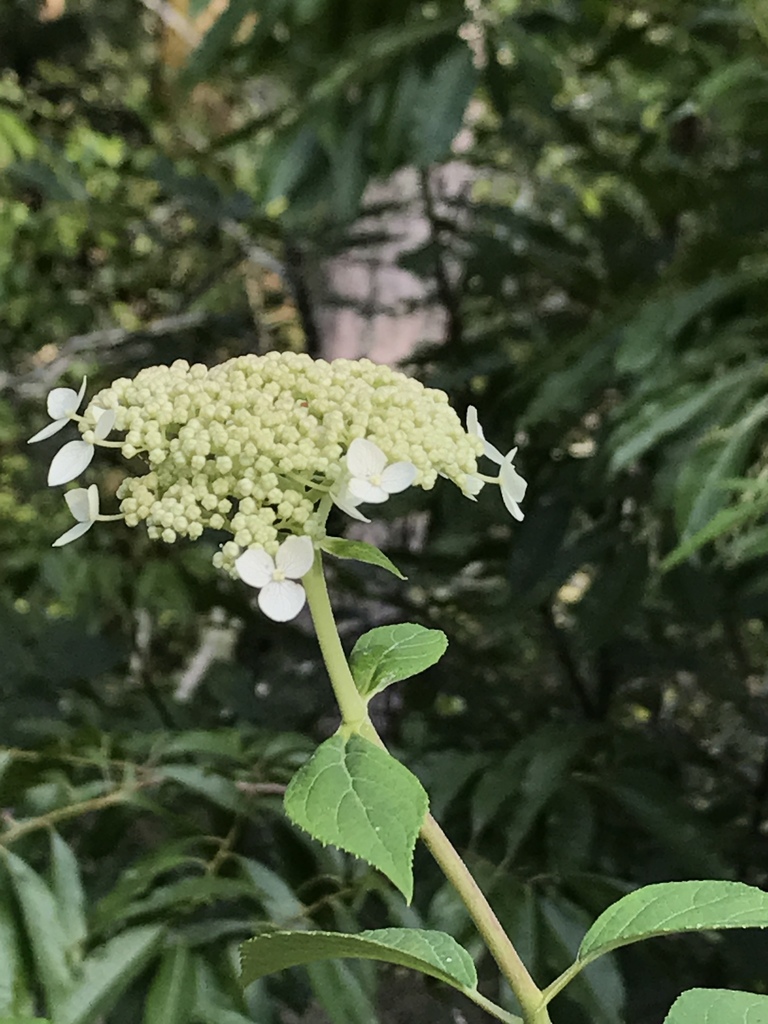
From about late May to July it produces flat-topped clusters (corymbs) 3 to 6 inches across. Most of the flowers are small, fertile and creamy white. Around the edge there are usually a few to several larger sterile florets, each with three to five white, petal-like sepals, giving a lacecap look. The name radiata, “with rays,” refers to these marginal florets.
Fruit
The fertile flowers become small, ribbed, dry capsules that turn brown and persist on the plant into winter, releasing tiny seeds.
Similar Species
Wild Hydrangea (H. arborescens) has leaves that are green and smooth or only slightly hairy beneath, and usually few or no sterile florets. Ashy Hydrangea (H. cinerea) has leaf undersides covered in grayish hairs, not bright white felt. Where the species meet, intermediate plants occur. Oakleaf Hydrangea has large, lobed, oak-like leaves and cone-shaped flower clusters.
Quick Facts
| Scientific Name | Hydrangea radiata Walter (syn. Hydrangea arborescens subsp. radiata (Walter) E.M. McClint.) |
| Family | Hydrangeaceae (hydrangea family) |
| Plant Type | Deciduous shrub |
| Mature Height | 3–6 ft |
| Mature Spread | 3–6 ft; spreads slowly by suckers |
| Growth Rate | Moderate to fast |
| Sun Exposure | Part shade; morning sun to light shade |
| Water Needs | Medium; evenly moist |
| Soil Type | Rich, moist, well-drained loam |
| Soil pH | About 5.0–6.5 |
| Bloom Time | Late May–July |
| Flower Color | Creamy white with white sterile florets |
| Fall Color | Yellowish; not showy |
| Fruit | Small, dry, ribbed capsules |
| Deer Resistant | No; often browsed |
| USDA Hardiness Zones | 5–8 |
Native Range
USDA PLANTS lists snowy hydrangea as native in North Carolina, South Carolina, Georgia and Tennessee. Its range is small and centered on the southern Blue Ridge, especially the Blue Ridge Escarpment where the mountains drop to the Piedmont in southwestern North Carolina, northwestern South Carolina and northeastern Georgia. It also reaches the adjacent upper Piedmont and the mountains of southeastern Tennessee.
It grows on moist, shaded slopes, rich coves, stream banks, river bluffs and wet rock outcrops and cliffs, often in rocky ground under a forest canopy. It is often seen along mountain roads and trails, where it can cover road banks with silvery foliage.
Within this area it can be locally common, but it occurs nowhere else in the world. It is often grown in gardens far outside its native range.
📋 Regional plant lists featuring Snowy Hydrangea: North & South Carolina · Alabama, Georgia & Mississippi · Kentucky & Tennessee
Growing & Care Guide
Snowy hydrangea is easy to grow in shady, moist gardens and is sold by native plant nurseries, sometimes as Hydrangea arborescens subsp. radiata or as silverleaf hydrangea. Its silvery leaves make it a standout even when it is not in bloom.
Light
It does best in part shade, with morning sun and afternoon shade, or bright dappled shade under trees. It tolerates more sun in cooler climates if the soil stays moist; in hot, dry, sunny sites the leaves scorch and wilt.
Soil & Water
Plant it in rich, moist, well-drained, acidic to neutral soil with plenty of organic matter. Keep the soil evenly moist, especially in its first year and during summer droughts; it wilts quickly when dry. A layer of leaf mulch helps keep the roots cool and moist.
Planting Tips
Plant in spring or fall, spacing plants 3 to 4 feet apart for a massed planting. Site it where the leaves can be seen from below or moved by a breeze, such as on a slope above a path or beside a stream. Like other hydrangeas, it is often browsed by deer, so protect young plants where deer are common.
Pruning & Maintenance
It flowers on new wood, so you can cut it back in late winter or early spring without losing that year’s flowers. Cutting stems back to about a foot tall keeps it compact; lighter pruning gives a larger shrub. Remove dead stems and old flower heads in late winter if you wish, although the dry heads add winter interest. It has few serious pests.
Propagation
It is easy to propagate by softwood cuttings in late spring or early summer, which root quickly. Rooted suckers can be divided from the clump in early spring. Seed is tiny and can be surface-sown on moist, fine mix, but cuttings are faster.
Landscape Uses
- Woodland gardens: silver-backed foliage and early summer flowers in part shade
- Slopes and stream banks: its suckering clumps help hold moist, shady banks
- Foliage contrast: white leaf undersides brighten shady borders all season
- Native alternative: a regional native substitute for non-native hydrangeas
- Pollinator gardens: its lacecap flowers attract bees, beetles and butterflies
Wildlife & Ecological Value
Snowy hydrangea is a useful shrub for insects and other wildlife in shady southern Appalachian forests.
For Pollinators
The fertile flowers produce pollen and some nectar and are visited by many small bees, flies, beetles (especially longhorn and soldier beetles) and butterflies. The showy sterile florets help attract insects to the clusters but produce no pollen or nectar. Hydrangeas are larval host plants for the hydrangea sphinx moth.
For Birds
The dense clumps offer cover and nest sites for shrub-nesting birds. Birds eat few hydrangea seeds, but they forage for insects on the foliage.
For Mammals
White-tailed deer browse the leaves and shoots readily. Small mammals shelter under the shrubs on shaded slopes.
Ecosystem Role
On steep, moist slopes and stream banks, snowy hydrangea’s spreading roots and suckers help stabilize soil. It is part of the diverse shrub layer of southern Appalachian cove and slope forests.
Cultural & Historical Uses
The species was described in 1788 by Thomas Walter in his Flora Caroliniana, one of the first floras of the southeastern United States, based on plants from the Carolinas. In the 20th century the botanist Elizabeth McClintock, in her revision of the genus, combined snowy hydrangea, ashy hydrangea and wild hydrangea as subspecies of one species, Hydrangea arborescens. Many southeastern botanists now treat them again as separate species, which is why both names appear in references and nurseries.
Hydrangeas have long been used in Appalachian and Native American folk medicine, especially the roots of wild hydrangea, which were used for kidney and bladder complaints. The name Hydrangea comes from Greek words meaning “water vessel,” for the cup-shaped capsules.
Safety note: hydrangea leaves, buds and flowers contain cyanogenic glycosides (such as hydrangin) that can release cyanide when chewed. Eating them can cause vomiting, diarrhea and stomach pain in people, pets and livestock, and large amounts can be more serious. Don’t eat any part of the plant or use it in homemade remedies, and keep pets and children from chewing it.
Frequently Asked Questions
Is snowy hydrangea the same as Hydrangea arborescens?
It is closely related. USDA PLANTS and Weakley’s flora treat it as a separate species, Hydrangea radiata, while many references and nurseries call it Hydrangea arborescens subsp. radiata. It differs from Wild Hydrangea mainly in its bright white, felted leaf undersides.
Why are the leaves of snowy hydrangea white underneath?
The undersides are covered in a dense mat of fine white hairs. This felt gives the plant its common names, snowy and silverleaf hydrangea, and makes it easy to identify.
Where does snowy hydrangea grow wild?
Only in the southern Blue Ridge and nearby upper Piedmont of North Carolina, South Carolina, Georgia and Tennessee, on moist, shaded slopes, stream banks and rock outcrops.
How do I prune snowy hydrangea?
It blooms on new growth, so prune it in late winter or early spring. Cut it back hard to about a foot for a compact shrub, or lightly for a larger one.
Is snowy hydrangea poisonous?
Yes, if eaten. Like other hydrangeas, its leaves, buds and flowers contain cyanogenic glycosides that can cause vomiting and diarrhea in people and pets. Don’t eat any part of it.

Looking for a nursery that carries Snowy Hydrangea?
Browse our native plant nursery directory: Georgia · North Carolina · South Carolina & Tennessee

