
Polar Willow (Salix polaris)
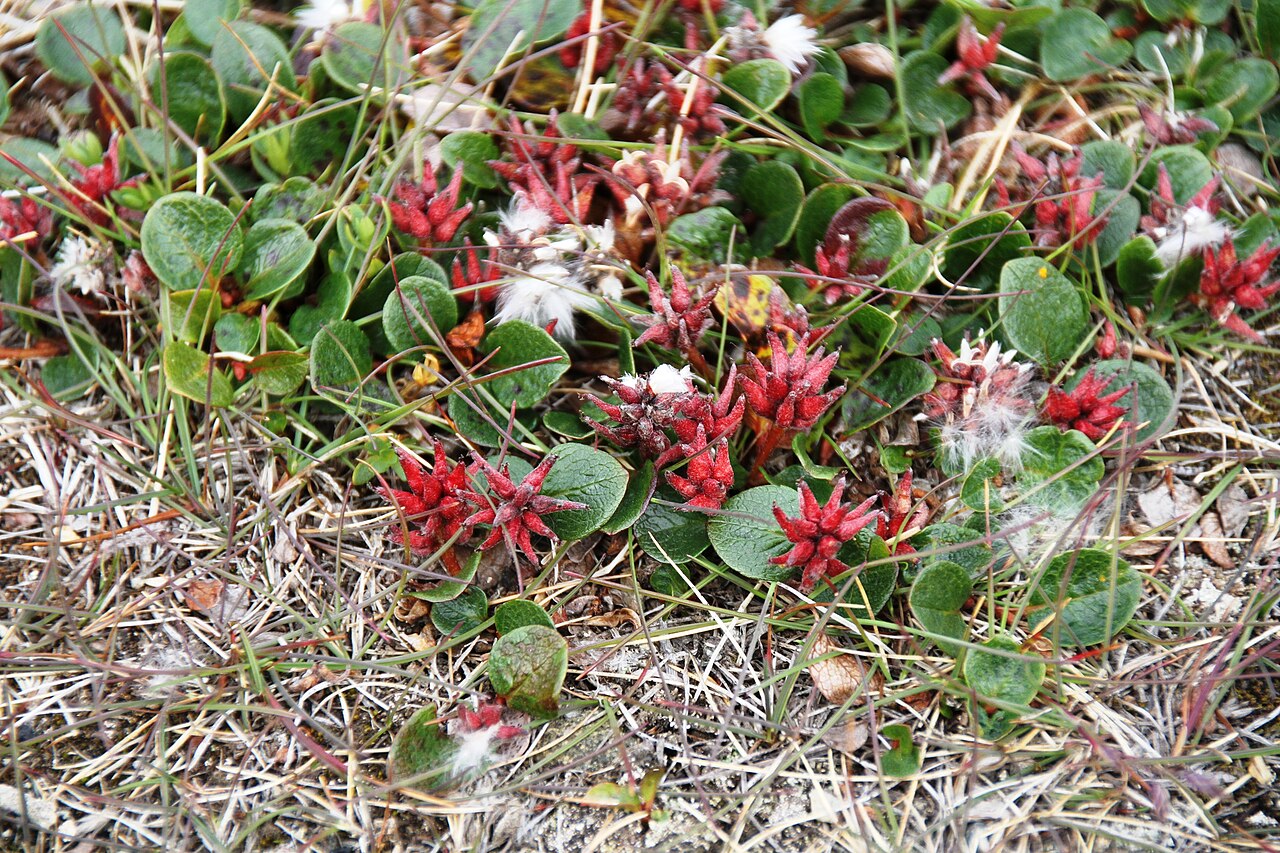
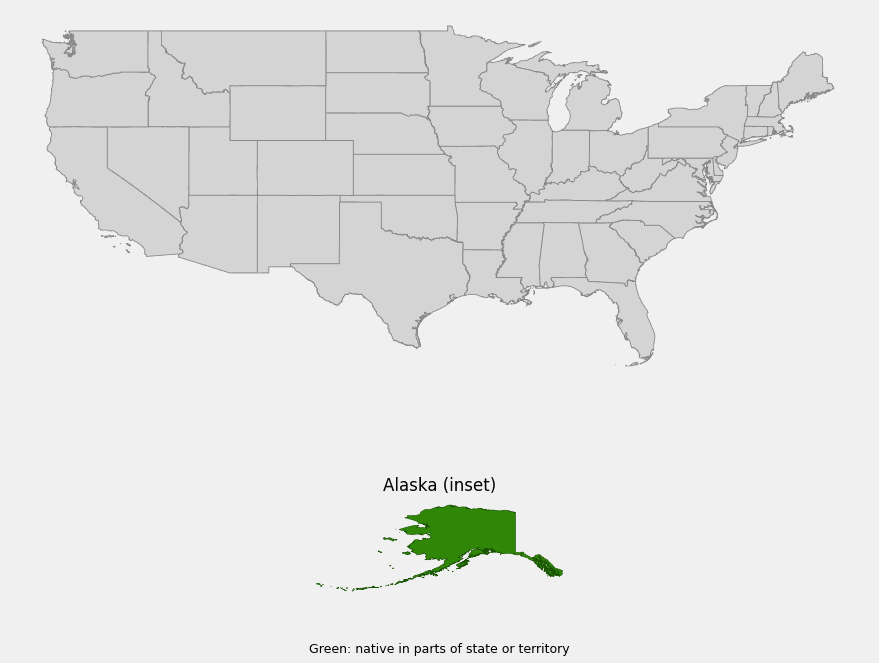
Salix polaris, the Polar Willow, is one of the smallest woody plants in the world. This creeping dwarf willow rarely grows more than 1 to 3 inches tall, with most of its stems running just below the surface of moss and soil, so that only its small, glossy, rounded leaves and tiny catkins show. It grows across the high Arctic of Europe, Asia and North America, and in the United States it is native only to Alaska.
Polar willow is a true shrub, with woody stems and the same catkins as its tree-sized relatives, but it has adapted to the harsh tundra by staying close to the ground, where it is protected by snow in winter and warmed by the soil in summer. Plants are either male or female. In early summer the short catkins turn red to purple, and in late summer the female catkins release seeds on fluffy white hairs.
This guide covers how to identify polar willow among Alaska’s many dwarf willows, where it grows, its role in the Arctic food web and its history as an Ice Age plant. It is not a garden plant outside the Arctic, so treat it as a plant to recognize and appreciate on the tundra; never dig it from the wild.
Identification
Polar willow forms low, creeping mats with small, rounded, smooth-edged leaves and short catkins with only a few flowers. It is often half-buried in moss and lichen.
Stems & Leaves
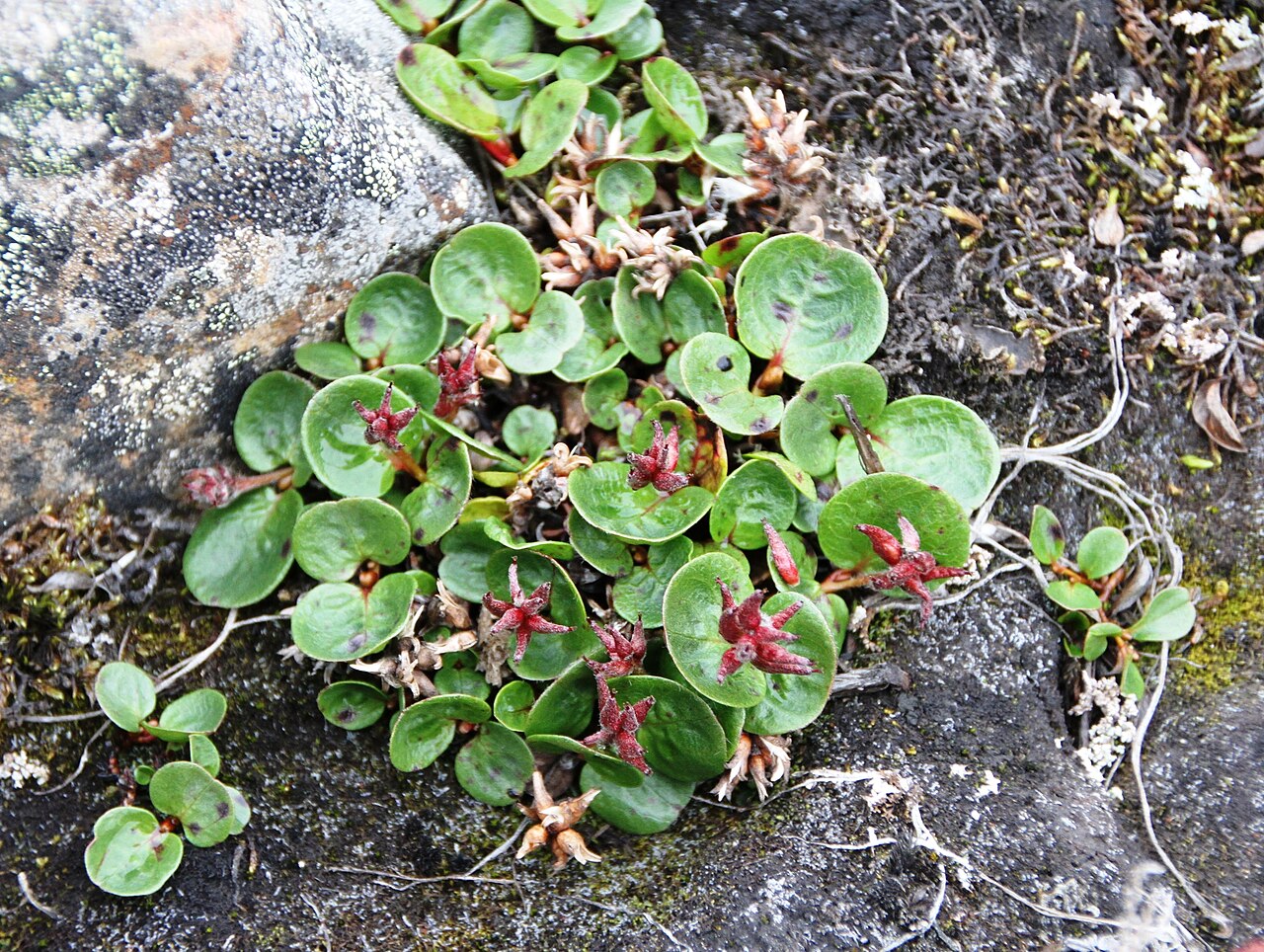
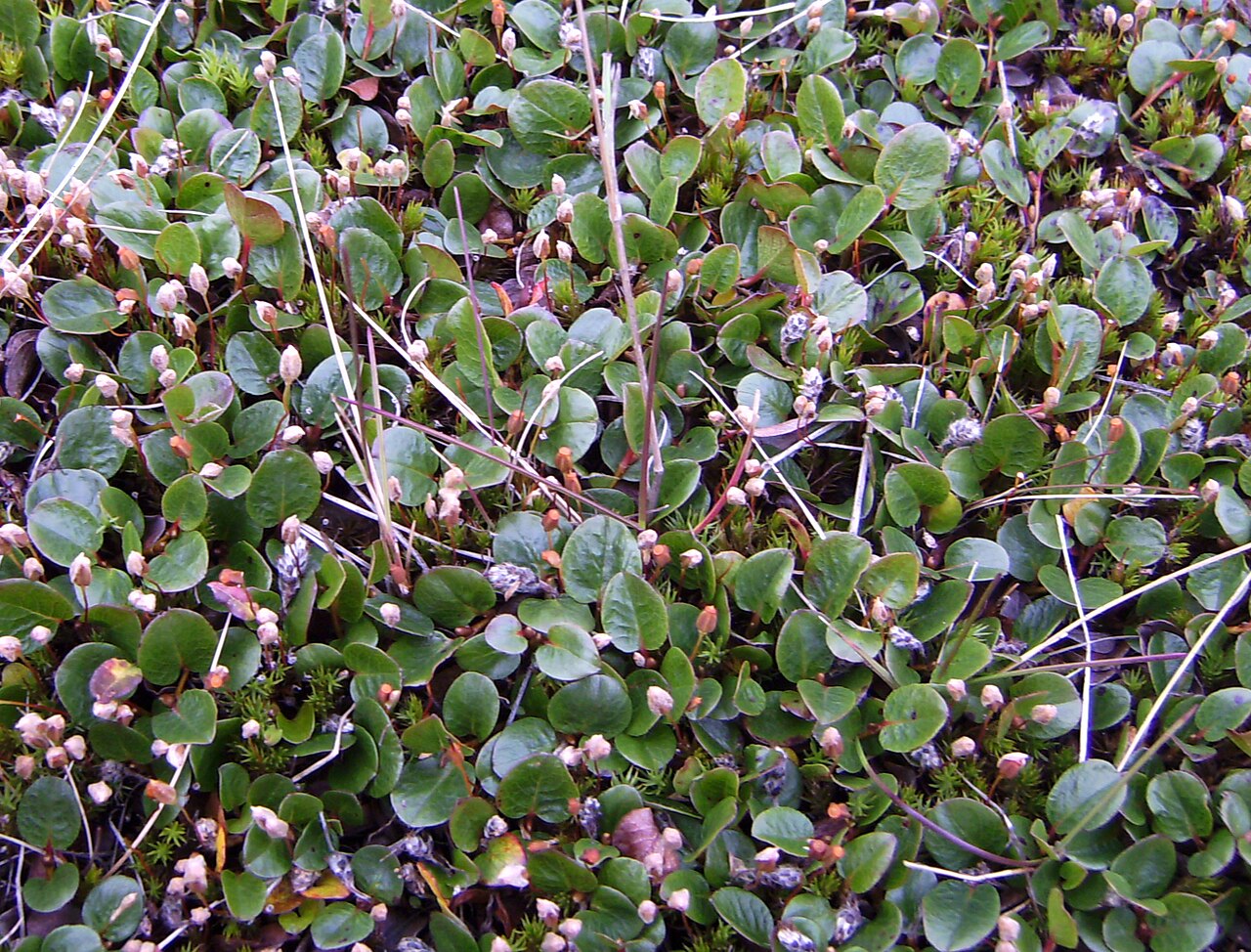
The stems creep underground or within moss and root freely, so the plant appears as scattered shoots or a loose carpet only about 1 to 3½ inches (2–9 cm) tall. Each shoot has a few leaves that are rounded to broadly oval, about ¼ to 1¼ inches long, dark green and glossy, with smooth (entire) edges and a slightly notched or rounded tip. The leaves are hairless or nearly so when mature.
Catkins
Polar willow is dioecious: male and female flowers are on separate plants. The catkins appear with the leaves in June and early July at the tips of the shoots. They are short, about ¼ to ¾ inch long, with only a few flowers and dark brown to blackish bracts. Male catkins have reddish to yellow anthers, and female catkins are red to purple as the capsules develop.
Fruit
The fruit is a small, reddish-brown, hairy capsule that splits in July and August to release tiny seeds with silky white hairs that carry them on the wind. Seeds are viable for only a short time.
Look-alikes
Least willow (Salix rotundifolia) is very similar and also common in Alaska; it has smaller leaves with fewer veins and catkins with only two to ten flowers, and the two are often confused. Netleaf willow (S. reticulata) has larger, strongly net-veined leaves. Arctic willow (S. arctica) is larger, with longer catkins and often hairy leaves. Dwarf snowbed willow (S. herbacea) has toothed leaves and is mainly eastern. Expert identification often requires looking at catkin bracts and capsules.
Quick Facts
| Scientific Name | Salix polaris Wahlenb. |
| Family | Salicaceae (willow family) |
| Plant Type | Deciduous creeping dwarf shrub |
| Mature Height | 1–3½ in |
| Mature Spread | Creeping; patches 1–3 ft or more |
| Growth Rate | Slow |
| Sun Exposure | Full sun |
| Water Needs | Moist; snowmelt-fed tundra soils |
| Soil Type | Moist tundra soil, moss mats, gravel |
| Soil pH | Acidic to neutral (about 5.0–7.5) |
| Bloom Time | June–July (catkins) |
| Flower Color | Red to purple catkins |
| Fall Color | Yellow to reddish-brown |
| Fruit | Small hairy capsule with cottony seeds |
| Deer Resistant | Low; grazed by caribou and muskoxen |
| USDA Hardiness Zones | 1–3 |
Native Range
Polar willow has a circumpolar range in the high Arctic, reaching the northern limits of land in Svalbard, Franz Josef Land and the Canadian Arctic islands. South of the Arctic it grows in the mountains of Norway, the northern Urals, Kamchatka and western North America. USDA PLANTS lists it as native in Alaska, and in British Columbia, the Yukon, the Northwest Territories and Nunavut.
In Alaska it is a plant of Arctic and alpine tundra in the north and west of the state, including the North Slope, the Brooks Range, the Seward Peninsula and the coasts and islands of the Bering Sea, with scattered alpine records farther south. It grows in moist to wet tundra, snowbed hollows where snow lies late, mossy slopes, frost-heaved ground and gravelly places that stay moist all summer.
Polar willow is common across much of its Arctic range and is not considered threatened. As the Arctic warms, taller shrubs are spreading into tundra, and studies on Svalbard have used polar willow to track how longer growing seasons change Arctic plant growth and the timing of leaf-out.
📋 Regional plant lists featuring Polar Willow: Alaska
Can You Grow It?
Polar willow is essentially never sold and is very difficult to keep alive outside the Arctic, where it needs long, cold winters under snow and cool, moist summers. It is best enjoyed in the wild. Never dig plants from the tundra; tundra plants grow very slowly, and disturbed tundra takes decades to recover. The notes below describe its needs for Arctic gardeners and restoration work.
Light
Full sun. It grows in open tundra with long summer days and no shade.
Soil & Water
It needs cool, constantly moist soil, such as a moss mat or gravel fed by snowmelt, and a deep, reliable snow cover in winter. It cannot tolerate heat, drought or warm summer nights.
Planting Tips
In Arctic or high-alpine gardens and restoration sites, plant rooted cuttings in moist, gravelly soil in early summer, ideally among mosses that protect the creeping stems.
Pruning & Maintenance
No pruning is needed. Keep the soil moist and protect plants from trampling.
Propagation
Willows root easily, and short cuttings of polar willow can be rooted in moist sand. Seeds must be sown fresh, within days of release, because they lose viability quickly. Only collect material where permitted.
Where to See It
- Alaska’s North Slope and Brooks Range: moist tundra along the Dalton Highway and in Gates of the Arctic National Park
- Seward Peninsula and Bering Sea coast: wet tundra and snowbeds near Nome and in Bering Land Bridge National Preserve
- Arctic restoration sites: revegetation of disturbed tundra from local cuttings
- High Arctic worldwide: Svalbard, Greenland and the Canadian Arctic islands, where it is abundant
Wildlife & Ecological Value
Despite its tiny size, polar willow is a major food plant in the high Arctic, where few other woody plants grow.
For Pollinators
The early catkins provide pollen and nectar for bumble bees and flies in the short Arctic summer. Willows are also pollinated in part by wind.
For Birds
Rock ptarmigan and willow ptarmigan eat the buds, leaves and catkins, and the seed fluff is used by small birds to line nests. Geese graze on tundra willows in summer.
For Mammals
Caribou, reindeer, muskoxen, Arctic hares, lemmings and voles all graze on polar willow. On Svalbard it is one of the most important summer foods of the Svalbard reindeer.
Ecosystem Role
Its creeping stems bind tundra soil and moss together, and its leaves add organic matter to thin Arctic soils. It also forms partnerships with mycorrhizal fungi, which help it take up nutrients in cold, nutrient-poor ground.
Cultural & Historical Uses
Göran Wahlenberg, a Swedish botanist who studied the plants of Lapland, described Salix polaris in 1812. The species name means “of the pole,” referring to its Arctic range. Salix is the classical Latin name for willow.
During the Ice Ages, polar willow grew far south of its present range. Fossil leaves have been found in Ice Age deposits in southern England, the Alps and the Carpathians, showing that tundra once covered much of Europe. Such fossils help scientists reconstruct past climates.
Along with least willow and other dwarf willows, it is often called one of the world’s smallest trees or shrubs. Arctic peoples used willows of many kinds for food, medicine and tinder, and the young leaves of dwarf willows are rich in vitamin C.
Frequently Asked Questions
Is polar willow really a willow?
Yes. It is a true willow in the genus Salix, with woody stems and catkins like larger willows, but it grows only 1 to 3½ inches tall, with most of its stems creeping underground or in moss.
Where does polar willow grow in the United States?
Only in Alaska, mainly on Arctic and alpine tundra in the north and west of the state, including the North Slope, the Brooks Range, the Seward Peninsula and the Bering Sea coast.
How do I tell polar willow from least willow?
The two are very similar. Polar willow has slightly larger, glossy, rounded leaves with more veins and catkins with more flowers. Look at the catkins and leaves closely, or use an Alaska flora key.
Can I grow polar willow?
Generally no. It needs long, cold winters under snow and cool, moist Arctic summers, and it is not sold in nurseries. Arctic restoration projects sometimes grow it from local cuttings.
What eats polar willow?
Caribou and reindeer, muskoxen, Arctic hares, lemmings, voles and ptarmigan all feed on it. In the high Arctic it is one of the most important summer foods for grazing animals.

Looking for a nursery that carries Polar Willow?
Browse our native plant nursery directory: Alaska

