
Arctic Bell-Heather (Cassiope tetragona)
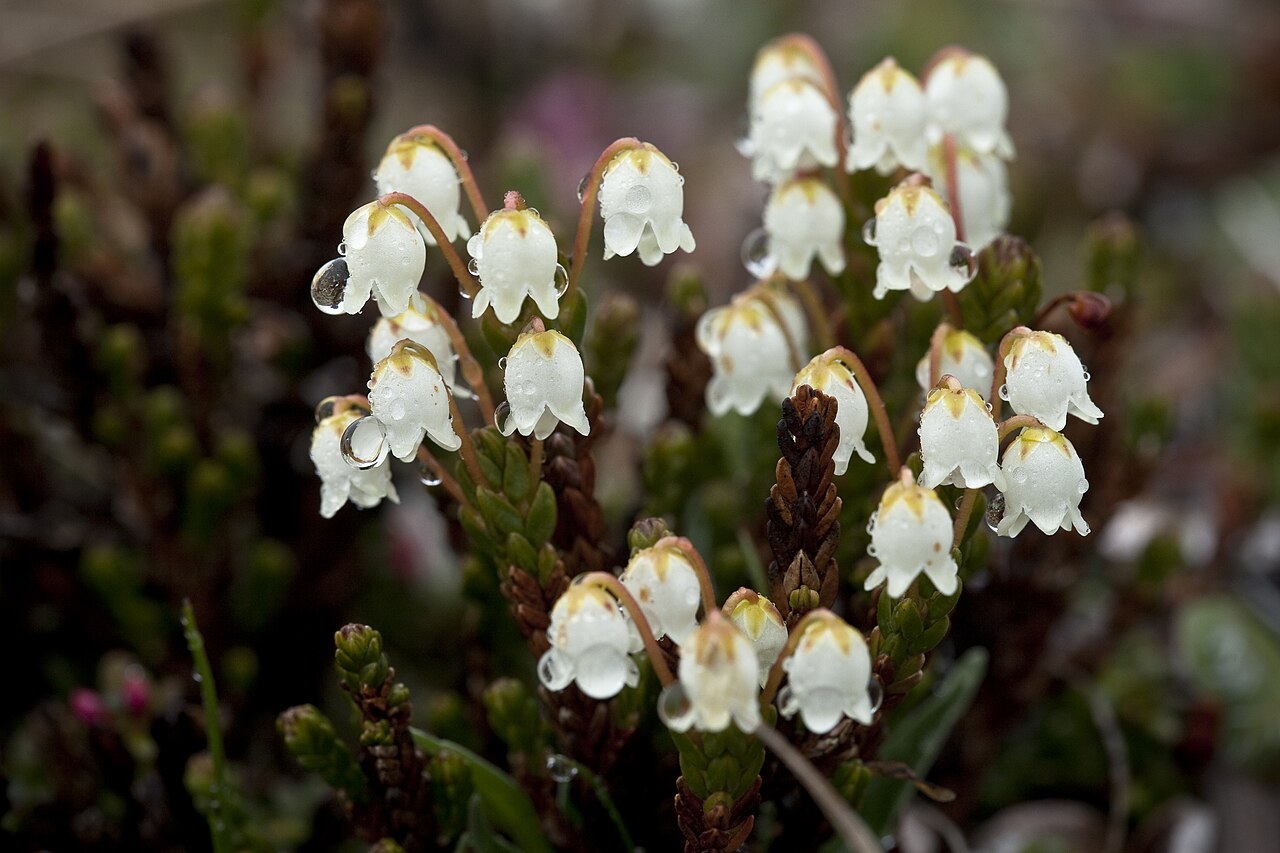
Cassiope tetragona, known as Arctic Bell-Heather, white arctic mountain heather or four-angled mountain heather, is a small evergreen shrub of the arctic tundra and high mountains. Its upright stems, 2 to 12 inches tall, are clothed in tiny scale-like leaves pressed tightly in four rows, so each stem looks like a square, braided cord. In early summer it bears dainty, nodding, creamy-white bells on red stalks. It belongs to the heath family (Ericaceae), though it is now often placed in its own family, Cassiopaceae.
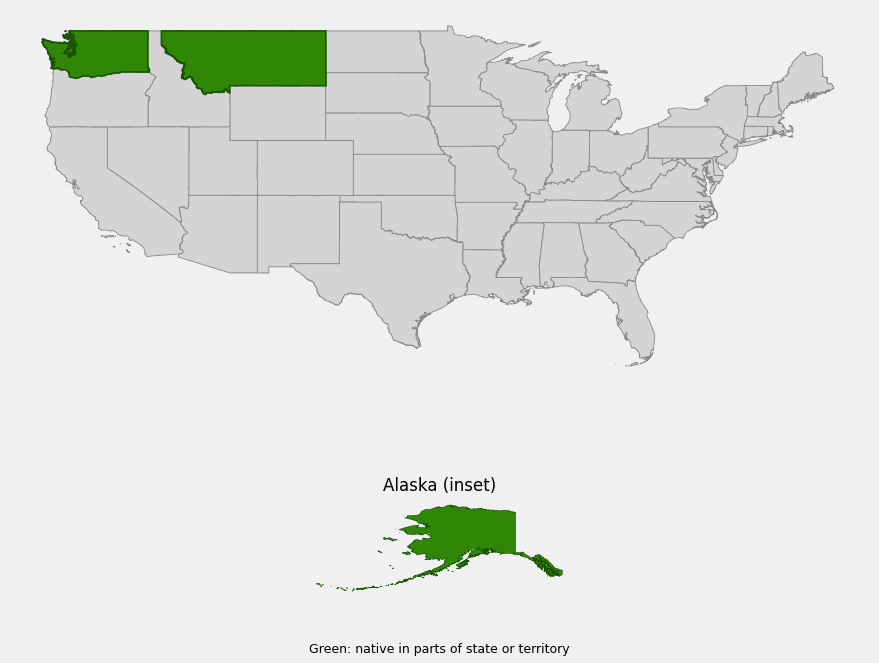
Arctic bell-heather is one of the most widespread and characteristic plants of the circumpolar Arctic, from Alaska and Canada to Greenland, Scandinavia and Siberia. In the United States it is common across much of Alaska, and farther south it reaches into the Rocky Mountains of Montana and the North Cascades of Washington, where the Rocky Mountain variety grows on high alpine ridges.
Its slow, steady growth leaves a yearly record in its stems, and scientists use it to track how arctic plants respond to changes in summer temperature. This guide covers how to identify it, where it grows, why it is so difficult to grow, and its role on the tundra.
Identification
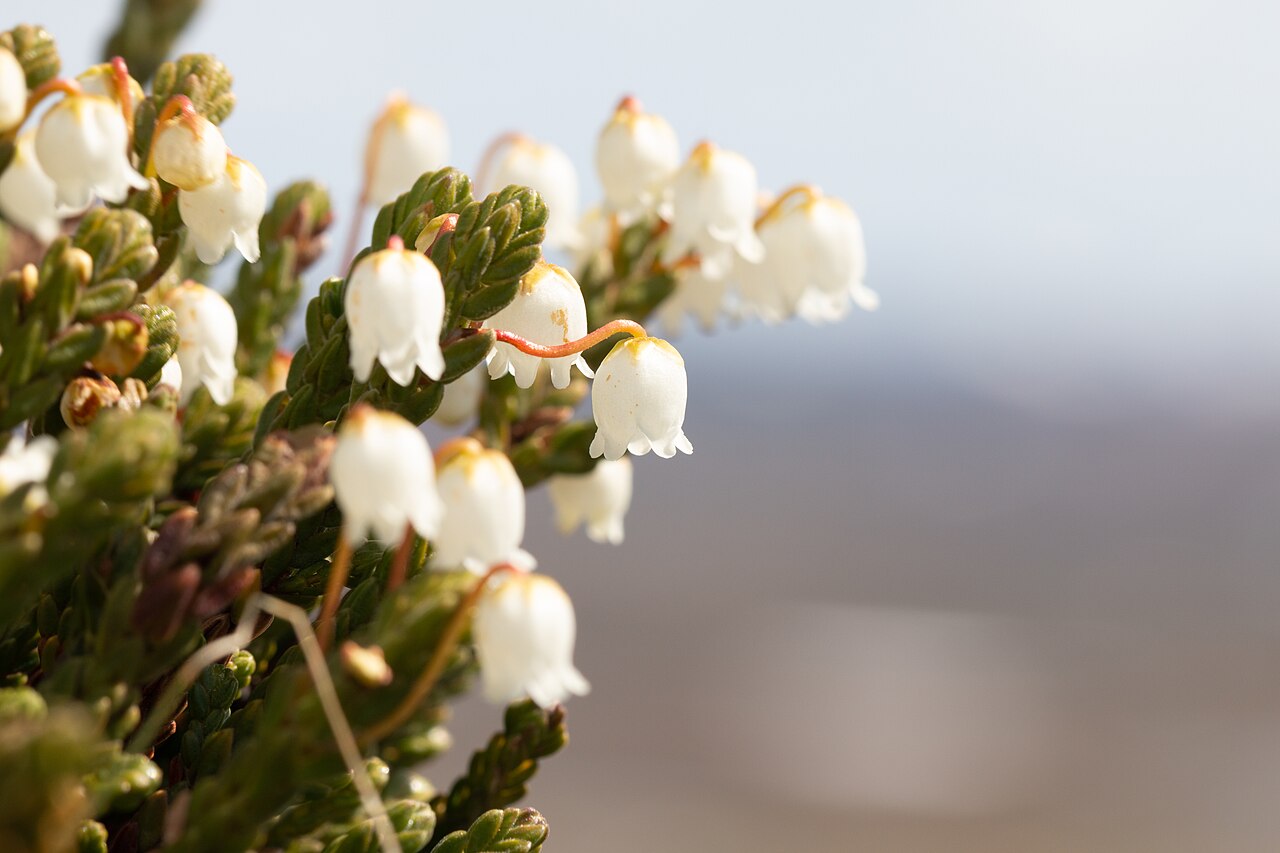
Arctic bell-heather is recognized by its four-sided stems of overlapping, deeply grooved scale leaves and its white bells borne along the sides of the stems near their tips.
Stems & Growth Habit
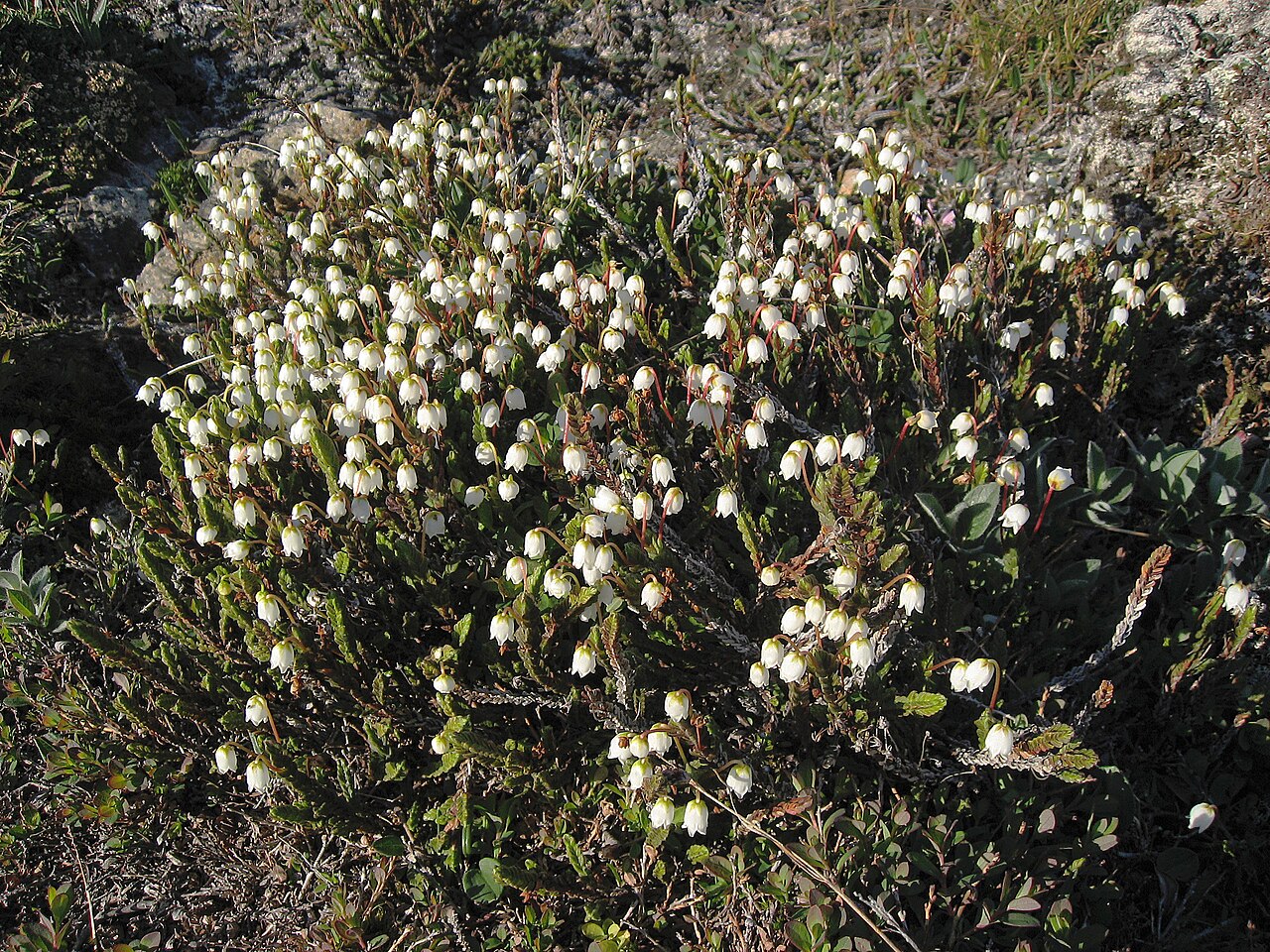
A low, evergreen dwarf shrub forming dense tufts and mats, with many upright to ascending stems 2 to 12 inches tall, branching from a woody base. With their leaves, the stems are about ⅛ to ¼ inch thick and distinctly four-angled. Old leaves stay on the lower stems for years.
Leaves
The leaves are tiny, about ⅛ to 3/16 inch long, thick and leathery, and pressed flat against the stem in four neat rows of opposite pairs. Each leaf has a deep groove running down its back, the key feature that separates it from the Western Moss Heather (C. mertensiana), whose leaves lack the groove. The leaves are dark green and resinous.
Flowers
From June to early August, single flowers hang on slender, reddish stalks from the leaf axils near the tips of the stems, often several per stem. Each is a nodding bell about ¼ inch long, white to creamy white, sometimes tinged pink, with five short, flared lobes and a small reddish calyx at the base.
Fruit & Look-alikes
The fruit is a small, round capsule that turns upright as it ripens and splits to release tiny seeds. Western Moss Heather has a very similar look but grows mostly in the Cascades, Sierra and Coast Mountains and has ungrooved leaves. Mountain heathers such as Pink Mountainheath have needle-like, spreading leaves and pink bells. Alaska moss heather (Harrimanella stelleriana) has spreading leaves and single flowers at the stem tips.
Quick Facts
| Scientific Name | Cassiope tetragona (syn. Andromeda tetragona) |
| Family | Ericaceae (heath family); sometimes placed in Cassiopaceae |
| Plant Type | Evergreen dwarf shrub |
| Mature Height | 2–12 in |
| Mature Spread | 6–24 in, slowly forming mats |
| Growth Rate | Very slow |
| Sun Exposure | Full sun to light shade |
| Water Needs | Moderate; cool, constantly moist but well-drained soil |
| Soil Type | Gritty, peaty or rocky soil |
| Soil pH | Acidic to near neutral (about 4.5–7.0) |
| Bloom Time | June–August |
| Flower Color | White to cream, sometimes pink-tinged |
| Fall Color | Evergreen; dark green to bronze |
| Fruit | Small upright capsule |
| Deer Resistant | Not a concern; rarely browsed |
| USDA Hardiness Zones | 1–5 (requires cool summers and winter snow cover) |
Native Range
Arctic bell-heather is circumpolar and among the most abundant dwarf shrubs of the High Arctic. USDA PLANTS lists it as native in Alaska, Montana and Washington. In Alaska it is widespread on the North Slope, in the Brooks Range, on the western and interior tundra, and in the Alaska Range. In Canada it grows from Yukon, the Northwest Territories and Nunavut to the Arctic islands, Quebec and Labrador, and south in the mountains of British Columbia and Alberta. It also grows in Greenland, Scandinavia, Svalbard and arctic Russia.
The plants of the Rocky Mountains, which extend from Alberta and British Columbia into northwestern Montana (including the Glacier National Park region) and the North Cascades of north-central Washington, are usually treated as a separate variety, var. saximontana. These are outlying, high-elevation populations at the southern edge of the species’ range and are rare in both states.
It grows on tundra, rocky slopes and ridges, moraines, heath and the edges of late snowbeds, often where a protective layer of snow covers it in winter. In the Arctic it dominates large areas of so-called Cassiope heath on moderately moist, acidic ground.
📋 Regional plant lists featuring Arctic Bell-Heather: Alaska · Montana & Wyoming
Growing & Care Guide
Arctic bell-heather is a challenging plant for specialist alpine gardeners. It needs cool summers, steady moisture, acidic soil and reliable winter snow or protection, and it rarely thrives where summers are warm. Plants are occasionally offered by alpine and rock-garden nurseries, along with hybrids between Cassiope species. Never dig plants from the wild, particularly from the rare populations in Montana and Washington.
Light
Full sun in cool climates; in milder areas, light shade or a north-facing position helps keep it cool. In nature it grows in full exposure on the tundra.
Soil & Water
Give it a humus-rich, acidic, gritty mix of peat or leaf mold with sand or fine grit, kept evenly moist but never waterlogged. It must never dry out completely, and it dislikes lime and fertilizer.
Planting Tips
Plant in spring in a peat bed, cool rock garden or trough in a cool, humid spot, ideally on a north-facing slope. It is best suited to zones 1 to 5 with cool summers, such as Alaska and the Pacific Northwest coast at high latitudes. Mulch with fine grit or moss to keep the roots cool.
Pruning & Maintenance
No pruning is needed. Keep it free of fallen leaves and competing plants, and provide a light winter cover of evergreen boughs where snow cover is unreliable.
Propagation
It is propagated from cuttings of current growth taken in summer and rooted in moist peat and sand, or by layering. Its dust-like seed can be sown on the surface of moist, acidic peat, but seedlings are very slow. Nursery propagation is preferable to collecting from the wild.
Landscape Uses
- Peat beds and alpine gardens: for experienced growers in cold, humid climates
- Troughs: a miniature evergreen with charming bells
- Tundra revegetation: native heath cover in Alaska
- Nature study and climate research: its growth rings record past summer temperatures
Wildlife & Ecological Value
Arctic bell-heather is a foundation plant of arctic heath, providing cover, a little forage and early nectar for the insects of the short northern summer.
For Pollinators
Its nodding bells are visited by bumblebees, which hang beneath the flowers to reach the nectar, and by flies and other small insects. The flowers can also self-pollinate, which helps in years when insects are scarce.
For Birds
Ptarmigan and other tundra birds feed in and shelter among its mats, and snow buntings and other ground-nesting birds use its low cover.
For Mammals
It is rarely eaten because of its tough, resinous leaves, though caribou, muskoxen and lemmings may nibble it when other forage is scarce. Its dense mats shelter small mammals.
Ecosystem Role
It forms extensive heath communities on moderately moist tundra, helping build organic soil and holding snow in winter. Like other heaths, it relies on root fungi to take up nutrients from cold, acidic soils.
Cultural & Historical Uses
Linnaeus described the plant in 1753 as Andromeda tetragona, and David Don moved it to the new genus Cassiope in 1834. The genus is named after Cassiopeia, the queen of Greek myth and the constellation, and tetragona means “four-angled,” for its square stems.
Because the stems are resinous and burn hot even when damp, Inuit and other Arctic peoples gathered arctic bell-heather as fuel where wood was unavailable, and it is still used as tinder by travelers in the North.
The plant’s leaves are produced in yearly bands along the stems, so scientists can measure its annual growth and flowering many years back. Researchers in the International Tundra Experiment and other programs have used arctic bell-heather to reconstruct past summer climate and to study how tundra plants respond to warming.
Frequently Asked Questions
How do I tell arctic bell-heather from western moss heather?
Look at the back of the tiny leaves. Arctic bell-heather has a deep groove down the back of each leaf, while western moss heather does not. Western moss heather is also the common species in the Cascades and Sierra, while arctic bell-heather is mainly arctic.
Where does arctic bell-heather grow in the lower 48?
Only in a few high alpine areas in northwestern Montana and northern Washington, where the Rocky Mountain variety (var. saximontana) grows. It is common in Alaska and arctic Canada.
Is arctic bell-heather the same as heather?
No. It is a relative in the heath family, but true heather (Calluna vulgaris) is a European plant. “Heather” is used loosely for several small heath-family shrubs.
Can I grow arctic bell-heather in my garden?
Only in cool, humid climates with acidic, moist, gritty soil. It is a specialist plant for peat beds and rock gardens and usually fails where summers are hot. Buy nursery-propagated plants and never collect from the wild.
Why was it used as fuel?
Its stems and leaves contain resin and burn readily even when damp, which made it a valuable fuel on the treeless tundra.

Looking for a nursery that carries Arctic Bell-Heather?
Browse our native plant nursery directory: Alaska · Montana · Washington

