
Meadow Spikemoss (Selaginella apoda)
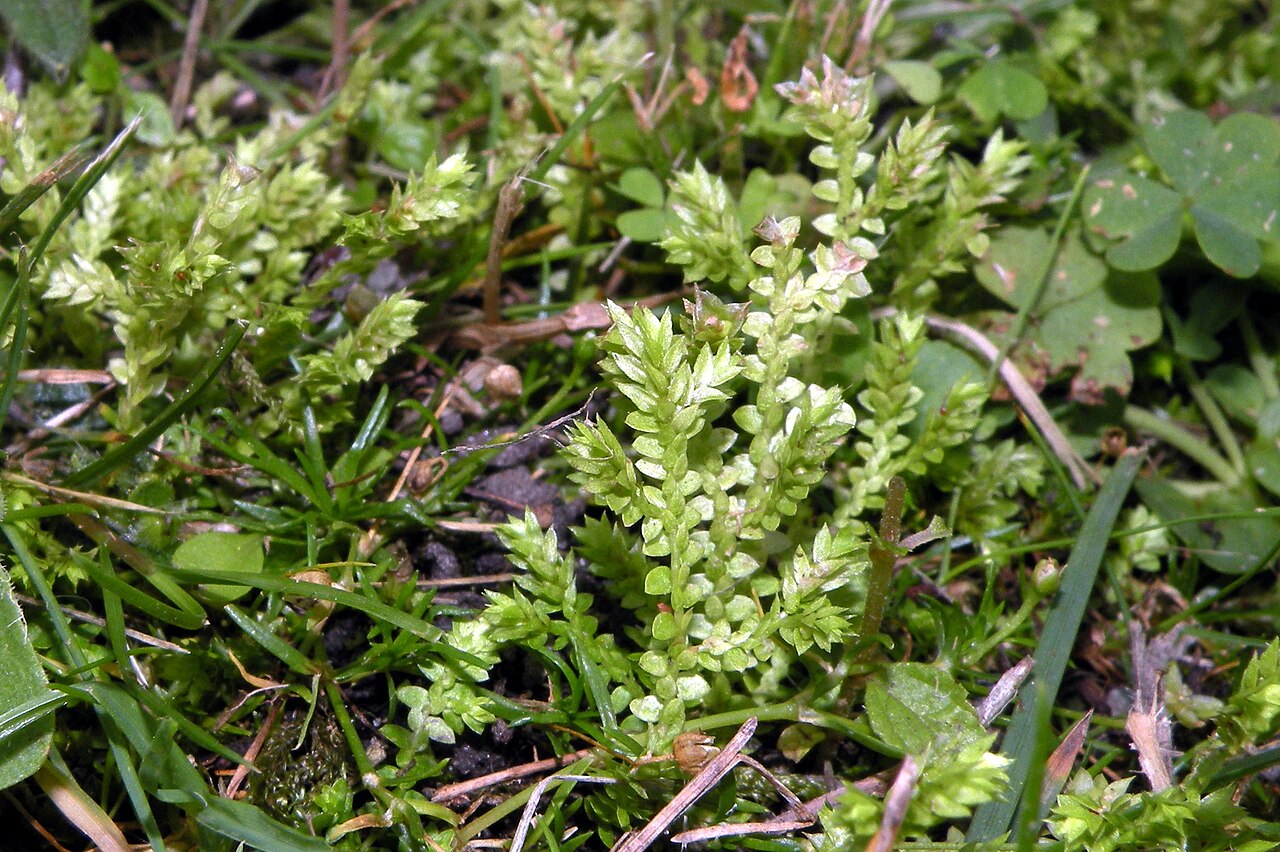
Selaginella apoda, Meadow Spikemoss, also called basket spikemoss or creeping spikemoss, is a tiny, bright green, mat-forming plant of damp ground in the eastern United States. It creeps over wet soil in meadows, seeps, stream banks, swamp edges and, very often, shady and soggy lawns, where most people mistake it for a moss. Its soft, flattened, feathery branches rarely rise more than an inch above the ground.
Spikemosses are not mosses at all. They are lycophytes, an ancient lineage of vascular plants related to clubmosses and quillworts, whose ancestors included the giant scale trees of the coal-age swamps more than 300 million years ago. Like ferns, they have true roots, stems and leaves with veins and reproduce by spores instead of seeds. Unlike ferns, they produce two kinds of spores, large female megaspores and tiny male microspores.
Meadow spikemoss is common and secure across most of its range, and it is the most widespread spikemoss in the eastern lowlands. It has a quiet charm for gardeners who notice it: a soft, living groundcover for wet shade and a popular plant for terrariums. This guide covers how to identify it, where it grows, how to grow it, and its ecological role.
Identification
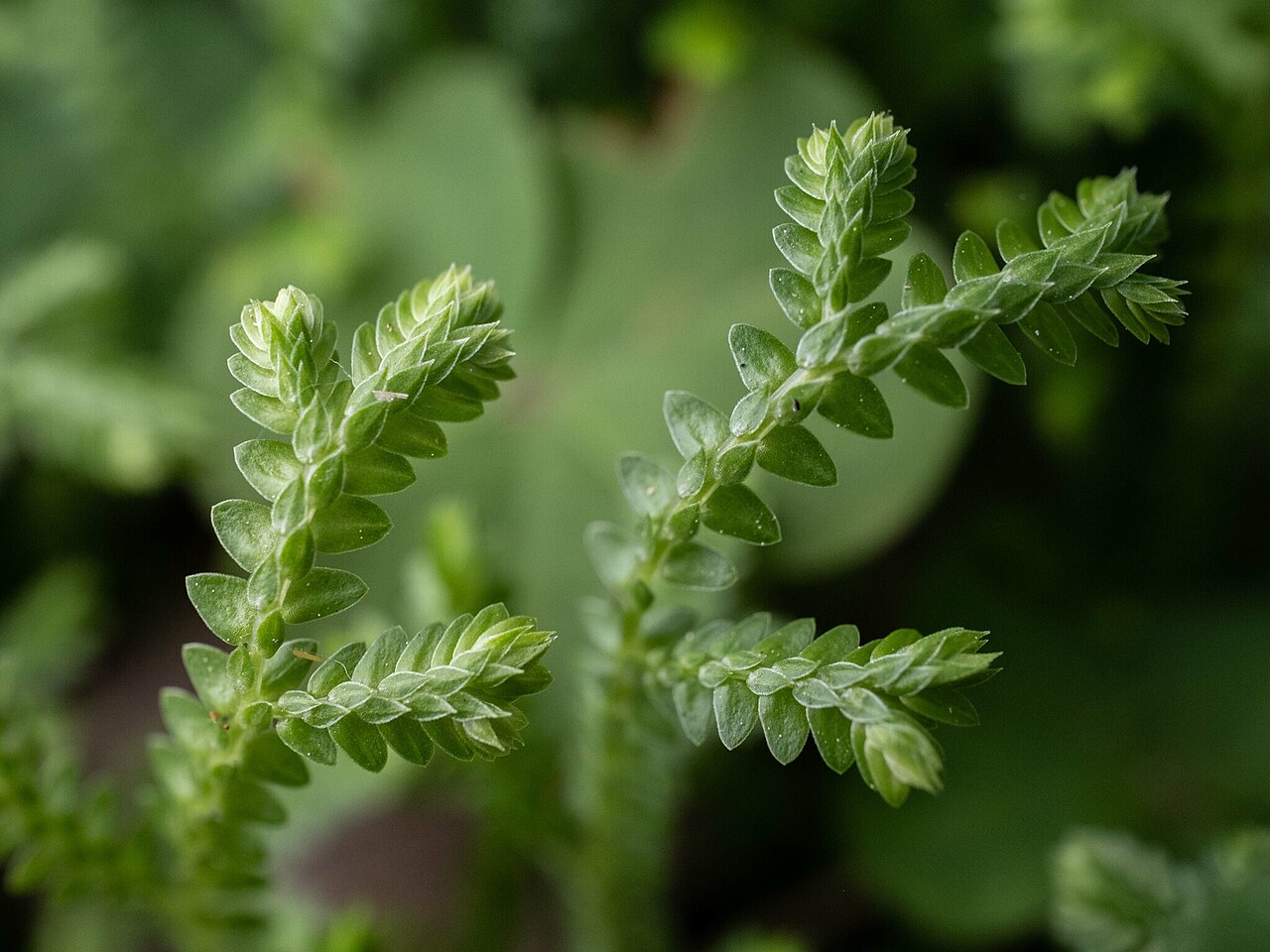
Meadow spikemoss is small enough to overlook, but its branching pattern is distinctive once you get down on your knees. Mosses have tiny leaves arranged all around a non-vascular stem; spikemosses have flattened branches with leaves arranged in four neat rows.
Growth Habit
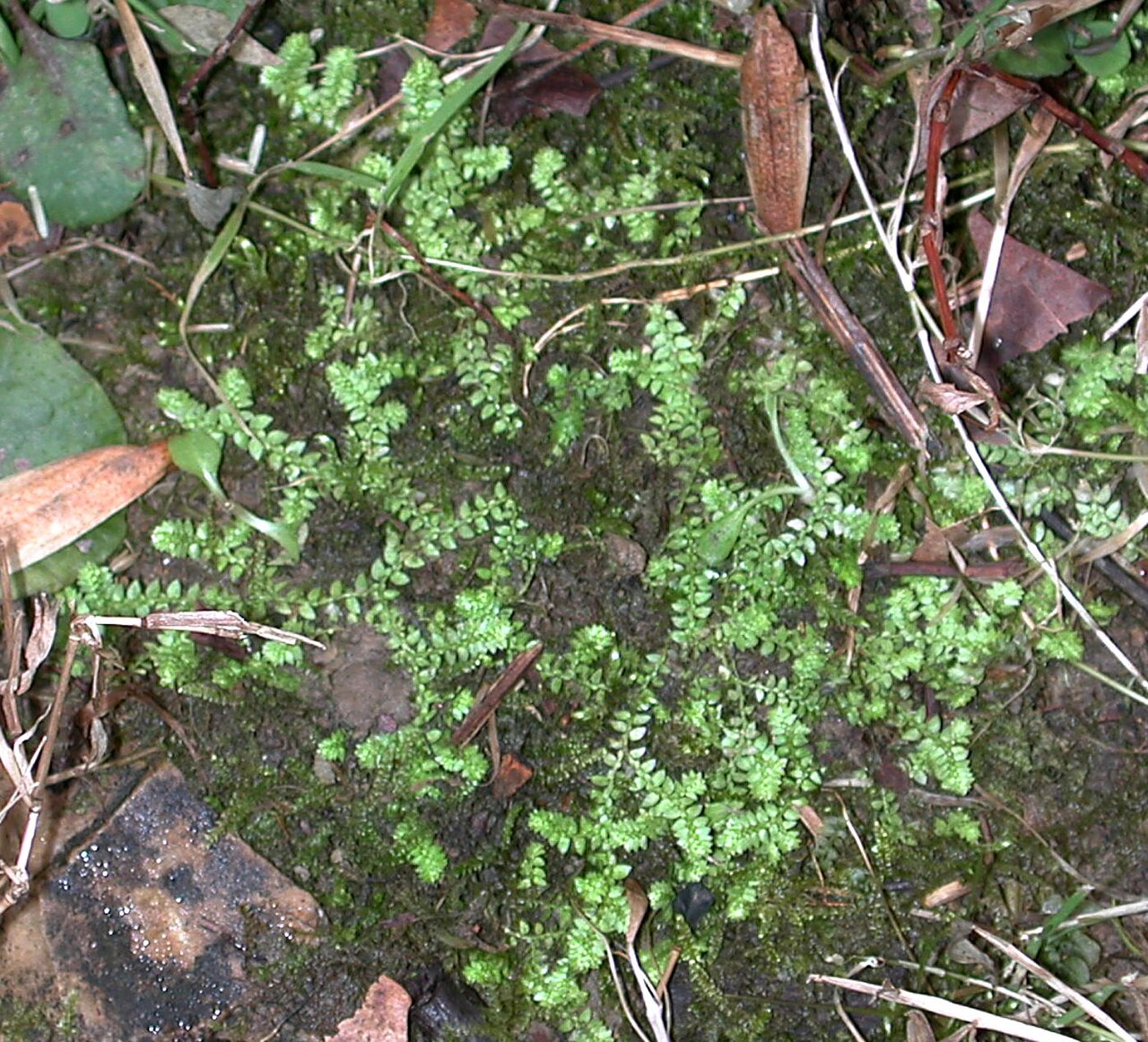
Stems creep along the ground and branch repeatedly, rooting along their length to form loose, flat mats a few inches to a foot or more across. The plant is usually less than an inch tall, though fertile branches may angle upward slightly. It is pale to bright yellow-green and soft to the touch, with no stiff hairs or bristles.
Leaves
The tiny leaves are of two sizes. Two rows of larger lateral leaves, each about 1/16 to ⅛ inch long, spread flat to the sides; two rows of much smaller median leaves lie pressed along the upper surface of the stem. Leaf margins are minutely toothed under a hand lens, and the leaves lack the long hair-like tip found in rock spikemoss (S. rupestris), a dry-rock species with leaves arranged all around the stem.
Strobili & Spores
Spores are produced in small, four-sided cones called strobili at the tips of the branches. They are only about ¼ to ¾ inch long and hardly wider than the branches, so they are easy to miss. Each strobilus contains both megasporangia, which hold four large female spores, and microsporangia, which hold hundreds of tiny male spores. Spores mature from late spring to fall.
Similar Species
In the Southeast, plants with more erect, less flattened branches are sometimes separated as Gulf spikemoss (S. apoda var. ludoviciana or S. ludoviciana). Hidden spikemoss (S. eclipes), of the Midwest and Northeast, differs in minute details of its leaves and is best separated with a microscope. Mosses differ in lacking the four-rowed leaf arrangement and producing spores in capsules on stalks.
Quick Facts
| Scientific Name | Selaginella apoda (syn. S. apus; Lycopodium apodum) |
| Family | Selaginellaceae (spikemoss family) |
| Plant Type | Mat-forming evergreen to semi-evergreen lycophyte (fern ally) |
| Mature Height | Under 1 in |
| Mature Spread | Mats 3–12+ in across |
| Growth Rate | Moderate |
| Sun Exposure | Part shade to full shade; full sun if soil stays wet |
| Water Needs | High; soil must stay moist to wet |
| Soil Type | Moist to wet loam, clay, sand or muck |
| Soil pH | About 5.0–7.5 |
| Bloom Time | None; produces spores late spring to fall |
| Flower Color | None (spore-bearing strobili, green) |
| Fall Color | Stays green; may brown in hard freezes |
| Fruit | None; reproduces by spores |
| Deer Resistant | Yes |
| USDA Hardiness Zones | 5–9 |
Native Range
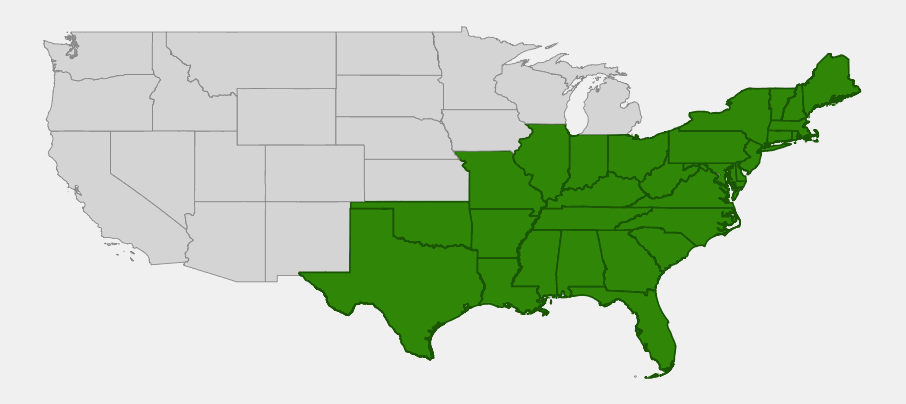
Meadow spikemoss is native across the eastern United States. USDA PLANTS records it from Maine, New Hampshire and Vermont south through the Atlantic states to Florida, and west through the Ohio Valley and the South to Illinois, Missouri, Oklahoma and eastern Texas. It also occurs in the District of Columbia.
It is most common on the Coastal Plain and Piedmont of the Southeast and in the Ohio and Mississippi valleys. In northern New England and at the western edge of its range it becomes scarce, and it is considered rare in some states at the margins of its distribution.
In the wild it grows in moist to wet open or lightly shaded places: wet meadows, seeps, spring runs, stream and river banks, floodplain forests, swamp and marsh edges, ditches and damp lawns. It often appears where the soil stays wet and the competing vegetation is kept short by mowing, flooding or grazing.
📋 Regional plant lists featuring Meadow Spikemoss: North & South Florida · Alabama, Georgia & Mississippi · North & South Carolina · Maryland, Virginia & West Virginia · Kentucky & Tennessee · Arkansas, Louisiana, Eastern Oklahoma & Eastern Texas · Illinois, Iowa & Missouri · Ohio & Indiana · New York, Pennsylvania & Northern New Jersey · Delaware, Southern New Jersey & Long Island · Connecticut, Massachusetts & Rhode Island · New Hampshire, Maine & Vermont · South & West Texas
Growing & Care Guide
Meadow spikemoss is easy to grow wherever the soil stays consistently moist, and it often arrives on its own in damp, shady lawns. It is also sold as a terrarium and dish-garden plant. Buy nursery-grown plants, or let it spread naturally in your garden; there is no need to dig it from the wild.
Light
Part shade to full shade suits it best. It tolerates full sun only where the soil stays wet all season, as in seeps and wet meadows. Indoors, give it bright indirect light.
Soil & Water
Keep the soil evenly moist to wet at all times; it shrivels quickly in dry soil and dry air. It grows in loam, clay, sand or muck. In a terrarium, use a moisture-retentive mix of peat-free potting soil with some sand and keep humidity high.
Planting Tips
Press small mats or rooted pieces into damp soil in spring or fall, firming them in so the stems touch the soil. Plant among stepping stones, along the edges of a pond or rain garden, or beneath taller wetland perennials as a living mulch. Keep it free of leaf litter, which can smother it.
Pruning & Maintenance
No pruning is needed. In a lawn it tolerates mowing because it grows below the blade height. Avoid herbicides and heavy fertilizer, which favor turfgrass and weeds.
Propagation
Divide mats at any time during the growing season and press the pieces into moist soil; they root along the stems. Growing from spores is possible but slow and is best left to specialists.
Landscape Uses
- Wet shade groundcover: a soft, living carpet between stepping stones and under ferns in damp shade
- Rain gardens and pond edges: fills gaps at the wet margins where few other low plants persist
- Moss and fern gardens: adds fine texture alongside true mosses, sedges and small ferns
- Terrariums and dish gardens: one of the best native plants for a closed terrarium
- Lawn alternative patches: welcome it in soggy, shady parts of a lawn instead of fighting it
Wildlife & Ecological Value
Meadow spikemoss is a small plant with a modest but real place in wet ecosystems.
For Pollinators
As a spore-producing plant, it has no flowers and provides no nectar or pollen. Its mats shelter tiny invertebrates such as springtails, mites and small beetles that live in the damp soil surface.
For Birds
It has no direct food value for birds, although ground-foraging birds such as thrushes and wrens pick insects from the damp soil and vegetation where it grows.
For Mammals
It is not eaten in any quantity by mammals. Deer and rabbits ignore it.
Ecosystem Role
Its creeping mats help hold bare, wet soil in place on stream banks, seeps and ditch edges and keep the soil surface moist and shaded. Spikemosses are also living links to some of the oldest lineages of land plants, and they are studied by botanists interested in the evolution of roots, leaves and seeds.
Cultural & Historical Uses
Linnaeus described this plant in 1753 as Lycopodium apodum, placing it with the clubmosses. It was later moved to Selaginella, and for much of the 20th century American botanists called it Selaginella apus; both come from the Greek apous, footless or stalkless, probably for the stalkless cones.
There is little record of human use of meadow spikemoss. Its cultural role is mainly as a terrarium and greenhouse plant. It has been grown in botanical garden conservatories in Europe and North America for well over a century, often spreading as a groundcover beneath tropical plants.
For naturalists, spikemosses are a gateway to the world of fern allies. The genus Selaginella has more than 700 species worldwide, from desert “resurrection plants” that curl up when dry to tropical forest species with iridescent blue leaves. Meadow spikemoss is the one most eastern Americans can find closest to home, sometimes in their own backyard.
Frequently Asked Questions
Is meadow spikemoss a moss?
No. Despite the name, it is a vascular plant in the lycophyte group, more closely related to clubmosses than to true mosses. It has true roots, stems and veined leaves and reproduces by spores produced in tiny cones.
Why is meadow spikemoss growing in my lawn?
It thrives where the soil is constantly damp and the grass is thin, typically in shady, poorly drained spots. It is harmless to grass and a native plant, so you can simply let it be. If you prefer turf, improve drainage and light.
Can meadow spikemoss be grown in a terrarium?
Yes. It is one of the most popular native terrarium plants. Give it bright indirect light, constantly moist soil and high humidity.
Is meadow spikemoss rare?
It is common across most of the eastern United States, but it is scarce at the edges of its range and may be listed as rare in a few northern states.
How does meadow spikemoss reproduce?
It spreads by creeping, rooting stems and reproduces by two kinds of spores, large megaspores and tiny microspores, produced in small four-sided cones at the branch tips.

Looking for a nursery that carries Meadow Spikemoss?
Browse our native plant nursery directory: Alabama & Arkansas · Connecticut, Delaware, Florida & Georgia · Illinois & Indiana · Kentucky, Louisiana, Maine, Maryland, Massachusetts, Mississippi & Missouri · New Hampshire, New Jersey, New York, North Carolina, Ohio & Oklahoma · Pennsylvania, Rhode Island, South Carolina, Tennessee, Texas, Vermont & Virginia · West Virginia

