
Rock Spikemoss (Selaginella rupestris)
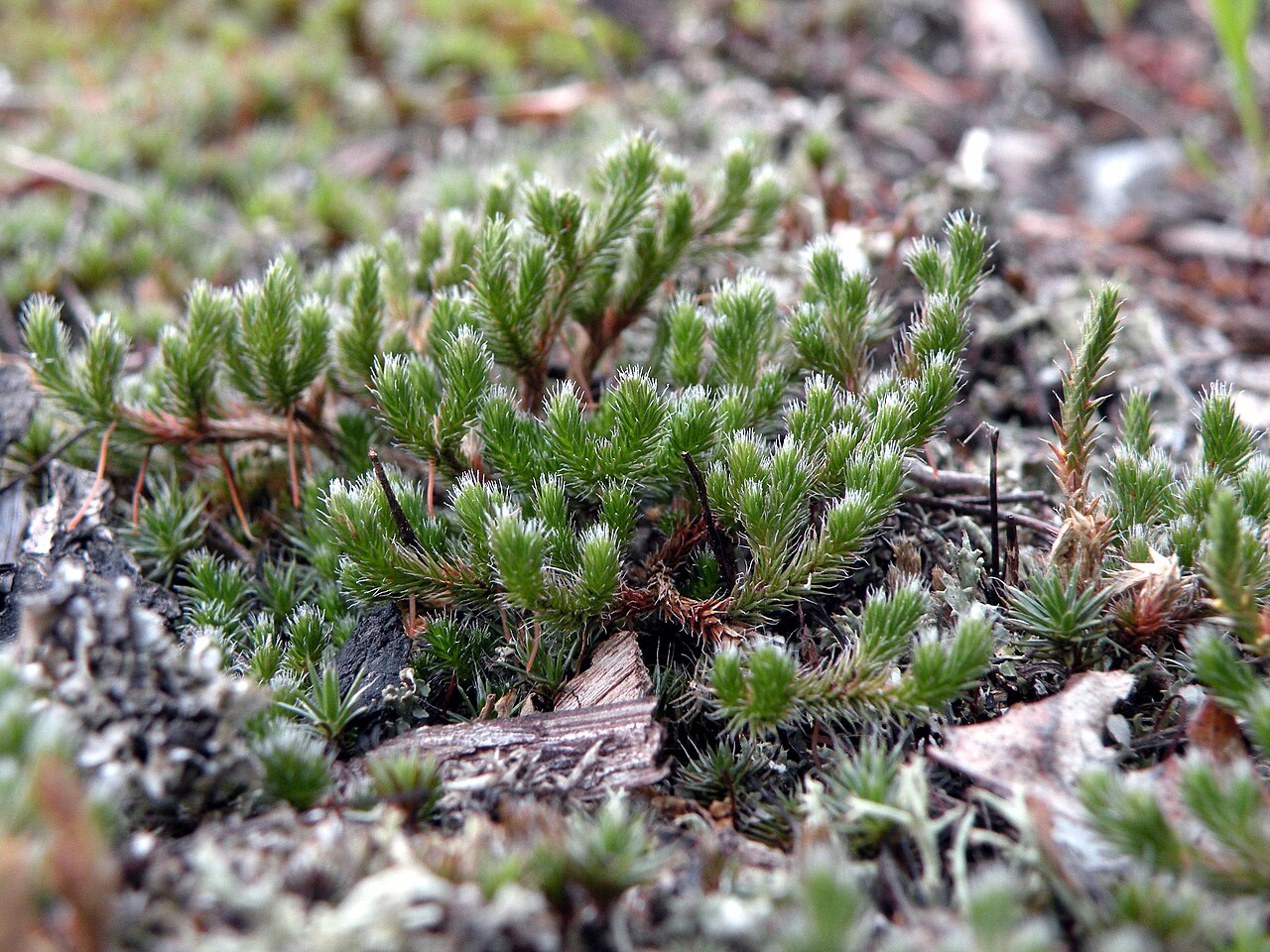
Selaginella rupestris, known as Rock Spikemoss, ledge spikemoss or northern selaginella (the USDA name), is a tiny, mat-forming native plant of dry rock outcrops, ledges and sandy barrens across eastern and central North America. It looks like a coarse, gray-green moss, forming low cushions only an inch or two tall of creeping stems covered in minute, bristle-tipped leaves. When it dries out it curls and turns grayish brown, then greens up again after rain.
Despite its name and looks, it is not a moss. Spikemosses belong to the lycophytes, an ancient group of vascular plants that also includes the clubmosses and quillworts, with origins more than 400 million years ago. Like ferns, spikemosses reproduce by spores rather than seeds, but they produce two kinds of spores, large and small, an unusual trait among living plants. The species name rupestris means “growing on rocks.”
Its range stretches from the Atlantic coast to the northern Great Plains, but it is local and patchy, confined to dry, open, rocky or sandy places. This guide covers how to identify rock spikemoss, where it grows, whether it can be grown in gardens, and its role as a pioneer on bare rock.
Identification
Rock spikemoss forms flat or cushion-like mats on thin soil over rock or on sand. Look closely for tiny, overlapping, needle-like leaves arranged all around the stem, each with a whitish hair at its tip, which give the mats a frosted gray-green look.
Growth Habit
It is a small evergreen perennial with creeping, branching stems that root along their length and form dense mats or tufts. The upright branch tips are usually only 1 to 2 inches tall. Mats may cover a few inches to a foot or more of rock or sand.
Leaves
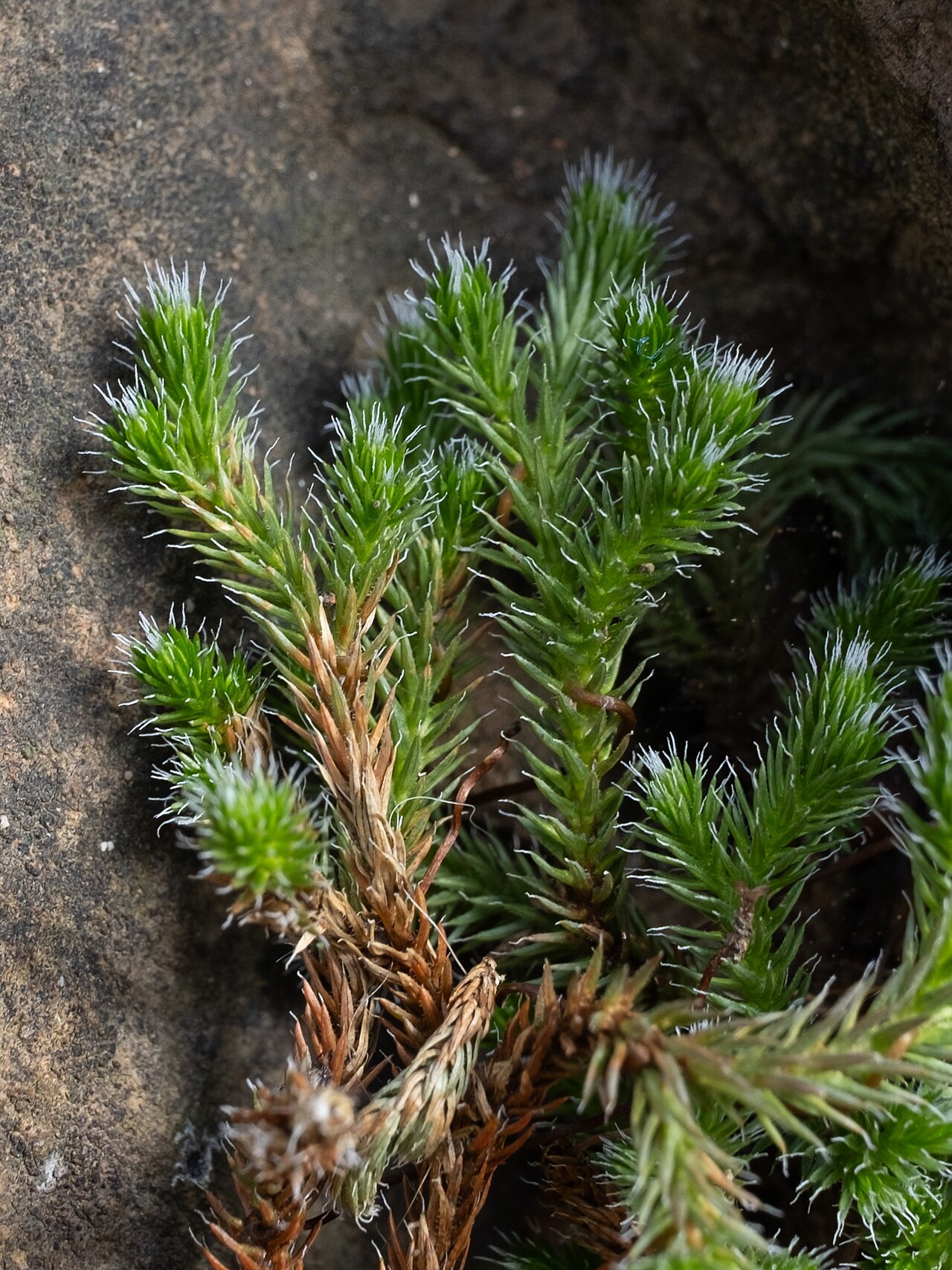
The leaves are very small (about 1/8 inch long), narrow and stiff, and spirally arranged all around the stem so that they overlap like scales. Each leaf has a groove on its back and ends in a fine, whitish bristle. The bristles give the mats a grayish sheen, especially when dry. Unlike many spikemosses, the leaves are all alike, not arranged in flattened ranks.
Spore Cones
Spores are produced in small, four-sided cones (strobili) at the tips of upright branches, about 1/4 to 1 inch long and a little paler than the rest of the plant. The cones bear two kinds of spore cases: some with many tiny microspores and some with a few large, yellowish megaspores. The cones mature mainly in summer and fall.
Drought Response
In dry weather the branches curl inward and the mats turn dull gray-brown and look dead. After rain they absorb water, unroll and turn green again within hours, an adaptation that lets the plant survive long periods without water on bare rock.
Look-alikes
Mosses such as haircap moss can look similar, but they have softer, thinner leaves without a groove and produce spore capsules on stalks rather than cones. Lesser spikemoss (Selaginella densa) replaces this species on the western Great Plains and in the Rocky Mountains and is very similar; Wallace’s spikemoss and bushy spikemoss are related western species. In the Southeast, sand spikemoss (Selaginella arenicola) and twisted-hair spikemoss (Selaginella tortipila) are similar relatives, separated by technical features of the leaves and spores. Meadow spikemoss (Selaginella apoda) grows in moist places and has flat, two-ranked leaves.
Quick Facts
| Scientific Name | Selaginella rupestris (L.) Spring |
| Family | Selaginellaceae (spikemoss family) |
| Plant Type | Evergreen, mat-forming lycophyte (spore-bearing, fern ally) |
| Mature Height | 1–2 in |
| Mature Spread | 4–12 in mats; slowly spreading |
| Growth Rate | Slow |
| Sun Exposure | Full sun to part shade |
| Water Needs | Very low; withstands long drought |
| Soil Type | Thin soil over rock, rock crevices, dry sand and gravel |
| Soil pH | Acidic to neutral (about 4.5–7.0) |
| Bloom Time | None (non-flowering); spore cones mature in summer and fall |
| Flower Color | None; gray-green foliage |
| Fall Color | Evergreen; gray-brown when dry |
| Fruit | None; spores in small four-sided cones |
| Deer Resistant | Yes; rarely browsed |
| USDA Hardiness Zones | 3–8 |
Native Range
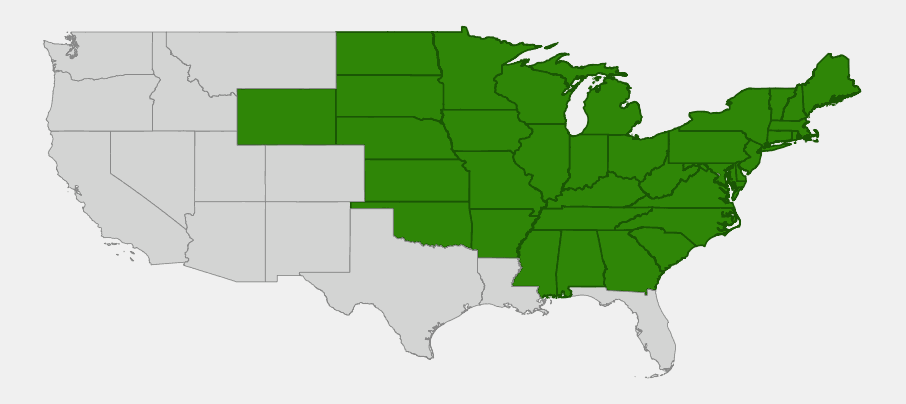
Rock spikemoss is native to eastern and central North America. USDA PLANTS lists it in 35 states, from Maine to Georgia and Mississippi and west to Minnesota, the Dakotas, Nebraska, Kansas, Oklahoma and Wyoming, as well as in eight Canadian provinces from Nova Scotia and New Brunswick to Alberta and British Columbia. A single locality is also known from Greenland.
Although its range is wide, it is sporadic, occurring only where suitable dry, open, rocky or sandy habitat exists. It is most frequent in New England, the Great Lakes region, the Appalachians and the Ozarks, and becomes rare toward the edges of its range. In Indiana, for example, it is listed as a threatened species. On the northern Plains it grows on rocky outcrops and in the Black Hills.
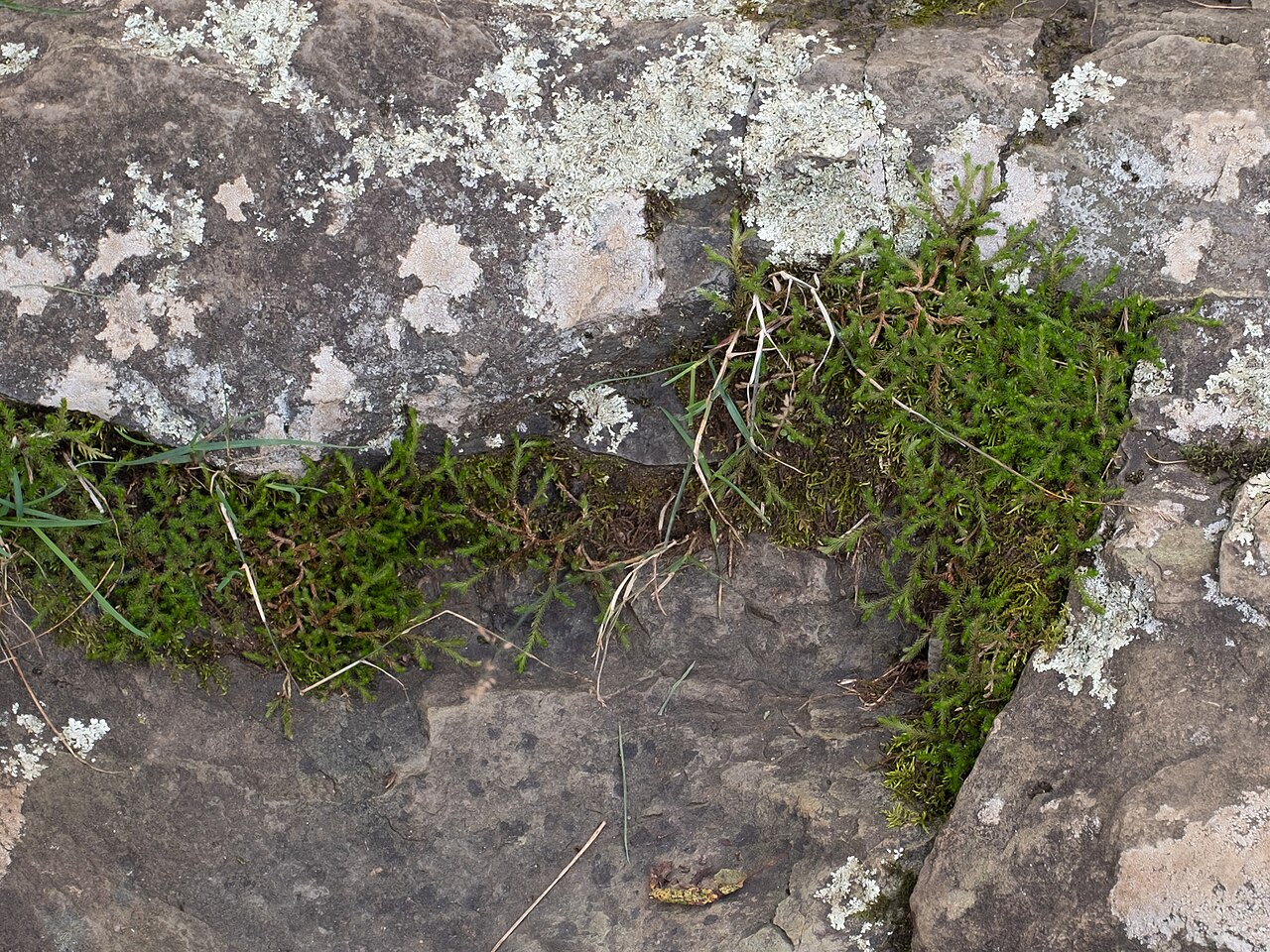
It grows on exposed granite, gneiss, sandstone and other acidic rock outcrops and ledges, in crevices and on thin soil over rock, on dry sandy barrens, sand prairies and dunes, and in openings in pine and oak barrens. It needs open, sunny sites with little competition from taller plants.
📋 Regional plant lists featuring Rock Spikemoss: New York, Pennsylvania & Northern New Jersey · Ohio & Indiana · Montana & Wyoming · Michigan, Wisconsin & Eastern Minnesota · Kentucky & Tennessee · Nebraska, Kansas & Eastern Colorado · Connecticut, Massachusetts & Rhode Island · New Hampshire, Maine & Vermont · Maryland, Virginia & West Virginia · Delaware, Southern New Jersey & Long Island · Illinois, Iowa & Missouri · Alabama, Georgia & Mississippi · North & South Carolina · Arkansas, Louisiana, Eastern Oklahoma & Eastern Texas · North Dakota, South Dakota & Western Minnesota
Growing & Care Guide
Rock spikemoss is a fascinating plant to find in the wild but a challenging one to grow, and it is almost never sold. It is best appreciated where it grows naturally. It is rare or protected in some states, so never dig it or peel mats from rocks: wild mats grow very slowly, are easily damaged and seldom survive transplanting.
Light
In the wild it grows in full sun or light shade on open rock. Shade from taller plants, fallen leaves or moss gradually crowds it out.
Soil & Water
It needs a lean, very well-drained, acidic medium, such as thin sandy or gritty soil over rock. It tolerates long droughts but suffers in constantly wet or rich soil and where leaf litter collects on it.
Planting Tips
Experienced rock gardeners occasionally grow spikemosses in troughs, on tufa or in crevice gardens with gritty, acidic mix. If you have it on your property, the best care is to protect the outcrop: keep foot traffic, leaf piles and invasive plants off the mats.
Pruning & Maintenance
No pruning is needed. Gently remove fallen leaves that cover the mats in fall. Avoid walking on mats, which break easily, especially when dry.
Propagation
In cultivation, spikemosses are usually propagated by small cuttings of rooted stem pieces from nursery plants, pressed onto gritty mix and kept lightly moist and shaded until they root. Growing from spores is difficult and rarely attempted. Do not collect from wild populations.
Landscape Uses
- Nature study: a living example of the ancient lycophyte lineage
- Rock and crevice gardens: for specialists, using nursery-propagated material only
- Outcrop conservation: a characteristic plant of dry rock and barrens habitats
- Education: shows how plants survive drought by drying out and reviving
- Habitat indicator: marks undisturbed, open rock outcrop and sand barren communities
Wildlife & Ecological Value
Rock spikemoss is small but plays a real part in the harsh environment of bare rock and sand, helping build soil and shelter tiny organisms.
For Pollinators
As a spore-bearing plant, rock spikemoss has no flowers and offers no nectar or pollen. The mats do shelter small insects, mites and spiders that live on rock outcrops, and some ground-nesting insects nest in nearby sand.
For Birds
Birds make little direct use of it, though ground-foraging birds may pick insects from the mats and the surrounding rock.
For Mammals
The tough, wiry plants are rarely eaten by mammals. Small mammals and reptiles may shelter in the rock crevices where it grows.
Ecosystem Role
Rock spikemoss is a pioneer on bare rock and sand. Together with lichens and mosses, its mats trap windblown dust, sand and organic matter, gradually building the thin soil that allows grasses, wildflowers and eventually shrubs to take hold. It is part of distinctive outcrop and barrens communities that are often home to rare plants and insects, and that are threatened by trampling, quarrying, development and fire suppression.
Cultural & Historical Uses
Linnaeus first described this plant in 1753 as Lycopodium rupestre, placing it with the clubmosses. In the nineteenth century the Belgian botanist Antoine Frédéric Spring transferred it to Selaginella, a genus that now includes several hundred species worldwide, most of them in the tropics.
Spikemosses and their relatives are survivors of a lineage that once included giant tree-like lycophytes, whose remains formed much of the world’s coal. Their two-spore reproduction is an early step in the evolution of seeds, which makes humble plants like rock spikemoss of special interest to botanists and teachers.
Because it curls up and looks dead when dry, then revives after rain, rock spikemoss is sometimes compared to the famous resurrection plant of the Chihuahuan Desert, Selaginella lepidophylla, a relative. For hikers on granite ledges and sand barrens, its frosted gray-green mats are a reminder to tread lightly on fragile outcrop communities.
Frequently Asked Questions
Is rock spikemoss a moss?
No. Despite its moss-like look, it is a lycophyte, a vascular plant related to clubmosses and quillworts. It has true roots, stems and leaves with veins, and it reproduces by spores in cones.
Why does it look dead in dry weather?
It curls up and turns gray-brown to reduce water loss during drought. After rain it absorbs water, unrolls and turns green again within hours.
Where does rock spikemoss grow?
On dry, open rock outcrops, ledges, crevices and sandy barrens across eastern and central North America, from Maine and Georgia to the Dakotas and Wyoming.
Can I grow rock spikemoss?
It is rarely sold and difficult to grow. Specialists sometimes grow spikemosses in troughs or crevice gardens with gritty, acidic soil. Never dig or peel mats from the wild.
Is rock spikemoss rare?
It is widespread and secure overall, but local and sporadic, and it is rare or protected in some states, such as Indiana, where it is listed as threatened.

Looking for a nursery that carries Rock Spikemoss?
Browse our native plant nursery directory: Alabama & Arkansas · Connecticut, Delaware & Georgia · Illinois, Indiana, Iowa & Kansas · Kentucky, Maine, Maryland, Massachusetts, Michigan, Minnesota, Mississippi & Missouri · Nebraska, New Hampshire, New Jersey, New York, North Carolina, North Dakota, Ohio & Oklahoma · Pennsylvania, Rhode Island, South Carolina, South Dakota, Tennessee, Vermont & Virginia · West Virginia, Wisconsin & Wyoming

