
Wallace’s Spikemoss (Selaginella wallacei)
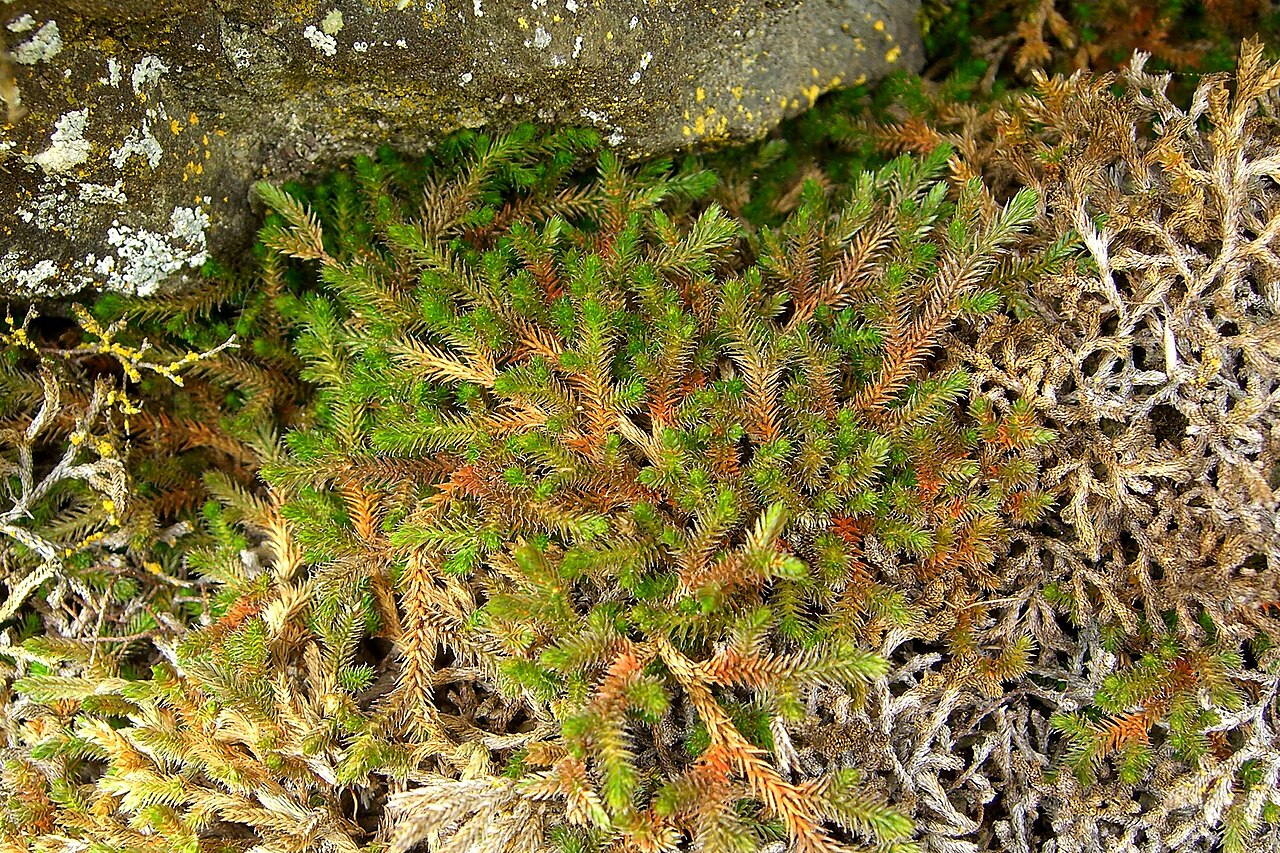
Selaginella wallacei, known as Wallace’s Spikemoss, is a small, mat-forming plant of rocky outcrops, cliffs and thin soils in western North America, from southern British Columbia south through Washington and Oregon to northern California and east to Idaho and western Montana. Its creeping stems are clothed in tiny, overlapping, bristle-tipped leaves, forming loose green to gray-green carpets over rock and gravel.
Despite its name, a spikemoss is not a moss, and it is not a true fern either. It is a lycophyte, a member of one of the oldest surviving groups of vascular plants, related to clubmosses and quillworts. Unlike mosses it has true roots and internal water-conducting tissue, and unlike ferns it has tiny single-veined leaves and produces spores in small cone-like spikes at the tips of its branches.
Wallace’s spikemoss is a quiet but important member of rocky habitats, helping to hold thin soils on balds, ledges and outcrops alongside lichens, mosses and wildflowers. It grows very slowly and is easily damaged. This guide covers how to identify it, where it grows, why it is rarely cultivated, and its role in rocky ecosystems. Never strip spikemoss mats from rocks: they take many years to form and do not survive being moved.
Identification
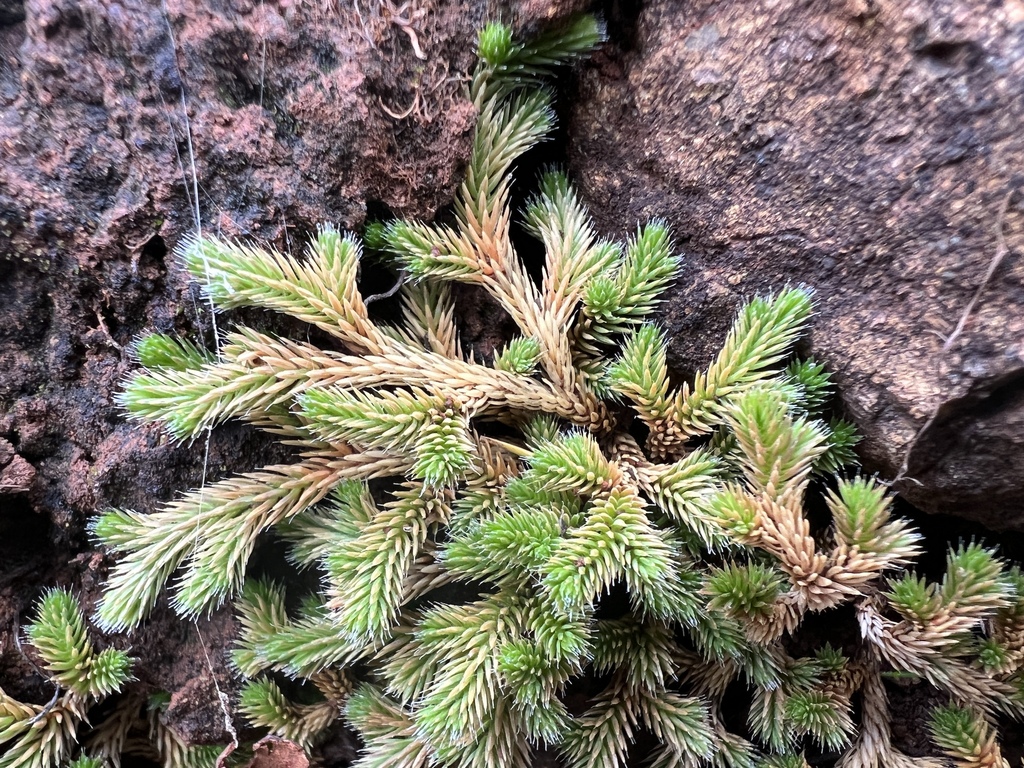
Wallace’s spikemoss is easy to mistake for a moss. Look closely, ideally with a hand lens: the stems are branched and creeping, the leaves are arranged all around the stem and end in a whitish bristle, and in season the branch tips carry four-sided spore-bearing spikes.
Stems & Growth Habit
The stems creep along the surface of rock or soil, branching repeatedly and rooting at intervals, with upright or ascending branch tips. Together they form loose to fairly dense mats, usually less than 2 inches tall but often a foot or more across. Mats are green when moist and turn grayish or brownish and curl when dry, then green up again after rain.
Leaves
The leaves are tiny, narrow and stiff, only a few millimeters long, set closely in spirals around the stem so that each branch looks like a small bottlebrush. Each leaf has a single vein, a groove on the underside and a short, whitish to translucent bristle at the tip, which gives the mats a frosted look. The leaf edges carry tiny hairs, visible with a hand lens.
Spore Spikes
Spikemosses reproduce by spores, not seeds or flowers. The spores form in small, four-sided cone-like spikes (strobili) at the tips of some branches. Like all Selaginella, Wallace’s spikemoss produces two kinds of spores in the same spike: tiny microspores and much larger megaspores, which develop into separate male and female generations. This two-spore system is one way lycophytes differ from ferns and mosses.
Roots
Unlike mosses, which only have hair-like rhizoids, spikemosses have true roots. In Selaginella they grow from special leafless branches called rhizophores that grow down from the stems and anchor the mat in rock crevices and thin soil.
Look-alikes
Several other spikemosses grow in the West. Compact spikemoss (Selaginella densa) forms tighter, cushion-like mats and is the common species of the Rocky Mountains and high plains. Oregon spikemoss (Selaginella oregana) hangs in long strands from trees and rocks in very wet coastal forests. Bushy spikemoss (Selaginella bigelovii) of southern California has more upright, bushy stems. Telling them apart reliably often needs a hand lens and attention to leaf bristles and hairs. True mosses lack the stiff, bristle-tipped, spirally arranged leaves and the four-sided spore spikes.
Quick Facts
| Scientific Name | Selaginella wallacei Hieron. |
| Family | Selaginellaceae (spikemoss family); a lycophyte |
| Plant Type | Evergreen, mat-forming lycophyte (spore-bearing; not a moss or a true fern) |
| Mature Height | Under 2 in |
| Mature Spread | Mats a few inches to 1 ft or more |
| Growth Rate | Very slow |
| Sun Exposure | Full sun to part shade |
| Water Needs | Low; tolerates long dry spells by going dormant |
| Soil Type | Rock surfaces, crevices, ledges and thin, gravelly or sandy soils |
| Soil pH | Acidic to near neutral rock and soil |
| Bloom Time | Does not flower; spores in small terminal spikes |
| Flower Color | None |
| Fall Color | Gray-green to brownish when dry; greens up after rain |
| Fruit | None; reproduces by spores |
| Deer Resistant | Not browsed to any notable extent |
| USDA Hardiness Zones | 5–9 |
Native Range
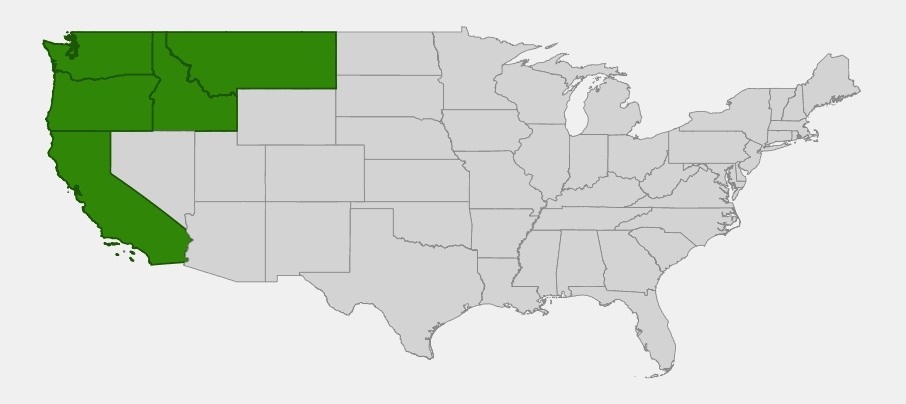
Wallace’s spikemoss is a plant of the Pacific Northwest and the northern Rocky Mountains. USDA PLANTS lists it as native to California, Idaho, Montana, Oregon and Washington, and it also grows in southern British Columbia, Canada.
West of the Cascades it is common on rocky balds, outcrops and cliffs, from the San Juan Islands and the Puget Sound region through the Willamette Valley foothills and the Columbia River Gorge to southwestern Oregon and northwestern California. It also grows east of the Cascades on basalt outcrops, rocky slopes and dry, lichen-covered ground in eastern Washington and Oregon, and it extends east into northern Idaho and western Montana.
Its habitats are open, rocky and often dry: rock outcrops and ledges, talus, cliff faces, thin soils over bedrock, and gravelly openings in oak and conifer woodlands, from near sea level to moderate elevations in the mountains. It is often found growing with lichens, mosses, stonecrops and spring wildflowers that also depend on shallow soils.
📋 Regional plant lists featuring Wallace’s Spikemoss: Idaho, Eastern Oregon & Eastern Washington · Montana & Wyoming · Western Oregon & Western Washington · California & Nevada
Growing & Care Guide
Wallace’s spikemoss is almost never sold, and it is not an easy garden plant. It grows very slowly, depends on the particular conditions of rock surfaces and thin soils, and rarely survives being moved. The best way to enjoy it is to protect it where it grows, including on rock outcrops in your own property, and to see it in the wild on rocky balds and ledges.
Light
In the wild it grows in full sun on open balds and in part shade on rock faces and woodland edges. Where it already grows, avoid shading it heavily with new plantings or letting invasive shrubs such as Scotch broom and Himalayan blackberry overgrow the rock.
Soil & Water
It needs rock, gravel or very thin, well-drained soil. It survives summer drought by drying out and going dormant, then revives with fall and winter rains. Do not add soil, compost, fertilizer or irrigation to areas where it grows; these favor weeds and grasses that smother it.
Planting Tips
Do not buy or collect spikemoss mats taken from the wild, and never peel mats off rocks for terrariums, crafts or rock gardens. Stripped mats almost always die, and the rock surface may take decades to be recolonized. If you have a natural outcrop with spikemoss, the best garden plan is to leave it undisturbed and keep foot traffic off it.
Pruning & Maintenance
No pruning or maintenance is needed. Protect existing mats from trampling, mowing, pressure washing and moss-removal treatments. On shared rocky balds, staying on trails keeps the thin spikemoss and lichen crust intact.
Propagation
In nature it spreads slowly by creeping stems and by spores. Spikemosses are seldom propagated even by specialists; small cuttings can sometimes be rooted on gritty mix in cool, humid conditions, but this should only be done with material from an existing cultivated plant or from salvage on a site about to be destroyed, never from healthy wild mats.
Landscape Uses
- Rock outcrop conservation: protecting existing mats on natural rock on your property
- Where to see it: rocky balds, ledges and outcrops from the San Juan Islands to the Columbia River Gorge
- Habitat restoration: an indicator of intact rocky bald and outcrop communities
- Nature study: a living example of the ancient lycophyte lineage
- Educational gardens: for interpretation of plant evolution, using only legally obtained material
Wildlife & Ecological Value
Wallace’s spikemoss is small, but on bare rock and thin soil it is a foundation plant.
For Pollinators
Spikemosses do not flower, so they offer no nectar or pollen. They do shelter many tiny invertebrates, such as mites, springtails and small insects, within their mats.
For Birds
Birds do not eat spikemoss, but some species pick insects and other small invertebrates from the mats and from the rock surfaces they cover.
For Mammals
Mammals rarely eat spikemoss. Small mammals and reptiles may use rock outcrops with spikemoss mats as cover and basking sites.
Ecosystem Role
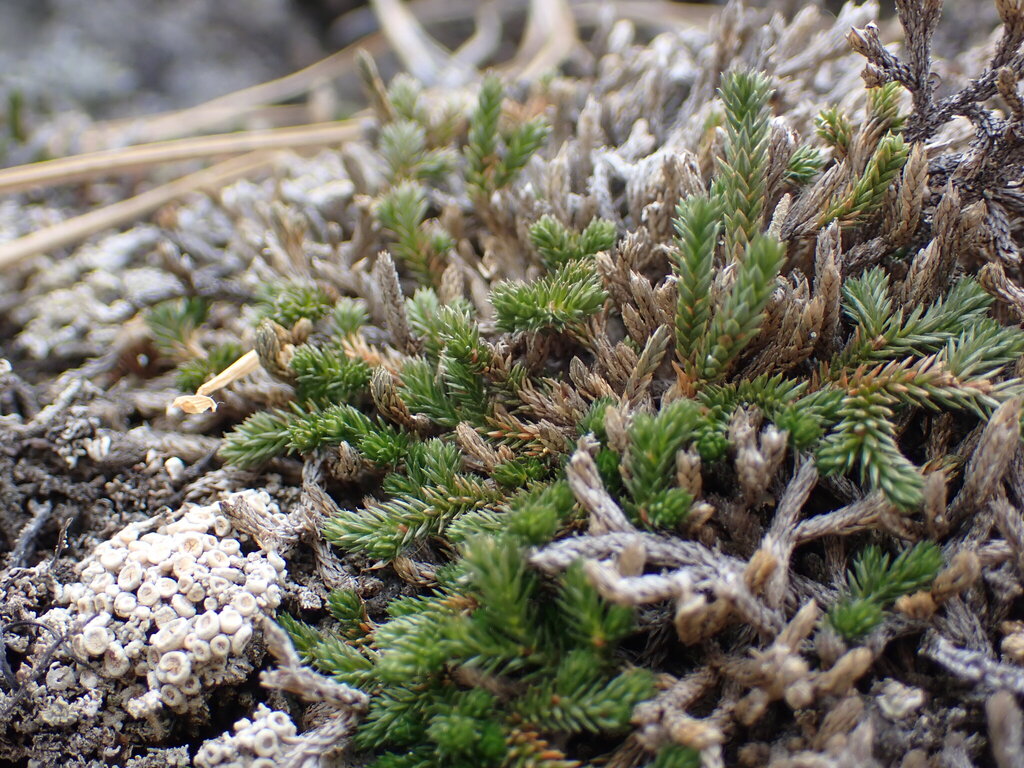
Together with mosses and lichens, Wallace’s spikemoss forms living mats that trap windblown dust and organic matter, hold moisture and slowly build soil on bare rock. These mats provide footholds for the seeds of stonecrops, camas and other wildflowers of rocky balds. Because the mats grow so slowly, trampling, grazing and invasive weeds can remove in a short time what took decades to form.
Cultural & Historical Uses
The genus name Selaginella is a diminutive of Selago, an old name for a clubmoss. Lycophytes are among the oldest lineages of vascular plants: their relatives, including giant tree-like lycophytes, were major parts of the coal-age forests hundreds of millions of years ago. Today’s spikemosses are small, but they still show features of that ancient group.
The species was described by the German botanist Georg Hieronymus, who studied Selaginella worldwide. The genus contains several hundred species, from tropical rainforest plants to desert “resurrection plants” that curl up when dry and unfurl after rain. Wallace’s spikemoss shows a milder version of this drought tolerance, drying and greening up again with the seasons.
On the rocky balds of the Pacific Northwest, spikemoss and lichen mats are a key part of a plant community that also includes camas, stonecrops and many spring wildflowers. Protecting these thin, fragile soils from trampling, off-trail use and invasive shrubs helps the whole community.
Frequently Asked Questions
Is Wallace’s spikemoss a moss?
No. It is a lycophyte, related to clubmosses and quillworts. Unlike mosses it has true roots and water-conducting tissue, and it reproduces from spores borne in small cone-like spikes.
Is Wallace’s spikemoss a fern?
No. Ferns and lycophytes both reproduce by spores, but lycophytes have tiny single-veined leaves and are an older, separate lineage. Spikemosses are often grouped with ferns in plant lists and nursery categories for convenience.
Where does Wallace’s spikemoss grow?
It grows on rock outcrops, ledges, balds and thin soils from southern British Columbia through Washington and Oregon to northern California, and east to Idaho and western Montana, on both sides of the Cascades.
Can I collect spikemoss for a terrarium or rock garden?
No. Wild mats grow very slowly and almost always die when removed. Leave them in place, and avoid buying moss or spikemoss products harvested from the wild.
Why does it look dead in summer?
It survives drought by drying out and going dormant, turning gray-brown and curling. It greens up again when fall and winter rains return.

Looking for a nursery that carries Wallace’s Spikemoss?
Browse our native plant nursery directory: California · Idaho · Montana · Oregon · Washington

