
Western Moss-Heather (Cassiope mertensiana)
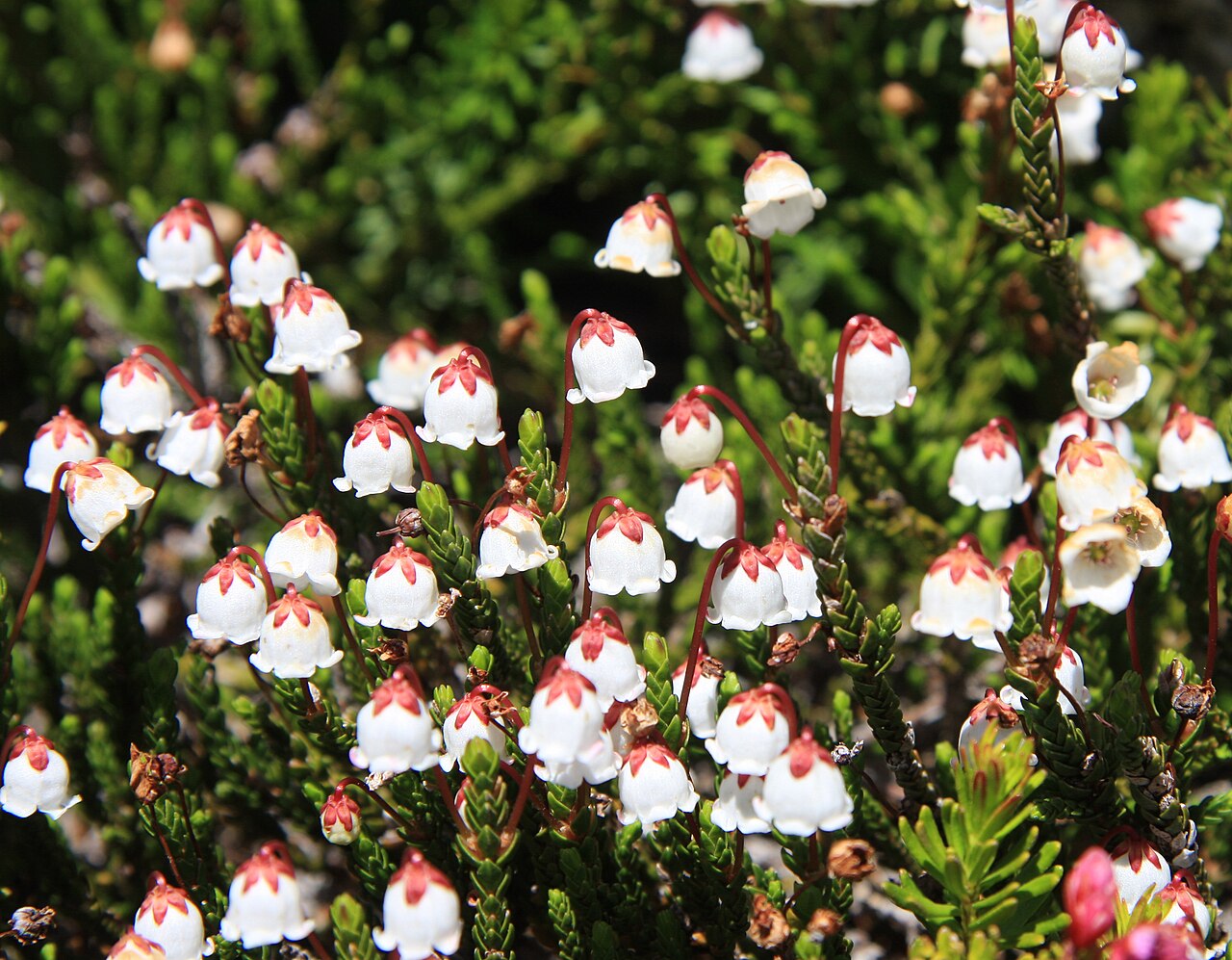
Cassiope mertensiana, known as Western Moss-Heather, white mountain heather or Mertens’ moss heather, is a low, evergreen dwarf shrub of the high mountains of western North America. It forms dense mats 4 to 12 inches tall of upright stems so tightly covered in tiny, scale-like leaves that they look like green cords or moss. In summer it is hung with small, nodding, white bells on red stalks, each cupped by bright red sepals.
It belongs to the heath family (Ericaceae), together with huckleberries and the mountain heaths (Phyllodoce), with which it often grows in subalpine heather meadows. It ranges from Alaska and Yukon south through the Coast Mountains, Cascades and northern Rockies to the Sierra Nevada of California, usually near or above timberline, where the snow lies late into summer.
Western moss-heather is a beloved sight for mountain hikers but a challenge in lowland gardens. It needs cool summers, constant moisture and acidic, well-drained soil, and it is best suited to rock gardens in cool, humid climates. This guide covers how to identify it, where it grows, what it takes to grow it, and its place in alpine ecosystems.
Identification
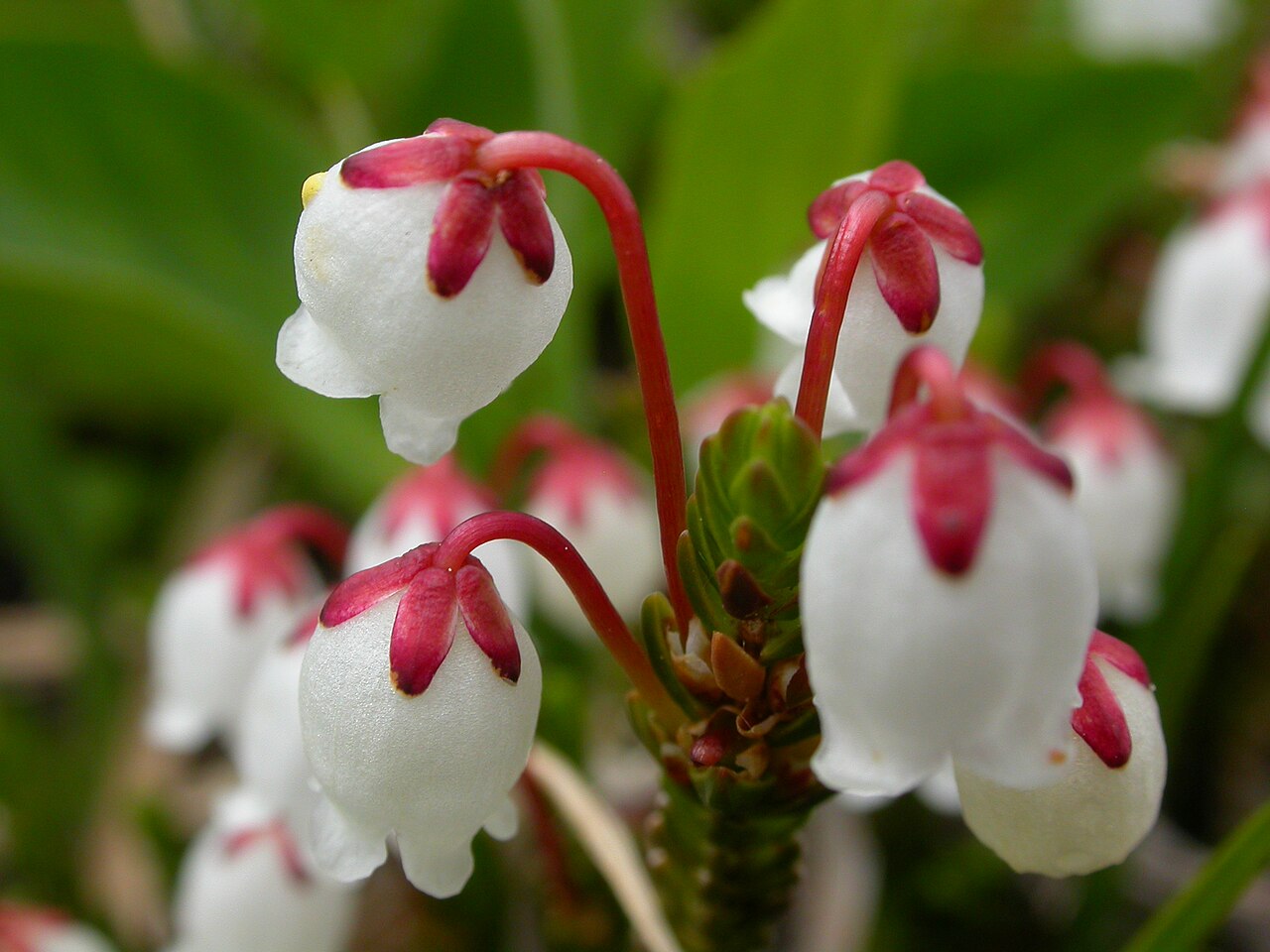
Western moss-heather is easy to recognize when in flower by its white bells and red sepals. Out of flower, its cord-like, scale-leaved stems are distinctive.
Growth Habit
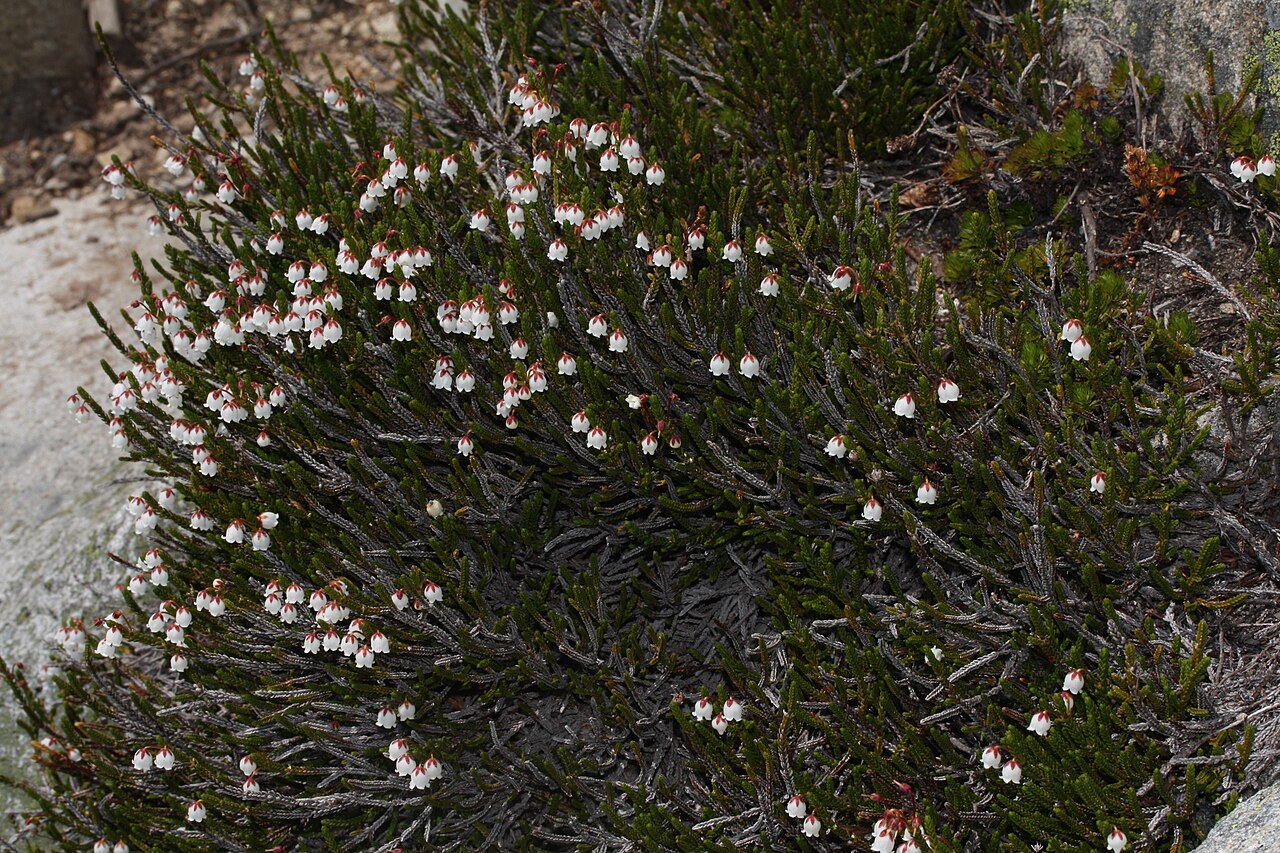
It is a low, evergreen shrub that forms dense mats or cushions, usually 4 to 12 inches tall and spreading by creeping, branching stems. The stems are upright to ascending and, with their covering of leaves, about 1/8 inch thick, giving the plant the look of a coarse moss or a dwarf conifer.
Leaves
The leaves are tiny, about 1/8 inch long, thick and scale-like, arranged in four tight rows that overlap like shingles and press against the stem. They are dark green and keeled on the back but lack the deep groove found in the related four-angled moss-heather (Cassiope tetragona).
Flowers
The flowers hang singly on slender, reddish stalks from the leaf axils near the branch tips. Each is a small white bell, about 1/4 inch long, with five short, flared lobes, set in a cup of red to pinkish sepals. They bloom from early to late summer, as soon as the snow melts.
Fruit & Seeds
After flowering, the stalks turn upright and each flower forms a small, round capsule that splits into five parts to release many tiny seeds in late summer and fall.
Look-alikes
Pink mountainheath (Phyllodoce empetriformis) and yellow mountain heath (P. glanduliflora) often grow with it, but they have needle-like, spreading leaves and pink or yellowish flowers. Purple mountain heath (P. breweri) of the Sierra Nevada has rose-purple, open flowers. Starry Cassiope (Harrimanella stelleriana) of the Northwest mountains has spreading leaves and white flowers with red sepals at the tips of the branches.
Quick Facts
| Scientific Name | Cassiope mertensiana (Bong.) G. Don |
| Family | Ericaceae (heath family) |
| Plant Type | Evergreen dwarf shrub, mat-forming |
| Mature Height | 4–12 in |
| Mature Spread | 1–3 ft, slowly spreading |
| Growth Rate | Slow |
| Sun Exposure | Full sun to part shade in cool climates |
| Water Needs | Moderate to high; constantly moist but well-drained soil |
| Soil Type | Acidic, gritty or rocky soils rich in organic matter |
| Soil pH | About 4.5–6.0 |
| Bloom Time | June–August, soon after snowmelt |
| Flower Color | White with red sepals |
| Fall Color | Evergreen; may darken in winter |
| Fruit | Small, round, five-parted capsule |
| Deer Resistant | Seldom browsed |
| USDA Hardiness Zones | 3–6 |
Native Range
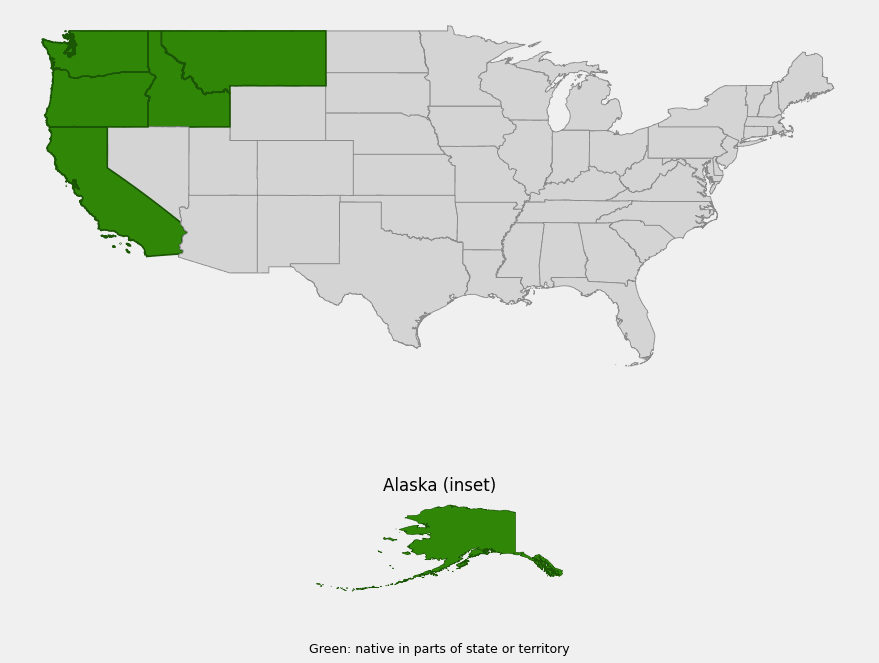
Western moss-heather is native to the mountains of western North America. In Canada it grows in British Columbia, western Alberta and Yukon. In the United States, USDA PLANTS lists it in Alaska, Washington, Oregon, Idaho, Montana and California. In Alaska it is found mainly in the southern coastal mountains and the Southeast.
In Washington and Oregon it is common in the Olympic Mountains and the Cascades, both on the wet western slopes and on the high country east of the crest, and it also grows in the Wallowa and Blue Mountains of northeastern Oregon. It continues east into the mountains of northern Idaho and western Montana. In California it grows in the Klamath Mountains, the southern Cascades and the Sierra Nevada, where it reaches its southern limit. A few records also come from the Carson Range near Lake Tahoe in Nevada.
Its home is subalpine and alpine heather meadows, rocky slopes, ledges, moist talus, and the edges of snowbeds and timberline forest. It grows from roughly 4,000 to 6,000 feet in the Pacific Northwest and Alaska, and from about 7,000 to over 11,000 feet in the Sierra Nevada. It favors places where snow lies late, protecting it in winter and keeping the soil moist into summer.
📋 Regional plant lists featuring Western Moss-Heather: Idaho, Eastern Oregon & Eastern Washington · Montana & Wyoming · Alaska · Western Oregon & Western Washington · California & Nevada
Growing & Care Guide
Western moss-heather is a specialist’s plant. It grows well in cool, humid coastal climates and at higher elevations, but it usually struggles or dies in hot, dry lowland gardens. If you want to try it, use nursery-propagated plants from rock-garden or alpine-plant specialists, and never dig plants from the wild.
Light
In cool, cloudy climates such as the coastal Pacific Northwest, give it full sun or light shade. Where summers are warmer, plant it where it gets morning sun and afternoon shade, and shelter it from drying winds.
Soil & Water
It needs acidic, gritty, humus-rich soil that stays evenly moist but never waterlogged, such as a mix of grit, sand and acidic compost or bark. Like other heaths, it depends on root fungi and dislikes lime and fertilizer. Water regularly during dry weather; it will not tolerate drought or hot, dry soil.
Planting Tips
Plant it in a rock garden, raised bed or trough, on a north- or east-facing slope or between rocks that keep the roots cool. It combines well with other alpine heaths, dwarf conifers and small ferns. Mulch with gravel or stone chips to keep the soil cool and moist.
Pruning & Maintenance
No pruning is needed. Trim out any dead stems in spring. Do not disturb the roots, and keep competing plants from crowding the slow-growing mat. In regions with little snow cover, a light winter covering of evergreen boughs can help protect it from drying winds.
Propagation
Propagate it from cuttings of new growth taken in summer and rooted in a moist, acidic mix, or by layering stems that touch the ground. It can also be grown from the tiny seeds, sown on the surface of a moist, acidic mix, but seedlings are very slow. Plants of known nursery origin are the best option for gardeners.
Landscape Uses
- Alpine and rock gardens: a choice evergreen mat with white bells in cool, humid climates
- Troughs and raised beds: gives control over soil, drainage and moisture
- Heather gardens: pairs with mountain heaths and dwarf huckleberries
- High-elevation landscapes: suited to cabins and gardens in subalpine mountain areas
- Hiking destinations: a highlight of heather meadows in the Cascades, Olympics and Sierra Nevada
Wildlife & Ecological Value
Western moss-heather is a key part of the low, evergreen heath communities that cover many subalpine slopes in the West.
For Pollinators
Its small bells are visited mainly by bumble bees, which can reach the nectar inside the hanging flowers, and by other small bees and flies. In the short alpine summer, its flowers are an important early source of nectar after snowmelt.
For Birds
The dense mats provide cover for ground-nesting birds of the high country, such as white-tailed ptarmigan in parts of its range, which feed on the buds and leaves of alpine shrubs in winter.
For Mammals
Mountain goats, pikas, marmots and other alpine mammals live in the heather meadows where it grows, though it is not a major food. Its tough, evergreen leaves are seldom browsed.
Ecosystem Role
Western moss-heather helps form subalpine heather communities that stabilize thin, rocky soils and protect them from erosion. Like other heaths, it relies on ericoid mycorrhizal fungi to obtain nutrients from poor, acidic soils. These communities recover very slowly from trampling, so stay on trails in heather meadows.
Cultural & Historical Uses
The genus Cassiope is named after Cassiopeia, the queen in Greek mythology who was the mother of Andromeda; the related bog rosemary is named Andromeda. The species honors Karl Heinrich Mertens (1796–1830), a German naturalist who collected plants around Sitka, Alaska, on a Russian voyage of exploration in the 1820s.
John Muir was devoted to the white mountain heather of the Sierra Nevada. In My First Summer in the Sierra, he described finding cassiope in the high country as one of the great joys of his wanderings, and he wrote about it with as much affection as any plant he knew.
For hikers in the Cascades, Olympics and Sierra Nevada, mats of white and pink heather in bloom are one of the classic sights of the high country. Many trails pass through heather meadows, and land managers ask visitors to stay on trails because these slow-growing plants are easily killed by trampling.
Frequently Asked Questions
Is western moss-heather a true heather?
It is in the heath family (Ericaceae), like the European heather (Calluna), but it is a different genus native to western North America.
Where can I see western moss-heather?
Look in subalpine and alpine heather meadows in the Olympics, Cascades, Sierra Nevada, northern Rockies and coastal mountains of British Columbia and Alaska, from July to August.
Can I grow western moss-heather in my garden?
Only in cool, humid climates or at high elevations, in acidic, gritty, moist soil. It usually fails in hot, dry lowland gardens. Use nursery-propagated plants and never dig wild ones.
How do I tell it apart from pink mountainheath?
Western moss-heather has tiny, scale-like leaves pressed against the stem and white bells with red sepals. Pink mountainheath has spreading, needle-like leaves and pink flowers.
Why are its leaves so small?
The small, thick, overlapping leaves reduce water loss and protect the plant from cold, wind and intense sunlight in the alpine environment.

Looking for a nursery that carries Western Moss-Heather?
Browse our native plant nursery directory: Alaska · California · Idaho · Montana · Oregon · Washington

