
Partridgefoot (Luetkea pectinata)
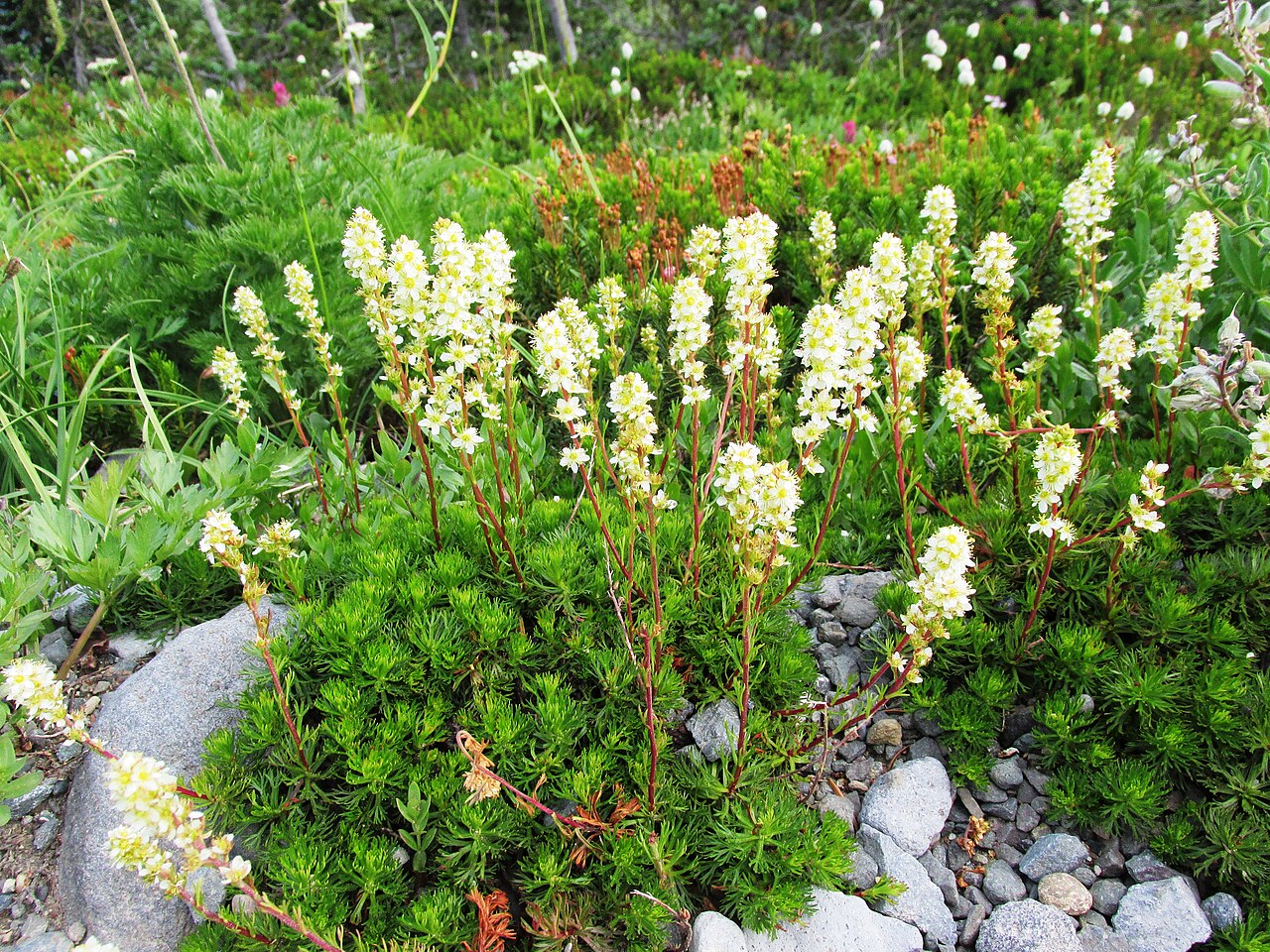
Luetkea pectinata, known as Partridgefoot, is a low, mat-forming subshrub of the high mountains of western North America. It is a member of the rose family (Rosaceae) and the only species in its genus. Partridgefoot spreads by creeping, rooting stems into dense carpets of small rosettes, each made of bright green, finely divided leaves. The name comes from these leaves, whose narrow, forked lobes look a little like the tracks of a bird’s foot.
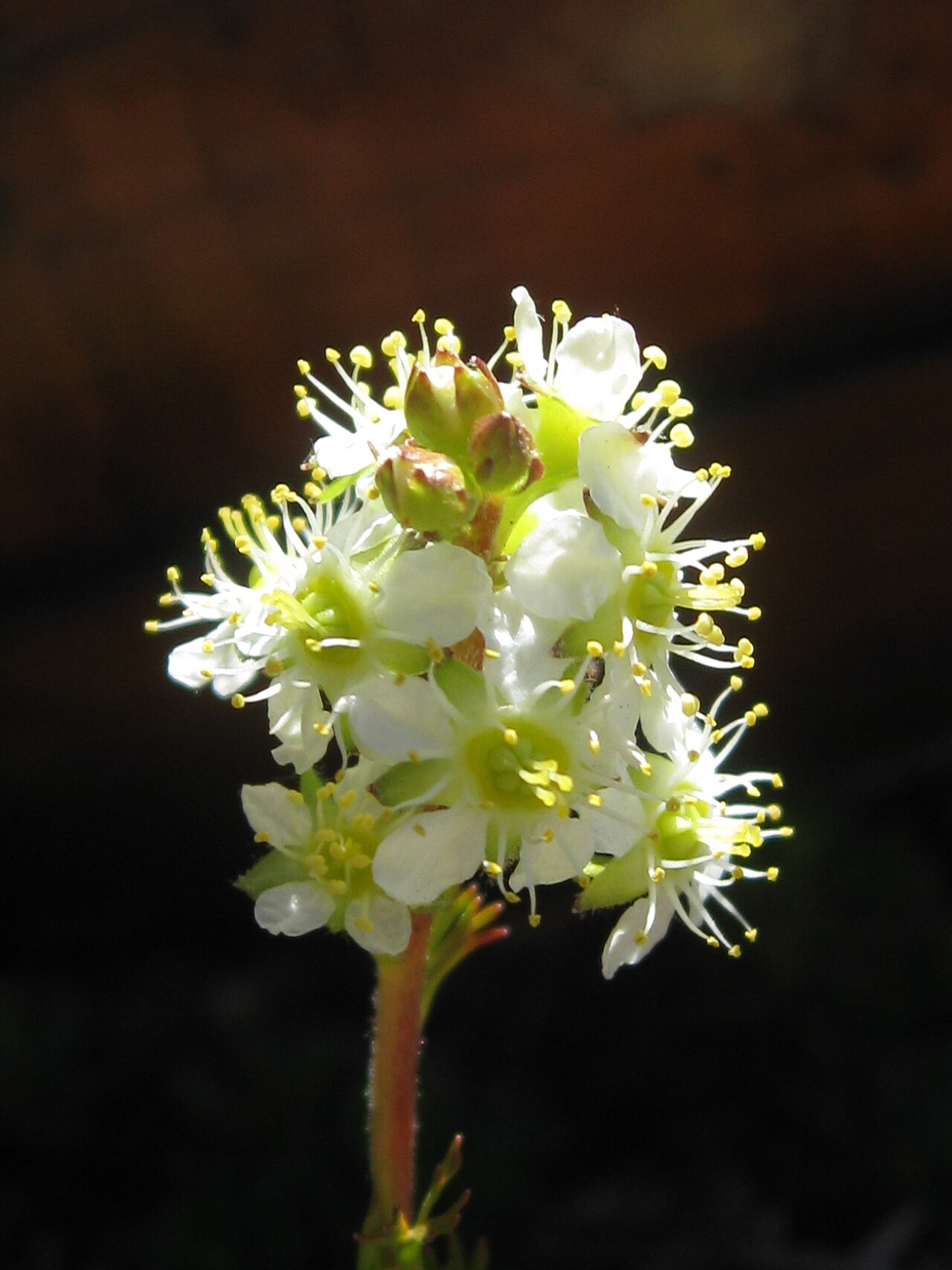
From June into August, as the snow melts back, partridgefoot sends up short stems 2 to 6 inches tall topped with dense clusters of small creamy white flowers. Each flower has a fuzzy tuft of stamens, so the clusters look soft and feathery. In good years whole slopes of subalpine meadow turn white with them, often alongside heathers, paintbrushes and lupines.
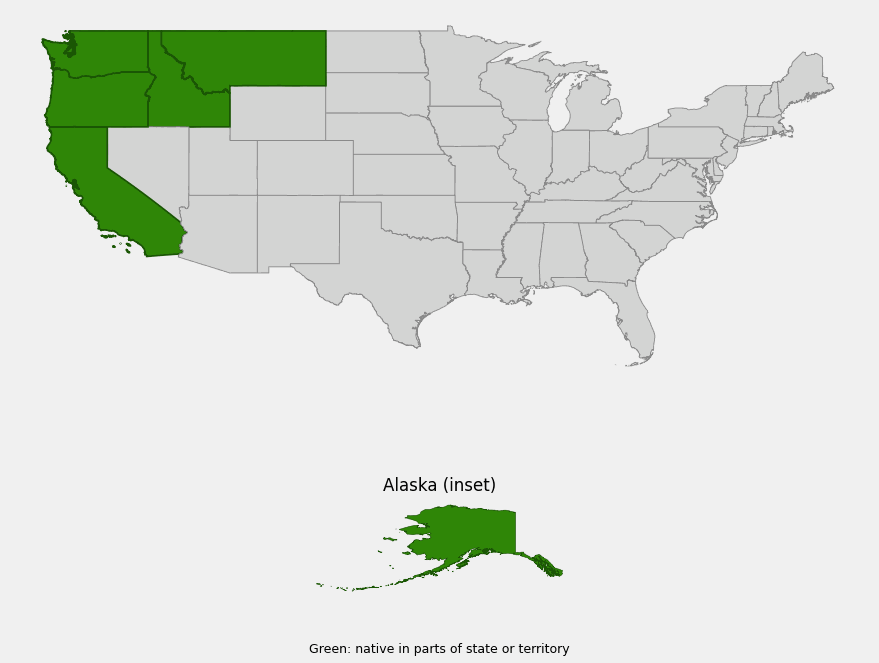
Partridgefoot grows from Alaska and the Yukon south through British Columbia and Alberta into the mountains of Washington, Oregon, Idaho, western Montana and far northern California. It is a plant of late-melting snowbeds, moist rocky slopes and subalpine meadows. Gardeners in cool, moist climates use it as a fine-textured groundcover or rock-garden plant; it struggles where summers are hot and dry.
Identification
Partridgefoot is easy to recognize in the mountains: look for a low, mossy-looking green mat of finely cut leaves with short spikes of creamy white flowers, usually in places where snow lies late into summer.
Growth Form
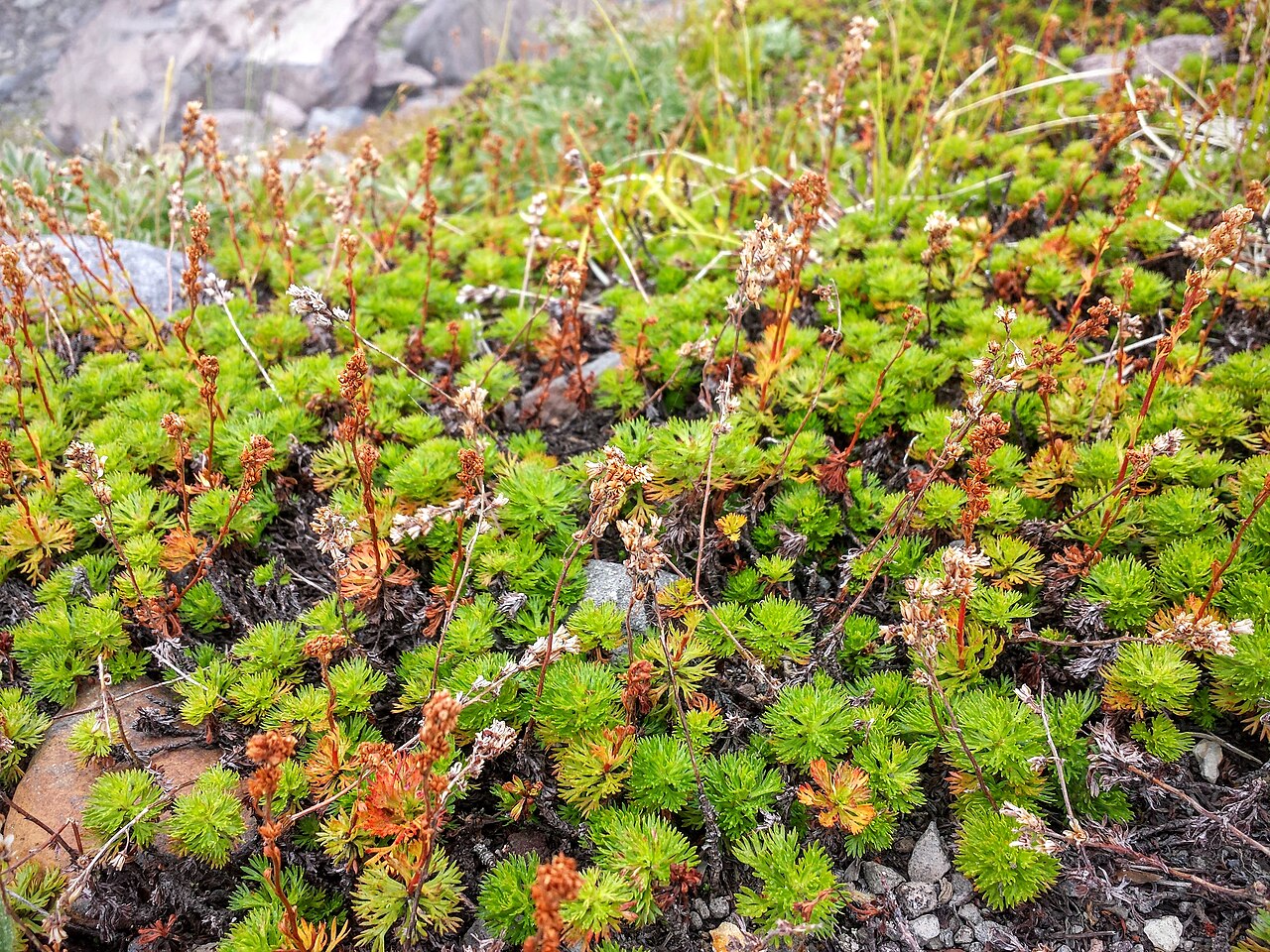
The plant is a woody-based subshrub that rarely rises more than an inch or two above the ground except when flowering. It spreads by slender stems that run along or just under the surface and root as they go, forming mats that can cover several square feet. Old leaves often persist, dry and brown, beneath the green rosettes.
Leaves
The leaves are crowded in tufts at the ends of the stems. Each is about 1/2 to 3/4 inch long, smooth and bright green, and divided two or three times into narrow, linear lobes. The fan of lobes gives the leaf a feathery, comb-like or bird-foot look; the species name pectinata means “comb-like.” The leaves are evergreen under the snow.
Flowers
Flowering stems are 2 to 6 inches tall, reddish and sparsely leafy, ending in a dense, elongated cluster (raceme) of many small flowers. Each flower is about 1/4 inch across, with five white to cream petals and about 20 long stamens. Bloom time follows snowmelt, mostly June to August, and later in deep snowbeds.
Fruit & Seeds
Each flower usually has four to six separate pistils that ripen into small dry pods (follicles) that split open along one side to release a few tiny seeds. The stalks and fruit often turn red-brown in late summer.
Look-alikes
Out of flower, the mats can be mistaken for a moss or a cushion saxifrage. Spotted saxifrage (Saxifraga bronchialis) has undivided, stiff, spine-tipped leaves, and goatsbeard (Aruncus) is a much larger plant with similar feathery flowers. Partridgefoot’s small, finely forked leaves in tight rosettes are the best clue.
Quick Facts
| Scientific Name | Luetkea pectinata |
| Family | Rosaceae (rose family) |
| Plant Type | Mat-forming evergreen subshrub (groundcover) |
| Mature Height | 1–2 in foliage; flower stems 2–6 in |
| Mature Spread | 1–3 ft or more, spreading by rooting stems |
| Growth Rate | Slow to moderate |
| Sun Exposure | Full sun to part shade |
| Water Needs | Medium to high; consistently moist but well-drained |
| Soil Type | Gravelly, rocky or humus-rich, well-drained soil |
| Soil pH | Slightly acidic to neutral |
| Bloom Time | June–August (after snowmelt) |
| Flower Color | White to cream |
| Fall Color | Foliage stays green; flower stalks turn reddish |
| Fruit | Small dry follicles in late summer |
| Deer Resistant | Mostly; low mats are seldom browsed heavily |
| USDA Hardiness Zones | 2–7 |
Native Range
Partridgefoot is a plant of the mountains of northwestern North America. USDA PLANTS lists it as native in Alaska, Canada and the lower 48 states, with U.S. records from Alaska, Washington, Oregon, California, Idaho and Montana. In Canada it grows in British Columbia, Alberta, the Yukon and the Northwest Territories. The Lady Bird Johnson Wildflower Center summarizes the range as the mountains of Alaska and the Yukon south to northern California and western Montana.
It is most abundant in the Coast Mountains, the Olympic Mountains and the Cascade Range, where it carpets subalpine meadows on peaks such as Mount Rainier, Mount Baker and Mount Thielsen. It also grows in the northern Rocky Mountains of Idaho and western Montana and reaches its southern limit in the mountains of far northern California. In Alaska it extends along the coastal mountains and down to low elevations where the climate is cool and snowy.
Typical habitats are moist subalpine and alpine meadows, snowbed hollows where snow lies into July, rocky slopes, talus edges and open forest openings near timberline. It favors places that stay moist from snowmelt through much of the short growing season.
📋 Regional plant lists featuring Partridgefoot: Idaho, Eastern Oregon & Eastern Washington · Montana & Wyoming · Alaska · Western Oregon & Western Washington · California & Nevada
Growing & Care Guide
Partridgefoot is a fine groundcover for gardens in cool, moist climates, such as the Pacific Northwest and higher elevations of the Mountain West. It wants what it gets in the mountains: steady moisture, good drainage and relief from summer heat. In hot, humid or dry lowland gardens it usually declines.
Light
In cool coastal or mountain gardens it takes full sun. Where summers are warmer, give it morning sun and afternoon shade, or bright light under high trees. Too much shade reduces flowering.
Soil & Water
Plant it in gritty, well-drained soil with some organic matter, such as a rock-garden mix or a slope of gravelly loam. Keep it evenly moist through the growing season, especially in its first summer; it is not drought tolerant. Avoid heavy clay that stays waterlogged in winter.
Planting Tips
Set plants about 12 inches apart in spring or early fall. It looks best tucked between rocks, along a shaded path, at the edge of a water feature or under dwarf conifers. A light gravel mulch keeps the crowns clean and the roots cool.
Pruning & Maintenance
Little care is needed. Shear off the spent flower stalks after bloom if you prefer a tidy mat, and pull weeds by hand until the mat closes. Water during hot, dry spells.
Propagation
The easiest method is to separate rooted rosettes or stem pieces from the edge of a mat in spring or early fall and pot them up in gritty mix. It can also be grown from fresh seed sown on the surface in fall and left outdoors for winter cold, though seedlings are tiny and slow. Collect only small amounts of seed from the wild where permitted; never dig wild plants.
Landscape Uses
- Rock gardens: a fine-textured mat between stones in cool-summer gardens
- Groundcover: a low, evergreen carpet for moist, partly shaded spots
- Alpine and trough gardens: pairs well with small heathers, saxifrages and dwarf conifers
- Pathside and step plantings: softens the edges of stone paths in moist gardens
- Subalpine restoration: helps stabilize moist rocky soils at high elevations
Wildlife & Ecological Value
In the short mountain summer, partridgefoot’s abundant flowers are an important source of food for insects, and its mats help hold soil on wet, rocky slopes.
For Pollinators
The open, fuzzy flowers offer easy access to pollen and nectar. They are visited by bumble bees, small native bees, flies and beetles, which are among the main pollinators in subalpine meadows. Blooming right after snowmelt, it feeds insects when few other flowers are open.
For Birds
The tiny seeds are not a major bird food, but partridgefoot meadows are habitat for birds of the high country such as ptarmigan, grouse, American pipits and rosy-finches, which forage for insects and seeds among the mats.
For Mammals
Partridgefoot is browsed lightly by some mountain herbivores, but it is not considered an important forage plant. Its dense mats provide cover for small mammals and insects living among the rocks.
Ecosystem Role
As a mat-former that roots along its stems, partridgefoot helps bind gravelly soil on snowbeds and moist slopes, reducing erosion where snowmelt runs off. It is one of the characteristic plants of the heath-and-meadow communities that ring the high peaks of the Pacific Northwest.
Cultural & Historical Uses
The genus Luetkea was named in honor of Count Fyodor Petrovich Litke (also spelled Lütke), a Russian navigator and explorer who led a round-the-world scientific voyage in the 1820s. Plants collected on that expedition, including specimens from the Sitka area of Alaska, were studied by botanists in St. Petersburg. The species was first described in the early 1800s as a saxifrage, Saxifraga pectinata, before it was recognized as a distinct member of the rose family.
Partridgefoot is the only species in its genus. Although it looks like a saxifrage, its flowers, with many stamens and separate pistils that become small follicles, place it in the rose family near goatsbeard and the spireas.
For hikers in the Cascades and Olympics, the white carpets of partridgefoot are one of the classic sights of subalpine meadows in midsummer. National parks such as Mount Rainier and North Cascades protect large areas of this habitat, and visitors are asked to stay on trails because the mats and the meadows around them recover very slowly from trampling.
Frequently Asked Questions
Why is it called partridgefoot?
The leaves are divided into narrow, forked lobes that resemble the track of a bird’s foot. The species name pectinata, meaning comb-like, refers to the same feature.
Can I grow partridgefoot in my garden?
Yes, if your summers are cool and you can keep it evenly moist in well-drained soil. It does best in the Pacific Northwest, at higher elevations and in rock gardens; in hot, dry or humid lowland gardens it usually fades out.
Is partridgefoot related to saxifrages?
No. It looks like a saxifrage and was first named as one, but it belongs to the rose family. It is the only species in the genus Luetkea.
How fast does it spread?
Slowly to moderately. It creeps by rooting stems and can form a mat a foot or more across in a few years in good conditions.
Where can I see partridgefoot in the wild?
Look in subalpine meadows of the Cascades and Olympics in July and August, for example around Paradise at Mount Rainier, on Mount Baker or at Crater Lake area peaks, and in the high country of northern Idaho, Glacier National Park and Alaska. Stay on trails to protect the meadows.

Looking for a nursery that carries Partridgefoot?
Browse our native plant nursery directory: Alaska · California · Idaho · Montana · Oregon · Washington