
Grape Honeysuckle (Lonicera reticulata)
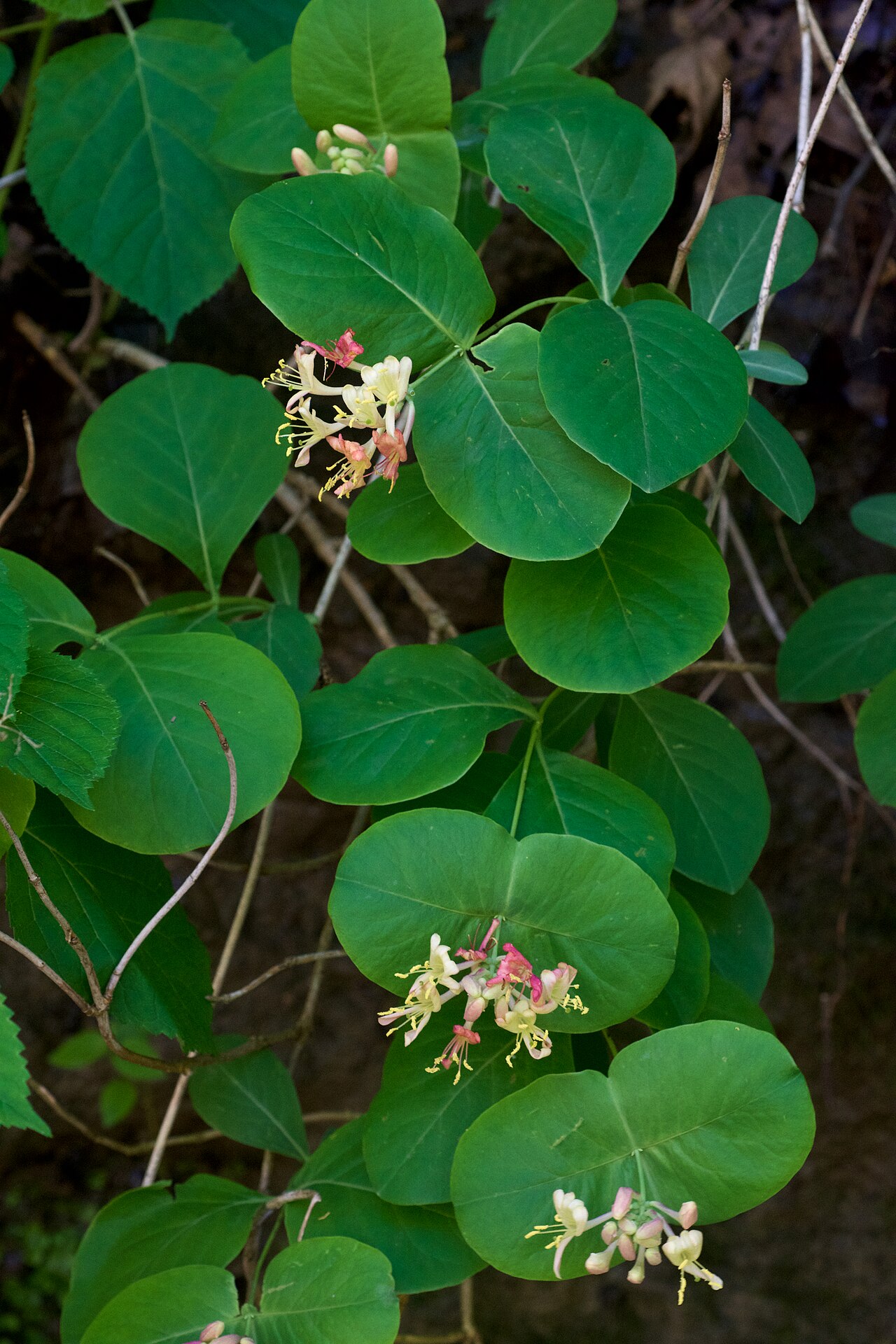
Lonicera reticulata, the Grape Honeysuckle, is a native climbing or sprawling honeysuckle of the Midwest and the central United States. It is easy to spot by its upper leaves, which are fused around the stem into round, blue-gray disks. In late spring, pale yellow, trumpet-shaped flowers cluster on top of these disks, followed in late summer by tight bunches of orange-red berries that give the plant its name. Many references still list it under the older name Lonicera prolifera.
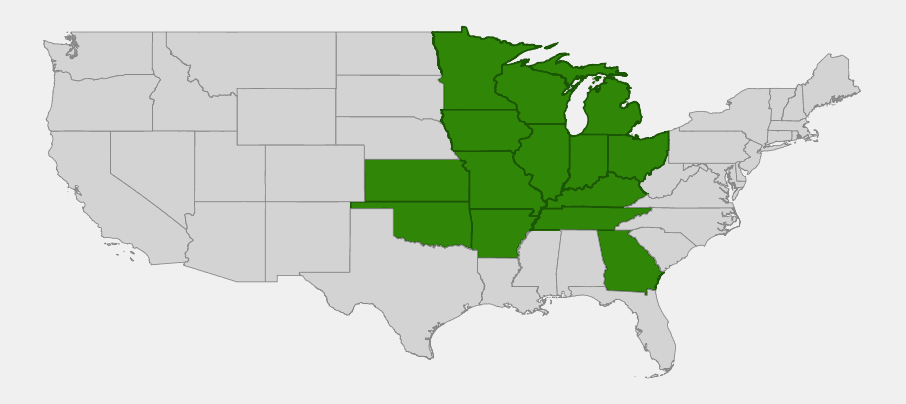
Its native range runs from Ohio, Indiana and Michigan west to Minnesota, Iowa and Kansas, and south to Kentucky, Tennessee, Missouri, Arkansas and Oklahoma, with an outlying record in Georgia. USDA PLANTS also lists Massachusetts and New York, but regional floras treat it as introduced there: Go Botany (Native Plant Trust) considers it introduced in New England, and the New York Flora Atlas lists it as non-native. Those states are left off the map.
Grape honeysuckle is a well-behaved native alternative to invasive Japanese honeysuckle and is valued by gardeners for its silvery foliage, as in the popular cultivar ‘Kintzley’s Ghost’. Its flowers feed hummingbirds and long-tongued bees and moths, and its berries feed birds. This guide covers identification, range, growing tips and wildlife value.
Identification
Grape honeysuckle is a woody vine that twines over shrubs and fences or sprawls as a loose shrub. The fused, blue-gray leaf disks, pale yellow flowers and clusters of red berries make it easy to recognize.
Stems & Leaves
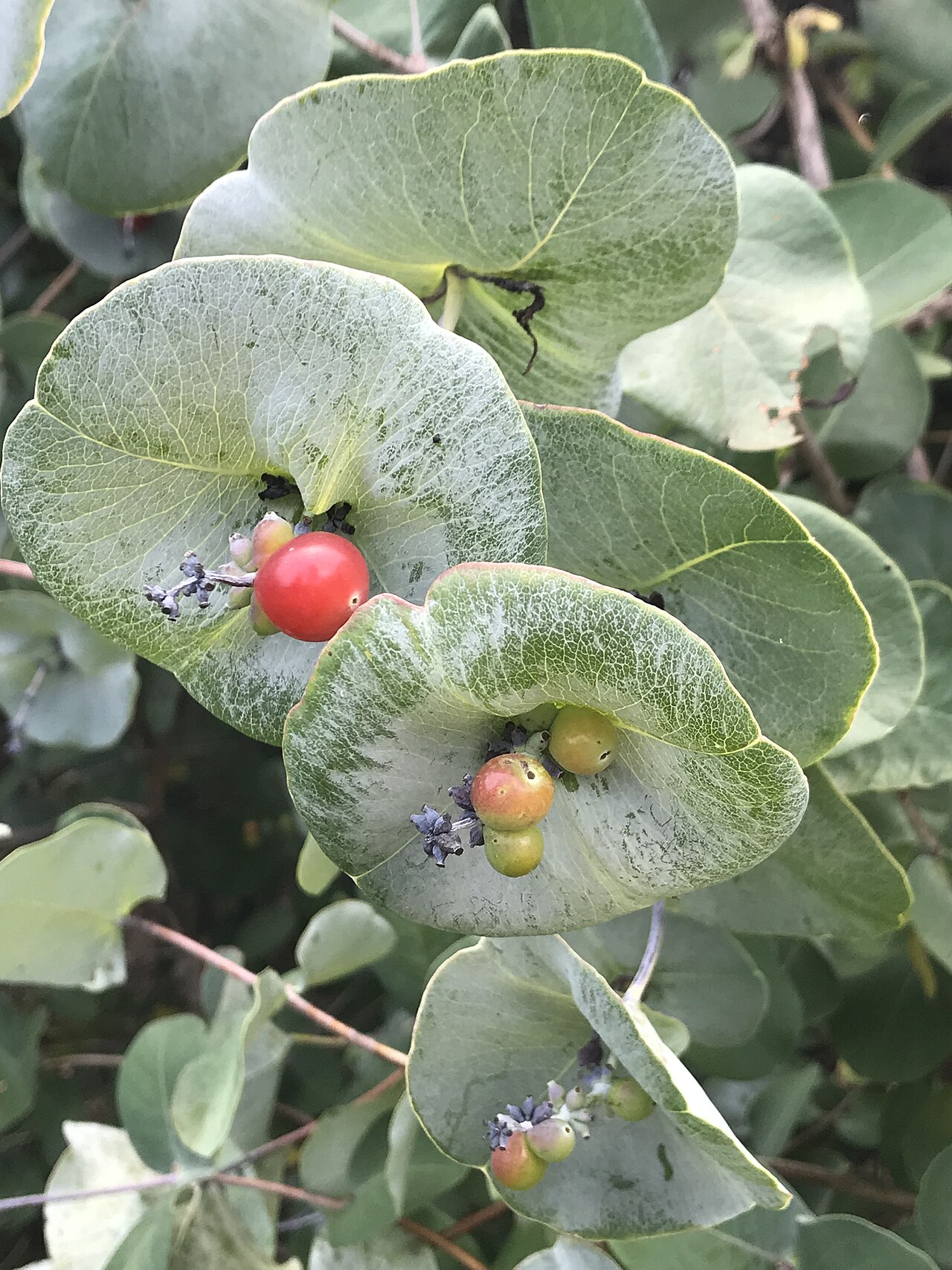
Stems twine and scramble up to about 15 feet long, or form a mounded, sprawling shrub when there is nothing to climb. Older stems have shreddy bark. The leaves are opposite, oval to nearly round, 2 to 4 inches long, thick and smooth, gray-green to blue-green above and strongly whitened (glaucous) beneath, with a noticeable net of veins, the source of the name reticulata (“netted”). The one or two pairs of leaves just below the flowers are fused at their bases into a single round disk that the stem passes through.
Flowers
In May and June, short-stalked whorls of 5 to 8 or more flowers sit on top of the uppermost leaf disk, often in two or more tiers. Each flower is about ¾ to 1 inch long, two-lipped, with a pale yellow to cream tube that may darken to orange yellow or be tinged purple as it ages.
Fruit
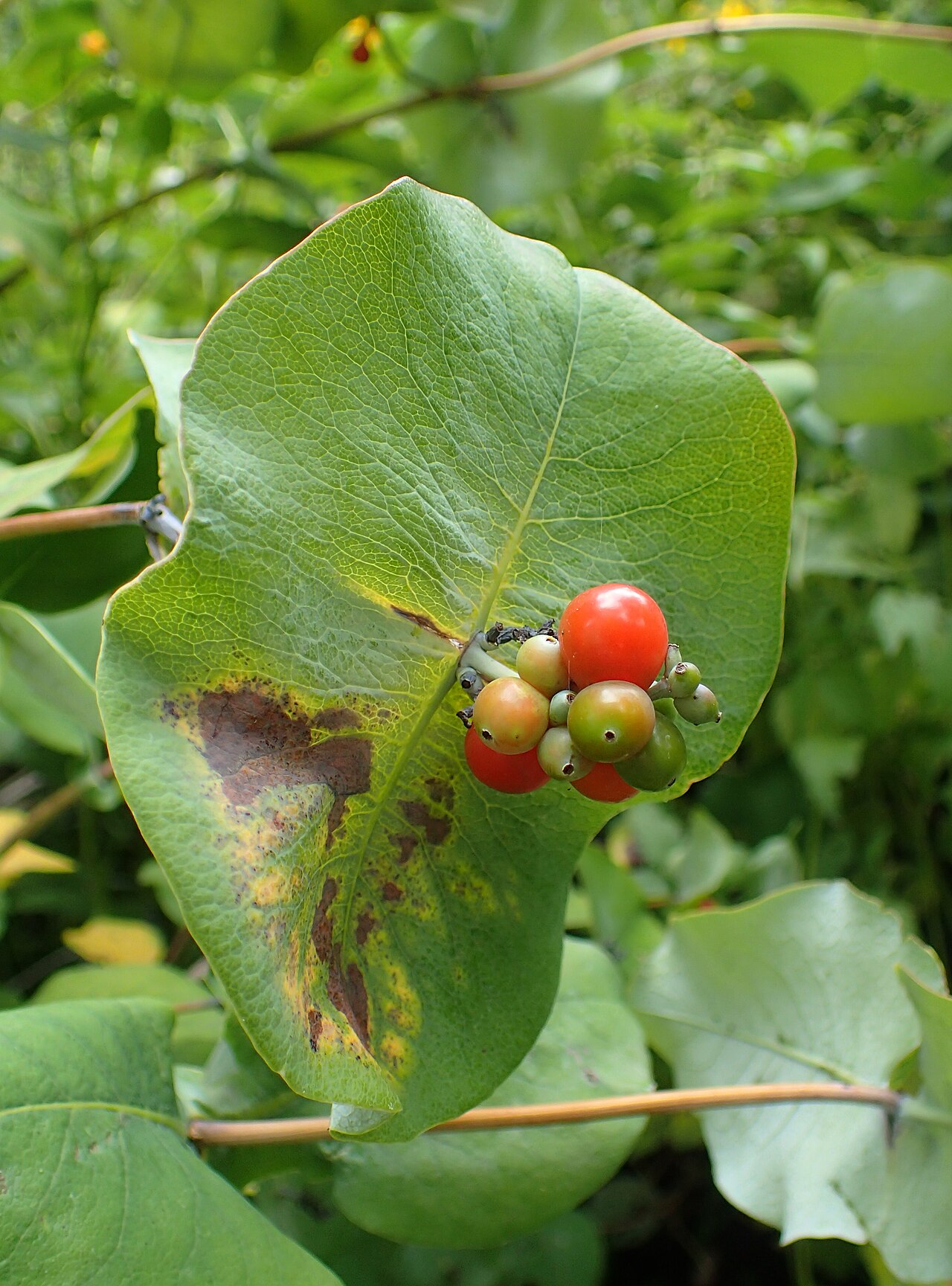
The berries ripen in late summer to early fall into tight clusters of round, orange-red to bright red fruits about ⅓ inch wide, resembling small bunches of grapes. Each berry holds a few seeds. Honeysuckle berries should not be eaten by people.
Look-alikes
Limber Honeysuckle (L. dioica) is similar but has smaller, greenish-yellow to purplish flowers, and thinner leaves with less prominent net veins. Yellow Honeysuckle (L. flava), mainly of the Ozarks and the South, has bright orange-yellow flowers. Coral Honeysuckle has long, red, tubular flowers. Invasive Japanese honeysuckle (L. japonica) has white to yellow flowers in pairs, never fused leaves, and black berries.
Quick Facts
| Scientific Name | Lonicera reticulata Raf. (syn. L. prolifera) |
| Family | Caprifoliaceae (honeysuckle family) |
| Plant Type | Deciduous twining woody vine or sprawling shrub |
| Mature Height | 6–15 ft (as a vine) |
| Mature Spread | 3–6 ft |
| Growth Rate | Moderate |
| Sun Exposure | Full sun to part shade |
| Water Needs | Medium; average, well-drained soil |
| Soil Type | Loam, sandy or rocky soils; tolerates limestone |
| Soil pH | About 6.0–8.0 |
| Bloom Time | May–June |
| Flower Color | Pale yellow, aging to orange yellow |
| Fall Color | Yellowish; foliage blue-gray all season |
| Fruit | Clusters of orange-red berries, late summer |
| Deer Resistant | Low; deer browse the foliage |
| USDA Hardiness Zones | 4–8 |
Native Range
Grape honeysuckle is native to the interior of eastern North America, centered in the Midwest. Its range runs from Ohio, Indiana and southern Michigan west through Illinois and Wisconsin to Minnesota and Iowa, south through Missouri and Kentucky to Tennessee, Arkansas and eastern Oklahoma, and west into eastern Kansas. USDA PLANTS also has a record from Georgia, at the far southeastern edge of its range. Northern Arkansas is near the southern edge of its main range.
USDA PLANTS lists it in Massachusetts and New York as well, but the regional floras for those states treat it as introduced: Go Botany describes it as native to much of the Midwest but introduced in New England, and the New York Flora Atlas lists it as non-native. Following those sources, this page and map show only its native states. In Canada, it occurs only as an introduced plant.
In the wild it grows in open, dry to moist woods, wooded slopes and bluffs, rocky hillsides, thickets, woodland edges, fencerows and riverbanks, often over limestone or dolomite. It typically scrambles over shrubs and small trees along forest edges, where it gets sun on its upper stems.
📋 Regional plant lists featuring Grape Honeysuckle: Ohio & Indiana · Michigan, Wisconsin & Eastern Minnesota · Kentucky & Tennessee · Nebraska, Kansas & Eastern Colorado · Illinois, Iowa & Missouri · Alabama, Georgia & Mississippi · Arkansas, Louisiana, Eastern Oklahoma & Eastern Texas
Growing & Care Guide
Grape honeysuckle is sold by Midwestern native plant nurseries, and the silvery cultivar ‘Kintzley’s Ghost’ is widely available in garden centers. It is a slower, better-behaved vine than invasive Asian honeysuckles and makes an attractive cover for a fence, trellis, arbor or post.
Light
Full sun to part shade. It flowers and fruits best with at least half a day of sun on its upper stems; in deep shade it grows sparsely and blooms little.
Soil & Water
Average, well-drained soil, from sandy or rocky to loamy, including limestone-based soils. Water regularly during its first season; established plants tolerate moderate drought. Avoid soggy soils.
Planting Tips
Give it a support to twine around: a trellis, chain-link fence, arbor or shrub. Plant it 3 to 6 feet from other vines. Its roots like to be cool, so a mulch or low plantings at the base help. It can also be left to sprawl as a loose shrub on a slope.
Pruning & Maintenance
Prune right after flowering, since it blooms on growth from the previous year. Remove dead or tangled stems and shorten long shoots to keep it in bounds. Powdery mildew and aphids can affect honeysuckles; good air circulation and sun help prevent problems.
Propagation
Take softwood or semi-hardwood cuttings in early to midsummer, or layer a low stem into the soil. Seeds need cleaning from the pulp and about 60 to 90 days of cold, moist stratification before sowing. Seedlings are slow to reach flowering size.
Landscape Uses
- Fences and trellises: a native, non-invasive honeysuckle vine
- Hummingbird gardens: tubular flowers in late spring
- Woodland edges: scrambling over shrubs in sun or part shade
- Foliage interest: ‘Kintzley’s Ghost’ offers silvery, disk-shaped leaves
Wildlife & Ecological Value
Grape honeysuckle supports pollinators in spring, birds in late summer and a variety of moth caterpillars all season.
For Pollinators
The nectar-rich flowers are visited by ruby-throated hummingbirds, bumble bees, long-tongued bees and butterflies, and sphinx moths and other moths at dusk. Hummingbird clearwing moths, whose caterpillars feed on honeysuckles, also visit. Several moth caterpillars feed on the leaves.
For Birds
Thrushes, catbirds, robins, cardinals and other songbirds eat the red berries in late summer and fall and spread the seeds. The tangled stems give cover and nesting sites to small birds.
For Mammals
Deer and rabbits browse the leaves and stems, and small mammals may eat fallen fruit.
Ecosystem Role
It is a characteristic vine of Midwest oak woods, bluffs and woodland edges. Planting native honeysuckles instead of invasive Japanese, Amur and Tatarian honeysuckles supports native insects and birds without the risk of spreading invasive plants into woods.
Cultural & Historical Uses
The genus Lonicera honors Adam Lonicer, a German botanist of the 1500s. Constantine Rafinesque named Lonicera reticulata in the early 1800s for its netted leaf veins. For much of the 20th century it was known as Lonicera prolifera, a name still found in many field guides and nursery catalogs; the two names refer to the same plant.
The cultivar ‘Kintzley’s Ghost’ is a selection valued for its silvery, nearly white, rounded leaf disks. It has become one of the best-known native honeysuckles in the nursery trade and helped introduce many gardeners to the species.
The common name refers to the clusters of red berries, which look like small bunches of grapes. Honeysuckle berries are not considered edible for people, so admire them and leave them for the birds.
Frequently Asked Questions
Is grape honeysuckle invasive?
No. It is a native vine in the Midwest and central U.S. and is much less aggressive than invasive Japanese, Amur and Tatarian honeysuckles. It is a good native alternative to them.
Is Lonicera prolifera the same as Lonicera reticulata?
Yes. Lonicera prolifera is an older name for grape honeysuckle; the accepted name is Lonicera reticulata.
Are grape honeysuckle berries edible?
No. Honeysuckle berries are not considered safe to eat for people, though birds eat them readily.
What is Kintzley’s Ghost honeysuckle?
‘Kintzley’s Ghost’ is a cultivar of grape honeysuckle grown for its silvery, round, fused leaves, pale yellow flowers and red berries.
Is grape honeysuckle native to New York or New England?
Regional floras treat it as introduced there. Go Botany considers it introduced in New England, and the New York Flora Atlas lists it as non-native. Its native range is the Midwest and central U.S.

Looking for a nursery that carries Grape Honeysuckle?
Browse our native plant nursery directory: Arkansas · Georgia · Illinois, Indiana, Iowa & Kansas · Kentucky, Michigan, Minnesota & Missouri · Ohio & Oklahoma · Tennessee · Wisconsin

