Yellow Honeysuckle (Lonicera flava)
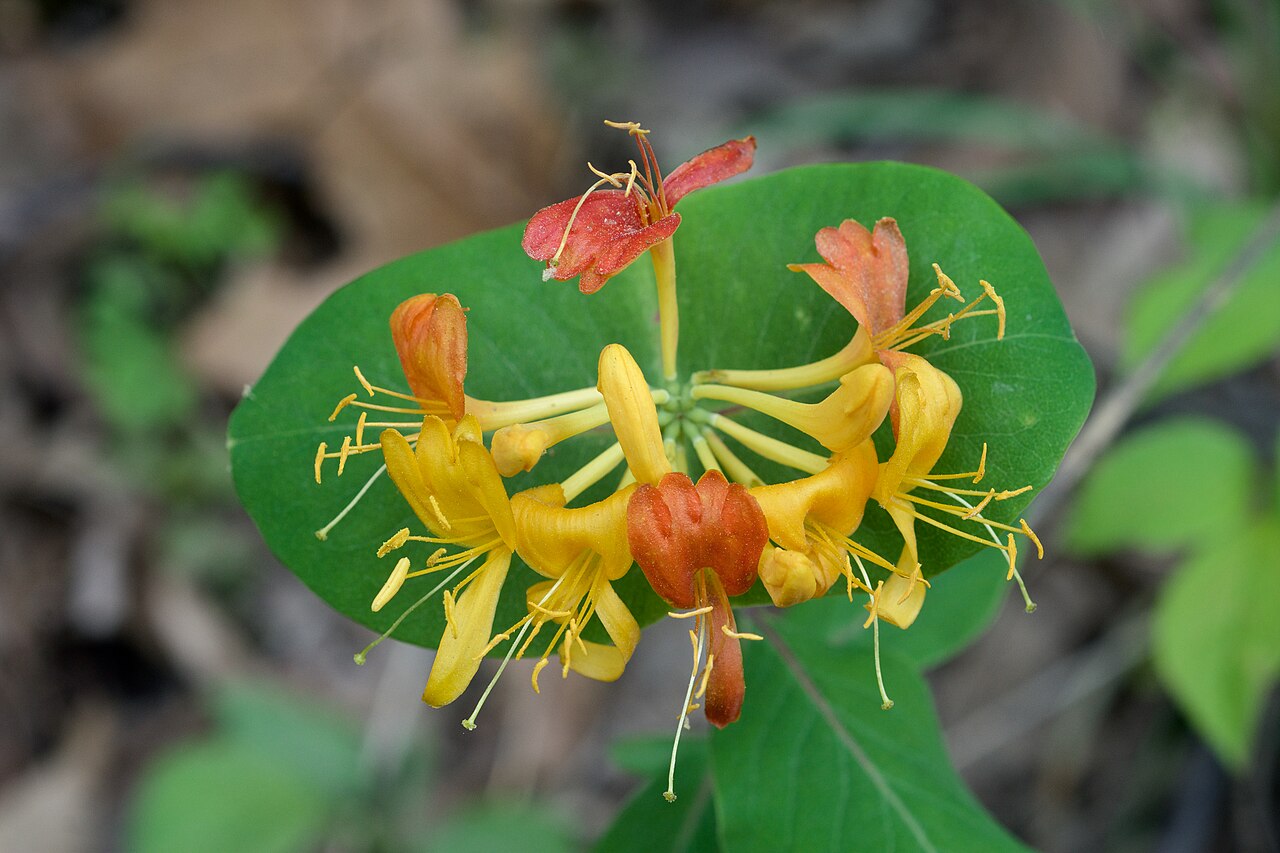
Yellow Honeysuckle (Lonicera flava) is a well-mannered, moderately climbing native vine of the Interior Highlands and the southern Appalachians, prized by gardeners for its clusters of fragrant, golden-orange flowers that bloom in a neat whorl above a saucer of fused, blue-green leaves. Unlike the invasive Japanese, Amur, and Tatarian honeysuckles that have overrun so many American woodlands, yellow honeysuckle is a true native that stays within bounds, rarely escaping cultivation or crowding out neighboring plants.
In the wild it grows on dry to moist wooded slopes, bluffs, and glade margins through the Ozark and Ouachita Mountains, the lower Midwest, and scattered sites in the Appalachians, where it twines modestly over shrubs and small trees rather than forming dense curtains. Its twining habit, reaching 10 to 20 feet with support, makes it a good candidate for a trellis, arbor, or fence where its showy spring flowers and bright red fall berries can be appreciated at eye level.
Yellow honeysuckle is an excellent substitute for gardeners who love the look of a flowering honeysuckle vine but want to avoid planting an invasive species. Hummingbirds visit the tubular flowers readily, and the red berries that follow feed songbirds through late summer — but like most honeysuckle fruit, they are grown for wildlife, not for the table.
Identification
Yellow honeysuckle is a twining, woody, deciduous vine that climbs by wrapping its stems around supports, typically reaching 10 to 20 feet where it has something to climb, or sprawling as a loose groundcover without support.
Stems
Young stems are slender and green to purplish, aging to gray-brown bark that becomes slightly shredded with maturity. The vine twines counterclockwise around supports and lacks tendrils, relying entirely on its stems to climb.
Leaves
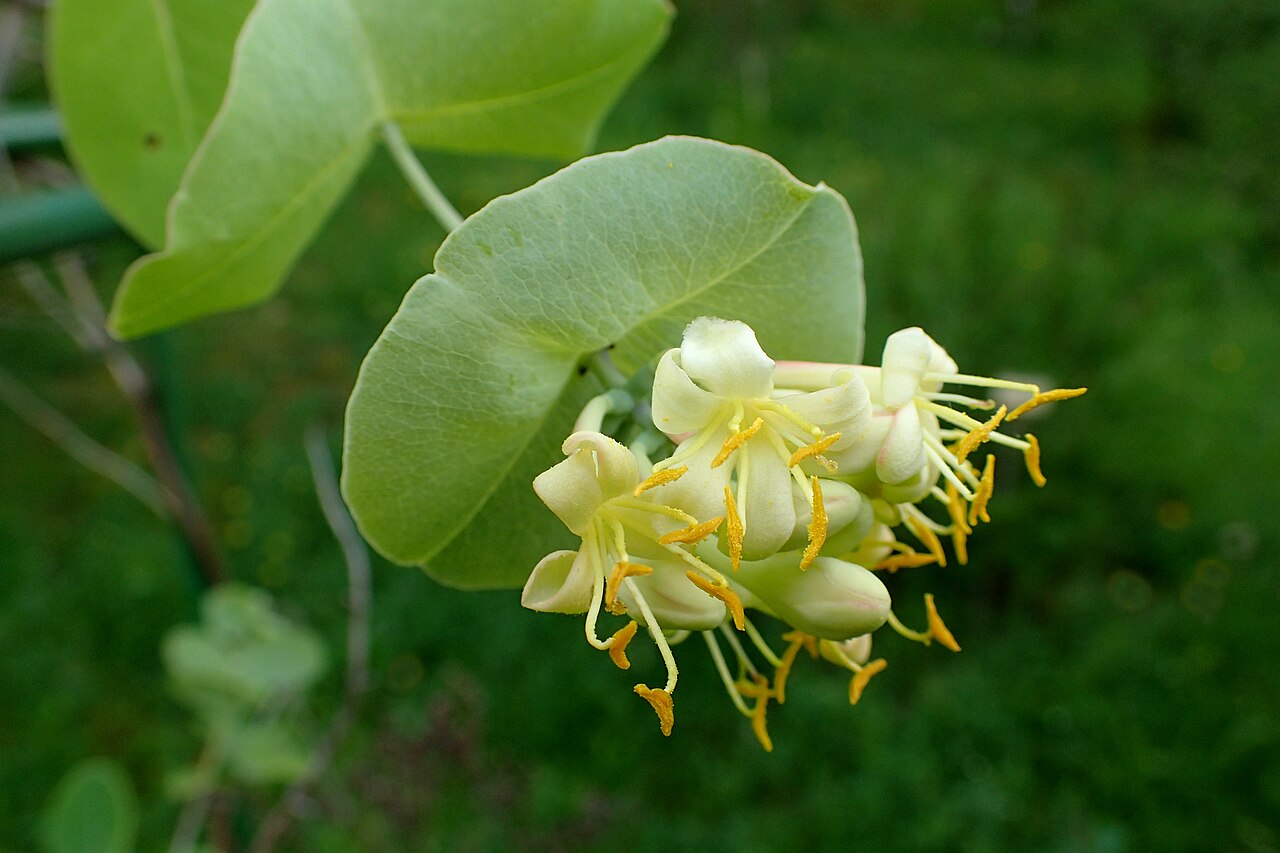
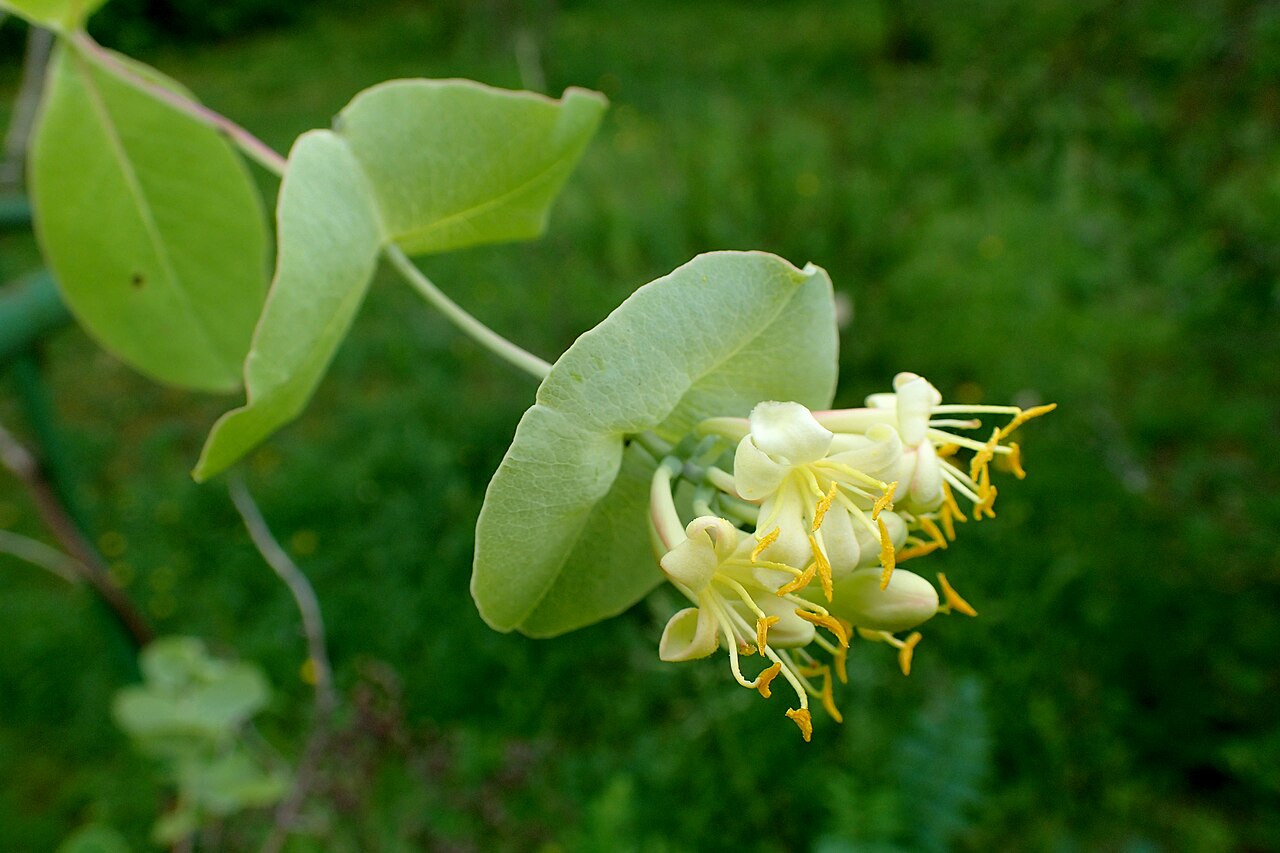
Leaves are opposite, oval to elliptic, 1.2 to 3.5 inches long, bright green above and pale or grayish beneath. The uppermost one or two pairs of leaves below each flower cluster fuse around the stem into a single perfoliate disc, a key identification feature shared with limber honeysuckle but not with the invasive Asian species.
Flowers
In April and May, tubular, two-lipped flowers 1 inch long open in a tight whorl at the center of the topmost leaf disc. Flowers are yellow to orange, slightly fragrant, with long protruding stamens that give the cluster a starburst appearance. Hummingbirds and butterflies visit frequently during the bloom period.
Fruit & Seeds
Small, round, red to reddish-orange berries ripen in clusters inside the leaf disc from August into September. They are an important late-summer food source for birds and small mammals; the berries are not used as human food and should always be described as wildlife forage, not something to eat.
Quick Facts
| Scientific Name | Lonicera flava |
| Family | Caprifoliaceae (Honeysuckle) |
| Plant Type | Deciduous Twining Vine |
| Mature Height | 10–20 ft climbing length |
| Mature Spread | 3–6 ft |
| Growth Rate | Moderate |
| Sun Exposure | Full Sun to Part Shade |
| Water Needs | Average to Dry |
| Soil Type | Well-drained; rocky, loamy, or sandy |
| Soil pH | 6.0–7.5 (neutral to slightly acidic) |
| Bloom Time | April – May |
| Flower Color | Yellow to orange |
| Fall Color | Green, not notable |
| Fruit | Red to orange berries, wildlife food only (not for people) |
| Deer Resistant | Moderate (browsed occasionally) |
| USDA Hardiness Zones | 5–8 |
Native Range
Yellow honeysuckle is native to the Interior Highlands and parts of the lower Midwest and southern Appalachians, with its heaviest concentration in the Ozark and Ouachita Mountains of Arkansas, Missouri, and Oklahoma. From there its range extends east through Kentucky, Tennessee, Illinois, Ohio, and south into Alabama, Georgia, and the Carolinas, generally as scattered, localized populations rather than a continuous range.
It favors dry to mesic upland woods and forests, rocky bluffs, stream banks, and the margins of limestone glades, often on slopes with good drainage. In the Ozarks it is a characteristic plant of oak-hickory woodland edges and rocky outcrops, climbing low over surrounding shrubs rather than reaching high into the canopy.
Though locally common within the Ozark-Ouachita core of its range, yellow honeysuckle is considered uncommon to rare in several states at the margins of its distribution, including parts of the Appalachians, and it should not be collected from the wild; nursery-propagated plants are readily available from native plant growers.
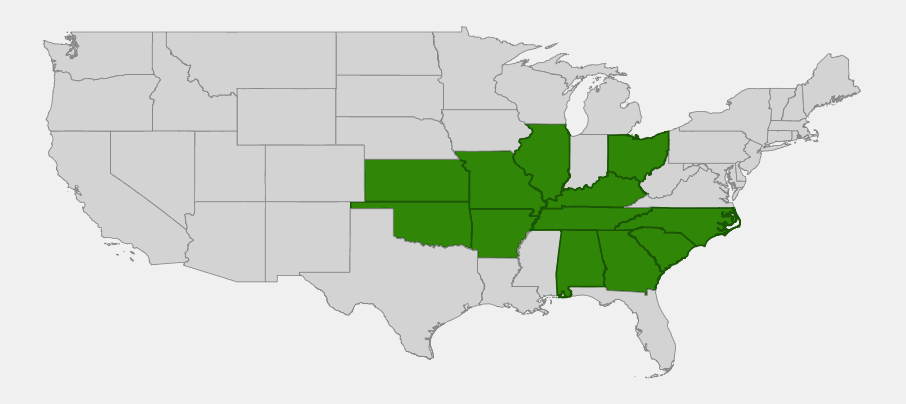
📋 Regional plant lists featuring Yellow Honeysuckle: Georgia, Alabama & Mississippi · Arkansas, Louisiana, Eastern Oklahoma & Eastern Texas · Nebraska, Kansas & Eastern Colorado · Kentucky & Tennessee · Illinois, Iowa & Missouri · North Carolina & South Carolina · Ohio & Indiana
Growing & Care Guide
Yellow honeysuckle rewards gardeners with fragrant spring color and reliable wildlife visits, and it is far easier to keep in bounds than the invasive honeysuckles it resembles at a glance.
Light
Full sun produces the heaviest bloom, though the vine tolerates light to moderate shade, especially in hotter southern parts of its range where some afternoon shade helps prevent leaf scorch.
Soil & Water
Yellow honeysuckle prefers well-drained soil, including thin, rocky, or limestone-derived ground that would challenge many garden plants. It is quite drought-tolerant once established and should not be planted in heavy, waterlogged clay.
Planting Tips
Give it a trellis, arbor, fence, or sturdy shrub to climb; without support it will sprawl as a loose groundcover. Plant in spring or fall and water regularly the first growing season. It performs especially well on a rocky slope or dry bank where few other flowering vines thrive.
Pruning & Maintenance
Prune after flowering to control size and shape, removing any dead or crowded stems. The vine is not aggressive and rarely needs hard pruning to keep it in bounds, unlike invasive bush and vine honeysuckles.
Propagation
Propagate from softwood cuttings in early summer or from seed collected from ripe berries, cleaned of pulp, and cold-stratified over winter before spring sowing.
Landscape Uses
Yellow honeysuckle fits well in several garden settings:
- Trellises and arbors for fragrant spring color at eye level
- Rocky slopes and dry banks where it thrives without extra watering
- Hummingbird gardens alongside other tubular-flowered natives
- Native alternative for gardeners wanting to replace invasive honeysuckle vines
- Glade and woodland-edge restoration in its native Ozark-Ouachita range
Wildlife & Ecological Value
Yellow honeysuckle provides nectar, fruit, and modest cover for wildlife through spring and summer, making it a worthwhile addition to a native pollinator or bird garden.
For Pollinators
The tubular flowers are visited by ruby-throated hummingbirds and swallowtail and fritillary butterflies, both well equipped to reach nectar deep in the flower tube. Long-tongued bees visit as well, though less frequently than hummingbirds.
For Birds
Songbirds and small mammals eat the red-orange berries from late summer into fall, helping disperse seed through the landscape. The twining vine also offers modest shelter for small birds along woodland edges.
For Mammals
Small mammals occasionally eat fallen berries, and white-tailed deer browse the foliage lightly, though it is not a preferred browse species in most of its range.
Ecosystem Role
As a non-aggressive native vine, yellow honeysuckle fills a niche in dry upland woods and glade-margin communities of the Interior Highlands without displacing neighboring vegetation the way invasive Asian honeysuckles do, adding structural and seasonal diversity to these habitats.
Cultural & Historical Uses
Yellow honeysuckle has long been admired by Ozark and Appalachian naturalists and wildflower enthusiasts for its bright, fragrant spring display, and historical botanical accounts from the region often single it out among native vines for its garden merit.
The species has a modest history in American ornamental horticulture, grown in native plant gardens since at least the 19th century, though it never achieved the widespread cultivation of Asian honeysuckle species — a fact now seen as fortunate, given the ecological damage those introduced vines have caused.
Today, yellow honeysuckle is promoted mainly by native plant societies and regional nurseries throughout its range as an attractive, well-behaved alternative to invasive honeysuckle vines, and it continues to be grown primarily for its ornamental and wildlife value rather than for any practical or medicinal use.
Frequently Asked Questions
Is yellow honeysuckle invasive?
No. Yellow honeysuckle is native to the Interior Highlands and nearby regions and grows in a controlled, well-behaved manner, unlike the invasive Japanese, Amur, and Tatarian honeysuckles that crowd out native vegetation across much of the eastern United States.
Can you eat the berries?
No. The red-orange berries are not a human food; they are valuable forage for birds and small mammals and should always be left for wildlife.
How is it different from invasive honeysuckles?
Yellow honeysuckle has fused, perfoliate leaves forming a disc below each flower cluster, climbs modestly rather than forming dense thickets, and does not escape cultivation aggressively — all traits that distinguish it from Japanese, Amur, and Tatarian honeysuckle.
Does it need a trellis?
It benefits from a trellis, arbor, or fence to climb; without support it sprawls loosely as a groundcover rather than forming a tall, dense curtain.
Is yellow honeysuckle fragrant?
Yes, mildly. Its yellow-orange flowers carry a light, sweet fragrance, though it is less pronounced than some other honeysuckle species.

Looking for a nursery that carries Yellow Honeysuckle?
Browse our native plant nursery directory: Alabama & Arkansas · Georgia · Illinois & Kansas · Kentucky & Missouri · North Carolina, Ohio & Oklahoma · South Carolina & Tennessee