
Kalia (Elaeocarpus bifidus)
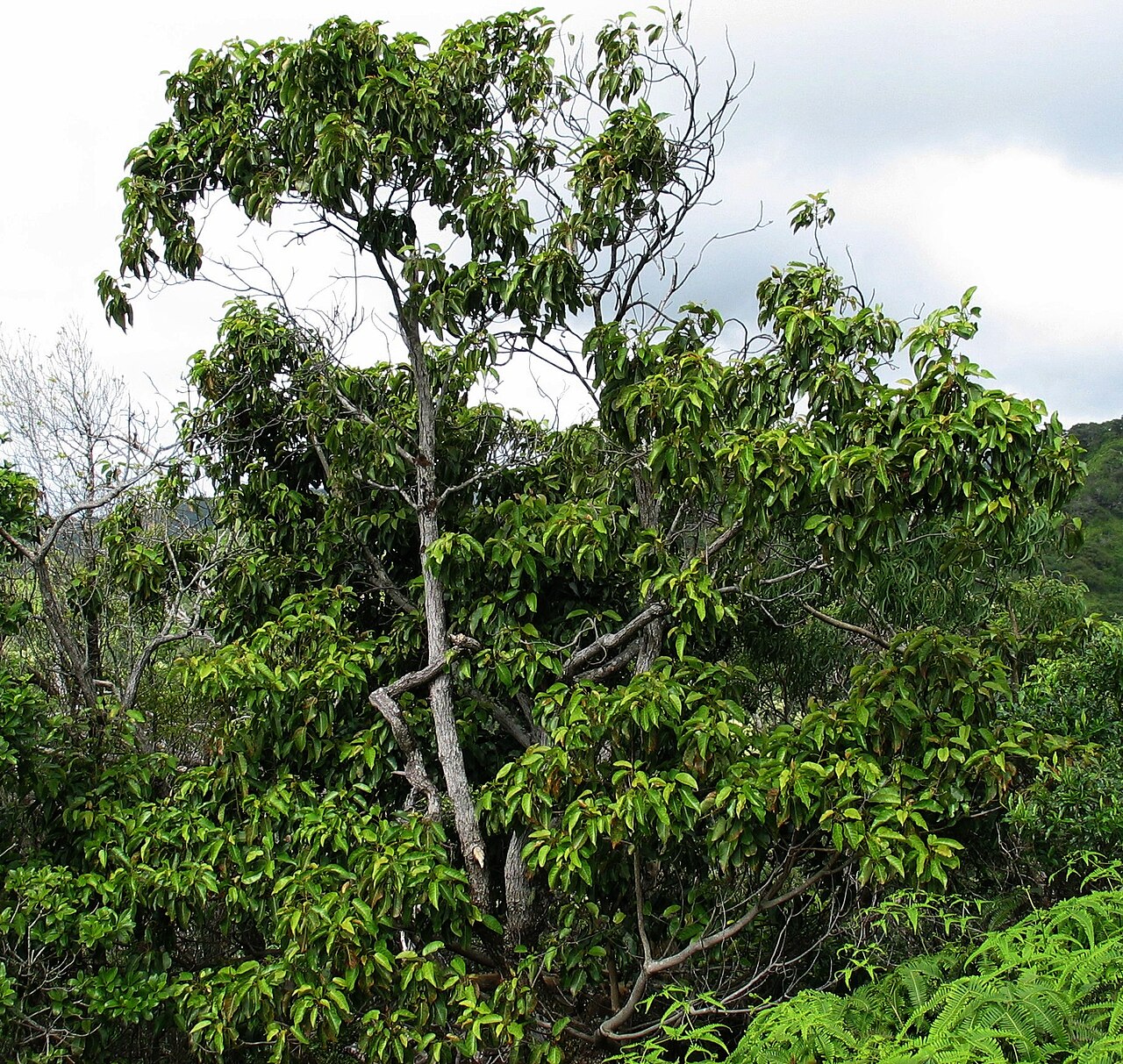
Elaeocarpus bifidus, known in Hawaiian as Kalia, is an evergreen tree found only on the islands of Kauaʻi and Oʻahu. It is the only native Hawaiian member of the genus Elaeocarpus, a large group of tropical trees sometimes called blueberry ash or quandong in other parts of the Pacific. Kalia has glossy, wavy-toothed leaves, small greenish-yellow bell-shaped flowers and olive-like fruits.
Kalia grows in mesic and wet forests, often on ridges and slopes in the Koʻolau and Waiʻanae ranges of Oʻahu and the mountains of Kauaʻi. It was an important tree in old Hawaiʻi: its tough bark fiber was twisted into cordage, its slender branches were used in house building, and it was a source of dark dye.
Kalia is assessed as Endangered on the IUCN Red List, although it is not listed under the U.S. Endangered Species Act. It is an attractive and worthwhile tree for native gardens and restoration on Oʻahu and Kauaʻi. This guide covers how to recognize kalia, where it grows, how to grow it, and its place in Hawaiian culture.
Identification
Kalia is a medium-sized tree that can be mistaken for several other glossy-leaved forest trees. Look for its toothed leaves with hairy undersides, its red old leaves and, in season, its dangling clusters of small bell-shaped flowers.
Growth Habit
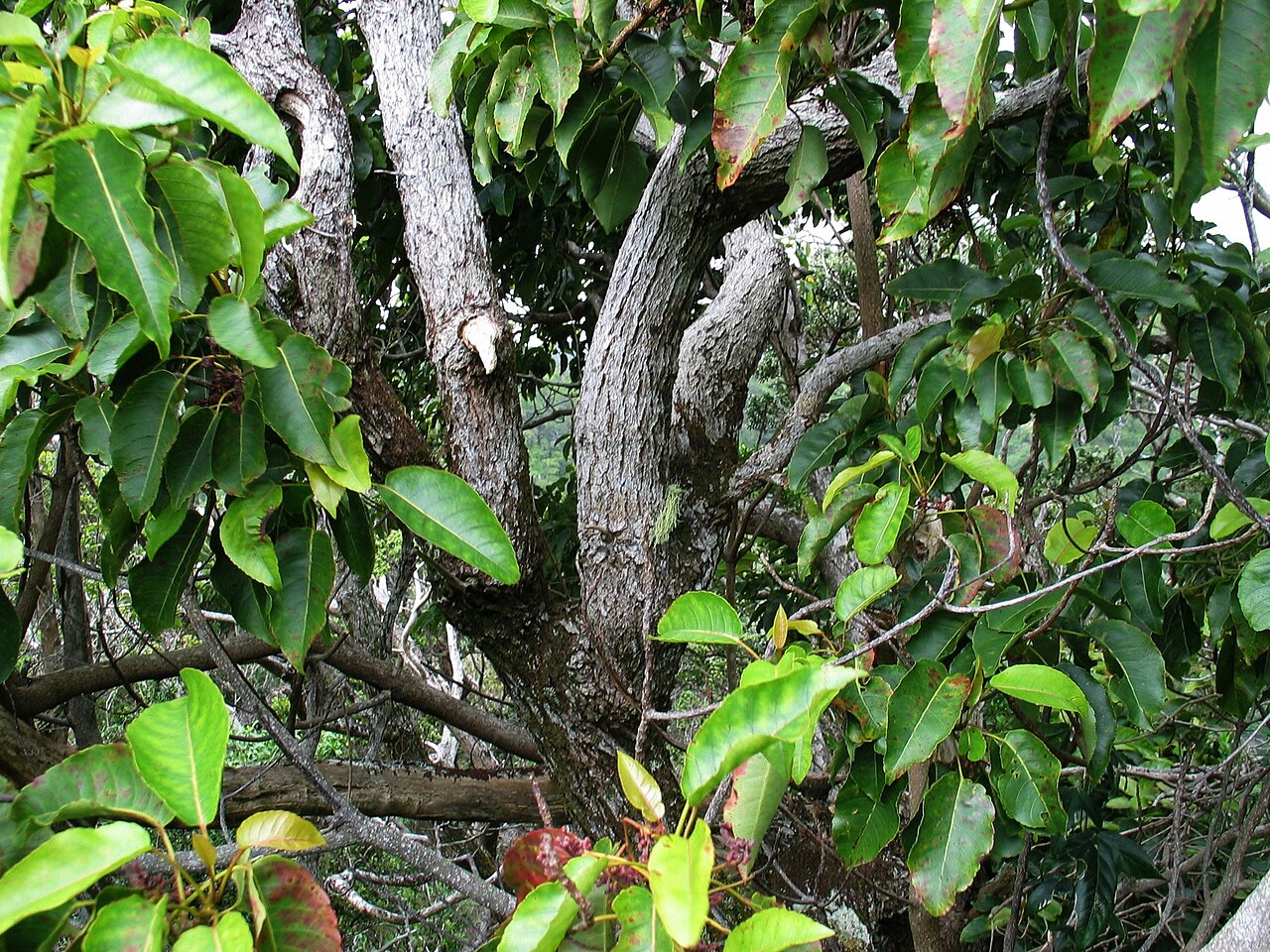
Kalia is an evergreen tree usually 15 to 40 feet tall, with a smooth gray trunk and a rounded to spreading crown. Branches are often clustered and somewhat tiered, with leaves concentrated near their tips. In exposed ridge sites it may be shrubby.
Leaves
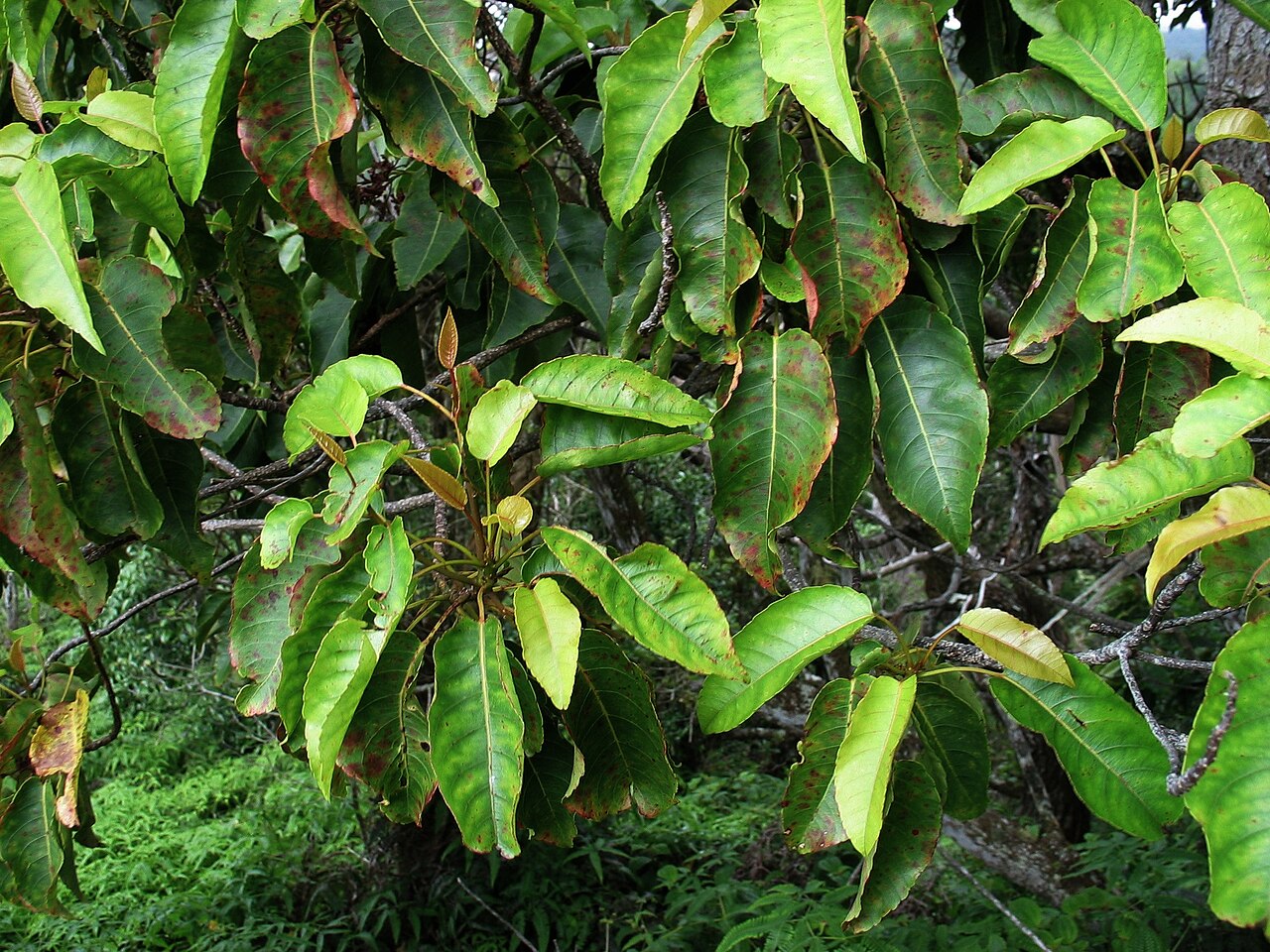
The leaves are alternate, ovate to lance-shaped, about 3 to 6 inches long and 1.5 to 4 inches wide, thin and somewhat papery, with shallowly wavy-toothed margins. They are glossy green above and covered with fine hairs below. Old leaves often turn bright red before falling, a trait shared with many Elaeocarpus species.
Flowers
Small, bell-shaped, pale greenish-yellow flowers hang in clusters (racemes) about 1 to 3 inches long from the leaf axils. As in other Elaeocarpus, the petals are notched or fringed at the tips, and each flower has many small stamens.
Fruit
The fruit is an olive-like drupe with a thin fleshy layer around a single hard, ridged stone. The genus name Elaeocarpus means olive fruit, after this resemblance.
Similar Species
Kalia is the only native Elaeocarpus in Hawaiʻi. Native trees like Olopua and ʻĀlaʻa also have glossy leaves, but olopua has smooth-edged opposite leaves and ʻālaʻa has milky sap and rusty-hairy leaf undersides.
Quick Facts
| Scientific Name | Elaeocarpus bifidus Hook. & Arn. |
| Family | Elaeocarpaceae (elaeocarpus family) |
| Plant Type | Evergreen tree; endemic to Kauaʻi and Oʻahu |
| Mature Height | 15–40 ft |
| Mature Spread | 10–25 ft |
| Growth Rate | Moderate |
| Sun Exposure | Full sun to part shade |
| Water Needs | Medium to high; regular moisture |
| Soil Type | Moist, well-drained loam or volcanic soil |
| Soil pH | About 5.0–6.5 |
| Bloom Time | Mainly spring and summer |
| Flower Color | Pale greenish-yellow |
| Fall Color | None; evergreen, old leaves turn red before dropping |
| Fruit | Olive-like drupe with a hard stone |
| Deer Resistant | Unknown; seedlings damaged by pigs and goats |
| USDA Hardiness Zones | 10–12 |
Native Range
Kalia is endemic to the Hawaiian Islands, where it grows only on Kauaʻi and Oʻahu. On Oʻahu it is found in both the Koʻolau and Waiʻanae mountains, and on Kauaʻi it grows in mountain forests across the island.
It grows in mesic and wet forests from about 300 to 4,000 feet, on slopes, ridges and in gulches, together with trees such as ʻŌhiʻa Lehua, Koa and Kōpiko, and an understory of ferns and shrubs.
Kalia is assessed as Endangered on the IUCN Red List because its range is small and its forest habitat has been reduced and degraded. It is not listed under the U.S. Endangered Species Act. Threats include invasive trees and shrubs such as strawberry guava and Koster’s curse, feral pigs, and the general loss of native lowland and mesic forest.
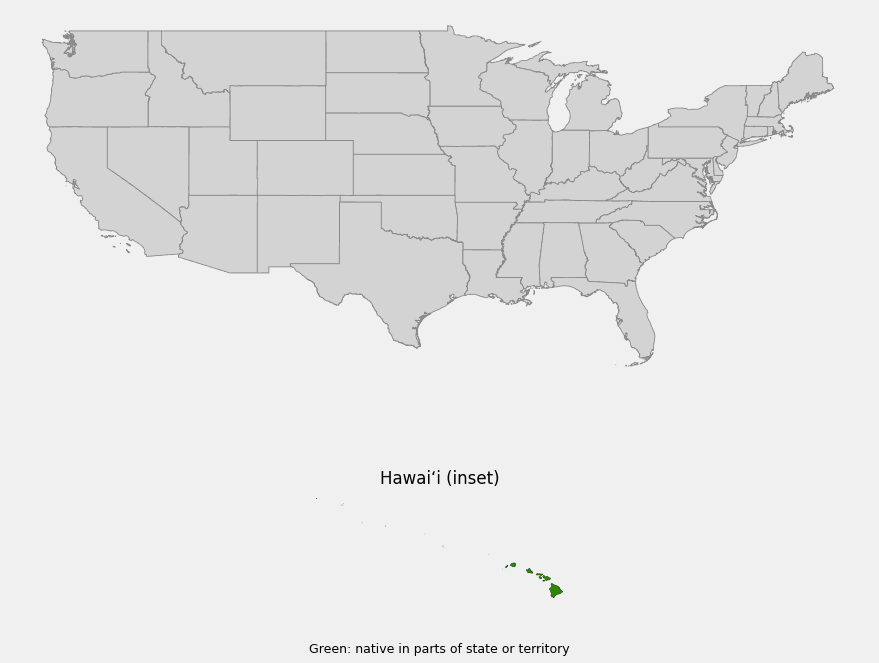
📋 Regional plant lists featuring Kalia: Hawaii
Growing & Care Guide
Kalia is not common in nurseries, but Hawaiʻi native plant nurseries occasionally offer it, and it makes a handsome specimen or shade tree for gardens with regular rainfall or irrigation. It is best suited to Oʻahu and Kauaʻi gardens at low to middle elevations with mesic to wet conditions. Buy only nursery-propagated trees, and never collect seed or plants from the wild without permission. Hawaiʻi restricts bringing plants in from other states.
Light
Kalia grows in full sun to part shade. Young trees appreciate some shade, as they would get under a forest canopy, and mature trees do well in full sun if they have enough water.
Soil & Water
Plant in moist, well-drained soil rich in organic matter. Water regularly, especially in dry leeward areas, and mulch around the base to keep the roots cool. It does not tolerate long drought or waterlogged soil.
Planting Tips
Give it room to reach about 20 to 30 feet in a garden. It works well as a specimen tree, as part of a mixed native canopy with ʻōhiʻa, kōpiko and hame, or along a property edge. Protect young trees from strong, dry winds.
Pruning & Maintenance
Little pruning is needed. Remove dead or crossing branches and shape young trees lightly to encourage a strong central leader. The red old leaves drop throughout the year and make a colorful mulch.
Propagation
Kalia is usually grown from seed. Clean the flesh from ripe fruits and sow the stones promptly; germination of the hard stones can be slow and uneven, taking several months. Air layering and cuttings are possible but less commonly used.
Landscape Uses
- Specimen tree: glossy foliage and red old leaves for native gardens
- Mesic forest restoration: a canopy tree for restoring Oʻahu and Kauaʻi forests
- Cultural plantings: a traditional source of cordage fiber and building material
- Shade: a medium-sized evergreen shade tree for moist gardens
- Conservation: growing it helps safeguard an IUCN-Endangered endemic
Wildlife & Ecological Value
Kalia is part of the native canopy that once covered much of the mesic and wet forest of Oʻahu and Kauaʻi.
For Pollinators
The small bell-shaped flowers are visited by insects, including native bees and moths, which feed on their pollen and nectar.
For Birds
Native forest birds forage for insects among kalia foliage. Its fruits may once have been dispersed by native birds, many of which are now rare or extinct.
For Mammals
Hawaiʻi’s only native land mammal, the Hawaiian hoary bat, forages over native forest. Introduced pigs and rats damage seedlings and eat seeds.
Ecosystem Role
Kalia contributes to the native canopy and understory of mesic and wet forests, shading out invasive plants and providing habitat for native insects, snails and birds.
Cultural & Historical Uses
Kalia was a useful tree in traditional Hawaiian life. The fibrous inner bark was used to make cordage, and its slender branches and larger limbs were used for the framework and rafters of thatched houses. A black and blue dye was also made from the plant.
The species was described by William Jackson Hooker and George Arnott Walker-Arnott in 1832, from specimens collected during the voyage of HMS Blossom. Its genus, Elaeocarpus, contains several hundred species across Asia, Australia and the Pacific, including the blue-fruited quandong of Australia and the rudraksha tree, whose seeds are used as prayer beads in India.
Today kalia is grown by conservation programs and native plant nurseries on Oʻahu and Kauaʻi, and it is a recognizable tree along trails such as the Kalauao Trail in the Koʻolau Mountains.
Frequently Asked Questions
Is kalia native to Hawaiʻi?
Yes. Kalia (Elaeocarpus bifidus) is endemic to Hawaiʻi and grows only on Kauaʻi and Oʻahu.
Is kalia endangered?
It is assessed as Endangered on the IUCN Red List, but it is not listed under the U.S. Endangered Species Act. Its habitat has been reduced by invasive plants, feral pigs and forest loss.
What was kalia used for?
Hawaiians used the bark fiber to make cordage, the branches and limbs in house building, and the plant as a source of dark dye.
Can I grow kalia in my garden?
Yes, in moist, well-drained soil with regular water, especially on Oʻahu and Kauaʻi at low to middle elevations. Buy nursery-propagated trees from Hawaiʻi native plant nurseries.
Why do kalia leaves turn red?
Old leaves turn red before they fall, a trait common in Elaeocarpus. It is normal and does not mean the tree is unhealthy.

Looking for a nursery that carries Kalia?
Browse our native plant nursery directory: Hawaii

