Ashy Silktassel (Garrya flavescens)
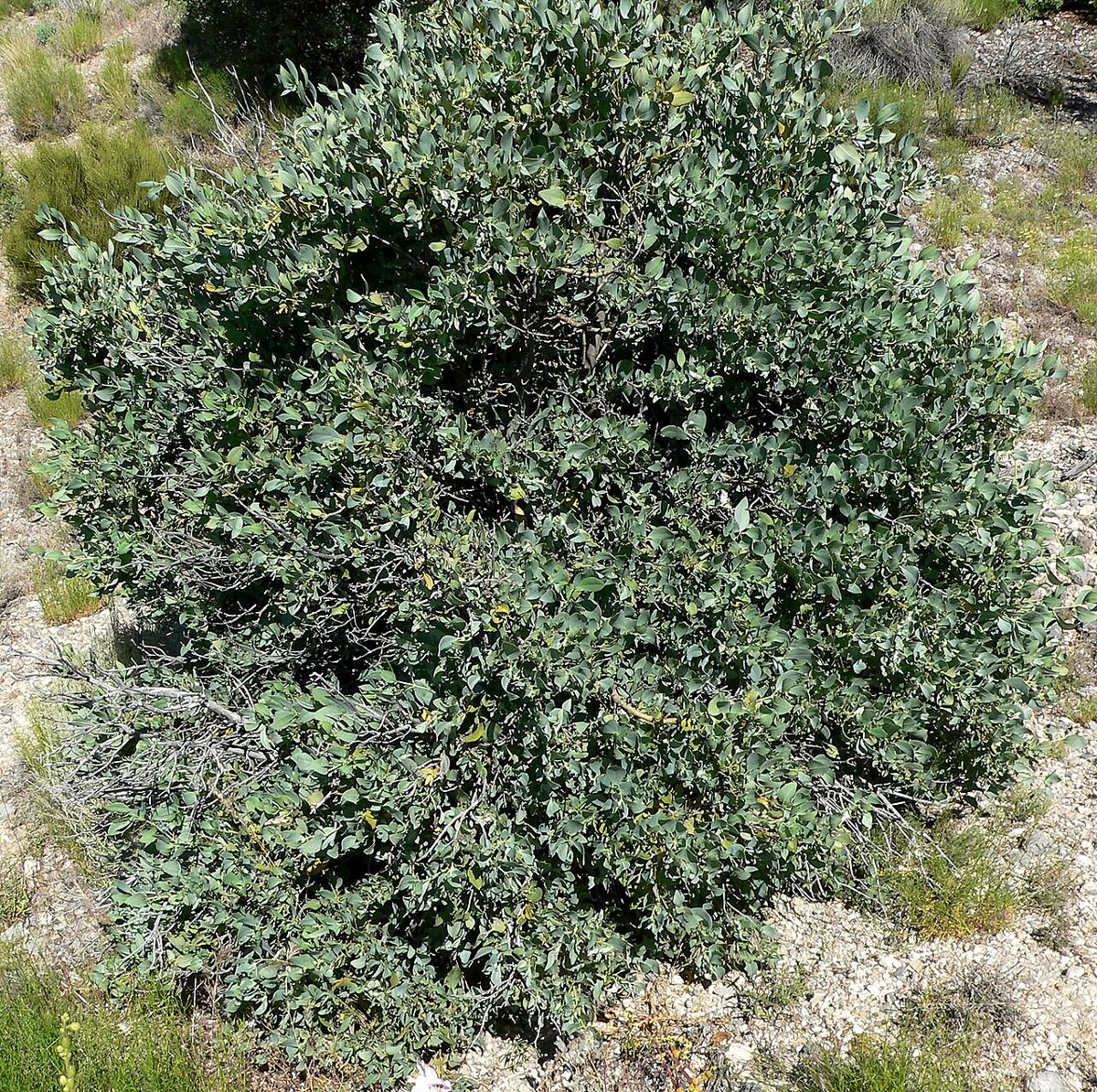
Garrya flavescens, commonly known as ashy silktassel or yellowleaf silktassel, is a tough evergreen shrub of the Southwest’s dry mountains and desert foothills, named for the pale, ashy-gray cast of its leaves and the long, silky tassels of flowers and fruit that hang from its branches in late winter and spring. It belongs to Garryaceae, a small family best known for these distinctive drooping flower chains, and it is one of the more cold-hardy and drought-tolerant members of its genus.
Ashy silktassel typically grows as a dense, rounded shrub 3 to 10 feet tall, with stiff, leathery, gray-green leaves held opposite each other on the stem. In late winter the shrub produces its signature feature: pendant catkin-like tassels of small flowers, several inches long, that dangle from the branch tips well before most other chaparral and desert shrubs begin to bloom. These give way to clusters of small, round, berry-like fruit that darken from green to purple-black as they mature.
For gardeners in its native range, ashy silktassel offers year-round structure, striking winter and early-spring flower tassels, and exceptional toughness in dry, rocky soils where few other evergreen shrubs thrive. It asks for very little once established and is well suited to naturalistic desert and foothill landscaping.
Identification
Ashy silktassel is a multi-stemmed, densely branched evergreen shrub, usually 3 to 10 feet tall and about as wide, occasionally reaching small-tree size in favorable sites. The overall form is rounded to mounding, with stiff branches and a fairly dense canopy of opposite leaves.
Stems
Young twigs are gray and finely hairy, becoming smooth and gray-brown with age. Branching is opposite, in keeping with the leaf arrangement, which gives the shrub’s branch structure a somewhat regular, criss-crossed look compared to many alternate-branched desert shrubs.
Leaves
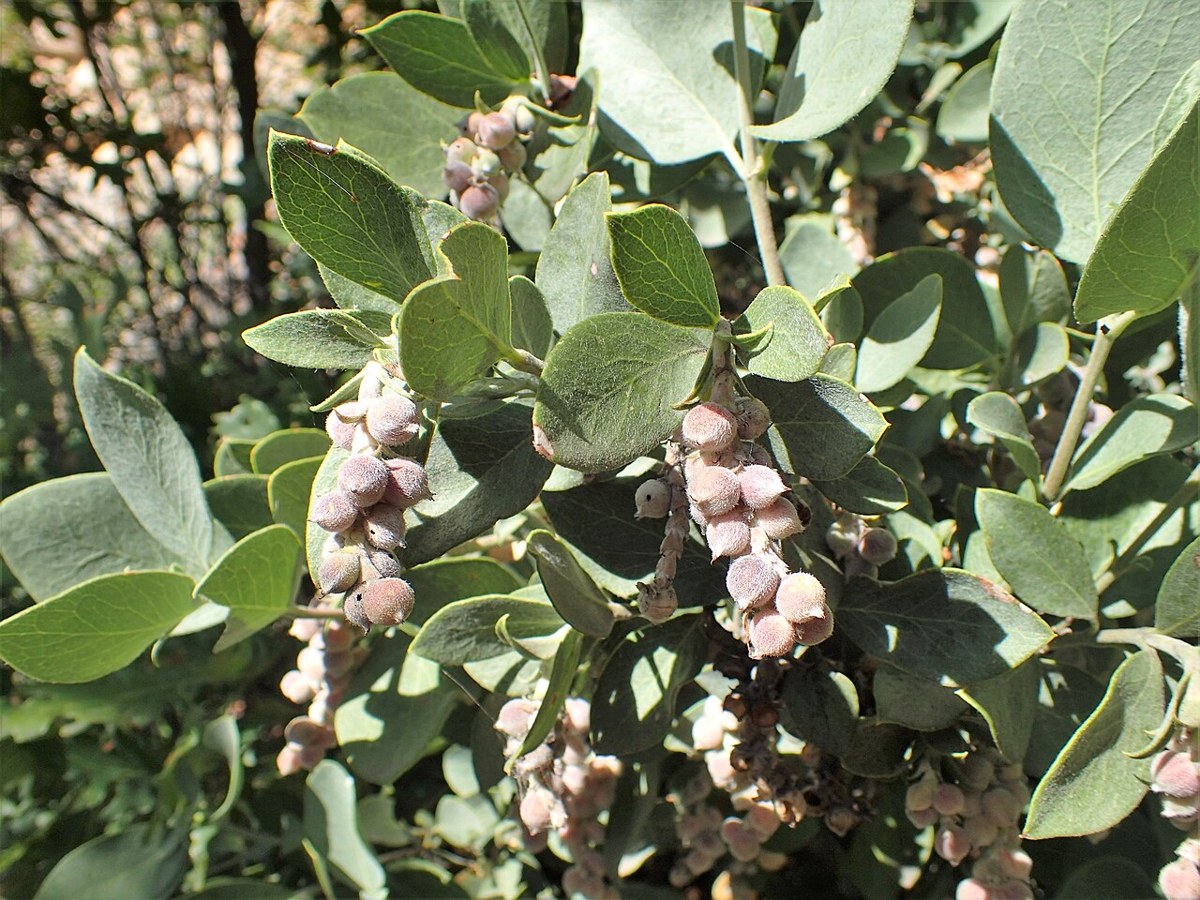
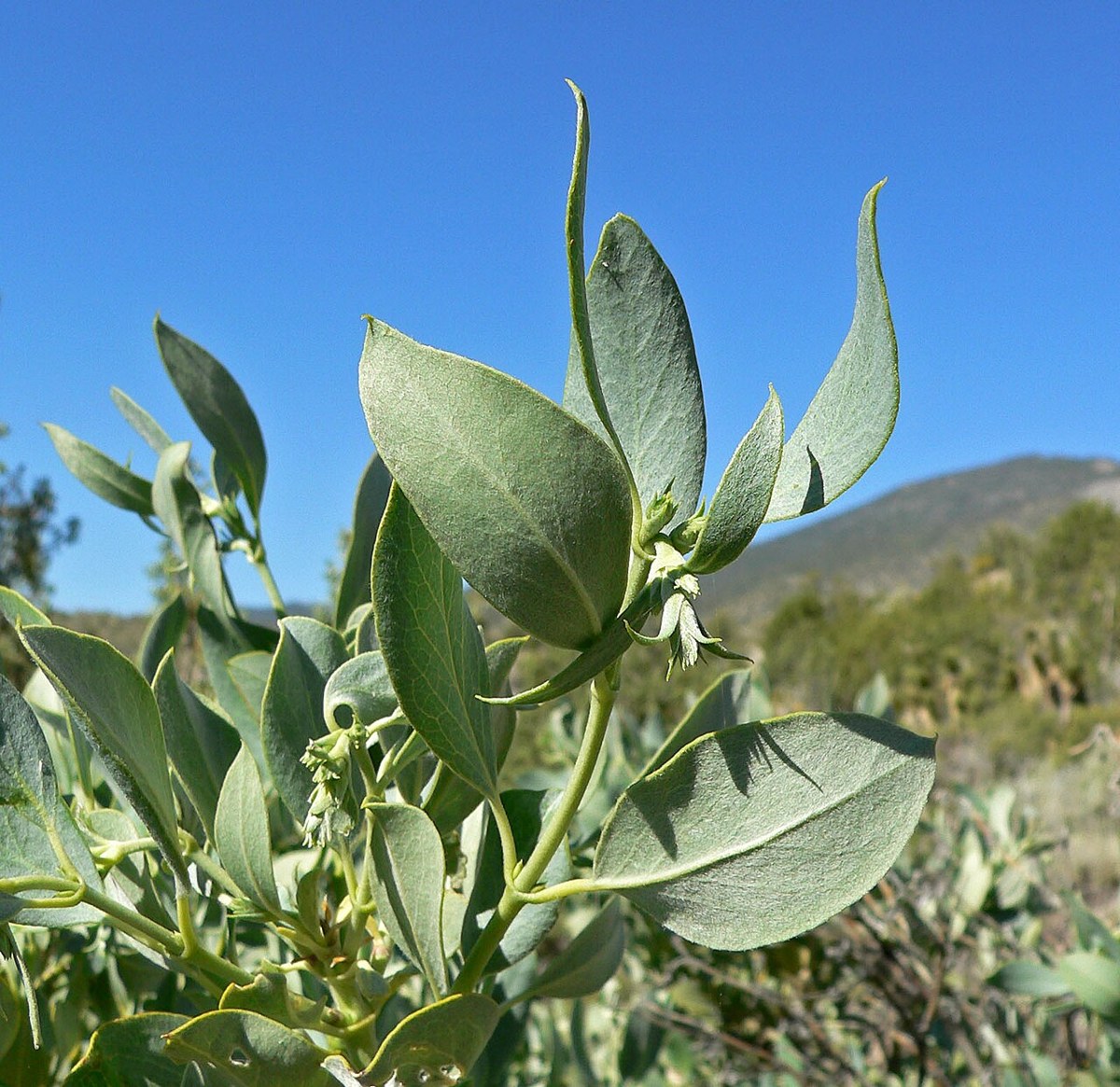
The leaves are opposite, evergreen, oval to elliptic, and 1 to 3 inches long, with smooth or slightly wavy margins. They are leathery and stiff to the touch, pale gray-green to grayish on both surfaces (sometimes more gray beneath), with a somewhat dusty or ashy look that gives the species its common name. This grayish, leathery leaf is one of the easiest ways to distinguish ashy silktassel from greener-leaved chaparral shrubs growing nearby.
Flowers & Fruit
Ashy silktassel is dioecious, meaning individual plants are either male or female. Flowers appear from January into April in drooping, catkin-like tassels 2 to 6 inches long at the branch tips; male tassels are typically longer and showier than the shorter female tassels. The tiny flowers lack petals and are wind-pollinated, a trait shared across the genus. On female plants, the flowers develop into small, round, berry-like fruits about ¼ to ⅜ inch across, covered in fine silky hairs when young, that ripen from green to dark purple or nearly black by summer.
Quick Facts
| Scientific Name | Garrya flavescens |
| Family | Garryaceae (Silktassel) |
| Plant Type | Evergreen shrub (occasionally small tree) |
| Mature Height | 3–10 ft |
| Mature Spread | 3–8 ft |
| Growth Rate | Slow |
| Sun Exposure | Full Sun to Part Shade |
| Water Needs | Low; drought tolerant once established |
| Soil Type | Rocky, gravelly, or sandy; must drain well |
| Soil pH | Neutral to alkaline (about 6.5–8.0) |
| Bloom Time | January – April |
| Flower Color | Pale green to cream, in drooping tassels |
| Fall Color | None (evergreen) |
| Fruit | Round purple-black berry-like fruit, female plants only |
| Deer Resistant | Yes |
| USDA Hardiness Zones | 7–10 |
Native Range
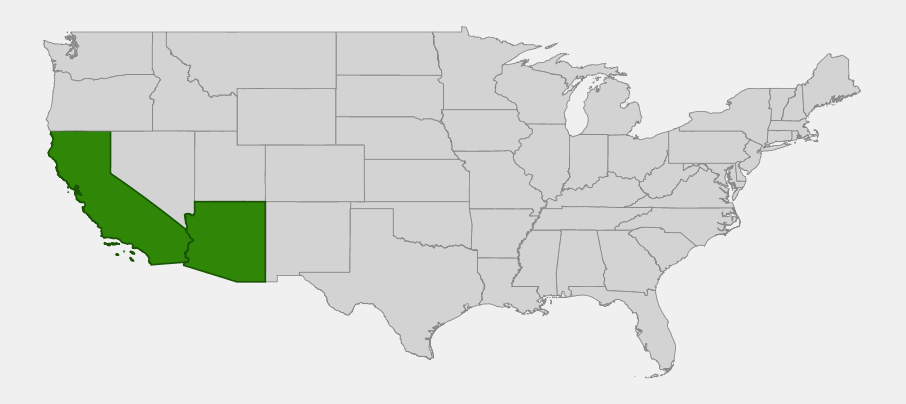
Ashy silktassel is native to California and Arizona, where it grows through the desert mountain ranges and foothill chaparral of the southern and eastern parts of its range. County-level records confirm the species across much of Southern California — from the Transverse and Peninsular ranges east through the desert mountains — and across central and western Arizona.
Nevada, Utah, and New Mexico appear within the broader shaded range on some coarse maps, but county-level botanical records do not confirm ashy silktassel as native in those states, so this page lists only California and Arizona as confirmed native range.
Typical habitat is dry, rocky slopes and canyons in desert mountain ranges, pinyon-juniper woodland, and chaparral, usually between about 2,000 and 7,000 feet elevation. It often grows on exposed, sun-baked slopes with thin, well-drained soils where few other evergreen shrubs can compete, and it is not considered rare anywhere in its range.
📋 Regional plant lists featuring Ashy Silktassel: California & Nevada · Arizona & New Mexico
Growing & Care Guide
Ashy silktassel is a slow but steady grower that rewards patience with a tough, long-lived evergreen shrub needing very little care once it settles into the garden.
Light
Full sun produces the densest, most compact growth and the heaviest flower tassels. The shrub also tolerates part shade, especially in hot, low-elevation gardens, where some afternoon shade can reduce summer stress, though growth will be looser and bloom lighter.
Soil & Water
This is a plant for sharply drained, rocky, or gravelly soil; it does not tolerate heavy clay or soil that stays wet. Once established, usually after the first one to two years, ashy silktassel needs little to no supplemental water and is an excellent choice for a true dry garden or rock garden. Overwatering, particularly in summer, is the main way gardeners lose this otherwise tough shrub.
Planting Tips
Plant in fall or late winter so roots can establish during the cooler, wetter months before summer heat arrives. Choose a site with excellent drainage, such as a slope or raised bed. Because the species is dioecious, gardeners hoping for fruit and the ornamental winter tassels on female plants should plant more than one specimen to improve the odds of getting both sexes, though male plants alone still provide attractive flower display.
Pruning & Maintenance
Ashy silktassel needs little pruning. Remove dead or damaged wood after the flowering period and shape lightly if a more formal look is wanted, but avoid heavy cutting into old wood, which the shrub is slow to recover from. It needs no regular fertilizer and has few pest or disease problems in the dry, well-drained conditions it prefers.
Landscape Uses
- Dry rock gardens and xeriscapes where little or no irrigation is available
- Desert foothill and chaparral restoration on rocky, well-drained slopes
- Winter interest plantings, since the flower tassels appear when little else is blooming
- Screening and informal hedges, given the shrub’s dense, rounded form
- Wildlife gardens that benefit from its evergreen cover and winter nectar
- Low-maintenance foundation plantings in hot, dry climates
Wildlife & Ecological Value
Ashy silktassel provides year-round structure and an unusually early source of food in the desert mountain and chaparral ecosystems where it grows.
For Pollinators
The wind-pollinated flowers do not rely on insects for pollination, but the tassels still draw some insect visitors seeking pollen, and the early winter bloom time means the shrub offers a resource when little else in the landscape is flowering.
For Birds
The dense, evergreen canopy offers year-round nesting and roosting cover for small birds in otherwise sparse desert mountain habitat. Birds such as towhees and sparrows forage in and around the shrub, and the dark, ripe fruit on female plants is eaten by a variety of fruit-eating birds in summer and fall.
For Mammals
Small mammals use the dense branching for cover from predators and weather, and some rodents and other wildlife feed on the ripe fruit. The shrub’s unpalatable, leathery leaves make it a low priority for deer browse, adding to its value as reliable, long-lasting cover.
Ecosystem Role
As one of relatively few evergreen shrubs on the hot, dry slopes it occupies, ashy silktassel adds structural diversity and year-round cover to desert mountain and chaparral plant communities. Its slow growth and long lifespan mean established stands can persist for decades, anchoring soil on steep, rocky slopes where erosion risk is high.
Cultural & Historical Uses
Ashy silktassel has a far more modest documented history of use than many Southwestern shrubs, in large part because its leathery leaves and small fruit offer little in the way of food or fiber value. Indigenous peoples of the desert Southwest, including groups in the Mojave and Sonoran desert regions, were familiar with the plant as part of the broader chaparral and pinyon-juniper landscape, though specific traditional uses of this particular species are not well documented compared to more utilitarian neighbors like yucca or agave.
The genus Garrya as a whole is named for Nicholas Garry, a Hudson’s Bay Company official who assisted the botanist David Douglas during his plant-collecting expeditions in the Pacific Northwest in the 1820s, connecting this desert shrub’s name to the broader history of North American botanical exploration.
Today, ashy silktassel’s primary value to people is horticultural: a rugged, low-water evergreen for desert and foothill gardens, prized by native-plant gardeners for its unusual winter flower tassels and its ability to thrive where few other evergreen shrubs will grow.
Frequently Asked Questions
Why are there only male flowers on my ashy silktassel?
Ashy silktassel is dioecious, meaning each plant is either male or female. If you planted an unsexed seedling or a single plant, there is roughly an even chance it turned out to be male, which will flower but never set fruit. Planting more than one specimen improves your odds of having both sexes for fruiting.
Is ashy silktassel the same as coast silktassel?
No. Ashy silktassel (Garrya flavescens) is a separate species from coast silktassel (Garrya elliptica), which grows along the California coast in moister conditions. Ashy silktassel is the more drought- and heat-tolerant of the two, suited to desert mountain and chaparral gardens rather than coastal ones.
How much water does ashy silktassel need?
Very little once established. Water regularly for the first one to two years after planting, then reduce watering significantly. Established plants are genuinely drought tolerant and often suffer more from overwatering than underwatering.
When does ashy silktassel bloom?
It blooms unusually early, typically from January into April, with the drooping flower tassels often appearing while many other native shrubs are still dormant. This makes it a valuable source of winter garden interest.
Is ashy silktassel deer resistant?
Yes. Its stiff, leathery leaves are not a preferred browse for deer, making it a reliable choice in gardens where deer pressure is a concern.

Looking for a nursery that carries Ashy Silktassel?
Browse our native plant nursery directory: California · Arizona