Scouler’s Willow (Salix scouleriana)
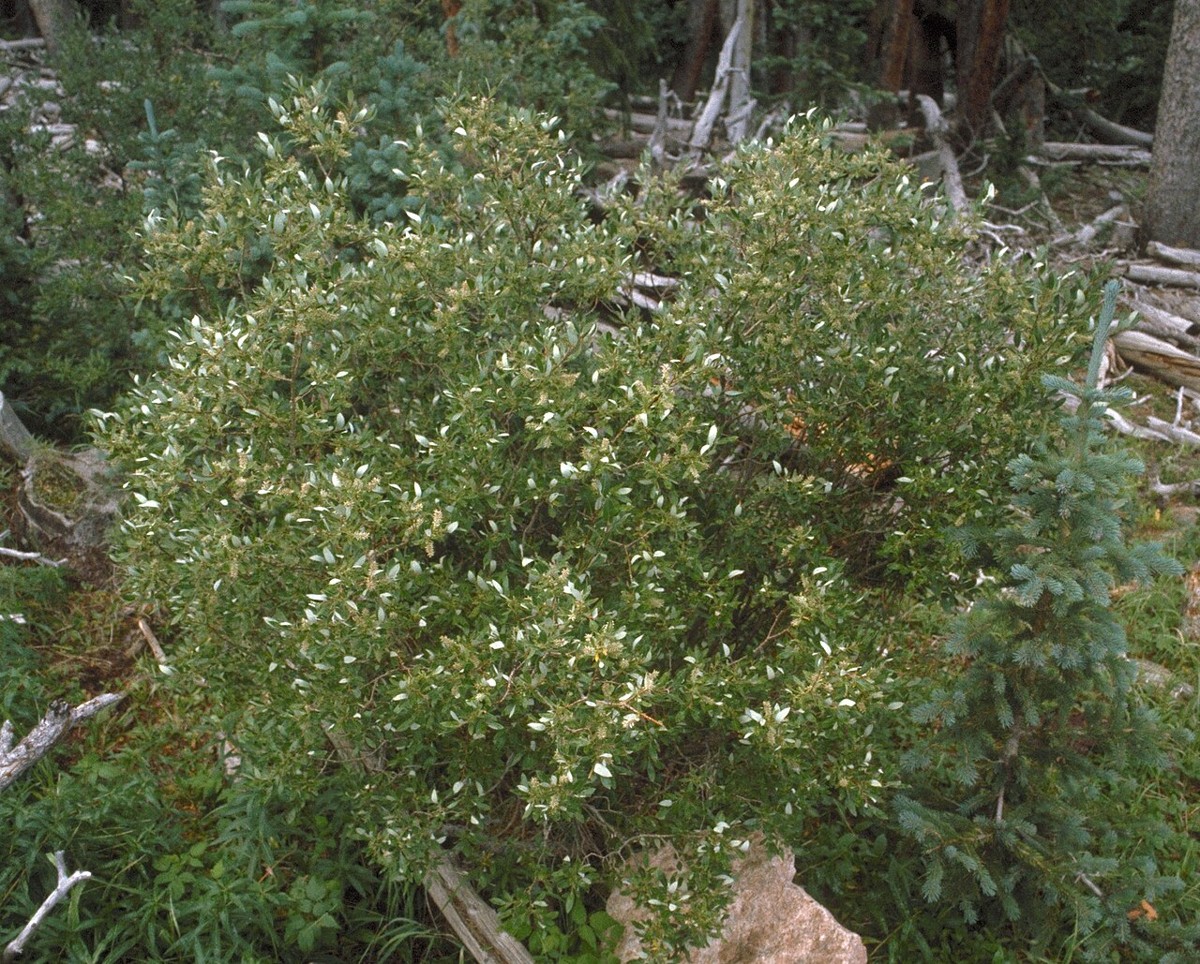
Salix scouleriana, commonly called Scouler’s willow or upland willow, is one of the most widespread and adaptable native willows of western North America. Unlike most willows, which hug streambanks and wetland edges, Scouler’s willow is equally at home on dry hillsides, open forest, clearcuts and mountain slopes far from any standing water — a trait that sets it apart from nearly every other species in its genus. It typically grows as a large, multi-stemmed shrub or small tree, 15 to 30 feet tall, though it can be stunted to a tangled 6-foot shrub on exposed, rocky sites.
The species is named for the Scottish naturalist John Scouler, who collected plants along the Pacific coast in the 1820s. It is instantly recognizable in late winter and early spring, when its fat, silvery-gray flower buds swell and open into fuzzy “pussy willow” catkins well before the leaves emerge, turning the whole shrub silver and then gold with pollen. This early bloom makes it one of the most important early-season nectar and pollen sources for native bees across its enormous range, which stretches from south-central Alaska and the Yukon down through the Rocky Mountains to California, Arizona and New Mexico.
For gardeners in the Mountain West and Pacific states, Scouler’s willow fills a niche few other native shrubs can: a fast-growing, pioneer species that thrives in average, well-drained garden soil without the constant moisture most willows demand. It is an excellent choice for naturalizing a dry slope, screening a property line, or anchoring a wildlife garden where early pollinators and browsing animals are welcome visitors.
Identification
Scouler’s willow grows as a large shrub with several trunks arising from the base, or occasionally as a single-stemmed small tree. Mature plants commonly reach 15 to 30 feet, with trunks 4 to 10 inches in diameter, though plants on dry, exposed, high-elevation sites may stay a compact 6 to 10 feet. The crown is rounded and often broader than it is tall, with stout, upright branches.
Bark & Stems
Young twigs are stout, reddish-brown to yellowish-green, and finely hairy at first, becoming smooth and darker with age. The bark on older trunks is gray to grayish-brown, developing shallow fissures and flat-topped ridges that give it a texture closer to a small tree than a typical shrubby willow. Unlike many willows, Scouler’s willow does not spread by root suckers, so it keeps a tidy, clump-forming habit rather than colonizing outward.
Leaves
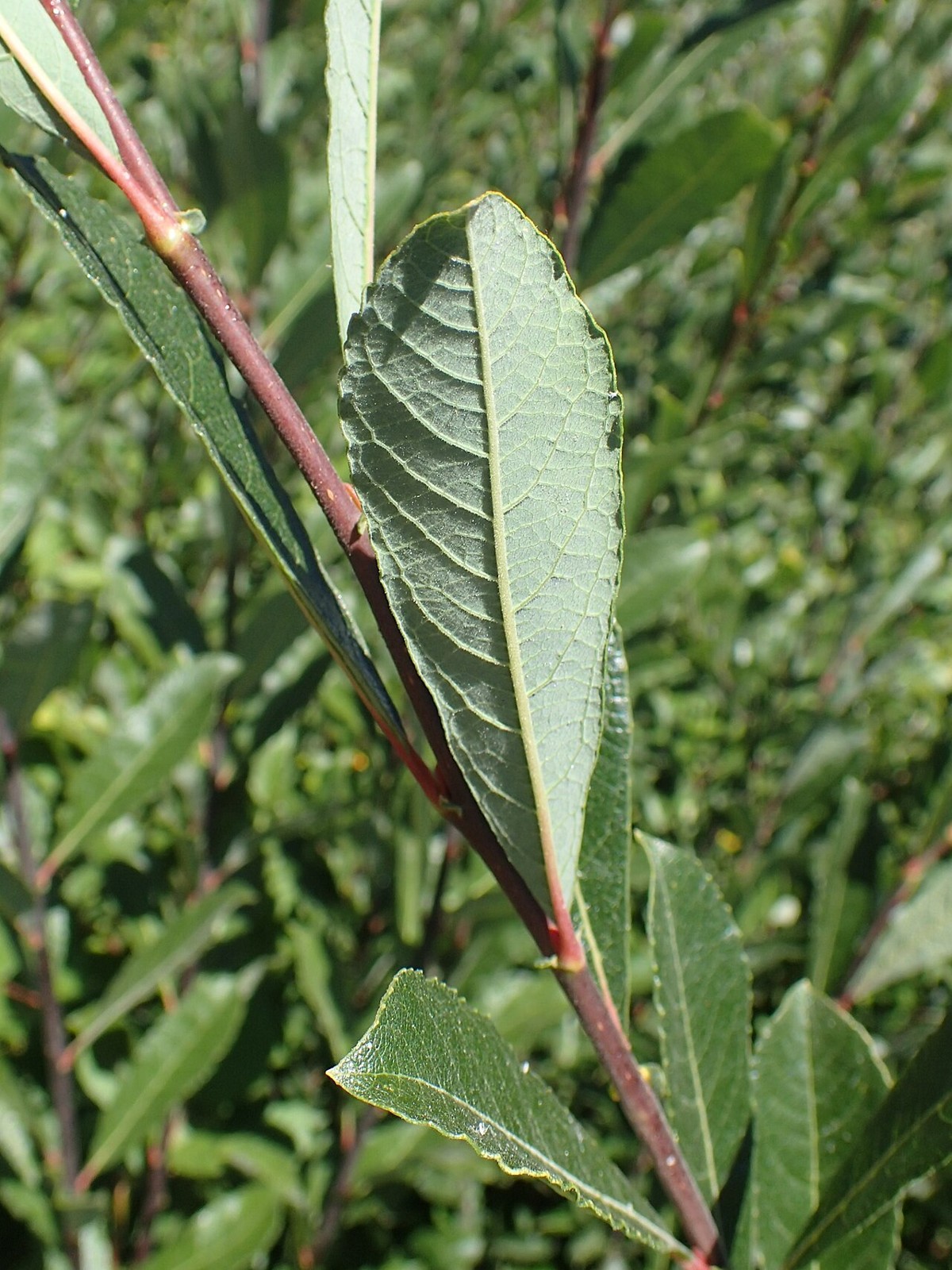
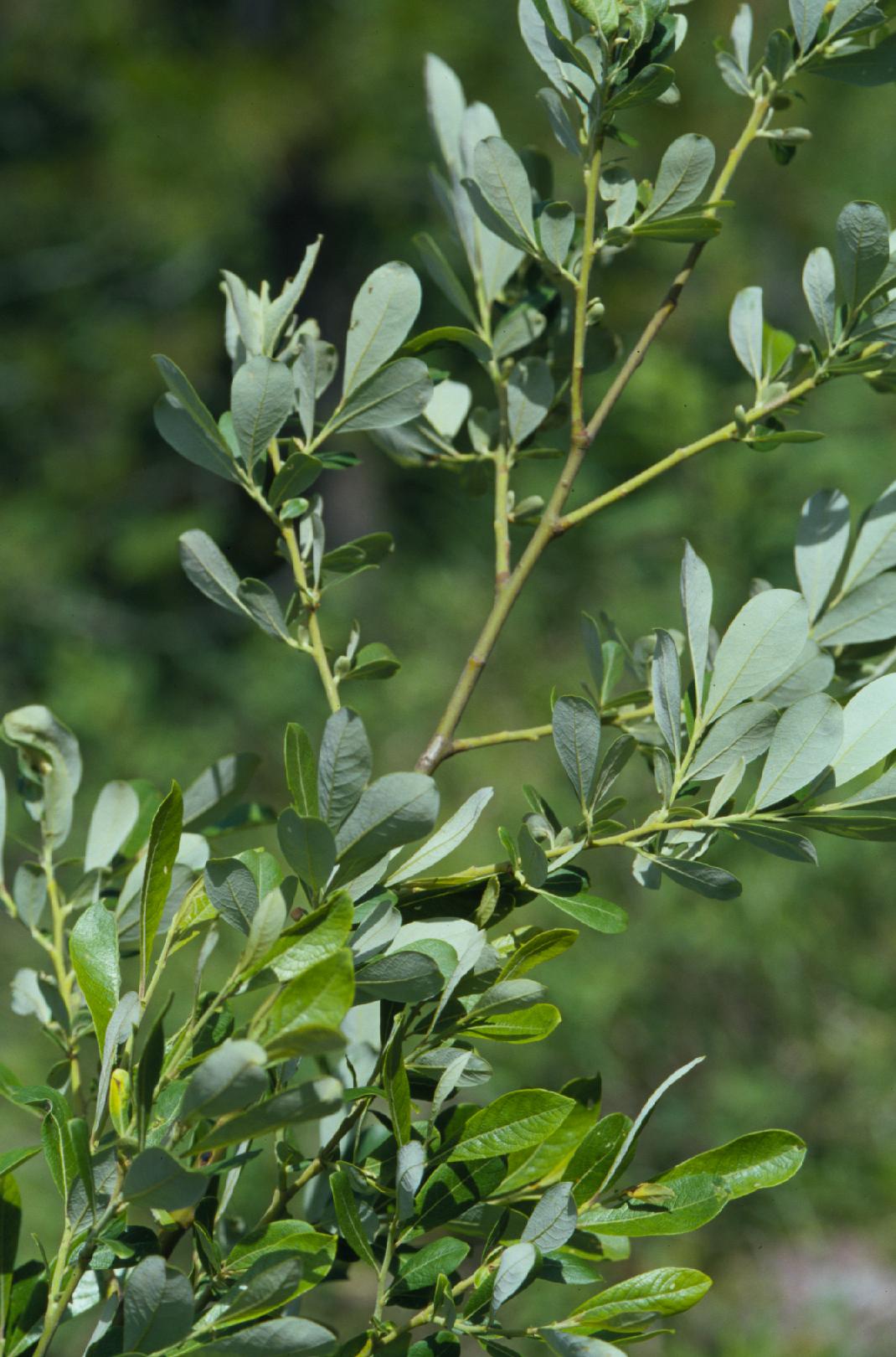
The leaves are simple, alternate, and quite variable in shape — typically oblong to obovate (widest above the middle), 2 to 4 inches long, with a rounded or blunt tip rather than the long tapering point seen on most willow leaves. The upper surface is dull green and often slightly hairy; the underside is a conspicuous whitish to rust-colored, with a fine network of raised veins that feels almost felted to the touch. This two-toned leaf, pale and net-veined beneath, is one of the most reliable field marks for the species. Fall color is a soft yellow.
Flowers
Like all willows, Scouler’s willow is dioecious, with separate male and female plants. Flowers appear in catkins before the leaves, from February to May depending on elevation and latitude — often the very first native shrub to bloom in its range. Male catkins are stout, silvery-silky ovals about 1 to 1.5 inches long that turn golden-yellow as the anthers open; female catkins are longer and more slender, maturing to green and then releasing seed by early summer.
Fruit & Seeds
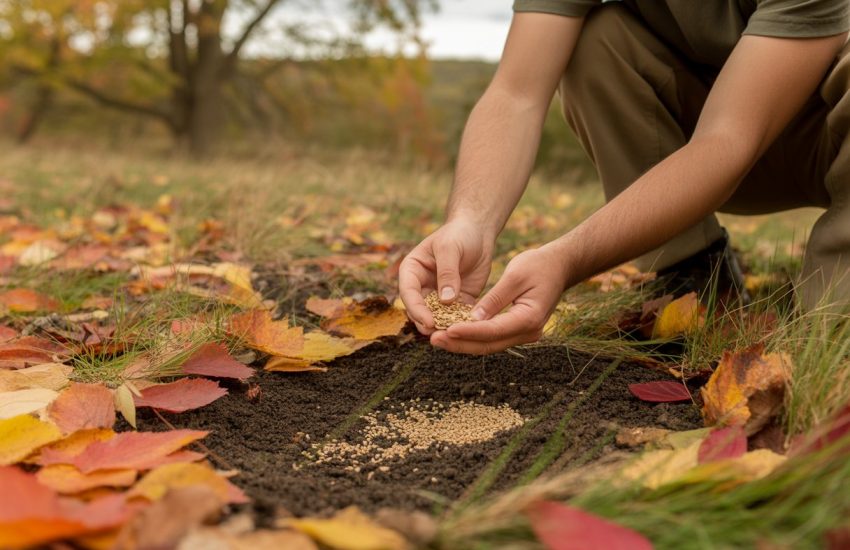
Female catkins ripen into clusters of small, hairy, light brown capsules that split open from May through July, releasing tiny seeds embedded in cottony fluff that rides the wind. Like other willows, the seeds remain viable for only a short time and need bare, moist soil to germinate, which is why Scouler’s willow is such a reliable early colonizer of burns, landslides and other disturbed ground.
Quick Facts
| Scientific Name | Salix scouleriana |
| Family | Salicaceae (Willow) |
| Plant Type | Deciduous large shrub / small tree |
| Mature Height | 15–30 ft (dwarfed to 6–10 ft on exposed sites) |
| Mature Spread | 10–20 ft |
| Growth Rate | Fast |
| Sun Exposure | Full Sun to Part Shade |
| Water Needs | Average; tolerates dry upland soils better than most willows |
| Soil Type | Adaptable — sandy, gravelly, rocky or loamy, well-drained |
| Soil pH | 5.0–7.5 |
| Bloom Time | February – May (before leaves) |
| Flower Color | Silvery-gray catkins aging to gold |
| Fall Color | Yellow |
| Fruit | Small hairy brown capsules with cottony seed, May–July |
| Deer Resistant | No (heavily browsed by deer, elk and moose) |
| USDA Hardiness Zones | 2–7 |
Native Range
Scouler’s willow has one of the broadest ranges of any western willow, running from south-central Alaska and the Yukon south through British Columbia, Alberta and Saskatchewan, and through essentially every western U.S. state from Washington and Montana south to California, Arizona and New Mexico. It is common from low valleys to subalpine elevations, and because it tolerates dry ground so well, it shows up in plant communities where few other willows ever grow.
Typical habitat includes open coniferous forest, forest edges and clearings, recently burned or logged ground, avalanche chutes, rocky slopes, and the margins of meadows — almost always on sites with good drainage rather than wet soil. It is a classic early-successional species, often one of the first woody plants to colonize a disturbed site, where it grows alongside species such as quaking aspen, lodgepole pine, Douglas-fir, chokecherry and serviceberry.
Because Scouler’s willow is so widely planted and naturally regenerates so readily after disturbance, it remains common and secure throughout its native range; it is not a species of conservation concern. Gardeners should still source nursery-propagated stock rather than transplanting wild shrubs, both out of respect for wild populations and because container-grown plants establish far more reliably.
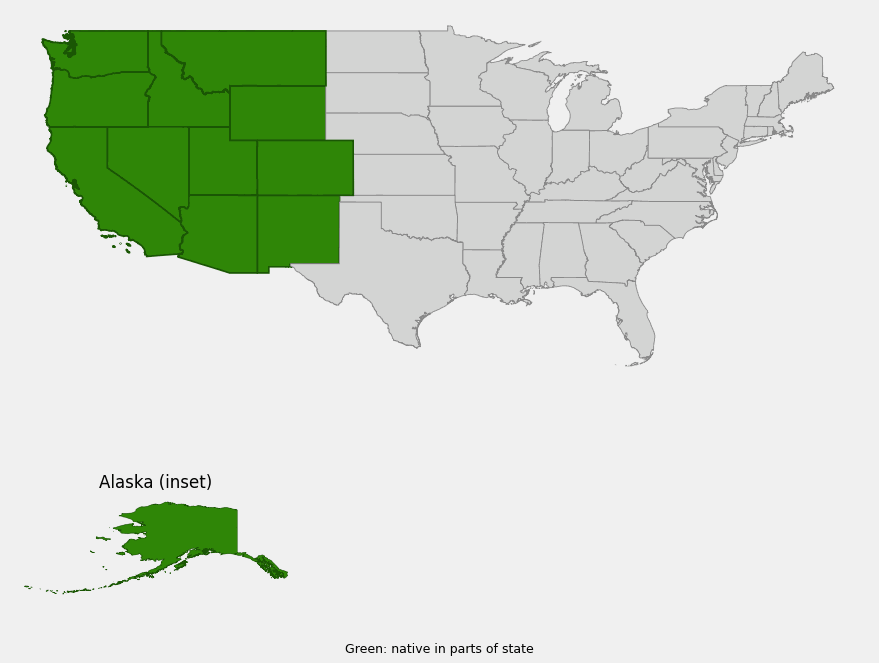
📋 Regional plant lists featuring Scouler’s Willow: California & Nevada · Western Oregon & Western Washington · Idaho, Eastern Oregon & Eastern Washington · Montana & Wyoming · Utah & Western Colorado · Nebraska, Kansas & Eastern Colorado · Arizona & New Mexico · Alaska
Growing & Care Guide
Scouler’s willow is one of the easiest native shrubs to establish because it does not demand the wet feet most willows need. Give it reasonable sun and drainage and it will grow quickly into a full, useful shrub.
Light
Plants flower and fill out best in full sun, but Scouler’s willow tolerates part shade, especially at lower, hotter elevations, where afternoon shade can keep the foliage from scorching in summer. In deep shade it becomes leggy and open.
Soil & Water
This is the rare willow that genuinely prefers well-drained ground. It grows in sandy, gravelly or rocky soils as readily as in average garden loam, and unlike streamside willows it does not want constantly wet roots. Water regularly through the first one to two growing seasons to establish a deep root system; after that, established shrubs handle normal garden watering or even summer drought in cooler climates. Avoid heavy, poorly drained clay that stays saturated.
Planting Tips
Plant container-grown stock in fall or early spring. Choose an open site with at least a half day of sun, and allow 10 to 15 feet of room for the shrub’s eventual spread if used as a specimen, or space plants 6 to 8 feet apart for a informal screen or hedgerow. Bare-root willow stakes and cuttings also root readily when cut during winter dormancy and pushed into moist, loosened soil.
Pruning & Maintenance
Scouler’s willow responds well to hard pruning and can be cut back nearly to the ground every few years to rejuvenate an older, leggy shrub and encourage dense new growth. Remove dead or crossing branches in late winter while plants are dormant. The shrub is generally free of serious pests, though like most willows it can host leaf-feeding beetles and aphids, which rarely cause lasting harm and feed birds in the process.
Propagation
Scouler’s willow grows readily from both seed and cuttings. Because willow seed stays viable only a week or two, it must be collected as soon as capsules split and sown immediately on bare, moist soil. Far easier for home gardeners is taking dormant hardwood cuttings in winter; pushed a few inches into moist soil, many willow cuttings root without any special treatment.
Landscape Uses
- Dry-slope restoration where most willows would fail from lack of moisture
- Wildlife hedgerow or screen planted in informal groups
- Early-pollinator garden — among the very first native shrubs to flower each year
- Post-fire or disturbed-site revegetation on forest and rangeland margins
- Mixed woodland edge plantings with quaking aspen and serviceberry
- Erosion control on rocky or sandy slopes
Wildlife & Ecological Value
Scouler’s willow punches well above its weight ecologically, in part because it blooms so early and grows in so many different habitats across its huge range.
For Pollinators
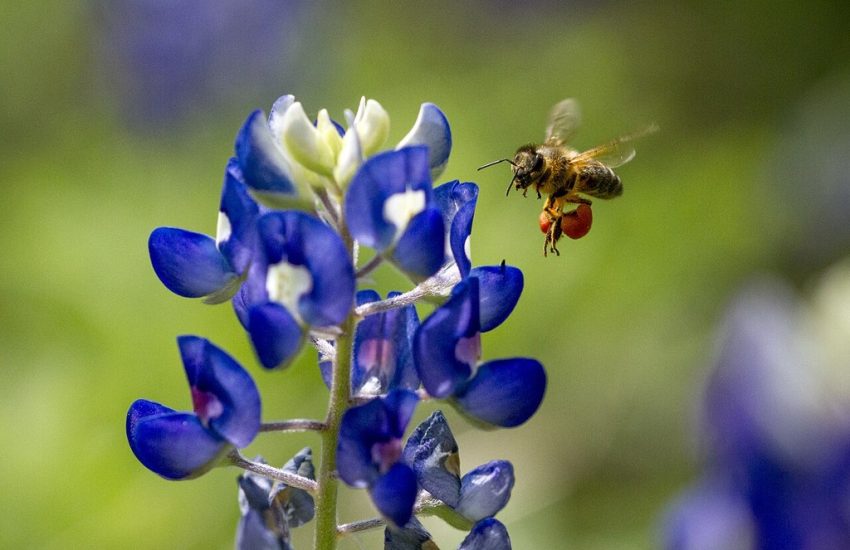
Its catkins are among the very first flowers available each year in much of the Mountain West and Pacific states, opening while snow often still lingers nearby. Native bees, including queen bumble bees just emerging from hibernation, rely heavily on this early pollen and nectar source, as do honeybees and many flies and beetles. Scouler’s willow is also a larval host plant for several native butterflies and moths, including swallowtails and mourning cloaks.
For Birds
The dense branching provides excellent nesting cover and concealment for songbirds, and the insects drawn to the foliage and catkins — including the caterpillars it hosts — are an essential protein source for nesting birds feeding their young. Seed-eating birds also pick at the cottony capsules in early summer.
For Mammals
Few native shrubs are browsed as heavily as willow. Deer, elk and moose eat the twigs and foliage, especially in winter and early spring, and Scouler’s willow is considered an important browse species across much of its range. Beavers use willow stems for both food and dam-building material where the shrub grows near water, and snowshoe hares browse young stems at ground level.
Ecosystem Role
As a fast-growing pioneer species, Scouler’s willow is often among the first woody plants to reestablish after fire, logging or landslides, stabilizing bare soil and creating shelter that allows slower-growing conifers and other shrubs to become established beneath it. Because it tolerates dry upland sites that true wetland willows cannot, it extends willow habitat value — early bloom, wildlife browse, insect host plant — into forest and rangeland settings far from any stream.
Cultural & Historical Uses
Many Indigenous peoples across the Pacific Northwest and Interior West used Scouler’s willow and other native willows for practical purposes. The flexible young stems were woven into baskets, fish traps and cordage, and the straight shoots were cut for arrow shafts and other tool handles. Willow bark, like that of several related species, contains salicin, the compound from which aspirin was later derived, and bark infusions were used historically among various tribal communities as a traditional remedy for pain and fever.
The species carries the name of John Scouler, a Scottish naturalist and ship’s surgeon who collected plants along the Columbia River and the Pacific coast in 1825 as part of a Hudson’s Bay Company expedition, working alongside the botanist David Douglas. Scouler’s broader collections helped introduce many Pacific Northwest native plants to European science.
In more recent history, Scouler’s willow has been valued by foresters and land managers less for direct human use and more for its role in reclaiming disturbed ground — it is frequently included in reforestation and erosion-control seed mixes for logged or burned sites throughout the Mountain West, where its drought tolerance lets it succeed on slopes too dry for other native willows.
Frequently Asked Questions
Does Scouler’s willow need to grow near water?
No. Unlike most willows, Scouler’s willow is genuinely drought-tolerant once established and often grows on dry, rocky slopes far from any stream. It is one of the few willows well suited to an ordinary garden bed with average watering.
How can I tell Scouler’s willow from other native willows?
Look at the leaf tip and underside. Scouler’s willow has blunt, rounded leaf tips rather than the long tapering point of most willows, and the leaf underside is pale and finely net-veined, almost felted. It also blooms earlier than most other willows, often in late winter.
Is Scouler’s willow a tree or a shrub?
Both forms occur. On good sites it grows as a small, single- or multi-trunked tree up to 30 feet; on dry, exposed or high-elevation sites it stays a dense, multi-stemmed shrub often under 10 feet.
Do deer damage Scouler’s willow in the garden?
Yes, expect browsing. Deer, elk and moose all eat willow twigs and foliage, which is part of its wildlife value but means young plants may need temporary protection in areas with heavy deer pressure.
When is the best time to plant Scouler’s willow?
Fall through early spring, while the plant is dormant, gives roots time to establish before summer heat. Bare-root cuttings taken in winter also root easily when planted directly into moist, loosened soil.

Looking for a nursery that carries Scouler’s Willow?
Browse our native plant nursery directory: Washington · Oregon · California · Idaho · Nevada & New Mexico · Utah · Colorado · Montana · Wyoming · Alaska & Arizona