
Avalanche Lily (Erythronium montanum)
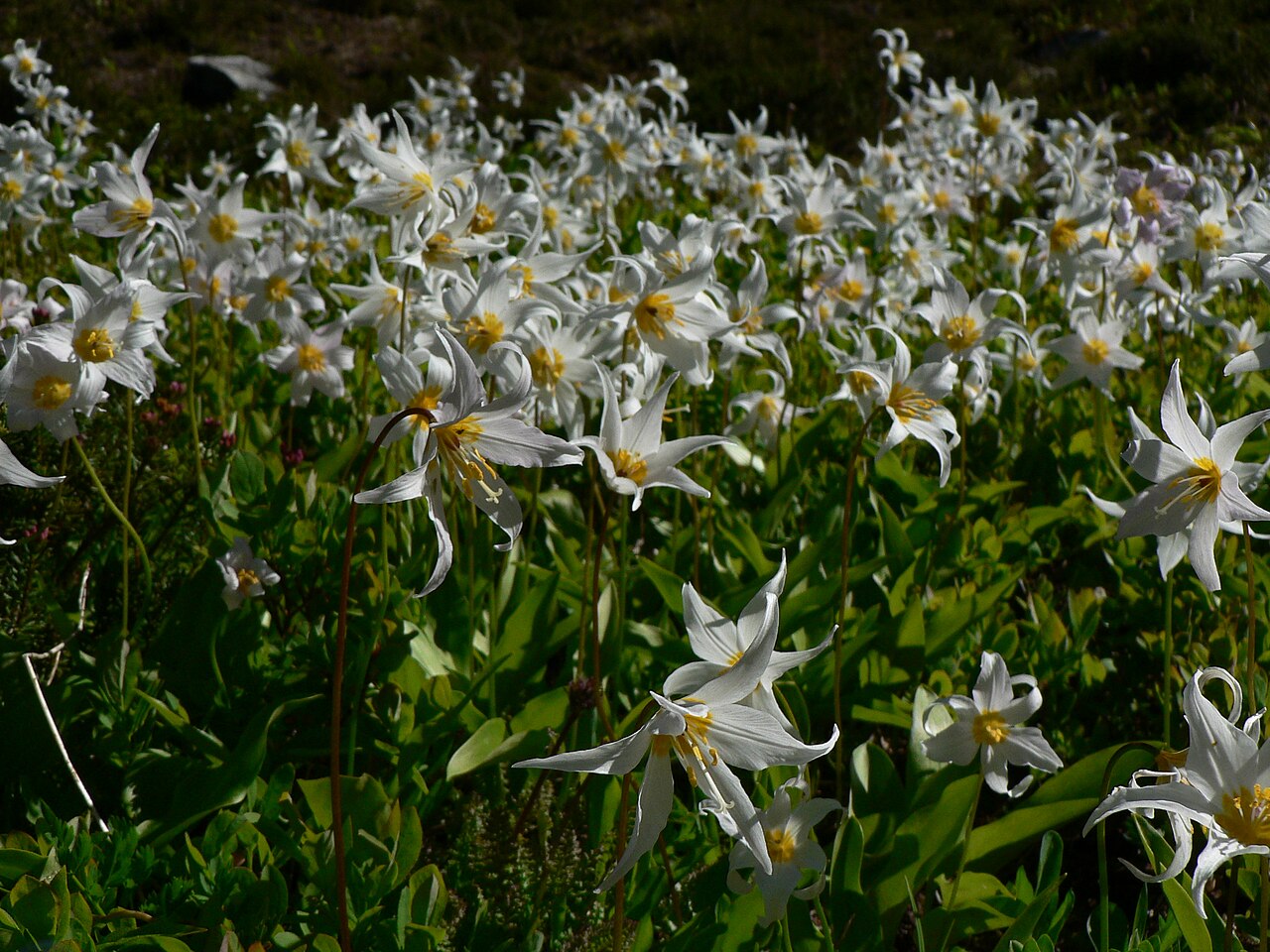
Erythronium montanum, known as Avalanche Lily or white avalanche-lily, is a small, spring-blooming lily of the high mountains of the Pacific Northwest. It grows only in the Olympic Mountains and the Cascade Range of Washington and northern Oregon and in the mountains of southwestern British Columbia. Each plant produces two broad, glossy green leaves and one to a few nodding white flowers with golden-yellow centers and gracefully swept-back petals.
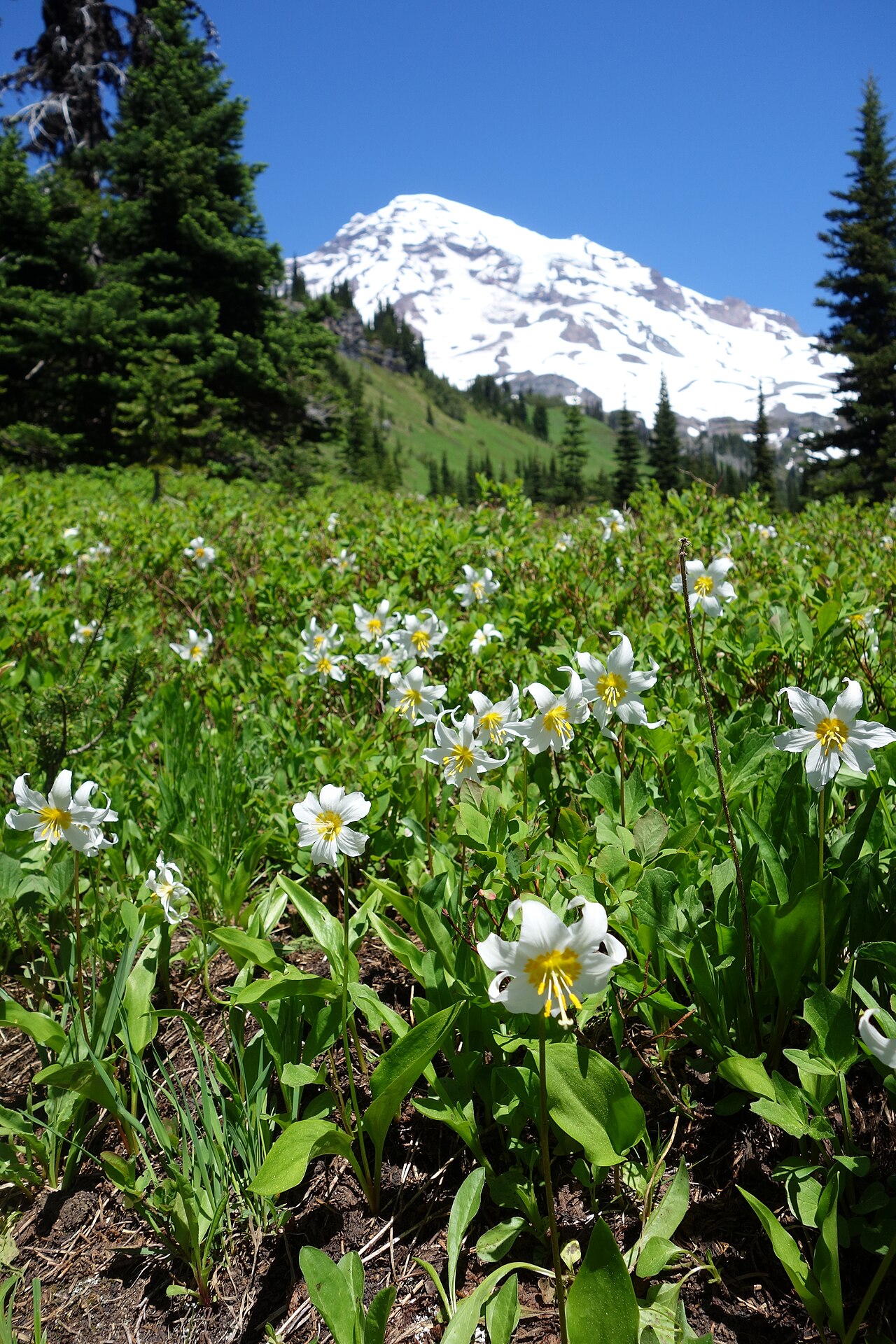
The common name describes its habit of blooming almost at the edge of retreating snowbanks. As the snow melts in early to midsummer, avalanche lilies push up through the wet soil and flower within days, sometimes in such numbers that whole meadows on Mount Rainier, Hurricane Ridge and other famous viewpoints turn white. The display is short, and by late summer the plants have set seed and withered back to their deep underground corms.
Avalanche lily is a plant to see and admire in the wild rather than to grow. It needs a long, cold winter under snow and cool, moist summers, and it is almost never available as nursery stock. Never dig wild plants: the corms are deep, slow to grow and rarely survive transplanting. This guide covers how to identify it, where and when to see it, and its role in subalpine ecosystems.
Identification
Avalanche lily is easy to recognize in its mountain habitat: it is the only common white-flowered Erythronium in the high Cascades and Olympics, and it blooms right after snowmelt.
Growth Habit
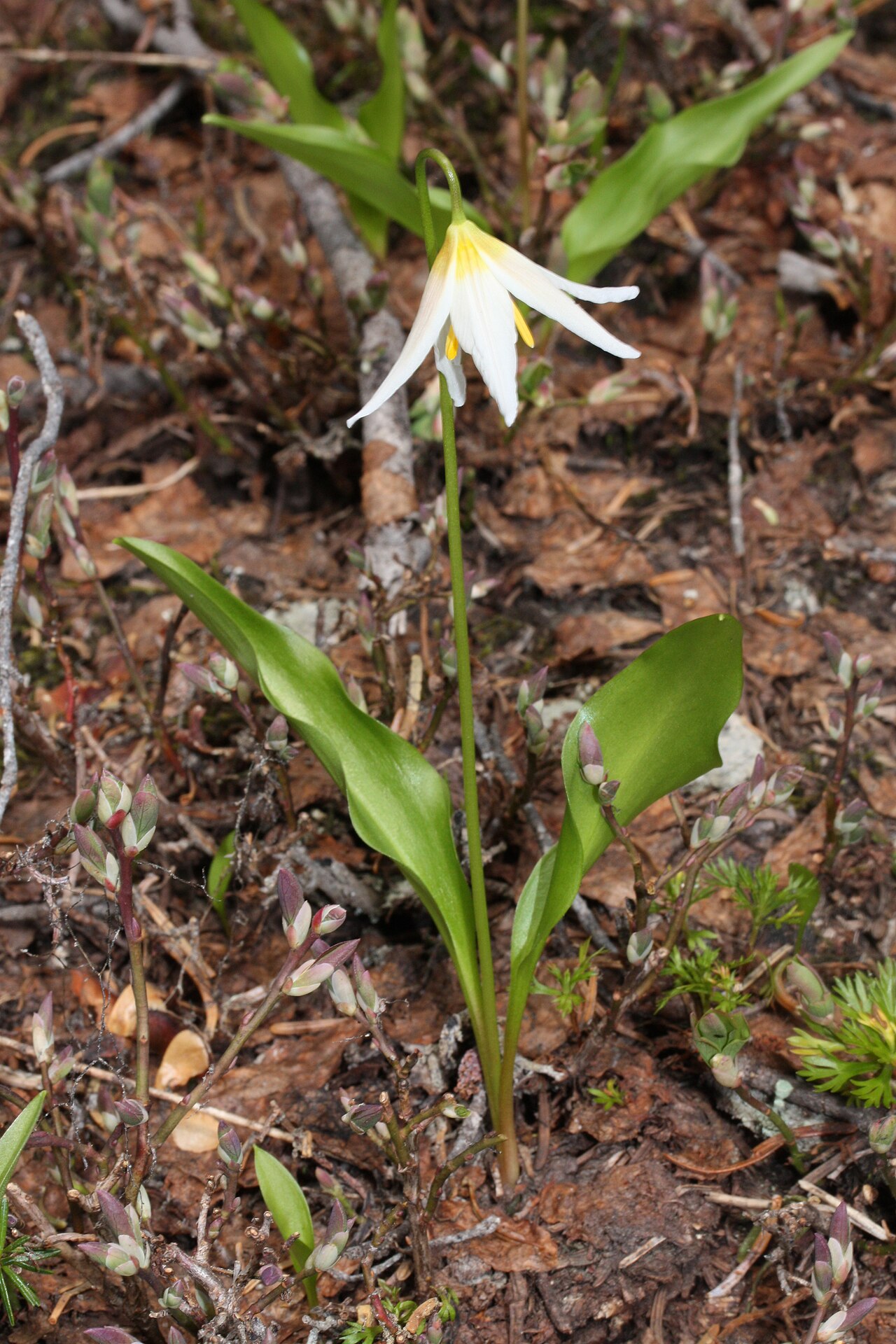
Each plant grows from a deep, elongated corm (often called a bulb) that may sit several inches below the surface. Young, non-flowering plants produce a single leaf; mature plants produce two leaves and a flowering stalk 4 to 16 inches tall. Plants often grow in dense colonies that build up over many years from seed.
Leaves
The two leaves are basal, broadly lance-shaped to elliptic, about 4 to 8 inches long, and plain bright green without the brown mottling of many trout lilies. They are smooth and slightly shiny, and they wither by late summer.
Flowers
The flowering stalk carries one to three (rarely up to five) nodding flowers. Each has six white petal-like tepals about 1 to 1 1/2 inches long, yellow or orange-yellow at the base, curving back sharply as the flower matures. The six stamens have yellow anthers, and the style ends in three slender, spreading stigma lobes. Flowers appear from June to August, depending on when the snow melts.
Fruit & Seeds
After flowering, the stalk straightens and an upright, club-shaped capsule about 1 to 2 inches long develops, often turning reddish as it ripens. It splits into three parts in late summer to release many brownish seeds.
Look-alikes
Glacier lily (Erythronium grandiflorum) often grows with it and has the same shape, but its flowers are bright yellow. White fawn lily (Erythronium oregonum) has white flowers but strongly mottled leaves and grows at lower elevations in oak woods and prairies west of the Cascades. Marsh marigold and other white subalpine flowers have open, upward-facing flowers rather than nodding lily flowers.
Quick Facts
| Scientific Name | Erythronium montanum S. Watson |
| Family | Liliaceae (lily family) |
| Plant Type | Herbaceous perennial from a deep corm; summer-dormant |
| Mature Height | 4–16 in |
| Mature Spread | 3–6 in per plant; forms colonies |
| Growth Rate | Very slow; several years from seed to flower |
| Sun Exposure | Full sun to partial shade |
| Water Needs | Constantly moist from snowmelt in spring and early summer |
| Soil Type | Moist, humus-rich, well-drained mountain soils |
| Soil pH | Acidic, about 5.0–6.5 |
| Bloom Time | June–August, right after snowmelt |
| Flower Color | White with a yellow center |
| Fall Color | None; plants are dormant by late summer |
| Fruit | Upright three-part capsule |
| Deer Resistant | Not well documented |
| USDA Hardiness Zones | 4–7 (requires cold winters with snow cover) |
Native Range
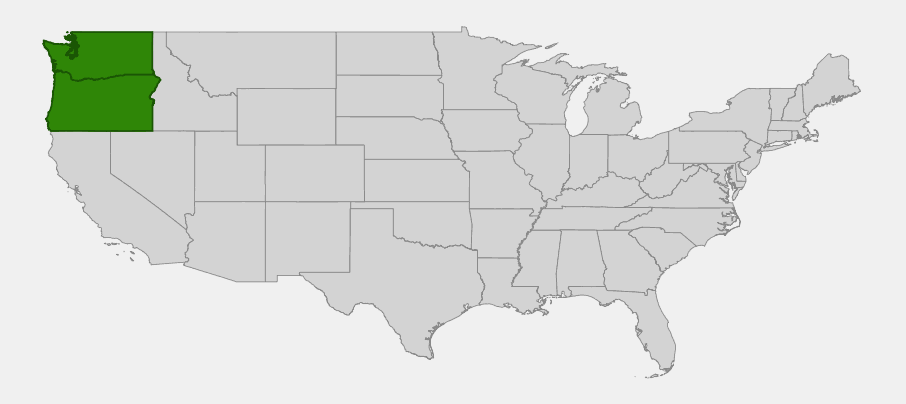
Avalanche lily has one of the smaller ranges of any Pacific Northwest wildflower. USDA PLANTS lists it as native in Washington and Oregon in the United States, and it also grows in southwestern British Columbia, including Vancouver Island and the southern Coast Mountains. The Lady Bird Johnson Wildflower Center describes its range as British Columbia to northern Oregon.
In Washington it is common in the Olympic Mountains and throughout the Cascades, from the Canadian border south past Mount Rainier and Mount Adams. It is famous in the meadows of Paradise and Sunrise at Mount Rainier and on Hurricane Ridge in Olympic National Park. In Oregon it continues south along the Cascade crest, mainly in the northern part of the range around Mount Hood and Mount Jefferson. It grows mostly on the west slope and near the crest, with some populations on the upper east slopes.
Typical habitats are subalpine meadows, open subalpine fir and mountain hemlock forests, forest openings and slopes where snow lies late into spring, usually at middle to high elevations. It grows in moist, well-drained soils that are soaked by snowmelt in early summer and dry out in fall.
📋 Regional plant lists featuring Avalanche Lily: Western Oregon & Western Washington
Can You Grow It?
Avalanche lily is not a practical garden plant for most people. It is adapted to deep winter snow, a short, cool growing season and constant snowmelt moisture, conditions that are very hard to copy in a lowland garden. It is almost never sold as nursery stock. The honest answer for most gardeners is to enjoy it in the mountains, and to plant a lowland relative at home instead.
Light
In the wild it grows in open meadows and light forest shade. A rock garden or woodland garden would need bright light with protection from afternoon heat.
Soil & Water
It needs cool, acidic, humus-rich soil that is wet in spring and early summer and drier, but never baked, in late summer. Hot, dry summers and mild, snowless winters are the main reasons it fails in lowland gardens.
Planting Tips
Specialist alpine and bulb growers occasionally grow it from seed in cool climates, such as high-elevation gardens in the Pacific Northwest. If you want a white Erythronium for a lowland Northwest garden, white fawn lily (Erythronium oregonum) is far easier and is sold by native plant nurseries.
Pruning & Maintenance
None is needed in the wild. In the mountains, stay on trails: meadow plants are easily trampled, and damaged subalpine meadows take decades to recover.
Propagation
Avalanche lily reproduces only from seed, which needs a long period of cold, moist conditions to germinate. Seedlings take several years to reach flowering size. Never dig wild corms, and never collect seed in national parks, where plant collecting is prohibited without a permit.
Where to See It
- Mount Rainier National Park: the meadows at Paradise and Sunrise and trails such as Naches Peak Loop and Mildred Point are famous for avalanche lily displays, usually from early July into August.
- Olympic National Park: Hurricane Ridge and the nearby subalpine trails often have large patches in late June and July.
- Washington and Oregon Cascades: look for it in subalpine meadows and open forests around Mount Adams, Mount Hood and Mount Jefferson soon after the snow melts.
- Timing your visit: avalanche lilies bloom within days of snowmelt, so the best displays move upslope as summer goes on. Check recent trail reports for snow conditions.
- Wildflower photography: it is one of the most photographed wildflowers of the Northwest. Stay on trails and use a long lens rather than stepping into the meadow.
Wildlife & Ecological Value
In the short subalpine summer, avalanche lily is one of the first and most abundant food sources for pollinators and wildlife.
For Pollinators
The flowers are visited by queen bumble bees, which emerge early in the mountain season and depend on the first large flower displays after snowmelt. Other native bees and flies also visit them for pollen and nectar.
For Birds
Birds make little direct use of the plant, but the insects drawn to avalanche lily meadows feed nesting songbirds and sooty grouse broods.
For Mammals
Black bears and grizzly bears dig up and eat the starchy corms of Erythronium species, and pocket gophers feed on them underground. Deer and elk browse the leaves and flowers, and marmots and ground squirrels eat them in subalpine meadows.
Ecosystem Role
Avalanche lily is a characteristic plant of subalpine meadows in the Olympics and Cascades. Its rapid growth after snowmelt helps hold soil on wet slopes, and the large colonies provide an early pulse of food for pollinators and grazing animals.
Cultural & Historical Uses
The genus name Erythronium comes from the Greek erythros, “red”, after the red-flowered European dog’s-tooth violet. The species name montanum means “of the mountains”.
Avalanche lily meadows are an iconic sight of the national parks of Washington. Naturalists, painters and photographers have celebrated them for more than a century; the artist Mary Vaux Walcott included it in her watercolors of North American wildflowers.
Climate change is a concern for avalanche lily and other snowbed plants. Studies at Mount Rainier have tracked how earlier snowmelt shifts subalpine flowering times, and the meadows where it grows are slowly being invaded by trees in some places.
Frequently Asked Questions
Where can I see avalanche lilies?
The best-known displays are at Paradise and Sunrise in Mount Rainier National Park and on Hurricane Ridge in Olympic National Park, but they grow throughout the subalpine Cascades of Washington and northern Oregon.
When do avalanche lilies bloom?
Right after the snow melts, usually from late June to early August depending on elevation and the year’s snowpack.
Can I grow avalanche lily in my garden?
Rarely. It needs cold winters with deep snow and cool, moist summers. It is almost never sold, and wild plants must never be dug. White fawn lily (Erythronium oregonum) is a much easier white-flowered native for Northwest gardens.
How is it different from glacier lily?
They have the same shape and often grow together, but avalanche lily has white flowers with yellow centers, while glacier lily has entirely yellow flowers.
Is avalanche lily rare?
No. It is abundant within its small range in the Cascades and Olympics, but that range is limited to a few mountain areas. Stay on trails to protect the meadows where it grows.

Looking for a nursery that carries Avalanche Lily?
Browse our native plant nursery directory: Oregon · Washington

