Beach Heather (Hudsonia tomentosa)
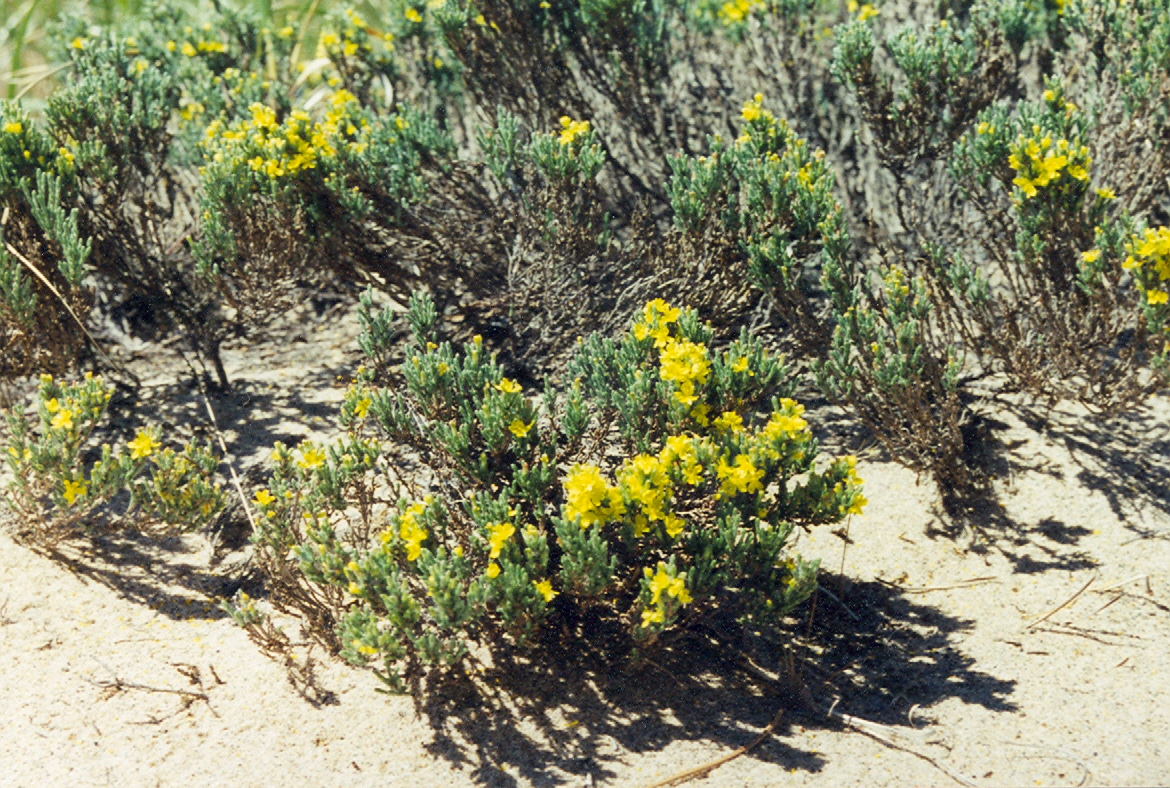
Hudsonia tomentosa, commonly called Beach Heather (also Woolly Beach-Heather, Sand-Heather, or False Heather), is a low, mat-forming evergreen subshrub of the rockrose family (Cistaceae) that specializes in one of the toughest habitats on the continent: bare, shifting, nutrient-poor sand. It is not a true heather — that name belongs to the unrelated Ericaceae — but its tiny, scale-like, silvery-gray leaves pressed tightly against wiry stems give it a convincingly heath-like look, especially from a distance where a colony can resemble a patch of gray-green moss draped over a dune.
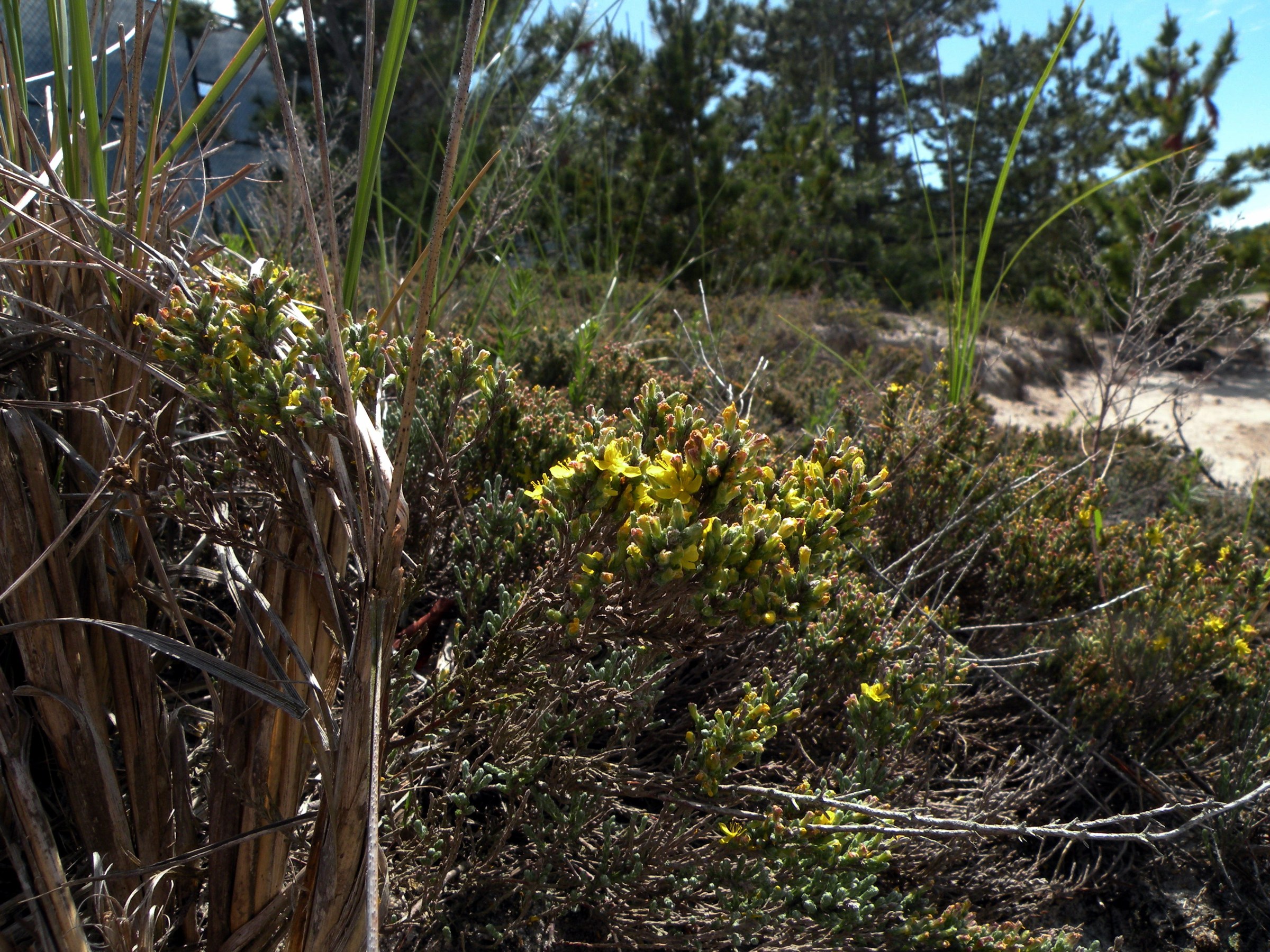
Beach heather rarely exceeds a foot in height, instead spreading outward into low, irregular hummocks a few feet across. In late spring it studs itself with small, bright yellow, five-petaled flowers that open for only a single morning each, so a blooming colony looks different almost hour to hour as one flush of flowers closes and the next opens. The rest of the year the plant reads as a quiet gray-green carpet, textured and soft-looking but actually covered in fine, water-conserving hairs (the “tomentosa” of its name) that reflect sun and slow moisture loss on exposed, droughty sand.
What makes beach heather valuable well beyond its modest good looks is its role as a pioneer: it is one of the first woody plants able to establish directly in bare, mobile sand, where its roots help knit dunes together and its low mounds slow wind and trap more sand, building habitat for the beachgrass, bearberry, and other dune specialists that follow. For gardeners on coastal or Great Lakes sand, it is an exceptionally low-maintenance, drought-proof groundcover that asks for almost nothing except full sun and soil most other plants would reject outright.
Identification
Beach heather is a low, woody subshrub, usually 4 to 12 inches tall, that spreads by branching stems into irregular mats or hummocks 1 to 3 feet or more across. Older colonies can form extensive, slowly expanding patches of fused mounds. The overall look is soft and gray-green to silvery, more like a cushion of foliage than a typical upright shrub.
Stems & Leaves
Stems are slender, wiry, and much-branched, becoming woody and gray with age. The leaves are tiny — about 1/16 to 1/8 inch long — scale-like or awl-shaped, and held tightly against the stem rather than spreading outward, similar in habit to a juniper or a true heath. Both leaves and young stems are covered in dense, short gray hairs, giving the whole plant a soft, felted, silvery-gray appearance that is one of its easiest field marks even without flowers.
Flowers
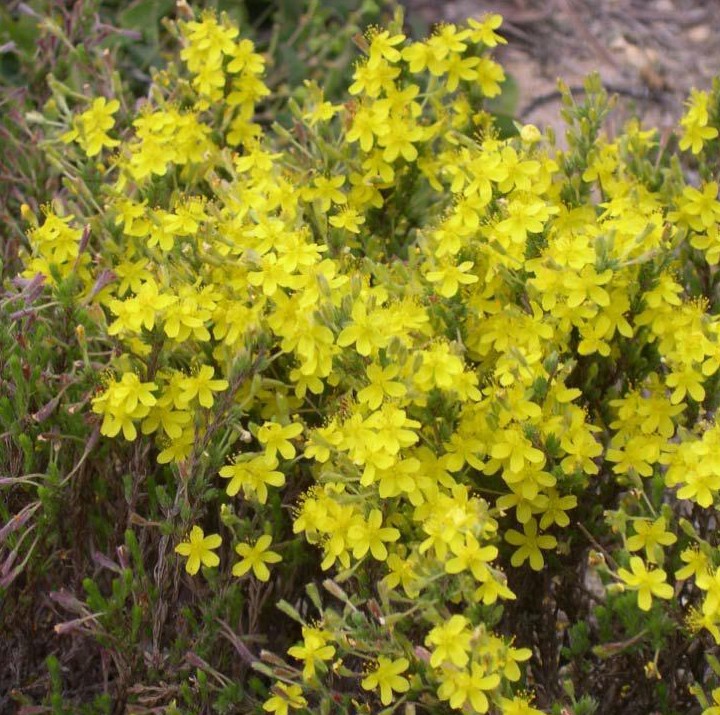
Flowers are small, about 1/4 to 3/8 inch across, with five rounded, bright yellow petals surrounding a cluster of yellow stamens. They are borne singly on short stalks scattered along the upper branches and open in a flush in late spring to early summer. Each individual flower lasts only a single morning, closing by early afternoon and never reopening, but a healthy colony produces a long, rolling succession of new blooms over several weeks, so flowering plants are rarely without at least some open flowers during the season.
Fruit & Roots
After flowering, small dry capsules develop, each holding a few tiny seeds that are shed nearby rather than dispersed widely. Below ground, beach heather sends down both a long, anchoring taproot and a dense web of fine lateral roots that associate closely with mycorrhizal fungi, allowing the plant to extract scarce water and nutrients from essentially sterile sand. Plants can also tolerate being partially buried by shifting sand, resprouting from buried stems, which is part of what makes them such effective dune stabilizers.
Quick Facts
| Scientific Name | Hudsonia tomentosa |
| Family | Cistaceae (Rockrose) |
| Plant Type | Evergreen mat-forming subshrub |
| Mature Height | 4–12 in |
| Mature Spread | 1–3 ft, slowly expanding into larger colonies |
| Growth Rate | Slow |
| Sun Exposure | Full Sun |
| Water Needs | Low; excellent drought tolerance once established |
| Soil Type | Pure, loose, well-drained sand; very low organic matter |
| Soil pH | Acidic to neutral (about 4.5–6.5) |
| Bloom Time | May – July |
| Flower Color | Bright yellow |
| Fall Color | None (evergreen, silvery-gray year-round) |
| Fruit | Tiny dry capsules with a few small seeds |
| Deer Resistant | Yes |
| USDA Hardiness Zones | 2–7 |
Native Range
Beach heather is native to two main centers in eastern North America: the Atlantic coastal dunes from Maine south through the Mid-Atlantic, and the sandy shores and inland dune fields around the upper Great Lakes, with scattered outlying colonies on sandy barrens elsewhere in the Northeast and Midwest. It is strongly tied to open, unstabilized to semi-stabilized sand, and essentially absent from ordinary garden soil habitats in the wild.
On the Atlantic coast, beach heather grows on primary and secondary dunes, in sandy blowouts, and on stabilized backdune ridges from Maine and New Hampshire down through southern New England, Long Island, New Jersey, Delaware, Maryland, and coastal Virginia, typically within sight or smell of salt water. Around the Great Lakes, it occupies open sand dunes, sand plains, and sandy lakeshore barrens in Michigan, Wisconsin, and northeastern Minnesota, habitats shaped by wind and wave action much like ocean dunes even though the “sea” here is fresh water.
Because it depends on open, disturbed-looking sand rather than closed vegetation, beach heather is vulnerable to the same pressures that threaten dune systems generally: shoreline development, beach stabilization structures, off-road vehicles, and heavy foot traffic that compact sand or crush the low mats. Many state natural heritage programs track its dune colonies, and some populations are locally rare even within its native range, so established wild colonies are worth protecting rather than collecting from.
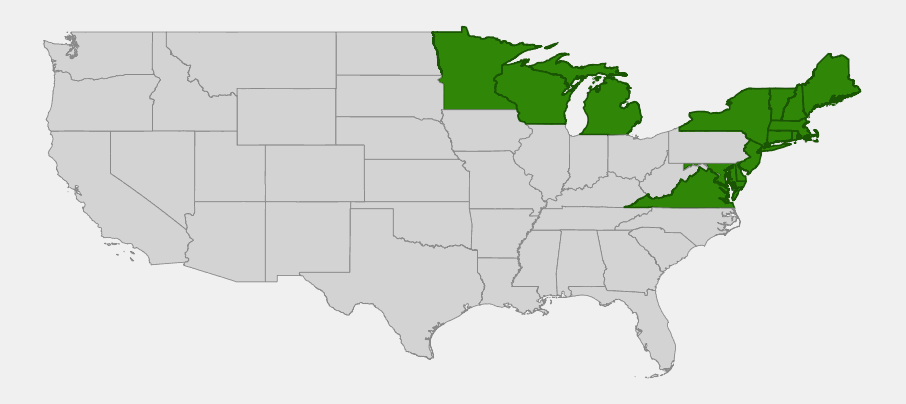
📋 Regional plant lists featuring Beach Heather: New Hampshire, Maine & Vermont · Connecticut, Massachusetts & Rhode Island · New York, Pennsylvania & Northern New Jersey · Delaware, Southern New Jersey & Long Island · Maryland, Virginia & West Virginia · Michigan, Wisconsin & Eastern Minnesota
Growing & Care Guide
Beach heather is not a plant for ordinary garden beds — it is a specialist for the single hardest planting site many gardeners face: loose, infertile, fast-draining sand in full sun. Give it those conditions and it is remarkably self-sufficient; put it in rich, moist garden soil and it tends to struggle or rot.
Light
Full sun is essential. Beach heather evolved on wide-open dunes with no shade competition, and it will thin out, stretch, and eventually decline in anything less than a full day of direct sun. This is a plant for the sunniest, most exposed part of a sandy yard, not a spot shaded by nearby trees or buildings.
Soil & Water
The single biggest key to success is soil: beach heather wants loose, well-drained, low-fertility sand, ideally close to pure beach or dune sand rather than amended garden loam. Rich, organic, or heavy clay soils that hold moisture around the roots are the most common cause of failure, leading to root and crown rot. Once established, plants need almost no supplemental water and are exceptionally drought tolerant; in fact, overwatering is a far greater risk than underwatering. A new planting benefits from light watering through its first summer to help roots establish, after which irrigation should be minimal to none.
Planting Tips
Plant small, nursery-grown container plants in spring, setting them at the same depth they grew in the pot and firming sand gently around the roots — avoid burying the crown. Space plants 18 to 24 inches apart to allow mounds to spread and eventually knit together. Beach heather resents root disturbance and transplants poorly once established, so choose its permanent site carefully. It is an excellent choice for coastal gardens, dune restoration plantings, and sandy, sun-baked slopes where little else will grow.
Pruning & Maintenance
Little to no pruning is needed. Older colonies can be lightly sheared in early spring to tidy woody, leggy growth and encourage denser mounding, but heavy pruning into old wood is poorly tolerated. Avoid fertilizing — added nutrients work against this plant’s adaptation to infertile sand and can encourage weak, disease-prone growth. Beach heather has few pest problems in the lean, dry conditions it prefers.
Propagation
Beach heather is propagated from seed sown on the surface of sandy mix and left exposed to light, or from semi-hardwood cuttings taken in mid to late summer and rooted in pure sand with excellent drainage. Both methods are slow, and germination and rooting rates are naturally modest, reflecting the plant’s adaptation to harsh, unpredictable dune conditions. Division is not practical given the plant’s low, branching, woody growth habit.
Landscape Uses
- Dune and sand-barren restoration, where its roots help stabilize shifting sand
- Coastal gardens on beach or barrier-island property with pure sandy soil
- Xeriscaping in sunny, infertile sites where irrigation should be minimized
- Erosion control on sandy slopes, banks, and blowouts
- Rock garden and gravel garden plantings that mimic its naturally lean conditions
- Specialty groundcover for sandy, full-sun sites too dry for turf grass
Wildlife & Ecological Value
Beach heather may look modest, but in the sparse world of open dunes it is a disproportionately important plant, offering structure, food, and stabilization in a habitat where few other species can survive at all.
For Pollinators
The short-lived yellow flowers attract small native bees and flies that specialize in sandy, open habitats, visiting the blooms for pollen during the brief morning window each flower is open. Because so few other plants flower in bare dune sand, beach heather’s long bloom season provides an outsized share of the nectar and pollen resources available to dune-specialist insects.
For Birds
The low, dense mounds offer ground-level cover for shorebirds and sparrows moving through dune habitat, and the tiny seeds are eaten in small amounts by seed-eating songbirds foraging over open sand. Its greatest value to birds is indirect: by helping stabilize dunes, it supports the beachgrass and shrub thickets that nesting and migrating birds depend on nearby.
For Mammals
Beach heather is lightly browsed by rabbits and occasionally deer, though its tough, hairy foliage is not a preferred food source, which is part of why it tends to persist well in areas with browsing pressure. Small mammals use the dense mats for cover while moving across otherwise exposed, predator-visible open sand.
Ecosystem Role
Beach heather is a classic dune pioneer and ecosystem engineer. Its roots bind loose sand, its low mounds slow wind and trap blowing sand, and its presence raises organic matter and moisture retention just enough to allow beachgrass, bearberry, and eventually shrubs and pines to establish behind it. In this way, a single beach heather colony can set the stage for the entire sequence of dune succession that follows.
Cultural & Historical Uses
Beach heather has little recorded history as a food, medicine, or craft plant among Indigenous peoples or early settlers, likely because its small size, tough fibrous stems, and sparse, infertile habitat offered little practical value compared to the trees, berries, and herbaceous plants growing in richer soils nearby. Its historical significance is primarily ecological rather than cultural: coastal communities have long recognized dune vegetation, including beach heather, as a natural buffer that helps protect inland land from storm erosion and blowing sand.
In more recent decades, beach heather has become a recognized indicator species for naturalists and conservationists monitoring the health of dune and sand-barren ecosystems. Its presence or absence is often used informally to gauge how much a dune has been disturbed, since healthy, undisturbed colonies tend to persist for many years while trampling, vehicle traffic, or sand mining quickly eliminate them.
Today beach heather’s main human use is horticultural and restorative: native plant nurseries propagate it for dune stabilization projects, coastal landscaping, and sand-barren habitat restoration, giving gardeners on sandy sites a genuinely native, low-input alternative to ornamental groundcovers that need irrigation and fertilizer to survive in the same conditions.
Frequently Asked Questions
Is beach heather a true heather?
No. “True” heathers and heaths belong to the Ericaceae family, while beach heather belongs to the unrelated Cistaceae (rockrose family). The resemblance — tiny, densely packed, scale-like leaves — is a case of similar adaptations to harsh, dry conditions rather than close kinship.
Can I grow beach heather in regular garden soil?
It is not recommended. Beach heather is adapted to pure, infertile, fast-draining sand, and ordinary garden loam or amended beds tend to hold too much moisture and nutrients, leading to root rot and poor growth. It performs best in sites that genuinely mimic open dune sand.
Why do the flowers only last one morning?
Each individual beach heather flower opens for a single morning and then closes permanently, which is thought to be an adaptation to intense sun and heat exposure on open dunes. The plant compensates by producing a long succession of new flowers over several weeks, so a colony is rarely without blooms during its flowering season.
Is beach heather drought tolerant?
Extremely. It is one of the most drought-tolerant native shrubs in the Northeast and Great Lakes region, adapted to survive on pure sand with minimal water-holding capacity and little rainfall retention. Established plants rarely if ever need supplemental watering.
Is it legal to collect beach heather from the beach?
Wild dune vegetation, including beach heather, is protected in many coastal states and parks because of its role in dune stabilization, and collecting plants from public beaches and dunes is typically prohibited. Always buy nursery-propagated plants rather than digging from wild colonies.

Looking for a nursery that carries Beach Heather?
Browse our native plant nursery directory: Maine, Massachusetts, Maryland, Michigan & Minnesota · New Hampshire, New York & New Jersey · Vermont, Rhode Island & Virginia · Connecticut & Delaware · Wisconsin