
Bejuco de Sopla (Securidaca virgata)
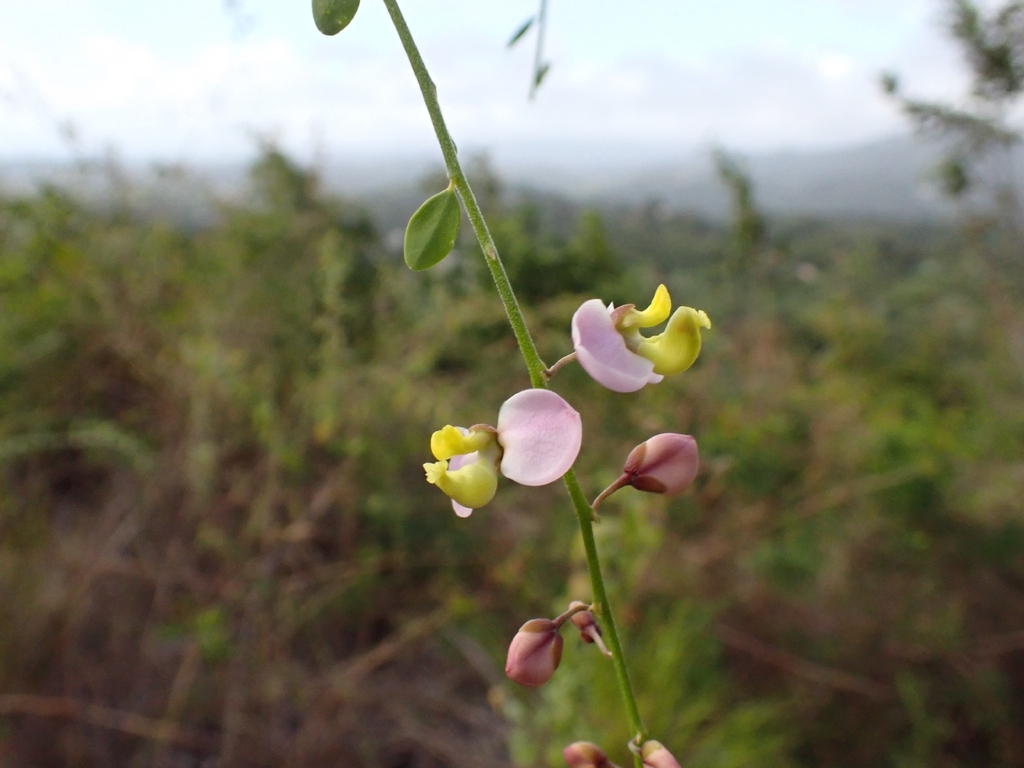
Securidaca virgata, known in Puerto Rico as Bejuco de Sopla and also as jaboncillo, is a scrambling, climbing shrub of the milkwort family (Polygalaceae). It forms tangles of long, slender, bright green stems that look almost leafless, and for much of the year it carries loose sprays of small pink and yellow flowers that resemble pea blossoms. These are followed by rosy, papery winged fruits that hang from the stems like small maple keys.
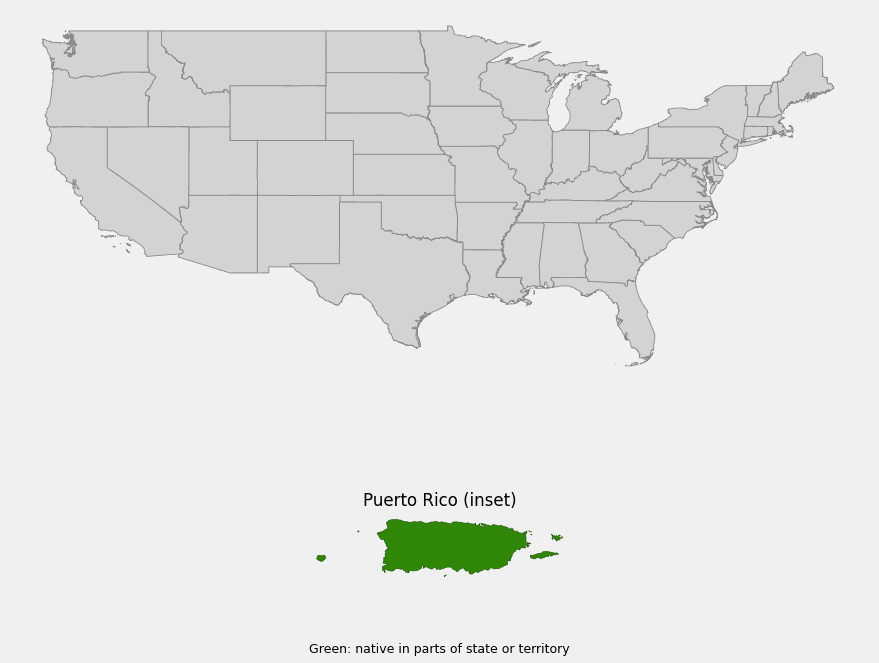
This is a West Indian plant, native only to Cuba, Hispaniola, Puerto Rico and St. Croix. In Puerto Rico it is widespread from the coast to about 2,600 feet, growing in thickets and forest edges from the northern karst hills and the Luquillo Mountains to the Cordillera Central, the serpentine forests of Susúa and Maricao, the dry southwest around Cabo Rojo and the Sierra Bermeja, and the island of Vieques. Kew’s Plants of the World Online places it mainly in the seasonally dry tropical biome.
Despite the pea-like flowers it is not a legume. Its closest relatives in North America are the milkworts (Polygala), which share the same unusual flower structure. This guide explains how to recognize it, where it grows, and how it can be used in native plantings in Puerto Rico.
Identification
Bejuco de sopla is easiest to recognize by its long, green, nearly leafless stems and, in flower or fruit, by its pink-and-yellow blossoms and pink samaras. “Bejuco de sopla” is also used in Puerto Rico for other vines, including Gouania species, so the scientific name is the surest guide.
Stems
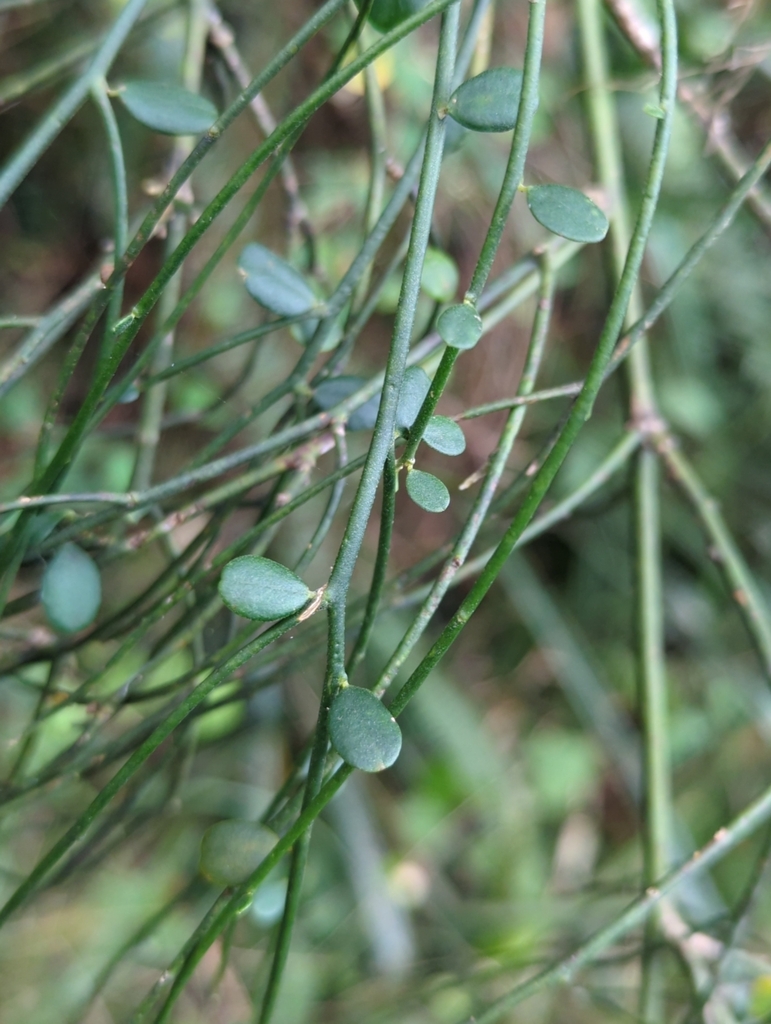
The plant is a climbing or scrambling shrub. Its many stems are long, thin, flexible and green, arching or hanging in curtains over other shrubs and small trees. The species name virgata means wand-like or twiggy and describes these whip-like shoots. Older stems become woody at the base. The green stems probably carry out much of the plant’s photosynthesis, which would help it cope with dry periods.
Leaves
The leaves are small, simple, alternate and widely spaced along the stems, oval to elliptic and roughly ½ to 1 inch long, with smooth edges and a bluish-green tone. On many shoots they are sparse or have fallen, which gives the plant its leafless, broom-like look.
Flowers
Flowers are borne in long, loose sprays along the stems, each on a short, slender stalk. Their structure is typical of the milkwort family. Of the five sepals, three outer ones are small, and two inner ones are enlarged, rounded and petal-like, pink to pale purple and roughly ⅓ inch across. These “wings” frame a white keel about ⅓ inch long and two fleshy yellow upper petals. The result looks much like a small pea flower. Puerto Rican plants have been recorded in flower and fruit in every month of the year.
Fruit & Seeds
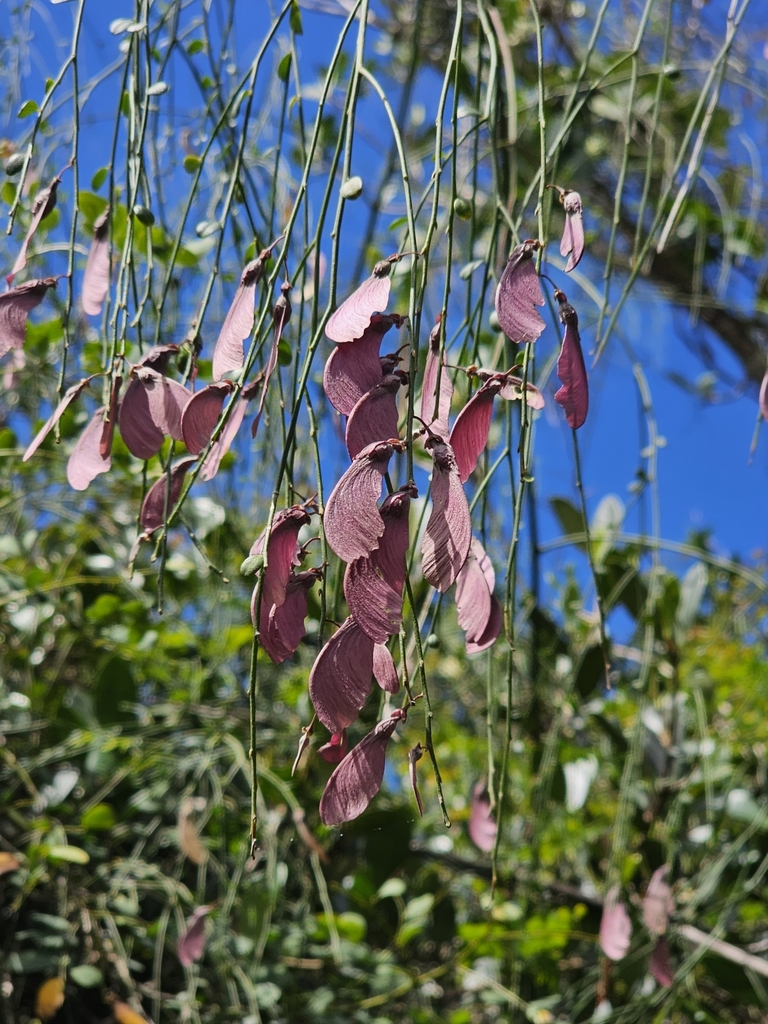
The fruit is a samara about 1½ inches long: a small, rounded, finely hairy seed case with a single papery wing, 1 to 1¼ inches long and about ⅓ to ½ inch wide, with a fine network of veins. Young fruits are green, turning rose-pink to purplish as they ripen and tan when dry. The wings carry the seeds on the wind.
Quick Facts
| Scientific Name | Securidaca virgata Sw. (syn. Elsota virgata) |
| Family | Polygalaceae (milkwort family) |
| Plant Type | Climbing or scrambling shrub (woody vine) |
| Mature Height | Scrambles about 6–15 ft over shrubs and small trees |
| Mature Spread | 6–10 ft |
| Growth Rate | Moderate |
| Sun Exposure | Full sun to partial shade |
| Water Needs | Low to medium; tolerates seasonal drought |
| Soil Type | Well-drained limestone, sandy, clay and serpentine soils |
| Soil pH | Acidic to alkaline (about 5.5–8.0) |
| Bloom Time | Year-round in Puerto Rico |
| Flower Color | Pink to pale purple with yellow and white |
| Fall Color | None; evergreen stems |
| Fruit | Pink to purplish winged samara, about 1½ in long |
| Deer Resistant | Not applicable in Puerto Rico |
| USDA Hardiness Zones | 10b–11 (frost-tender) |
Native Range
USDA PLANTS lists bejuco de sopla as native to Puerto Rico and the U.S. Virgin Islands. It is not native to the continental United States. Outside U.S. territory it occurs only in Cuba and Hispaniola (the Dominican Republic and Haiti), so its whole range lies in the Greater Antilles and St. Croix. Smithsonian’s Flora of the West Indies treats it as endemic to the West Indies.
In Puerto Rico it is one of the more widespread native woody vines. Axelrod’s Systematic Vademecum to the Vascular Plants of Puerto Rico records it from the northern coastal lowlands and northern limestone hills, the Sierra de Luquillo, the Sierra de Cayey, Las Piedras Chiquitas and the southeastern foothills, the Central and Western Cordillera, the Susúa Forest Reserve, the southwestern coastal lowlands at Cabo Rojo, the Sierra Bermeja, Cerro Las Mesas near Mayagüez, the western coast and Vieques, from near sea level to about 800 m (2,600 ft).
Its range spans a wide variety of rock types, from the limestone karst of the north to the volcanic rocks of the central mountains and the serpentine soils of Susúa, Maricao and the Sierra Bermeja. It is most often found in sunny thickets, forest edges, roadsides and open, shrubby second-growth, especially in the drier and seasonally dry parts of the island.
📋 Regional plant lists featuring Bejuco de Sopla: Puerto Rico
Growing & Care Guide
Bejuco de sopla is rarely offered in nurseries, but it is a tough, attractive native for informal plantings, hedgerows and restoration in Puerto Rico. Grow it from seed collected responsibly from cultivated plants or obtained from native plant programs, rather than digging wild plants.
Light
Plant it in full sun to light shade. It flowers and fruits best where its stems can reach full sun on top of a fence, shrub or small tree.
Soil & Water
It is not fussy about soil as long as it drains well, and it grows on limestone, sandy, clay and serpentine soils. Water regularly while young; once established it tolerates the long dry seasons of southern and western Puerto Rico. Avoid soggy ground.
Planting Tips
Give it room and support. It works best scrambling over a fence, a rock wall or a hedge of tougher native shrubs, where the green stems can arch and hang. It is not suited to small formal beds.
Pruning & Maintenance
Little care is needed. Cut back overlong shoots after a flush of flowering to keep it in bounds, and remove dead stems from the base occasionally. No fertilizer is needed on most soils.
Propagation
Sow ripe, freshly collected samaras just below the surface of a well-drained mix and keep them barely moist in bright shade. Germination can be slow and irregular. Semi-woody cuttings may also root under mist, but seed is the usual method.
Landscape Uses
- Native hedgerows and fences: a light, airy screen of green stems with pink flowers and fruits
- Dry forest and coastal restoration: in the drier south and west of Puerto Rico and on Vieques
- Pollinator gardens: long-flowering, bee-visited blossoms through much of the year
- Serpentine and limestone plantings: tolerates the difficult soils of Puerto Rico’s serpentine and karst areas
- Native vine collections: an uncommon West Indian endemic for botanical and educational gardens
Wildlife & Ecological Value
Bejuco de sopla adds structure to forest edges and thickets, and its long flowering season provides a steady source of nectar and pollen.
For Pollinators
The pea-like flowers of the milkwort family are visited mainly by bees, which land on the keel and press it down to reach the pollen and nectar inside. Because Puerto Rican plants can flower in every month, the vine is a dependable resource for native bees.
For Birds
The wind-dispersed samaras offer little food for birds, but the dense tangles of stems provide perches and cover for small birds in thickets and forest edges.
For Mammals
It has little direct value for mammals. Puerto Rico’s only native land mammals are bats.
Ecosystem Role
As a fast-climbing native of open, disturbed ground, bejuco de sopla helps knit together thickets and forest edges after clearing or storms. Its green stems can photosynthesize even when leaves are few, an advantage in seasonally dry forest, and its winged fruits spread it to new openings.
Cultural & Historical Uses
The Swedish botanist Olof Swartz described Securidaca virgata in 1788 in his Prodromus of West Indian plants. The genus name comes from the Latin securis, a hatchet, a reference to the shape of the winged fruit. For a time the genus was called Elsota, and the species appears as Elsota virgata in older works, including Britton and Wilson’s survey of Puerto Rico, which called it “slender elsota”.
Its Spanish names are bejuco de sopla and jaboncillo. Bejuco is the general Caribbean word for a woody vine, and the same name is applied to other vines in Puerto Rico, including chewstick (Gouania). Jaboncillo, “little soap,” is also used for several unrelated plants.
Bejuco de sopla is one of many native vines that are rarely planted but common in the island’s countryside. Growing it in gardens and restoration projects is a way to keep a West Indian endemic, found nowhere outside the Greater Antilles and St. Croix, part of the cultivated landscape.
Frequently Asked Questions
Is bejuco de sopla a legume?
No. Its flowers look like pea blossoms, but it belongs to the milkwort family (Polygalaceae). In milkworts the two large, colorful “wings” of the flower are sepals, not petals.
Where does bejuco de sopla grow?
Only in the Greater Antilles: Cuba, Hispaniola, Puerto Rico and St. Croix. In Puerto Rico it grows from the coast to about 2,600 feet in thickets, forest edges and dry to moist forest, including the karst hills, the Cordillera Central and the serpentine forests of Susúa and Maricao.
Why does it look almost leafless?
Its leaves are small and widely spaced, and many fall during dry periods. The long green stems probably carry out much of the plant’s photosynthesis, an adaptation to seasonally dry habitats.
Is “bejuco de sopla” always this plant?
No. In Puerto Rico the name is also used for other vines, such as chewstick (Gouania). Use the scientific name, Securidaca virgata, when buying plants or seed.
Can I grow bejuco de sopla in Florida?
It is not native to Florida or anywhere in the continental United States, and it is frost-tender. It is best grown in Puerto Rico and the U.S. Virgin Islands, where it is native.

Looking for a nursery that carries Bejuco de Sopla?
Our nursery directory does not yet include Puerto Rico. Browse the native plant nursery directory by state: Alabama–Arkansas · California · Colorado–Hawaii · Idaho–Kansas · Kentucky–Montana · Nebraska–Oklahoma · Oregon · Pennsylvania–Virginia · Washington · West Virginia–Wyoming