Bitter Cherry (Prunus emarginata)
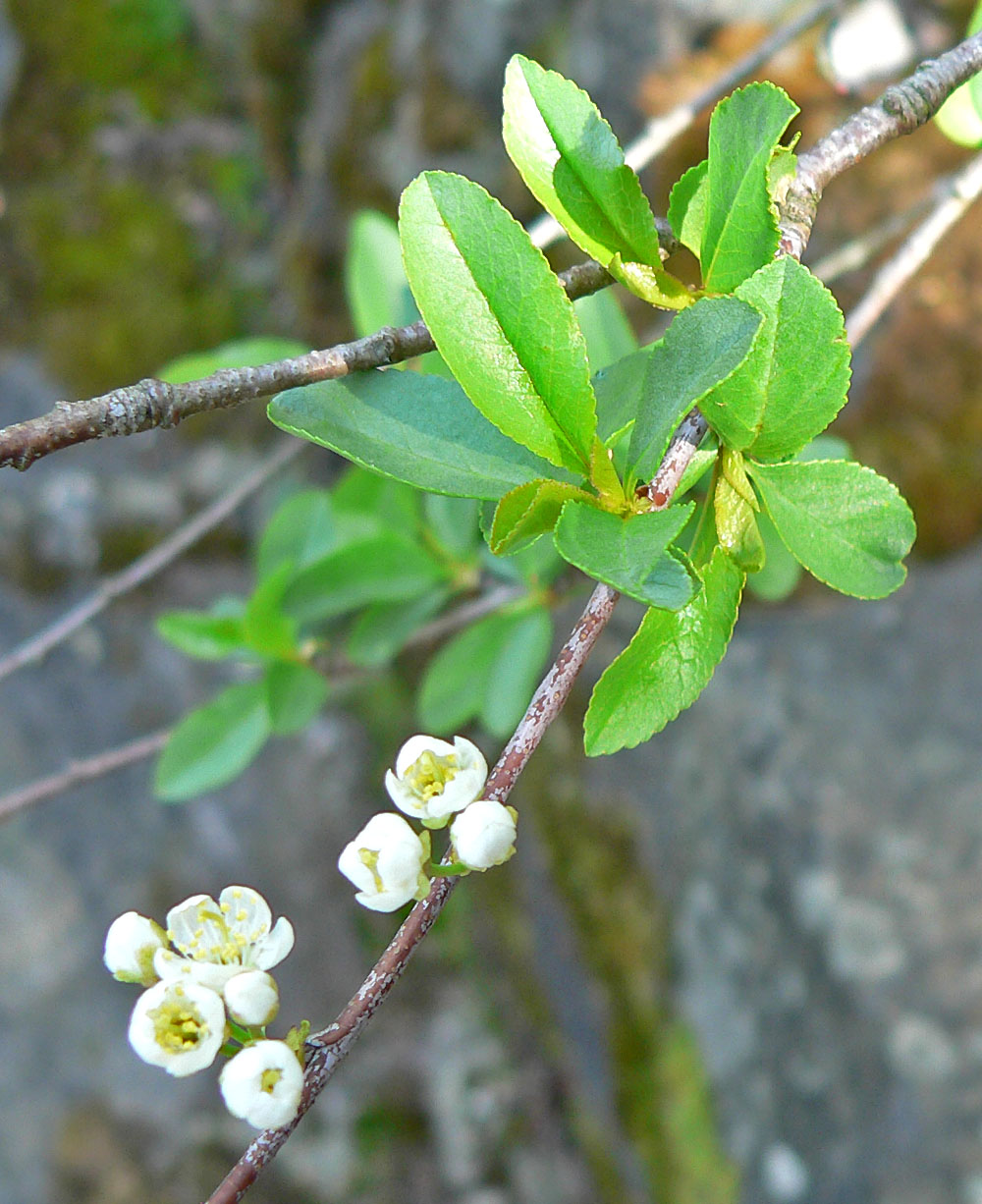
Prunus emarginata, commonly known as Bitter Cherry or Oregon Cherry, is a remarkable deciduous shrub or small tree that epitomizes the resilience and adaptability of Pacific Northwest native plants. This hardy member of the rose family thrives across an impressive elevation range from sea level coastal areas to mountain slopes exceeding 9,000 feet, making it one of the most widely distributed cherry species in western North America. With its fragrant clusters of white spring flowers, distinctive smooth bark with horizontal lenticels, and ability to colonize disturbed sites, Bitter Cherry plays crucial ecological roles while offering unique beauty for native plant enthusiasts and wildlife gardeners.
Quick Facts
| Scientific Name | Prunus emarginata (Douglas ex Hook.) D. Dietr. |
| Plant Type | Deciduous Shrub to Small Tree |
| Height | 3-50+ feet (1-15+ meters) |
| Sun Exposure | Full Sun to Part Shade |
| Water Needs | Low to Moderate (Drought Tolerant) |
| Soil Type | Well-draining, Adaptable to Poor Soils |
| Soil pH | 5.0-7.5 (Acidic to Neutral) |
| Bloom Time | April to July (elevation dependent) |
| Flower Color | White with Pink Tinge |
| USDA Hardiness Zones | 3-9 |
Identification
Bitter Cherry is highly variable in form depending on growing conditions, ranging from a low shrub of 3-6 feet in harsh mountain environments to an impressive tree reaching 50+ feet in favorable coastal locations. This remarkable adaptability is part of what makes the species so successful across diverse habitats. The plant typically develops either a single trunk or multiple stems from the base, with a relatively narrow, upright crown when growing as a tree.
Leaves
The leaves of Bitter Cherry are simple, alternate, and deciduous, measuring 2-4 inches (5-10 cm) long and 1-2 inches (2.5-5 cm) wide. They are oval to elliptical with a distinctly pointed tip and exhibit fine, sharp serrations along the margins—these teeth are notably more uniform and regular than those found on many other cherry species. The leaf surface is smooth and somewhat glossy, colored a fresh yellowish-green that provides an attractive backdrop for the spring flowers.
Young leaves emerge with a bronze or reddish tint before maturing to their characteristic green color. In fall, the foliage often develops beautiful yellow to orange-red autumn colors before dropping, though fall color can be variable depending on growing conditions and genetics. The leaf stalks (petioles) are relatively short and may bear small glands near the base of the leaf blade.
Bark and Stems
One of the most distinctive identifying features of Bitter Cherry is its smooth, attractive bark that varies in color from gray to reddish-brown or even purplish. The bark is marked by prominent horizontal lenticels (breathing pores) that create characteristic light-colored bands across the trunk—a feature that makes the species easily recognizable even in winter. This lenticel pattern is particularly pronounced and gives the bark a distinctive striped appearance that resembles birch bark.
Young twigs are smooth and often reddish-brown, becoming darker with age. The bark of mature trees may develop some roughness at the base, but the characteristic smooth bark with horizontal lenticels typically persists well up the trunk, making identification straightforward throughout the year.
Flowers
From April through July (depending on elevation), Bitter Cherry produces abundant clusters of small but beautiful white flowers that fill the air with a sweet, almond-like fragrance. Individual flowers are approximately ½ inch (10-15mm) across with five white petals that may show a pink tinge, especially in bud. The flowers feature numerous prominent stamens with yellow anthers, creating an attractive contrast against the white petals.
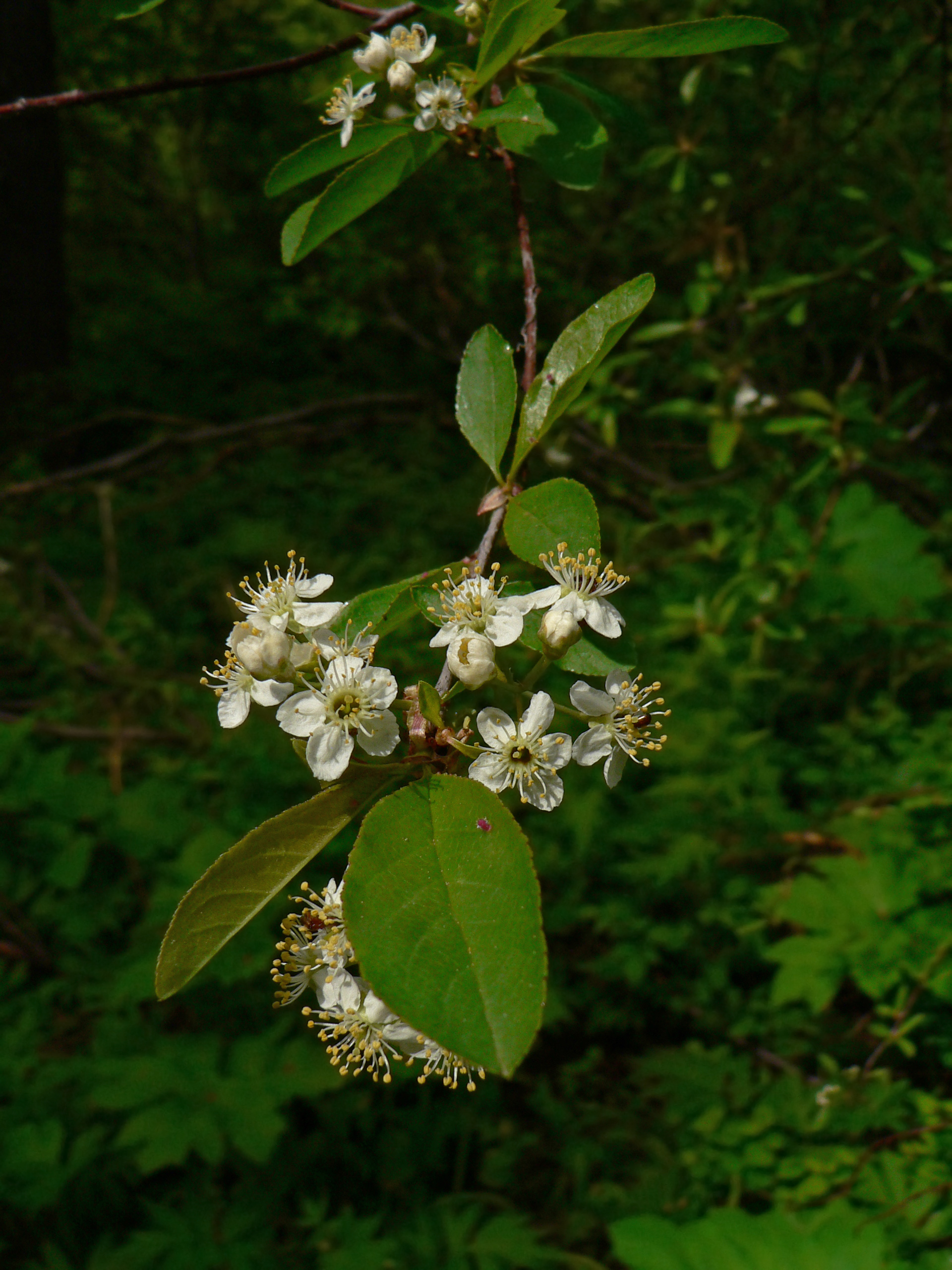
The flowers are arranged in small clusters (corymbs) along the branches, typically containing 3-10 individual flowers per cluster. The blooming period extends over several weeks, providing sustained resources for early-season pollinators including native bees, butterflies, and other beneficial insects. The timing of flowering varies significantly with elevation, with low-elevation plants blooming as early as April while high-elevation populations may not flower until July.
Fruit and Seeds
Following successful pollination, Bitter Cherry develops small, round cherries that ripen from green through red to dark purple or nearly black when fully mature. The fruits measure about ¼-½ inch (7-14mm) in diameter and contain a single large seed (pit) surrounded by relatively little flesh. As the common name suggests, these cherries are extremely bitter and astringent, making them generally unpalatable to humans, though they are consumed by various wildlife species.
The cherries ripen throughout summer and into early fall, with timing varying by elevation and local climate. The seeds have extremely hard shells that can remain viable for decades, with germination often triggered by fire scarification or other disturbance events. This seed longevity contributes to the species’ role as a pioneer plant in post-disturbance recovery.
Native Range
Bitter Cherry boasts one of the most extensive native ranges among western North American trees and shrubs, naturally occurring from British Columbia south to Baja California and east to western Montana, Wyoming, Utah, Nevada, Arizona, and New Mexico. This vast distribution encompasses an remarkable diversity of habitats and elevations, from coastal forests at sea level to high mountain slopes exceeding 9,000 feet in elevation.
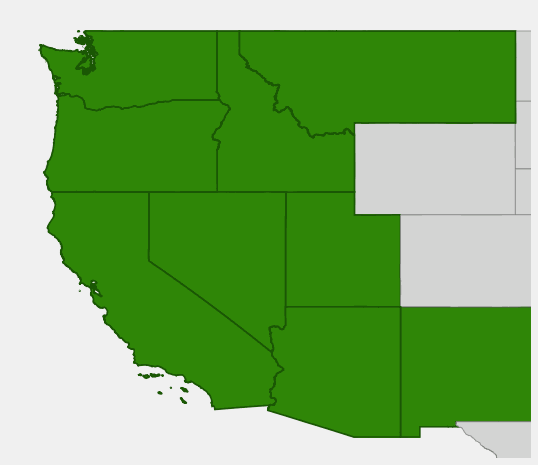
Throughout this extensive range, Bitter Cherry demonstrates remarkable ecological plasticity, growing in diverse habitats from moist coastal forests dominated by Douglas Fir and Western Hemlock to dry interior mountain slopes with Ponderosa Pine and Quaking Aspen. The species shows particular adaptability to disturbed sites, open woodlands, forest edges, rocky slopes, and areas recovering from fire or other disturbances.
In the Pacific Northwest, Bitter Cherry is commonly found in recently logged areas, along roadsides, and in natural openings within coniferous forests. At higher elevations, it often grows in association with Lodgepole Pine, Engelmann Spruce, and Subalpine Fir. In the inland regions, it frequently occurs with Ponderosa Pine, Douglas Fir, and various oak species, while in the Sierra Nevada and southern portions of its range, it can be found growing with White Fir, Red Fir, and Mountain Hemlock.
📋 Regional plant lists featuring Bitter Cherry: Western Oregon & Western Washington

📋 Regional plant lists featuring Bitter Cherry: Western Oregon & Western Washington
Growing & Care Guide
Bitter Cherry’s extensive natural range and ecological adaptability translate into relatively easy cultivation for gardeners seeking a hardy, low-maintenance native tree or large shrub. The species’ tolerance for poor soils, drought conditions, and temperature extremes makes it particularly valuable for challenging landscape situations and restoration projects.
Light Requirements
Bitter Cherry performs best in full sun to partial shade conditions, though it demonstrates good tolerance for a range of light levels:
- Full Sun (6+ hours of direct sun): Optimal growth and flowering, particularly important at higher elevations
- Part Sun (4-6 hours of direct sun): Good performance with reliable flowering and fruiting
- Part Shade (2-4 hours of direct sun): Acceptable but may result in reduced flowering and more open growth habit
In its native habitat, Bitter Cherry often grows in forest openings, along edges, and in recently disturbed areas where it receives substantial sunlight. However, young trees can tolerate some shade and will grow toward available light sources.
Soil Preferences
One of Bitter Cherry’s greatest assets is its remarkable tolerance for poor soil conditions, making it suitable for locations where many other trees would struggle:
- Drainage: Requires well-draining soil; cannot tolerate waterlogged conditions
- Soil Type: Highly adaptable to sandy, rocky, clay, or loamy soils
- pH Range: Tolerates acidic to neutral soils (pH 5.0-7.5)
- Fertility: Thrives in poor, low-nutrient soils; does not require fertile conditions
- Special Tolerances: Excellent performance on shallow, rocky, or disturbed soils
The species’ tolerance for challenging soil conditions reflects its role as a pioneer species in nature, able to colonize sites where soil development is minimal or where disturbance has created harsh growing conditions.
Water Requirements
Bitter Cherry exhibits excellent drought tolerance once established, making it ideal for water-wise landscaping and areas with limited irrigation:
- Establishment Period: Regular watering needed for the first 1-2 years to develop deep roots
- Mature Plants: Minimal to no supplemental irrigation required in most regions
- Drought Tolerance: Can survive extended dry periods typical of western summers
- Overwatering Sensitivity: Avoid excessive watering, which can lead to root problems
In its native range, the species receives most of its annual moisture from fall, winter, and spring precipitation, entering natural dormancy during summer dry periods.
Planting and Establishment
Successful establishment of Bitter Cherry involves understanding its pioneer nature and providing appropriate early care:
- Best Planting Time: Fall or early spring for optimal establishment
- Site Preparation: Ensure good drainage; amend heavy clay soils if necessary
- Planting Depth: Plant at the same depth as grown in container
- Mulching: Apply 2-3 inches of organic mulch, keeping away from trunk
- Staking: Generally not needed due to the plant’s sturdy growth habit
Pruning and Maintenance
Bitter Cherry requires minimal pruning and maintenance, especially when grown in naturalized settings:
- Pruning Needs: Minimal pruning required; naturally develops good structure
- Timing: Prune in late winter or early spring if needed
- Techniques: Remove dead, damaged, or crossing branches; light shaping acceptable
- Suckering: May produce root suckers; remove if single-trunk form desired
- Disease Prevention: Good air circulation helps prevent fungal issues
Propagation
Bitter Cherry can be propagated through several methods, though seed propagation requires patience:
- Seed: Requires cold stratification for 3-4 months; germination can be slow and irregular
- Cuttings: Semi-hardwood cuttings in late summer with rooting hormone
- Suckers: Root suckers can be carefully separated and transplanted
- Layering: Low branches can be layered to produce new plants
Wildlife & Ecological Value
Despite its common name suggesting limited palatability, Bitter Cherry provides exceptional value to wildlife and plays crucial ecological roles throughout its range. The species serves as both a primary food source and important habitat provider for numerous animal species while contributing to ecosystem stability and recovery processes.
Pollinators and Beneficial Insects
The abundant spring flowering of Bitter Cherry provides critical early-season nectar and pollen resources:
- Native Bees: Solitary bees, mining bees, and mason bees heavily utilize the flowers
- Honeybees: Domestic honeybees actively forage on the nectar-rich flowers
- Butterflies and Moths: Various species visit flowers and use the plant as host for larvae
- Beneficial Insects: Predatory and parasitic insects find shelter and alternative food sources
The extended blooming period, which can span several weeks, provides sustained resources during the critical spring period when many pollinator species are establishing their annual cycles.
Birds
Bitter Cherry fruits are consumed by numerous bird species despite their astringent flavor:
- Game Birds: Grouse species consume both fruits and occasionally browse foliage
- Songbirds: Cedar Waxwings, American Robins, Varied Thrushes, and various sparrows eat the berries
- Woodpeckers: Several species forage for insects in the bark crevices
- Nesting Sites: Dense branching provides nesting habitat for small to medium birds
Bird consumption of the fruits plays a crucial role in seed dispersal, helping the species colonize new areas and recover from disturbance events.
Mammals
Various mammal species utilize Bitter Cherry for food and habitat:
- Large Herbivores: Deer, elk, and livestock browse foliage, particularly young growth
- Small Mammals: Chipmunks, squirrels, and mice consume fruits and may cache seeds
- Bears: Black bears occasionally consume the berries when other fruits are scarce
- Browsing Tolerance: Plant can recover well from moderate browsing pressure
Lepidoptera Hosts
Bitter Cherry serves as a larval host plant for numerous butterfly and moth species, making it particularly valuable in butterfly gardens:
- Swallowtails: Pale Tiger Swallowtail and Western Tiger Swallowtail larvae feed on foliage
- Admiral Species: Lorquin’s Admiral uses the plant as a primary host
- Azure Butterflies: Spring Azure larvae develop on the flowers and young foliage
- Sphinx Moths: Several sphinx moth species utilize the plant including Blinded Sphinx and Elegant Sphinx
Ecosystem Functions
Beyond direct wildlife value, Bitter Cherry performs several critical ecosystem functions:
- Pioneer Species: Among the first woody plants to establish after disturbance
- Soil Stabilization: Root system helps prevent erosion on slopes and disturbed sites
- Nitrogen Fixation Association: Often grows with nitrogen-fixing shrubs, benefiting from improved soil
- Fire Recovery: Resprouts vigorously after fire and helps initiate forest succession
- Nurse Plant Function: Provides shelter and improved conditions for other species establishment
Cultural and Historical Uses
Bitter Cherry holds significant cultural importance for indigenous peoples throughout its range and continues to be valued for various traditional and contemporary applications.
Indigenous Traditional Uses
Pacific Northwest indigenous peoples developed numerous uses for Bitter Cherry despite its unpalatable fruit:
- Basketry Materials: Flexible bark strips used in basket construction and decoration
- Medicinal Applications: Bark preparations used for various digestive and respiratory ailments
- Tool Making: Hard, dense wood utilized for small tools and implements
- Food Processing: Berries occasionally processed and mixed with other foods to reduce bitterness
- Ceremonial Uses: Various parts of the plant incorporated into traditional ceremonies
Contemporary Applications
Modern applications of Bitter Cherry focus primarily on ecological restoration and landscape use:
- Restoration Projects: Valuable pioneer species for habitat restoration and erosion control
- Wildlife Enhancement: Planted specifically to provide wildlife habitat and food
- Landscape Use: Appreciated for spring flowers, attractive bark, and low maintenance
- Agroforestry: Sometimes incorporated into sustainable forestry and farming systems
Landscape Design Applications
Bitter Cherry’s combination of ecological value, seasonal interest, and low maintenance requirements makes it suitable for numerous landscape applications, particularly in naturalized or wildlife-focused settings.
Wildlife Gardens
Exceptional choice for wildlife gardens, providing food and habitat for numerous species while requiring minimal care. The extended blooming period supports pollinators, while fruits feed birds and small mammals throughout summer and fall.
Restoration Landscaping
Ideal for challenging sites including slopes, poor soils, and areas recovering from disturbance. The species’ pioneer nature and rapid establishment make it valuable for erosion control and quick establishment of vegetative cover.
Naturalized Areas
Perfect for large-scale naturalized plantings where a native, low-maintenance tree or large shrub is desired. Can be allowed to form colonies through natural suckering, creating wildlife-rich thickets.
Spring Interest Gardens
Valuable for its abundant spring flowers and sweet fragrance, providing early-season interest when many other plants are just beginning growth. The white flowers create beautiful displays against the emerging green foliage.
Drought-Tolerant Landscapes
Excellent performer in water-wise landscapes once established, thriving with minimal or no supplemental irrigation in most of its range.
Varieties and Related Species
Bitter Cherry demonstrates significant morphological variation across its range, leading to recognition of two main varieties:
Prunus emarginata var. emarginata
The typical variety, usually remaining shrubby with young shoots and leaves that are hairless or only lightly hairy. This form is found throughout most of the species’ range and represents the common form encountered in inland and higher-elevation sites.
Prunus emarginata var. mollis
The coastal variety, typically developing into a larger tree with young shoots and leaves that are noticeably downy or fuzzy. This variety shows reddish-brown bark with particularly prominent light horizontal bands resembling water birch. It occurs primarily from Oregon north to British Columbia, mainly in coastal regions.
Closely Related Species
Bitter Cherry is closely related to Pin Cherry (Prunus pensylvanica), which occupies similar ecological niches in eastern and northern North America. The two species can hybridize where their ranges overlap, and both serve similar ecological functions as pioneer species in their respective regions.
Common Challenges and Solutions
While generally trouble-free, understanding potential challenges helps ensure successful cultivation:
Slow Initial Growth
Young plants may appear to grow slowly the first year as they establish their root system. This is normal; growth typically accelerates significantly in the second and third years.
Suckering Behavior
The species naturally produces root suckers, which can be viewed as either beneficial (for wildlife thickets) or problematic (for formal landscapes). Regular removal of unwanted suckers controls this tendency.
Fire Susceptibility
Like many deciduous trees, Bitter Cherry can be damaged by wildfire, though it typically resprouts vigorously from roots and base after burning.
Limited Commercial Availability
Bitter Cherry may be less commonly available at mainstream nurseries compared to other native plants, though specialty native plant nurseries typically carry it.
Seasonal Interest and Garden Value
Bitter Cherry provides multi-season interest and ecological value throughout the year:
- Spring: Abundant fragrant white flowers create stunning displays lasting several weeks
- Summer: Fresh green foliage provides attractive backdrop; fruits develop and ripen
- Fall: Foliage often develops attractive yellow to reddish autumn colors
- Winter: Distinctive bark with horizontal lenticels provides structural interest; persistent fruits feed wildlife
Companion Plants
Bitter Cherry combines well with other Pacific Northwest natives and species adapted to similar growing conditions:
- Trees: Douglas Fir, Ponderosa Pine, Quaking Aspen, Pacific Madrone, Oregon White Oak
- Shrubs: Serviceberry, Red-osier Dogwood, Ninebark, Snowberry, Oregon Grape
- Perennials: Native grasses, lupines, penstemons, asters, and other wildflowers
- Ground Covers: Kinnikinnick, wild strawberry, and native sedges
These combinations create authentic Pacific Northwest plant communities that support local wildlife while providing year-round garden interest with minimal maintenance requirements.
Frequently Asked Questions
How fast does Bitter Cherry grow?
Growth rate varies by species and growing conditions. Most native plants have moderate growth rates of 1-2 feet per year once established.
Is Bitter Cherry deer resistant?
Native plants vary in deer resistance. Check the Quick Facts table above for specific deer resistance information for this species.
When is the best time to plant Bitter Cherry?
Plant in fall or early spring for best establishment. Fall planting allows roots to develop over winter before summer stress.
Where can I buy Bitter Cherry?
Check our native plant nursery directories for Oregon and Washington (links below) to find nurseries that carry this species.
What growing conditions does Bitter Cherry need?
See the Growing & Care Guide section above for detailed light, soil, and water requirements specific to this species.

Looking for a nursery that carries Bitter Cherry?
Browse our native plant nursery directory: Oregon · Washington