
Black-spored Quillwort (Isoetes melanospora)
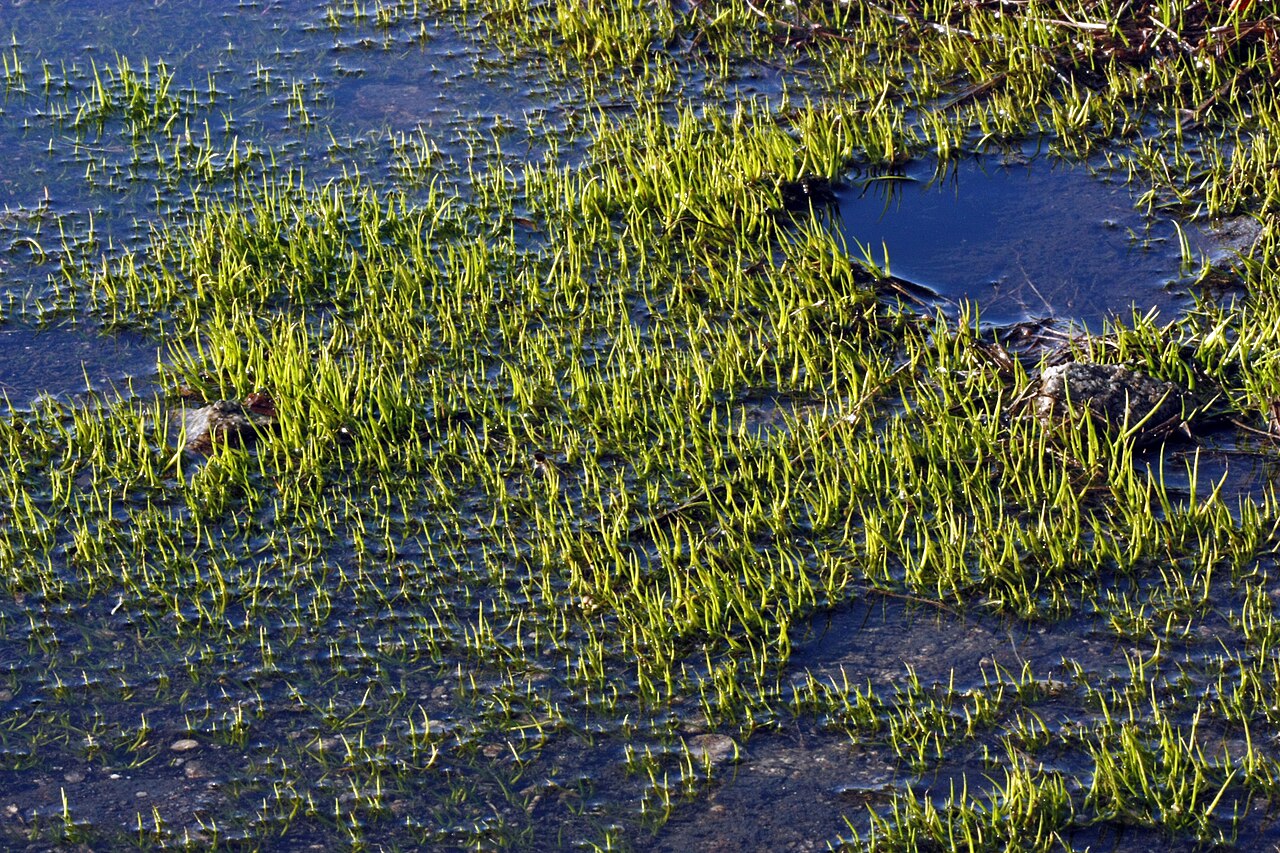
Isoetes melanospora, the Black-spored Quillwort or black-spored Merlin’s grass, is one of the rarest plants in the eastern United States. It is a tiny, grass-like spore-bearing plant that lives only in shallow, rain-filled pools on the tops of granite outcrops in the Georgia Piedmont. Its bright green, quill-shaped leaves are rarely more than 3 inches long and appear in fall and winter, when the pools fill with rain, then wither as the pools dry out in late spring and summer.
Quillworts are not grasses or rushes. They are lycophytes, an ancient group of spore-producing plants related to clubmosses and spikemosses, whose ancestors include the giant tree-like lycopods of the coal-age forests. Black-spored quillwort is named for its black megaspores, which distinguish it from other quillworts.
The species has been listed as federally endangered under the Endangered Species Act since 1988. It cannot be bought, grown or transplanted, and its fragile pools are easily destroyed by trampling, so this page is an identification and appreciation guide to a plant best enjoyed from the edge of the rock.
Identification
Black-spored quillwort is the only quillwort in the shallow, flat-bottomed granite pools where it grows. Like all quillworts, it needs a microscope for certain identification.
Leaves & Growth Habit
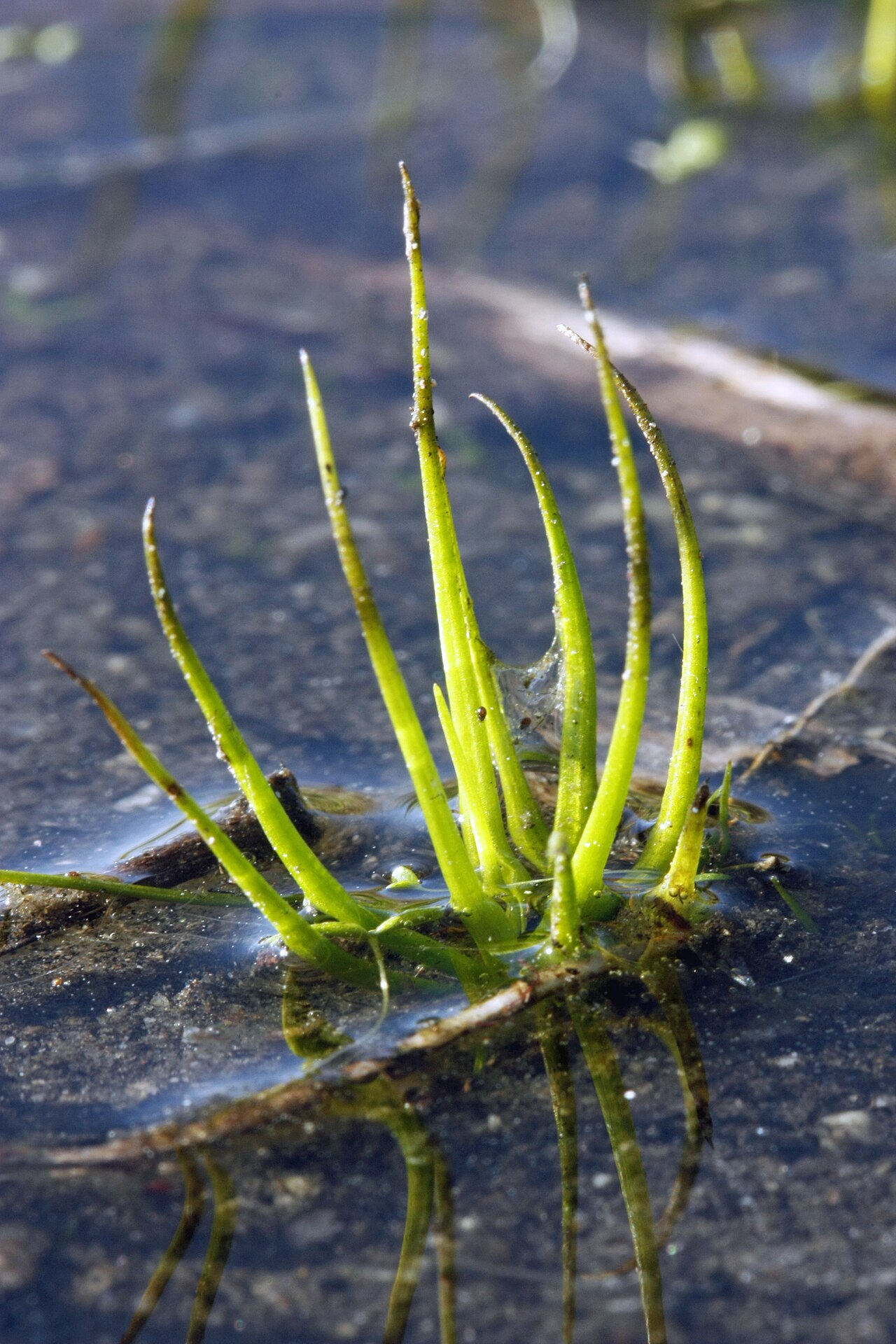
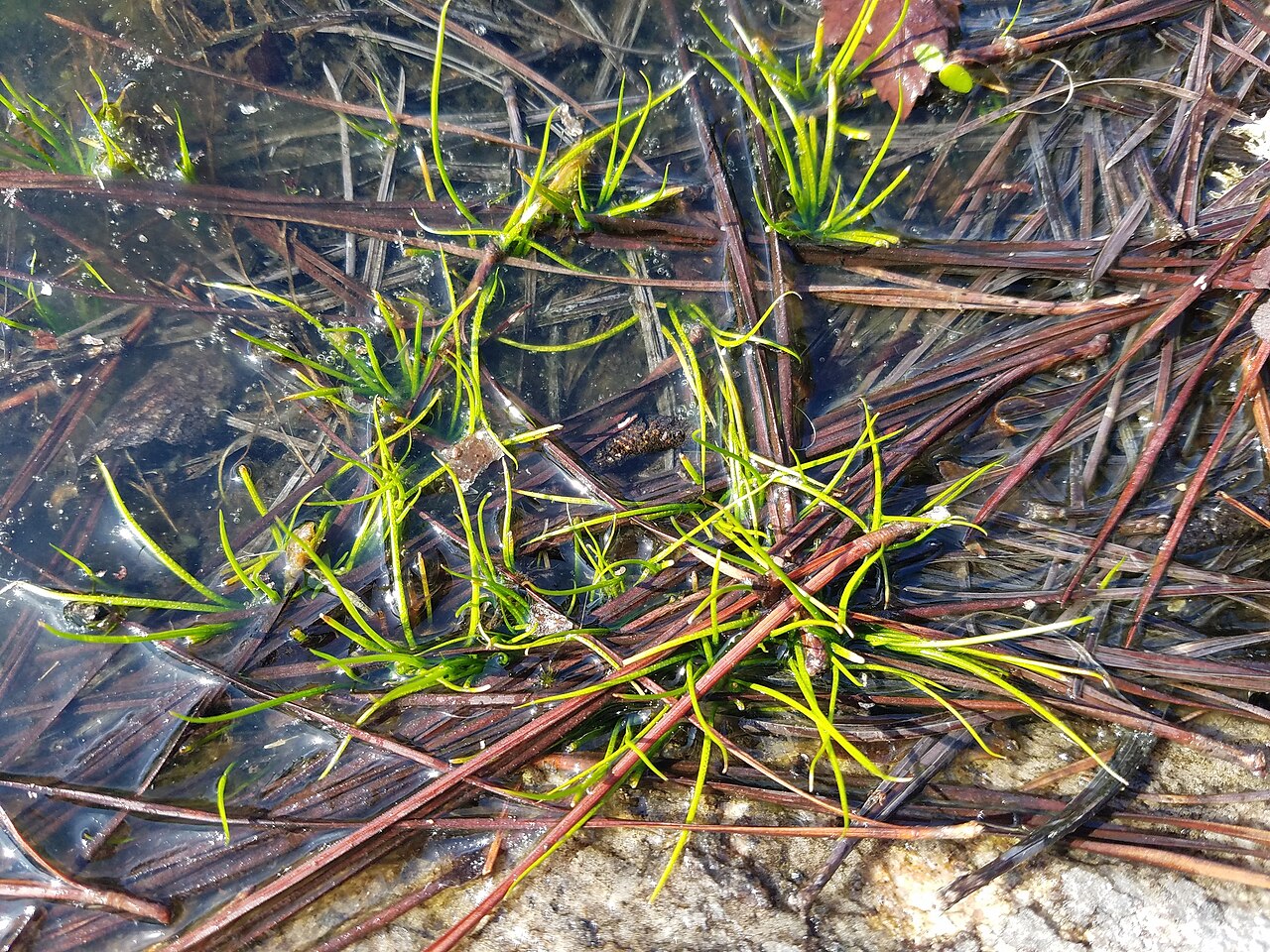
A small perennial with a rounded, bulb-like base (a corm) about ¼ inch across, anchored by fine roots in a thin layer of sandy soil and organic muck on the granite. From it grow a tuft of 5 to 15 narrow, quill-like leaves, about 1 to 3 inches long, spirally arranged and tapering to a fine point. The leaves are bright green, soft and slightly translucent, and grow underwater or in saturated mud.
Spores
There are no flowers or seeds. Instead, the swollen bases of the leaves contain sporangia: some with large female spores (megaspores) and some with tiny male spores (microspores). The megaspores of black-spored quillwort are gray to black and about 0.35 to 0.48 mm across, while the microspores are brown. Other quillworts have white or pale megaspores.
Seasonal Cycle
Plants sprout soon after fall and winter rains fill the pools and grow through the cool season. As the pools dry in late spring, the leaves turn brown and shrivel, and the plant survives the hot, dry summer as a dormant corm in the dry mud.
Look-alikes
In the same granite pools, young rushes and spikerushes can look similar, but they have round stems and lack the spoon-shaped leaf bases with spore cases. Piedmont quillwort (Isoetes piedmontana) also grows on granite outcrops, usually in seepage areas and deeper pools, and has white megaspores. Pool sprite (Amphianthus pusillus), a threatened flowering plant often found with black-spored quillwort, has floating leaves and tiny white flowers.
Quick Facts
| Scientific Name | Isoetes melanospora |
| Family | Isoetaceae (quillwort family) |
| Plant Type | Aquatic perennial lycophyte (spore-bearing, non-flowering) |
| Mature Height | 1–3 in |
| Mature Spread | 1–2 in per plant; forms colonies |
| Growth Rate | Fast in the wet season; dormant in summer |
| Sun Exposure | Full sun |
| Water Needs | Submerged in shallow seasonal pools; dry in summer |
| Soil Type | Thin layer of sand and muck over bare granite |
| Soil pH | Acidic |
| Bloom Time | Does not flower; spores mature in spring |
| Flower Color | None (spore-bearing) |
| Fall Color | New leaves appear in fall after rains |
| Fruit | None; black megaspores and brown microspores |
| Deer Resistant | Not applicable |
| USDA Hardiness Zones | Not cultivated (wild in zones 7b–8a) |
Native Range
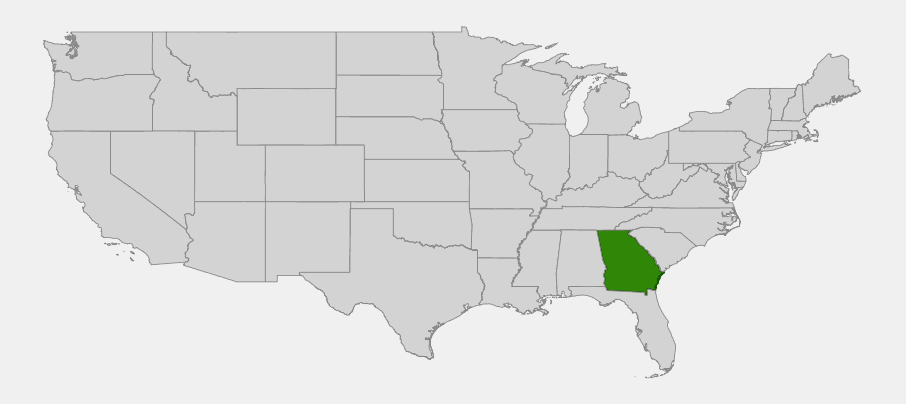
Black-spored quillwort is endemic to the granite outcrops of the Piedmont in the southeastern United States. USDA PLANTS lists it only in Georgia, where it survives in shallow pools on a small number of granite domes and flatrocks east of Atlanta, including Stone Mountain and Arabia Mountain. A single population was once recorded on a granite outcrop in South Carolina, but it is believed to have been lost.
About 18 sites were known after the species was discovered, and the number has since fallen to around 11 in Georgia. Quarrying of granite outcrops destroyed several populations, and others have been damaged by trash dumping, vehicles, off-trail hiking and other trampling, which crushes the plants and fills the shallow pools.
Its habitat is extremely specialized: flat-bottomed solution pits, often only an inch or two deep, carved into the exposed granite. These pools hold rainwater from late fall through spring and dry out completely in summer, when the bare rock heats up. Only a handful of plants are adapted to this cycle of flooding and baking.
📋 Regional plant lists featuring Black-spored Quillwort: Alabama, Georgia & Mississippi
Can You Grow It?
No. Black-spored quillwort is federally endangered, is not available from nurseries, and should never be collected or transplanted. It depends on a very narrow set of natural conditions that cannot be reproduced in a garden. The best way to help it is to protect the granite outcrops where it grows.
Light
In the wild it grows in full, unshaded sun on bare granite. Shade from encroaching trees or shrubs reduces the quality of its habitat.
Soil & Water
It needs shallow pools of clean rainwater that fill in late fall and winter and dry completely in summer, over only a thin layer of sand and organic muck. Pollution, sediment from nearby disturbance, and changes in water depth all harm it.
Planting Tips
It is not planted. Collecting plants or spores is illegal on federal lands and harmful anywhere, and researchers working on its recovery must have permits.
Pruning & Maintenance
Land managers protect its pools by keeping visitors and vehicles off the rock pools, removing trash, and fencing or rerouting trails where needed.
Propagation
In nature it reproduces by spores, which are released as the leaf bases decay and germinate when the pools refill. Any propagation for recovery work is carried out by conservation professionals under federal permits.
Where to See It
- Arabia Mountain: in the Davidson-Arabia Mountain Nature Preserve, part of the Arabia Mountain National Heritage Area near Lithonia, Georgia; view the pools from marked trails
- Stone Mountain: granite pools on the mountain are protected habitat for both black-spored quillwort and pool sprite
- Best season: late winter and early spring, when the pools are full and the plants are green
- Etiquette: never step in or touch rock pools, stay on marked paths, and leave no trash
Wildlife & Ecological Value
Black-spored quillwort is one of the specialist plants that make granite outcrops one of the most distinctive natural communities in the Southeast.
For Pollinators
As a non-flowering plant, it offers nothing to pollinators. Its pools, however, are home to tiny aquatic invertebrates, including tiny crustaceans and insect larvae, that live in the temporary water.
For Birds
It has no direct value as food for birds, but birds drink from and bathe in the granite pools when they are full.
For Mammals
It has no known value as food for mammals.
Ecosystem Role
It is part of a small, specialized community of plants that grow only in granite outcrop pools, along with pool sprite and other rare species. Its survival depends on the protection of the outcrops themselves, many of which have been quarried, developed or heavily used for recreation.
Cultural & Historical Uses
George Engelmann, a German-American botanist and physician in St. Louis, described Isoetes melanospora in 1877 from plants collected on Stone Mountain, Georgia. The name means “black spore,” from the Greek melas (black) and spora (seed or spore). The genus name Isoetes means “equal year,” a reference to the evergreen habit of some quillworts.
In 1988, the U.S. Fish and Wildlife Service listed black-spored quillwort as endangered and pool sprite as threatened, citing the loss of granite outcrop habitat to quarrying and the damage caused by vehicles, trash and heavy foot traffic. Both species are now managed under a federal recovery plan.
Quillworts are sometimes called “living fossils.” Their closest relatives are the extinct giant lycopods such as Lepidodendron and Sigillaria, which formed the swamp forests whose remains became much of the world’s coal. The tiny quillwort in a Georgia rock pool is a surviving branch of that ancient lineage.
Frequently Asked Questions
What is black-spored quillwort?
A tiny, federally endangered, spore-bearing plant related to clubmosses. It grows only in shallow, seasonal rain pools on granite outcrops in Georgia.
Why is it endangered?
It survives at only about a dozen sites. Its pools have been destroyed by granite quarrying and damaged by trampling, vehicles, trash and pollution.
Can I buy or grow black-spored quillwort?
No. It is not available from nurseries, and collecting it is harmful and illegal on federal land. It depends on natural rock pools that cannot be reproduced in a garden.
Where can I see it?
At protected granite outcrops in Georgia, such as Arabia Mountain and Stone Mountain. Look from the edges of the pools in late winter or early spring, and never step in the pools.
Is a quillwort a grass?
No. Quillworts are lycophytes, ancient spore-producing plants related to clubmosses. They have no flowers or seeds.

Looking for a nursery that carries Black-spored Quillwort?
Browse our native plant nursery directory: Georgia

