Bog Rosemary (Andromeda polifolia)
Andromeda polifolia, commonly known as Bog Rosemary, is a delicate but tough native evergreen shrub found in the cold bogs, fens, and peaty wetlands of northern New England and the boreal forest. Despite its common name, it bears no botanical relationship to culinary rosemary (Salvia rosmarinus); the name comes from the superficial resemblance of its narrow, aromatic evergreen leaves to those of true rosemary. This exquisite miniature shrub is a jewel of the bog landscape — a circumpolar species of ancient lineage that has survived ice ages and now graces the sphagnum moss mats of northern bogs with its dainty pink flowers and glaucous blue-green foliage.
Bog Rosemary grows in the most challenging of habitats: nutrient-poor, waterlogged, highly acidic peat bogs where few other shrubs can survive. It thrives in the company of other bog specialists — Leatherleaf, Labrador Tea, Sundews, Pitcher Plants, and sphagnum mosses — forming a characteristic bog community that is one of the most distinctive and ecologically unusual plant communities in North America. The plant is highly adapted to its environment: its narrow, waxy leaves reduce water loss, its evergreen habit allows it to begin photosynthesizing as soon as snow melts, and its mycorrhizal fungi help it extract nutrients from the nutrient-poor peat.
For the adventurous native plant gardener willing to provide the right growing conditions — very moist, very acidic soil — Bog Rosemary is a rewarding and distinctive addition to a wetland garden or bog planting. Its early spring flowers, beautiful blue-green foliage, and compact form make it an outstanding plant for moist acid gardens, rain gardens, and bog features. It also holds significant value as a conservation plant, helping to establish and restore bog communities that are increasingly threatened by climate change and drainage.
Identification
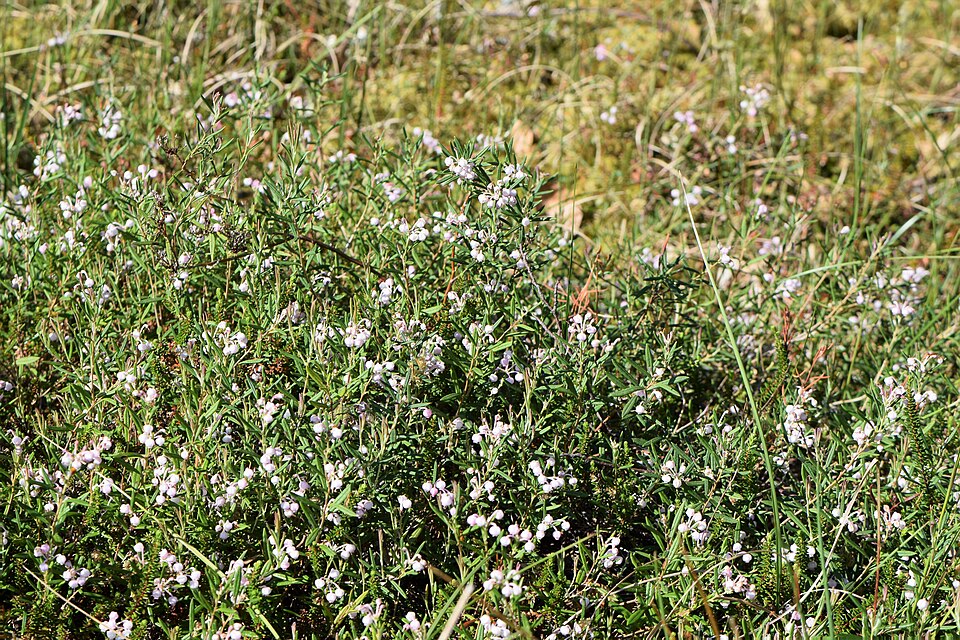
Bog Rosemary is a low-growing, mat-forming evergreen shrub, rarely exceeding 12 inches (30 cm) in height but often spreading wider by layering and stolons. Its compact, creeping growth form is perfectly adapted to life on sphagnum moss mats, where the plant roots into the peat and sends out horizontal branches that root at nodes. The overall appearance is of a delicate, blue-green cushion studded with pink flowers in late spring.
Stems & Structure
The stems are slender, wiry, and reddish-brown to gray, becoming woody at the base but remaining flexible near the tips. They grow in a low, spreading manner, rooting where they touch moist substrate. The plant spreads slowly by layering to form loose colonies on bog surfaces. Young stems are greenish and flexible; older stems are woody and persistent. The overall structure is open and delicate — unlike the denser, boxier forms of related bog shrubs like Leatherleaf.
Leaves
The leaves are the most distinctive feature: narrow, leathery, and evergreen, 1 to 1½ inches (2.5–4 cm) long and only ⅛ inch wide, with a characteristic blue-green upper surface and strongly white-glaucous underside. The leaf margins are conspicuously rolled under (revolute), a feature that reduces water loss and gives the underside a distinctly narrow appearance. The leaves are alternate, densely covering the stems, and persist for 2–3 years before dropping. When crushed, the leaves have a faint, slightly resinous fragrance — reminiscent of rosemary — that gives the plant its common name. The combination of narrow form, blue-green color, and rolled margins makes Bog Rosemary immediately recognizable even without flowers.
Flowers & Fruit
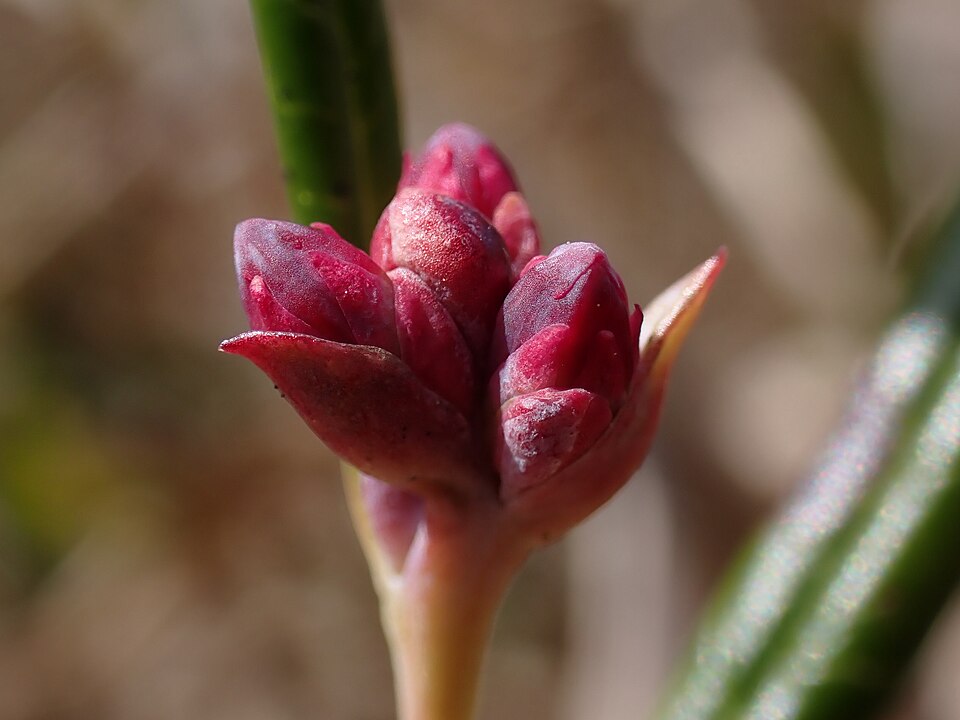
The flowers are among the most charming of any bog plant. They are small, nodding, and urn-shaped (urceolate) — a typical shape in the heath family (Ericaceae) — about ¼ inch (5–7 mm) long, with five fused petals forming a rounded pink to pale rose capsule with a constricted mouth. They appear in small clusters (typically 2–6 flowers) at the tips of the branches, nodding downward on slender pink stalks. Bloom time is late May to June in northern New England, often while the bog sphagnum is still partly snow-covered. The flowers are visited by small native bees that vibrate the anthers to release pollen (a process called buzz pollination).
The fruit is a small, round, dry capsule about ⅛ inch (3–4 mm) in diameter, persisting on the stems through winter. The capsules split into 5 chambers to release tiny seeds. The seeds are lightweight and can be wind-dispersed across the bog surface. All parts of Bog Rosemary — leaves, stems, flowers, and fruit — are toxic if ingested, containing andromedotoxins (grayanotoxins) that can cause severe illness in humans and livestock.
Quick Facts
| Scientific Name | Andromeda polifolia |
| Family | Ericaceae (Heath Family) |
| Plant Type | Evergreen Shrub (low-growing, mat-forming) |
| Mature Height | 1 ft |
| Sun Exposure | Full Sun to Part Shade |
| Water Needs | High — requires moist acidic soil |
| Soil Requirements | Acidic peat, pH 3.5–5.5 (highly acidic required) |
| Bloom Time | May – June |
| Flower Color | Pink to pale rose |
| Foliage | Evergreen; narrow, blue-green with white undersides |
| Toxicity | All parts toxic if ingested (grayanotoxins) |
| USDA Hardiness Zones | 2–6 |
Native Range
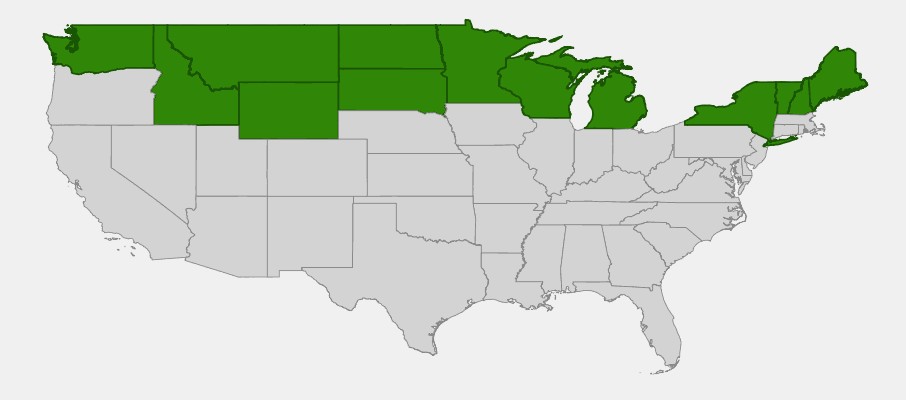
Bog Rosemary is a circumpolar species with one of the widest ranges of any bog plant in the Northern Hemisphere. In North America, it extends from Alaska east across the boreal forests of Canada to Newfoundland and Labrador, and south into the northern United States wherever cool, acidic bogs persist. In New England, it occurs in Maine, New Hampshire, and Vermont, where it is characteristic of sphagnum bogs, poor fens, and peaty lakeshores at various elevations.
The species ranges south in the United States to include the Great Lakes states (Michigan, Wisconsin, Minnesota) and extends into the northern Rocky Mountain states (Wyoming, Idaho) in suitable high-elevation bog habitats. In the western mountains, it occurs in subalpine and alpine bogs, often growing in the same community as other circumpolar bog species. Across all parts of its range, the species is strongly associated with sphagnum-dominated wetlands on acidic, nutrient-poor substrates.
Bog Rosemary is threatened throughout much of its southern range by bog drainage for agriculture and development, altered hydrology, peat mining, and climate change — warmer temperatures accelerate peat decomposition and shift the competitive balance away from cold-adapted bog specialists. Protecting and restoring the acidic bog habitats where it grows is essential for maintaining this species and the remarkable ecological communities it represents.
📋 Regional plant lists featuring Bog Rosemary: New England
Growing & Care Guide
Bog Rosemary is a specialist plant with very specific growing requirements. In the right conditions it is surprisingly easy to grow, but attempting to grow it in standard garden soil will fail. Success depends entirely on replicating the acidic, wet, nutrient-poor conditions of its native bog habitat.
Light
Bog Rosemary grows best in full sun to partial shade. In its native bog habitat it grows in open, sunny conditions on exposed sphagnum mat surfaces, and it performs best with at least 4–6 hours of direct sun. It will tolerate partial shade — such as the dappled light under sparse Black Spruce canopy — but flowering is reduced in shadier conditions. Avoid deep shade, which weakens the plant and reduces its characteristic blue-green foliage color.
Soil & Water
This is where Bog Rosemary is non-negotiable: it requires consistently moist to wet, highly acidic, nutrient-poor growing conditions. A pH of 3.5–5.5 is ideal — true bog conditions. The best growing medium is a mix of pure sphagnum peat moss and perlite, or pure sphagnum moss. Do not add fertilizer — nutrient-rich soil will actually harm the plant by encouraging competitive weeds and disrupting its specialized mycorrhizal relationships. The soil must never dry out completely; in its natural habitat, the water table is at or very near the surface year-round. A constructed bog garden — essentially a lined, peat-filled basin kept perpetually moist with rainwater or untreated water — is the ideal growing environment.
Planting Tips
Plant Bog Rosemary in a dedicated bog garden or rain garden with very acidic soil. Avoid using tap water for irrigation, as its mineral content and neutral pH can gradually raise soil pH. Rainwater or distilled water is ideal. Plant in spring after danger of hard frost has passed, spacing plants 12–18 inches apart to allow spreading. In container culture, use a half-and-half mix of sphagnum peat and coarse perlite in a container that can be kept in a tray of water. Mulching with sphagnum moss helps maintain moisture and acidity.
Pruning & Maintenance
Bog Rosemary requires almost no pruning. Remove any dead branches in late spring after new growth has begun. Light tip pruning after flowering can encourage denser growth, but is generally not necessary. The plant spreads slowly by layering and does not become invasive. Minimal maintenance is part of what makes it appealing — once established in the right bog garden conditions, it largely cares for itself. Periodically remove any aggressive competitors such as cattails or invasive mosses that might crowd it.
Landscape Uses
- Constructed bog gardens — the ideal setting for this specialist plant
- Rain garden margins — consistently moist, acidic zones
- Peat garden features — with other ericaceous bog plants
- Wetland restoration — reintroduction to degraded bog habitats
- Container growing — specialty container with acidic growing medium kept in water tray
- Carnivorous plant companion — pairs beautifully with Pitcher Plants and Sundews
Wildlife & Ecological Value
While Bog Rosemary’s highly specialized habitat means its direct wildlife interactions are more limited than generalist shrubs, it plays an important ecological role within the bog community and provides several specific wildlife benefits.
For Birds
The dense, low-growing mats of Bog Rosemary provide cover and nesting substrate for ground-nesting birds that use bog habitats. Palm Warblers — a characteristic bog bird of the boreal zone — nest in sphagnum bogs and forage through the low shrub layer where Bog Rosemary grows. Lincoln’s Sparrows, Swamp Sparrows, and Wilson’s Warblers are also common bog birds that use the vegetative cover provided by Bog Rosemary and its associates. The small seed capsules provide minor food value for granivorous birds.
For Mammals
Though all parts of Bog Rosemary are toxic due to grayanotoxins, some specialists handle the toxicity: moose have been documented browsing it in boreal bogs despite the toxicity. Snowshoe Hares and other small mammals use the dense mat vegetation for cover. Bog Lemmings — one of the most specialized bog mammals — occur in the same habitats and likely interact with Bog Rosemary as part of their ecosystem.
For Pollinators
The small pink flowers are visited by small native bees, particularly bumblebees, which are well-adapted to the cool temperatures of bog habitats. The flowers require buzz pollination (sonication) — a specialized technique where bees vibrate their flight muscles at a specific frequency to shake pollen from the anthers. This is the same technique used by bumblebees to pollinate tomatoes, and it is particularly important in the cold bog environment. Early-season bumblebee queens are the primary pollinators.
Ecosystem Role
Bog Rosemary is an integral component of the sphagnum bog ecosystem. It contributes to the physical structure of the bog surface, helping to stabilize sphagnum moss mats and reduce erosion. Its evergreen leaves contribute organic matter to peat formation as they decompose (extremely slowly, given the acidic, anaerobic conditions). As a member of the heath family, it participates in the ericoid mycorrhizal network that enables plants to extract nutrients from the otherwise nutrient-locked peat environment. The species’ deep evolutionary history in circumpolar bog systems makes it a keystone component of this globally rare and ecologically important habitat type.
Cultural & Historical Uses
Bog Rosemary has played a limited but interesting role in human culture, primarily because of its striking appearance and its strongly toxic properties. Indigenous peoples of the boreal zone were well aware of the plant’s toxicity. Various First Nations groups in Canada recognized that livestock — particularly sheep — that grazed on Bog Rosemary (and related toxic bog heaths like Bog Laurel) could become seriously ill or die, a condition historically known as “sheep laurel poisoning.” The active compounds are grayanotoxins (also called andromedotoxins), which disrupt sodium channels in nerve and muscle cells.
Despite its toxicity, Bog Rosemary has been used in traditional folk medicine in parts of Scandinavia and Russia (where it also occurs as a circumpolar species) as a treatment for various ailments, including arthritis and skin conditions. These uses were always risky given the plant’s toxicity, and modern herbalism does not recommend internal use. The plant’s aromatic leaves were sometimes used as an insect repellent or to scent linens — a use borrowed from its more famous namesake, culinary rosemary.
Botanically, the genus Andromeda was named by Carl Linnaeus, who was so struck by the beauty of the plant when he first encountered it in a Swedish bog that he compared it to the mythological princess Andromeda — chained to a rock by the sea, surrounded by danger (sea monsters/bog toxins), yet incomparably beautiful. It was one of the few plants Linnaeus described in emotionally expressive terms in his botanical writings, calling it “lovely as Andromeda” in the midst of the dangerous bog creatures that surrounded it. Linnaeus originally placed many ericaceous bog plants in the genus Andromeda, but most have since been moved to other genera, leaving Andromeda polifolia as the sole representative of the genus in North America.
Today, Bog Rosemary is cultivated as an ornamental plant for specialty bog gardens and rock gardens with acidic, moist soils. Several cultivars have been developed, particularly in European horticulture, offering varying flower colors and compact forms. The species is also important as a sentinel species for bog ecosystem health — its presence indicates intact, highly acidic, waterlogged conditions, making it useful for ecological monitoring of bog habitats under climate change.
Frequently Asked Questions
Is Bog Rosemary actually related to rosemary?
No — despite the common name and similar appearance of their narrow evergreen leaves, Bog Rosemary (Andromeda polifolia) is not related to culinary rosemary (Salvia rosmarinus). Bog Rosemary belongs to the heath family (Ericaceae), while culinary rosemary is in the mint family (Lamiaceae). The name comes purely from the superficial resemblance of the narrow, aromatic, evergreen leaves.
Is Bog Rosemary poisonous?
Yes — all parts of Bog Rosemary are toxic to humans and animals if ingested. The plant contains grayanotoxins (also called andromedotoxins) that can cause serious illness including low blood pressure, slow heart rate, vomiting, numbness, and in severe cases, paralysis. Do not allow children or pets to eat any part of this plant. Livestock (especially sheep and goats) can be poisoned by grazing on Bog Rosemary.
Why is my Bog Rosemary dying?
The most common reason Bog Rosemary fails is inadequate soil acidity and/or insufficient moisture. If soil pH rises above 5.5 or if the soil dries out, the plant will decline rapidly. Check your soil pH and ensure it remains in the 3.5–5.0 range. Use only rainwater or acidified water for irrigation. Excessive sun in hot climates without adequate moisture can also stress the plant. If in doubt, grow in a container with pure sphagnum peat, kept in a tray of water.
Can I grow Bog Rosemary alongside Pitcher Plants and Sundews?
Absolutely — and in fact this is one of the most rewarding combinations in a bog garden. Pitcher Plants (Sarracenia purpurea), Sundews (Drosera species), Bog Laurel (Kalmia polifolia), and Labrador Tea (Rhododendron groenlandicum) are all natural companions of Bog Rosemary in northern bogs. They share the same requirements for highly acidic, nutrient-poor, constantly moist growing conditions. Together they create a stunning and ecologically authentic bog garden planting.
Does Bog Rosemary stay green in winter?
Yes — Bog Rosemary is an evergreen shrub, maintaining its narrow blue-green leaves through the winter months. The foliage may develop a slightly more purplish or bronzed tinge in cold weather, but the leaves remain green and functional. This evergreen habit is an adaptation to the short growing season of boreal bogs — the plant can begin photosynthesizing immediately when temperatures warm in spring, without waiting to grow new leaves.

Looking for a nursery that carries Bog Rosemary?
Browse our native plant nursery directory: Maine · New Hampshire · Vermont · Connecticut