
Buffalo Nut (Pyrularia pubera)
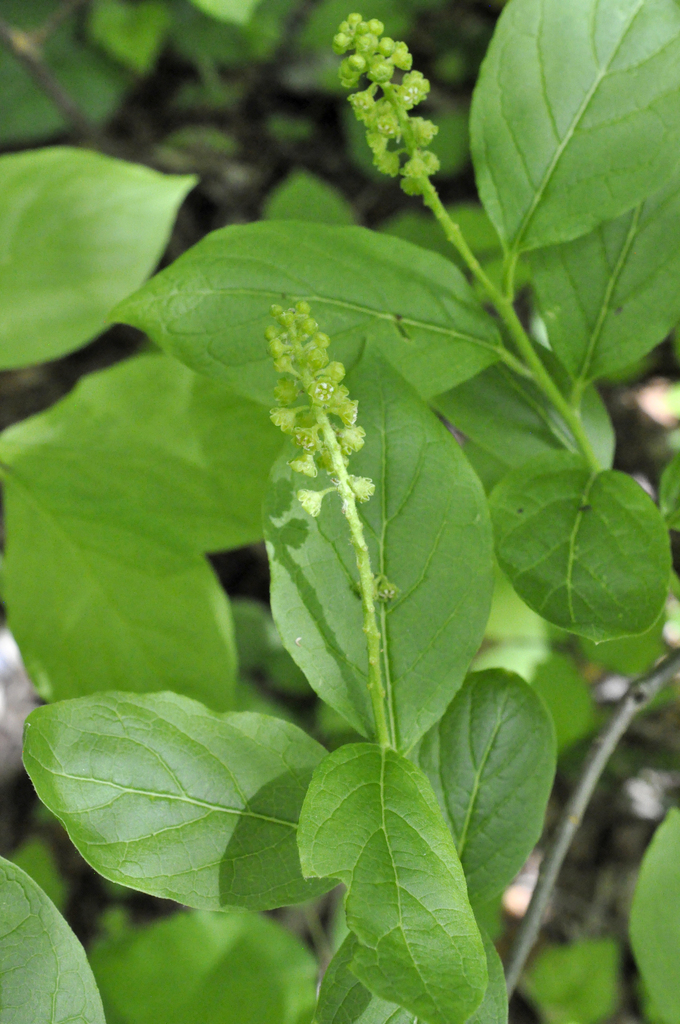
Pyrularia pubera, known as Buffalo Nut or oil nut, is a deciduous understory shrub of the Appalachian forests, from Pennsylvania south to northern Georgia and Alabama. It has soft, oval, light green leaves, short spikes of tiny greenish flowers in spring, and in fall a pear-shaped, yellowish-green fruit about an inch long that holds a single large, oily seed. It belongs to the sandalwood family (Santalaceae), a family famous for its parasitic members.
Buffalo nut is a root hemiparasite. It has green leaves and makes its own sugars, but its roots form attachments to the roots of neighboring trees, shrubs and wildflowers and draw water and minerals from them. It is not choosy: it has been found attached to many different hosts, from hemlocks and oaks to rhododendrons and herbs. This lifestyle explains why it is almost never sold by nurseries and why it should never be dug from the wild.
All parts of the plant, especially the oily seeds, contain a toxic protein, and the fruit should never be eaten. This guide covers how to identify buffalo nut, where it grows, why it is so hard to cultivate, and the role it plays in Appalachian forests.
Identification
Buffalo nut is easy to overlook as just another green shrub in the understory, but a few features set it apart: its soft, thin, unlobed leaves, its terminal spikes of tiny greenish flowers in spring, and above all its distinctive pear-shaped fruit in late summer and fall.
Growth Habit & Bark
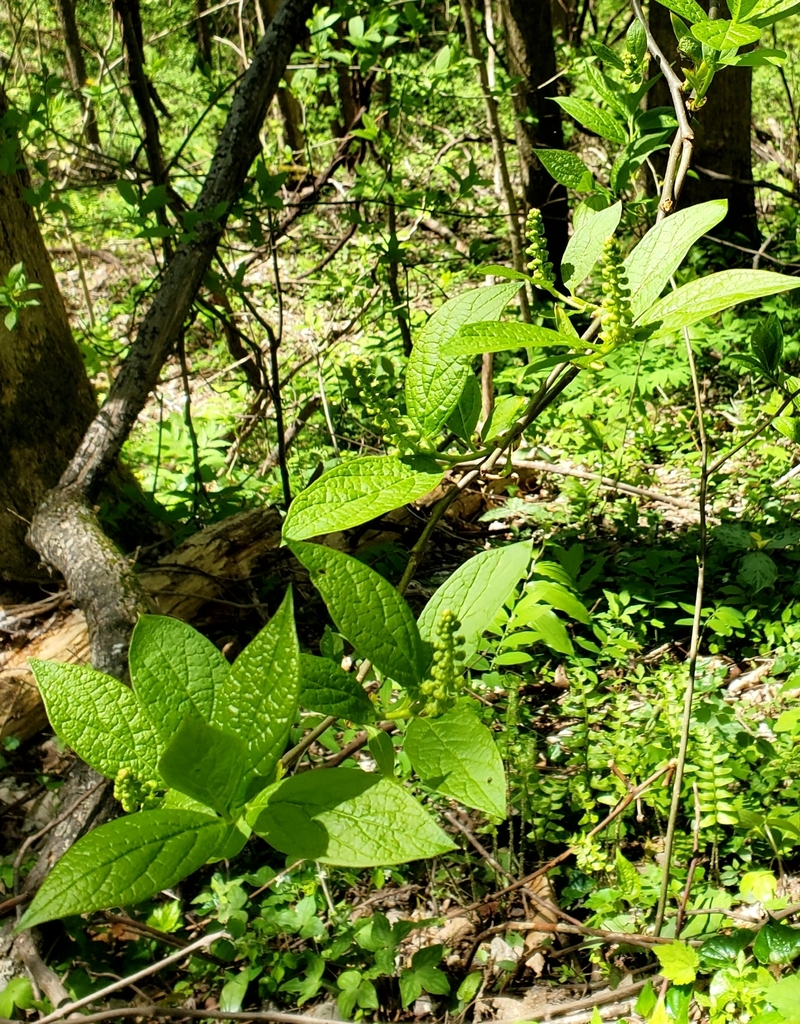
Buffalo nut is a loosely branched, deciduous shrub, usually 3 to 6 feet tall but occasionally reaching 12 feet or more. It often grows in scattered clumps or small colonies, since it can sprout from the roots. Young twigs are greenish and finely hairy; older stems have smooth, gray-brown bark dotted with small pale lenticels.
Leaves
The leaves are alternate, simple and unlobed, elliptic to obovate (widest above the middle), about 2 to 6 inches long, with smooth edges and a pointed tip. They are thin, light to medium green and softly hairy, especially underneath and when young; the species name pubera means “downy.” The leaves often have a slightly drooping look and turn a pale yellow before falling in autumn.
Flowers
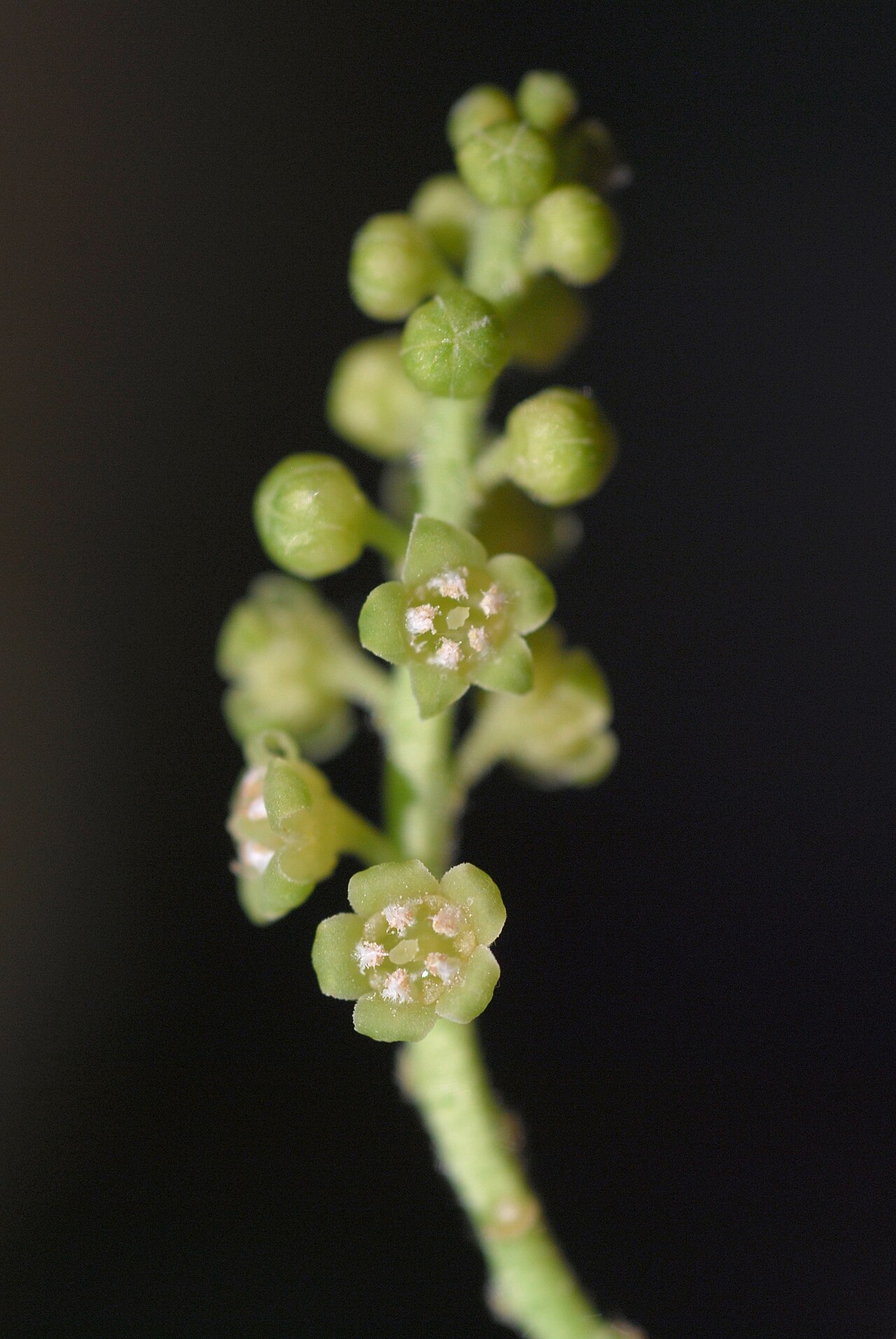
In spring, usually April to May, each new shoot ends in a short spike or raceme 1 to 2 inches long of small, greenish to yellowish flowers. Each flower is about ¼ inch across, with five triangular, slightly hairy lobes around a fleshy central disk. Plants carry either male flowers or flowers that are bisexual, so not every shrub produces fruit. The flowers are easy to miss but have a faint, sweetish scent.
Fruit & Seeds
The fruit is the plant’s best field mark: a pear-shaped drupe about 1 inch long, green at first and ripening to yellowish or tan in September and October, topped by the small remains of the flower. Inside is a single, large, oily seed. The genus name Pyrularia means “little pear.” The fruit has a strong, unpleasant taste and is poisonous; see the safety note below.
Look-alikes
Out of fruit, buffalo nut can resemble spicebush (Lindera benzoin), which has aromatic leaves that smell spicy when crushed and yellow flower clusters along bare stems in early spring. Young sassafras and some blueberries may also look similar. Buffalo nut leaves have no scent, its flowers come at the tips of leafy shoots, and its pear-shaped fruit is unique among shrubs in its range.
Safety Note
Buffalo nut is poisonous. The seeds and other parts contain a toxic protein (a thionin, sometimes called pyrularia thionin) that can damage cell membranes and cause serious illness if eaten. Do not eat the fruit or seeds, and keep children and pets away from them. Even tasting the raw fruit causes intense burning in the mouth.
Quick Facts
| Scientific Name | Pyrularia pubera |
| Family | Santalaceae (sandalwood family) |
| Plant Type | Deciduous shrub; root hemiparasite |
| Mature Height | 3–6 ft (occasionally to 12 ft or more) |
| Mature Spread | 3–6 ft; may form small colonies |
| Growth Rate | Slow to moderate |
| Sun Exposure | Part shade to full shade |
| Water Needs | Medium; dry to moist forest soils |
| Soil Type | Acidic, humus-rich, well-drained forest soils |
| Soil pH | Acidic (about 4.5–6.0) |
| Bloom Time | April–May (into June at high elevations) |
| Flower Color | Greenish to yellowish green |
| Fall Color | Pale yellow |
| Fruit | Pear-shaped drupe about 1 in long with one oily seed; poisonous |
| Deer Resistant | Moderate; occasionally browsed |
| USDA Hardiness Zones | 5–8 |
Native Range
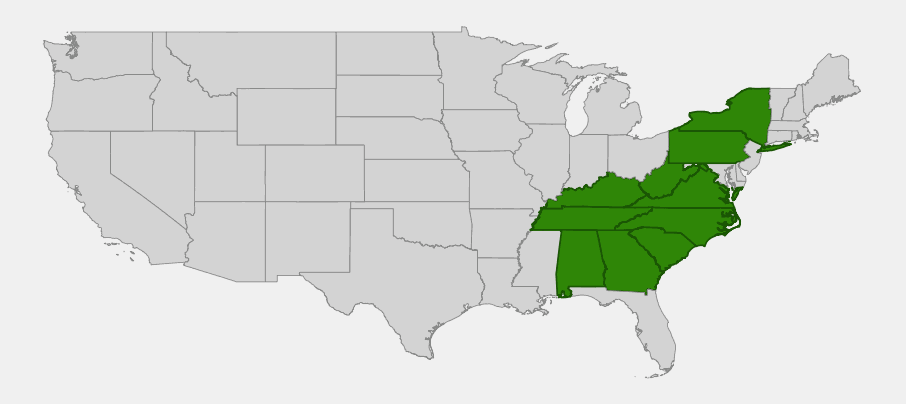
Buffalo nut is an Appalachian specialist. USDA PLANTS lists it as native in Alabama, Georgia, Kentucky, New York, North Carolina, Pennsylvania, South Carolina, Tennessee, Virginia and West Virginia. Its heartland is the Blue Ridge and the Great Smoky Mountains of North Carolina, Tennessee and Georgia, where it is a common shrub in many forest types. From there it extends north along the mountains and the Cumberland Plateau through Virginia, West Virginia and eastern Kentucky to southern Pennsylvania, where it is uncommon at the northern edge of its range.
The New York record is an outlier: herbarium specimens and a few recent observations come from scattered sites on Long Island (Suffolk County), far from the main Appalachian range. Whether these plants are a relict native population or an old introduction is not well documented, so treat New York as an outlying record rather than part of the main range. In the south, buffalo nut reaches the upper Piedmont and the mountains of northern Alabama, northern Georgia and upstate South Carolina.
Within its range it grows in a wide variety of forests: rich cove forests, oak-hickory and chestnut-oak woods on dry ridges, hemlock and rhododendron thickets along streams, and pine-oak woods. Because it can attach to so many host species, it is less tied to a particular plant community than most parasitic plants, but it is almost always found under a tree canopy.
📋 Regional plant lists featuring Buffalo Nut: New York, Pennsylvania & Northern New Jersey · Kentucky & Tennessee · Maryland, Virginia & West Virginia · Delaware, Southern New Jersey & Long Island · Alabama, Georgia & Mississippi · North & South Carolina
Can You Grow It?
In practice, no. Buffalo nut is not available from the nursery trade, and it is not a plant to try to establish in a garden. As a root hemiparasite it needs living host roots to connect to, its seeds are slow and unreliable to germinate, and wild plants do not survive transplanting. Never dig buffalo nut from the wild: the plants will almost certainly die and the digging damages forest populations. If it already grows on your land, the best thing you can do is protect it.
Light
In the wild it grows in partial to full shade under a forest canopy. It tolerates the brighter conditions of forest edges and gaps, but it is a plant of wooded settings, not open gardens.
Soil & Water
It grows in acidic, humus-rich, well-drained forest soils, from fairly dry ridges to moist coves and streambanks. What matters most is not the soil itself but the presence of the trees, shrubs and wildflowers whose roots it taps for water and minerals.
Planting Tips
There is no reliable way to plant it. Nursery stock is essentially unavailable, and transplanted wild plants fail because their connections to host roots are broken. If you own Appalachian woodland where buffalo nut already grows, keep the forest canopy and understory intact around it, and avoid clearing, grading or heavy foot traffic in the area.
Pruning & Maintenance
Wild plants need no care. The most helpful thing you can do is control invasive plants such as Japanese stiltgrass, multiflora rose and Oriental bittersweet, which crowd out native understory shrubs, and avoid applying herbicides near the shrubs or their hosts.
Propagation
Propagation is experimental at best. Seeds from ripe fruit have been germinated in research settings, but the seedlings must find and attach to host roots to thrive, and success is low. This is not a project for home gardeners. Because of the plant’s toxicity, wear gloves when handling the fruit.
Where to See It
- Great Smoky Mountains National Park: common along many trails through cove and oak forests, especially in spring bloom and fall fruit
- Blue Ridge Parkway: look in the forest understory along overlooks and trails in North Carolina and Virginia
- Joyce Kilmer Memorial Forest and the Nantahala National Forest: old-growth and second-growth forests in western North Carolina
- Southern Appalachian national forests: the Chattahoochee, Cherokee, Pisgah and George Washington and Jefferson national forests
- Fall walks: the easiest time to spot it is September and October, when the yellowish pear-shaped fruits hang from the branches; look, but do not taste
Wildlife & Ecological Value
Buffalo nut is a modest but interesting part of the Appalachian understory, linking many plants together underground through its root connections.
For Pollinators
The small, fragrant spring flowers produce nectar on an open disk, where short-tongued insects can reach it easily. Small bees, flies and beetles are the main visitors and likely pollinators.
For Birds
The plant offers some cover and nesting structure in the forest understory. The large, toxic fruits are not a significant food for birds.
For Mammals
Deer occasionally browse the foliage. The fallen fruits are reportedly eaten or carried off by some rodents, which may help disperse the seeds, but the fruit is poisonous to people and pets.
Ecosystem Role
As a root hemiparasite, buffalo nut draws water and minerals from the roots of many different host plants, including trees, shrubs and herbs. In this way it takes a small share of resources from its neighbors, a common strategy in the sandalwood family. It is also part of the diverse shrub layer of Appalachian forests, which supports insects, spiders and the birds that feed on them.
Cultural & Historical Uses
The common names buffalo nut and oil nut refer to the large, oily seed, which is rich in oil but far too toxic to use as food. The origin of the name “buffalo nut” is uncertain. Another regional name is rabbitwood.
Buffalo nut has attracted interest from biochemists. Its seeds contain a small, toxic protein called pyrularia thionin, which damages cell membranes. It has been studied as an example of the thionins, a group of defensive proteins found in many plants that help protect them against insects and microbes.
The genus name Pyrularia comes from the Latin pyrum, “pear,” a reference to the shape of the fruit. The only other species in the genus grow in eastern Asia, a classic example of the botanical link between the forests of eastern North America and eastern Asia.
Frequently Asked Questions
Is buffalo nut poisonous?
Yes. The seeds and other parts contain a toxic protein that can cause serious illness. Do not eat the fruit or seeds, and keep children and pets away from them.
Is buffalo nut a parasite?
It is a hemiparasite. It has green leaves and photosynthesizes, but its roots attach to the roots of nearby plants and take water and minerals from them.
Can I buy buffalo nut for my garden?
It is essentially unavailable in the nursery trade and is very difficult to establish because it needs host roots. Never dig it from the wild.
Where can I see buffalo nut?
In the forests of the southern and central Appalachians, especially in Great Smoky Mountains National Park and the national forests of western North Carolina, eastern Tennessee and northern Georgia.
How do I recognize buffalo nut?
Look for a shrub 3 to 6 feet tall with soft, thin, oval leaves, short spikes of tiny greenish flowers in spring and pear-shaped yellowish fruits about an inch long in fall.

Looking for a nursery that carries Buffalo Nut?
Browse our native plant nursery directory: Alabama · Georgia · Kentucky · New York & North Carolina · Pennsylvania, South Carolina, Tennessee & Virginia · West Virginia

